

Партнерка на США и Канаду по недвижимости, выплаты в крипто
- 30% recurring commission
- Выплаты в USDT
- Вывод каждую неделю
- Комиссия до 5 лет за каждого referral
B Burning of hydrogen
C Fission of helium into hydrogen
D Fusion of helium into hydrogen
4. Apollo 11 was the first NASA mission to–
A Orbit Earth
B Land on the moon
C Put a man into space
D Visit Mars
5. The maps below show the amount of sea ice surrounding the continent of Antarctica at two different times of the year. Map A represents late August when the area covered by sea ice approaches its greatest extent. Map B represents the minimum extent of sea ice.
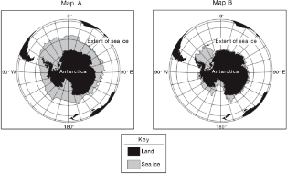
Which month is most probably represented by map B?
A February
B June
C May
D October
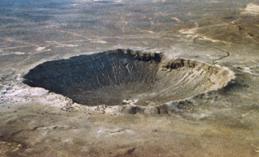
6. The photograph below shows a huge hole approximately 1 mile across located in
Diablo Canyon, Arizona. What MOST LIKELY created this?
A asteroid collision
B stream erosion
C plate tectonics
D glacial erosion
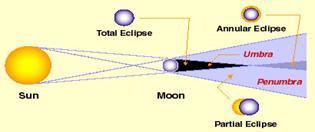
 7. Which statement is true concerning the diagram shown below?
|
|

A A lunar eclipse was observed from position A.
B A lunar eclipse was observed from position B.
C A solar eclipse was observed from position A.
D A solar eclipse was observed from position B.
8. The most accepted theory for the origin of the sun and planets is–
A Big bang theory
B Solar nebula theory
C Steady state theory
D Offspring theory
9. Which theory states that the universe was created from a very hot dense state that expanded and eventually condensed into galaxies?
A XBig bang theory
B Solar nebula theory
C Steady state theory
D Offspring Theory
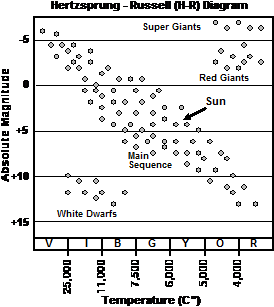
10. According to this H-R diagram, which are the brightest stars?
A Red giants
B Main sequence stars
C Super giants
D White dwarfs
Earth Science SOL Review Sheet #5 : Minerals
Essential Knowledge and Skills
· A mineral is a naturally occurring, inorganic, solid substance with a definite chemical composition and structure.
· Minerals may be identified by their physical properties such as hardness, color, luster, and streak.
· Most rocks are made of one or more minerals.
· Some major rock - forming minerals are quartz, feldspar, calcite, and mica.
· Ore minerals include pyrite, magnetite, hematite, galena, graphite, and sulfur.
· The major elements found in Earth’s crust are oxygen, silicon, aluminum, and iron. The most abundant group of minerals is the silicates, which contain silicon and oxygen.
Important Words You Need to Know:
cleavage - tendency of a mineral to break along smooth, flat, definite surfaces
diamond - the hardest known mineral
element - a material made up of one kind of atom
fracture - break or crack in rock; in minerals, the way a mineral that does not cleave breaks along a rough or jagged surface
hardness - ability of a mineral to resist being scratched
luster - the way in which a mineral reflects light from its surface
major elements of Earth’s crust - the elements found in the largest amounts in Earth’s crust: oxygen, silicon, aluminum, and iron
Moh's Scale - ten common minerals with increasing hardness from talc to diamond that is used to rate the hardness of all other minerals
ore mineral – a mineral from which useful metals or nonmetals can be profitably removed (pyrite, magnetite, hematite, galena, graphite, and sulfur)
pyrite - “fool’s gold”, chemical formula is FeS2
rock-forming minerals - common minerals that make up most of the rocks in Earth’s crust: quartz, feldspar, calcite, and mica
silicates - the most common mineral group; those minerals containing silicon and oxygen
streak - color of the powder left by a mineral when it is rubbed against a hard, rough surface (streak plate)
Now You Try It!
Practice Questions: Circle the correct answer!
1. The diagram below shows how a sample of the mineral mica breaks when hit with a rock hammer.
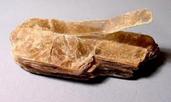
This mineral breaks in smooth, flat surfaces because it –
A is very hard
B is very dense
C contains large amounts of iron
D has a regular arrangement of atoms
2. Halite has three cleavage directions at 90° to each other. Which model best represents the shape of a broken sample of halite?
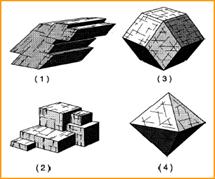
3. Which of these is NOT an ore mineral?
A Pyrite
B Magnetite
C Calcite
D Galena
4. Which term is most associated with the mineral property “hardness”?
A Shine
B Break
C Scratch
D Heavy
5. Which term is most associated with the mineral property “luster”?
A Shine
B Break
C Scratch
D Heavy
6. The chart below shows the Mohs scale for comparing the hardness of minerals. A
mineral that can scratch fluorite and can be scratched by orthoclase is able to—
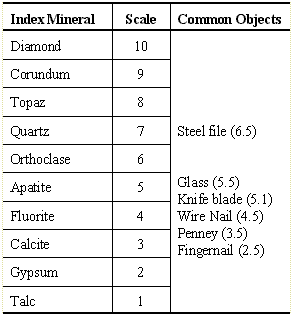
A Scratch both calcite and quartz
B Be scratched by both calcite and quartz
C Scratch calcite and be scratched by quartz
D Scratch quartz and be scratched by calcite
7. The streak test that is useful in identifying minerals, involves studying the–
A Mineral’s crystal with a microscope
B The color of the mineral as it burns
C The mineral under a fluorescent light
D Color of the powdered form of the mineral
8. Calcite dissolves when exposed to hydrochloric acid. Which geologic process is this most similar to?
A Faulting
B Folding
C Weathering
D Subduction
9. Which of the following minerals would you be able to scratch with a fingernail?
A Gypsum
B Corundum
C Fluorite
D Diamond
10. This igneous rock is compose primarily of large mineral crystals that were formed by–
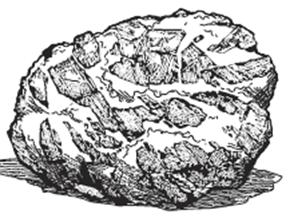
Granite
A Cooling magma
B Compaction of sediments
C Evaporation of sea water
D Subduction
11. Pencils that are used everyday in schools do not contain the element lead. Pencil lead is made by combining clay and which of the minerals below?
A Graphite
B Pyrite
C Quartz
D Calcite
lfur is a mineral that has many uses. It is also easily identified by its yellow color and its distinct–
A Density
B Fluorescence
C Odor
D Calcite
13. Which of these rock forming minerals would you NOT expect to find in a sample of granite?
A Mica
B Calcite
C Quartz
D Feldspar
14. Which of these minerals does NOT have a metallic luster?
A Pyrite
B Galena
C Gold
D Quartz
Earth Science SOL Review Sheet #6 - Rocks
Essential Knowledge and Skills
· Igneous rock forms from molten rock that cools and hardens either below or on Earth’s surface.
· Sedimentary rocks may either form from rock fragments or organic matter bound together or they are formed by chemical precipitation.
· Metamorphic rocks form when any rock is changed by the effects of heat, pressure, or chemical action.
· Extrusive igneous rocks have small or no crystals resulting in fine - grained or glassy textures.
· Intrusive igneous rocks have larger crystals and a coarser texture.
· Extrusive igneous rocks include pumice, obsidian, and basalt.
· Intrusive igneous rocks include granite.
· Sedimentary rocks are clastic or chemical
· Clastic sedimentary rocks are made up of fragments of other rocks and include sandstone, conglomerate, and shale.
· Non-clastic sedimentary rocks include limestone and rock salt.
· Metamorphic rocks can be foliated or unfoliated (nonfoliated).
· Foliated metamorphic rocks have bands of different minerals. Slate, schist, and gneiss are foliated metamorphic rocks.
· Unfoliated metamorphic rocks have little or no banding and are relatively homogenous throughout. Marble and quartzite are unfoliated metamorphic rocks.
· Interpret the rock cycle diagram.
· Classify the following rock types as igneous, metamorphic, or sedimentary: pumice, obsidian, basalt, granite, sandstone, conglomerate, shale, limestone, slate, schist, gneiss, marble, and quartzite.
Important Words You Need to Know:
foliated: – metamorphic rock whose minerals are arranged in parallel layers

|
Из за большого объема этот материал размещен на нескольких страницах:
1 2 3 4 5 6 7 |
