


Партнерка на США и Канаду по недвижимости, выплаты в крипто
- 30% recurring commission
- Выплаты в USDT
- Вывод каждую неделю
- Комиссия до 5 лет за каждого referral
· close some state forests and national parks on days of extreme bushfire weather, to increase public safety and reduce the likelihood of fires starting in forested areas
· share bushfire risk analysis information with local governments, other emergency services agencies, land managers and community-based planning forums, to improve bushfire prevention activities on public and private land.
Being prepared for bushfires
We must be adequately prepared for bushfires, to improve our response to them when they occur.
Well-maintained roads and tracks are essential for quick response and for community and firefighter safety. DELWP manages 30 800 km of roads on public land in our landscape; they allow access for heavy firefighting machinery, safe access for bushfire response and a safe environment for planned burning.
DELWP will manage our strategic roads and bridges to the standard for bushfire management agreed with other agencies, and ensure road maintenance budgets are prioritised consistent with this.
Each year, before the bushfire season, DELWP and CFA will jointly assess the bushfire risk across the whole landscape to identify priority areas for response, fuel management and community engagement, and develop local mutual aid plans that cover our joint preparedness and response activities.
DELWP and PV will review and revise emergency management plans for closing, evacuating and protecting priority visitor sites (such as camping sites, walking tracks and day-use areas) when the fire danger rating is Severe or above, and where people may be at risk from bushfire.
DELWP will work with relevant agencies and infrastructure managers to develop and implement bushfire mitigation actions for infrastructure identified as having high-to-extreme risk of bushfire damage.
DELWP will develop and maintain its staff capability in bushfire management, including emergency response.
DELWP will work in partnership with other agencies (including Emergency Management Victoria, CFA, local governments and Victoria Police) to include strategic risk analysis and PHOENIX RapidFire simulation in municipal and regional fire and emergency management planning.
DELWP will provide bushfire risk information to Victoria Police, local governments and CFA to help them develop evacuation and traffic management plans for priority communities and locations.
Responding to bushfires
DELWP is responsible for suppressing fires in state forests and national parks, and on protected public land. To improve bushfire response, DELWP will:
continue to provide an integrated response to bushfires with CFA and other emergency managers
share bushfire risk assessment data and information with other fire agencies and land managers (such as PV, CFA, VicForests and private plantation owners) to support bushfire response
continue to identify and validate our landscape’s priority assets for protection.
Recovering after bushfires
DELWP and PV are responsible for the recovery of public land after a bushfire. To improve bushfire recovery, DELWP will:
· work with other agencies and communities to identify recovery priorities
· address recovery priorities to re-establish access to public land in a timely manner, and support bushfire-impacted communities to return to normal daily life.
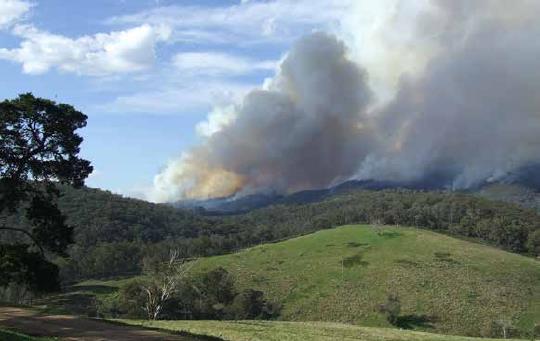
Picture caption: Planned burning in the Tambo district © Greg McCarthy DELWP
How we will continuously improve the planning process
DELWP and PV will monitor, evaluate and report on implementation of our planning process. We will identify what, where and when monitoring activities need to be done to support evaluation of the effectiveness of our planning. This will enable us to make more informed decisions over time. We will continue to engage with the community and key stakeholders in our planning, monitoring and implementation. Bushfire management will continue to evolve with advances in science, technology and how we engage with communities. We intend to continually improve our bushfire management planning approach.
We will continue to engage with the regional Traditional Owners and work in partnership with those who have settlement agreements with the state on public land, to achieve a balanced fuel management strategy.
Monitoring activities will be guided by the statewide monitoring, evaluation and reporting framework. These activities will measure changes to:
· residual risk
· ecosystem resilience.
We will use the information we collect about fuels, habitat and ecosystem resilience to:
· evaluate the extent to which the fuel management strategy has reduced the impact of bushfires on life, property and the environment
· quantify the effect of the fuel management strategy on ecosystem resilience
· refine and improve the models that underlie our strategic planning.
We will assess how effectively our activities are achieving the two code of practice objectives. Through DELWP’s annual fuel management reporting, we will report on how we are monitoring our activities and progressing towards the two code of practice objectives. We will use the Monitoring, Evaluation and Reporting Framework for Bushfire Management on Public Land to guide how we monitor and evaluate implementation of this strategic bushfire management plan, particularly:
· the extent to which the fuel management strategy has reduced the impact of bushfires on communities and the environment
· the effectiveness of the fuel management strategy at maintaining or improving ecosystem resilience across the landscape
· the risk to ecosystem resilience in areas that may be burnt below their TFI (such as Forby forest, Grassy/heathy dry forest, Moist forest, Tall mixed forest and Foothill forest).
We will report to the community regularly. We will report annually on fuel management activities; every five years on the effectiveness of the fuel management strategy and other actions in this plan; and at least every ten years on achievement of the code of practice objectives.
Through DELWP’s Bushfire Science Strategy 2013–17, we will invest in research to improve the information available for future plans. We plan to improve our risk assessment method by better incorporating weather patterns, ignition likelihood weightings and convection strength and by developing better measures for ecosystem resilience. We also plan to improve how we identify and rate public administration assets and social (including cultural heritage) assets.
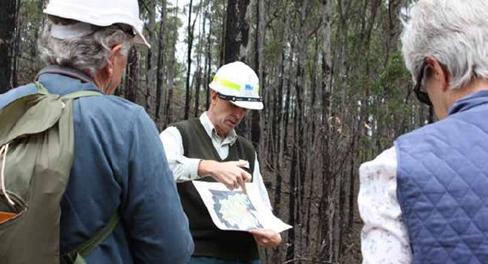
Picture caption: A community field day © DELWP
We will develop a long-term burn schedule. The schedule will take into account changes in vegetation structure and other aspects of habitat that are affected by bushfires or other fuel management activities. This will help us to better balance immediate asset protection needs with long-term vegetation and ecosystem resilience needs. It can also be adjusted to reflect the impacts of any bushfires that may occur.
We will further analyse particular areas to better understand the best places to manage fuel to maintain and improve ecosystem resilience. This will include areas with long-unburnt vegetation or with habitat for fire-sensitive species we want to protect from bushfires and planned burning.
Glossary
Asset Protection Zone – an area around properties and infrastructure where we do intensive fuel management to provide localised protection against radiant heat and ember attack in the event of a bushfire.
Bushfire Moderation Zone – an area where we manage fuel load to reduce the speed and intensity of bushfires, and to protect nearby assets, particularly from ember attack in the event of a bushfire.
CFA – Country Fire Authority.
Code of practice – Code of Practice for Bushfire Management on Public Land 2012.
DELWP – Department of Environment, Land, Water and Planning.
Ecological fire group (EFG) – a grouping of ecological vegetation classes with common ecological requirements for fire, and common fire behaviour characteristics.
Fire Management Zone (FMZ) – an area of public land where fire is used for specific asset, fuel and overall forest and park management objectives. There are four types of fire management zone: Asset Protection Zone, Bushfire Moderation Zone, Landscape Management Zone and Planned Burning Exclusion Zone.
ISO 31000 – a family of standards relating to risk management codified by the International Organization for Standardization.
Landscape Management Zone – an area where we manage fuel load to reduce fuel hazard, improve ecosystem resilience and for other purposes.
PHOENIX Rapidfire – software that simulates how bushfires spread given terrain, fuel and weather conditions.
PIPE$S – a systematic way of categorising assets by People, Infrastructure, Public Administration, Environment, Economy and Social Setting.
Planned burning – deliberate burning to manage the quantity of leaf litter, twigs, bark and undergrowth in order to reduce bushfire risk.
Planned Burning Exclusion Zone – an area where we try to avoid planned burning, mainly because the vegetation cannot tolerate fire, or because we cannot burn it safely.
PV – Parks Victoria.
Residual risk – the risk, on average and across the whole landscape – including public and private land – that bushfires will impact on life, property or other assets. Residual risk is expressed as the percentage of risk that remains after bushfire history and fuel management (mainly planned burning) are taken into account.
Tolerable fire intervals (TFIs) – the minimum and maximum recommended times between fire events for a particular ecological fire group (EFG). Burning regularly outside these intervals increases the risk that there will be fundamental changes in species’ abundance and composition, and the type of vegetation.
Victorian Fire Risk Register (VFRR) - The Victorian Fire Risk Register is a systematic process used to identify assets at risk from bushfires, assess the level of risk to assets and record a range of current treatments to mitigate the risk. The register includes human, economic, environmental and cultural assets. The Country Fire Authority (CFA) facilitates and manages the VFRR.
We – DELWP and PV, together.
Customer Service Centre 136 186
www. delwp. vic. gov. au

|
Из за большого объема этот материал размещен на нескольких страницах:
1 2 3 4 5 6 |
