


Цели подсистем, как известно, должны совпадать с генеральной целью всей системы – созданием нового облика демократической России (НОР предполагает обеспечить благосостояние и свободу граждан России, экономическое возрождение страны, рост и процветание отечественной экономики при соответствующем четком курсе). Тогда рыночные трансформации можно рассматривать как функцию, определяемую совокупным влиянием таких факторов, как: демократизация общественной жизни (ДОЖ), реформа политической системы (РПС), радикальная экономическая реформа (РЭР), активизация предпринимательской деятельности и эффективность труда (АПД и ЭТ). Подсистемы взаимно обусловливают друг друга. Так, ДОЖ "обволакивает" РПС и РЭР, а АПД и ЭТ "пронизывает" ДОЖ, РПС, РЭР.
С учетом предложенной логики взаимосвязи этих подсистем можно сформулировать следующие выводы. Если результативность двух подсистем (РПС и РЭР) незначительна по своим масштабам, то рыночные трансформации в целом затягиваются на неопределенный срок. Стало быть, чтобы быстрее во времени достигнуть нового облика России, надо повышать результативность РПС и РЭР при достаточно высоких "значениях" ДОЖ и АПД и ЭТ. Говоря другими словами, достижение нового облика России тогда возможно, когда ДОЖ и АПД и ЭТ достигнут такого необходимого уровня, при котором РПС и РЭР будут выполнены, т. е. рыночные трансформации возможны при развитии факторов ДОЖ и АПД и ЭТ, обеспечивающих результативность РПС и РЭР.
Однако на практике цели подсистем все еще остаются не достигнутыми.
Понятие нового облика России неразрывно связано и с возрождением ее духовной культуры (ДКР). Без ДКР немыслимо достижение генеральной цели всех осуществляемых рыночных трансформаций. НОР неотделим от ДКР, то есть эти два понятия слиты в одно целое. Безусловно, формирование НОР оказывает влияние как на мировую цивилизацию, так и на развитие отечественных основ менеджмента.
Вместе с тем Европейский Союз взял курс не только на замораживание сближения с Россией, но и начал де-факто проводить политику "мирного сосуществования", а то и жесткой, если не враждебной конкуренции в экономической сфере.
Требует коррекции и нового осмысления также и политика в отношении стран СНГ. Большинство интеграционных проектов на этом пространстве работать не будут: жизнеспособными видятся пока лишь российско-казахстанский интеграционный проект и российско-белорусский проект.
В докладе, подготовленном специалистами Всемирного банка "Бизнес в 2006 году", приводится обобщенная классификация 155 государств по ключевым показателям делового законодательства и реформ. Согласно этим данным, страны Содружества независимых государств (СНГ) ускорили ход реформ, нацеленных на стимулирование предпринимательской деятельности, роста малых и средних предприятий. В ходе анализа, проведенного специалистами банка, выяснилось, что Россия – впереди всех стран СНГ по объему проведения реформ и почти приблизилась к мировым лидерам. Однако темп проведения реформ в странах СНГ все еще отстает от стран Восточной Европы. И одной из наиболее острых проблем для развития бизнеса в Содружестве остается административное бремя. Тем не менее, по данным доклада, за 2005 г. каждая страна СНГ улучшила хотя бы один аспект деловой среды. Такой уровень реформ считается самым высоким в мире[68].
Что касается России, то, как отмечают авторы доклада, в стране были упрощены процедуры и сокращено время для регистрации бизнеса. Но, пожалуй, главное то, что были созданы условия для появления частных кредитных бюро, благодаря которым будет расширен доступ к кредитам. Россия, таким образом, сделала важный шаг в расширении доступа к финансированию.
Не менее важные шаги были предприняты и в реформе налогообложения. Измерение налоговой базы для расчета налога на прибыль, с одной стороны, снизило бремя для компаний, с другой – позволило сделать налоговую систему более прозрачной. Однако реформу надо продолжать, считают эксперты, например, уменьшить ставку налога на добавленную стоимость. С этим не согласны многие российские чиновники, так как НДС относится к самым собираемым налогам.
Хотя Россия и является одним из лидеров реформ, говорят авторы доклада, их надо активно продолжать. Страна до сих пор находится в наиболее выигрышной позиции по отношению к другим странам с развивающейся экономикой. И все-таки в России реформы проводятся быстрее, чем в таких странах, как Индия, Бразилия и Китай. Однако в глобальном рейтинге стран по простоте ведения бизнеса Россия занимает всего 79-е место из 155 стран, участвующих в исследованиях. Тогда как Индия находится на 116-м, Бразилия – на 119-м, а Китай на 91-м.
Впервые федеральный бюджет сформирован в рамках трехлетнего бюджетного планирования на годы, что является первым реальным шагом к повышению качества и точности его показателей, эффективности управления государственными финансами. По существу это дает возможность решить во взаимной увязке проблемы сдерживания уровня инфляции, обеспечения экономического роста, проведения социальных реформ и повышения реального уровня жизни населения, спланировать условия стабильной работы как для бизнеса, так и для органов государственного управления.
Удалось добиться максимального приближения параметров бюджета к реальным оценкам и значительно увеличить по сравнению с 2005 годом доходы (на 598 млрд. рублей) и расходы – на 322 млрд. рублей. Увеличение расходов предлагается прежде всего направить на реализацию приоритетных национальных проектов – здоровье и образование, строительство жилья и развитие агропромышленного комплекса, а также на строительство дорог. Кроме того, впервые в составе расходов федерального бюджета образован Инвестиционный фонд в объеме 70 млрд. рублей, средства которого будут направлены на реализацию совместно с частными инвесторами особо значимых инвестиционных и инновационных проектов.
Согласно утвержденному Правительством РФ Положения об инвестиционном фонде, вступившем в силу с 1 января 2006 года, определен порядок формирования фонда, формы, механизмы и условия предоставления государственной поддержки[69] Она может осуществляться как в форме софинансирования на договорных условиях инвестиционного проекта с оформлением прав собственности РФ, так и направления средств в уставные капиталы юридических лиц. Минимальная стоимость инвестиционного проекта, установленная для получения государственной поддержки, составляет 5 млрд. рублей. Отбор проектов будет проходить в два этапа. На первом – работу проводит министерство экономического развития и торговли. На втором – формируется правительственная комиссия по инвестиционным проектам.
В целом бюджет 2006 г. способен стабилизировать российскую экономику: в нем удалось совместить макроэкономическую стабильность и максимальное использование доходов. При этом ВВП и цена на нефть могут оказаться несколько выше прогнозируемых.
Как нам представляется, использование инноваций и высоких технологий, кооперация с зарубежными партнерами позволят стране решить задачу модернизации экономики. В этой связи отмечает следующее: "Правительство берет на вооружение сценарий модернизации, основанный на высвобождении частной инициативы и усилении роли государства в обеспечении благоприятных условий хозяйствования, включая финансовую и социальную стабильность"[70].
Таким образом, использование принципов системного подхода, дает основание прийти к заключению о затяжном характере проводимых рыночных трансформаций. Вместе с тем российские рыночные трансформации, в сочетании с высоким уровнем образования населения, крупномасштабной наукой и достаточно мощной индустрией, должны были бы стать новой исходной основой развития российского менеджмента на рубеже XX и XXI веков. Однако их осуществление все еще не вносит положительных изменений в общую кризисную ситуацию в промышленном производстве, экономике и социальной сфере: ошибочная макроэкономическая политика не позволяет осуществить прогрессивную структурную трансформацию народного хозяйства.
Чтобы целенаправленно стремиться к созданию полноценной социально ориентированной экономики, России необходимо переориентировать функции государства с преимущественно традиционных (содержание аппарата государственного управления, армии, правоохранительных органов) на преимущественно современные (финансирование системы образования, здравоохранения, науки, культуры и другое).
Kari Liuhto, Professor
Peeter Vahtra, researcher
Pan-European Institute
Turku School of Economics, Finland
The Impact of Russia’s WTO Accession
on Russian Outward Foreign Direct Investment[71]
Introduction. Russia commenced its accession negotiations with the World Trade Organization (WTO) more than 10 years ago. “The accession process begun in early June 1993 when Russian government submitted its application to the WTO. … In initial stages, however, Russian government did not prioritize the WTO accession when conducting its policy. This can be explained by the transition challenge the country was facing. The 1998 financial crisis put pressure on Russian authorities to resolve the vulnerable and urgent state of the economy and not much attention was given to the WTO issue. The turning point came with the election of President Putin who announced WTO accession as one of the goals of his presidency. … However, in spring of 2006 Russia still remains in negotiations with the WTO for its accession which makes it the last big country and an important international trade player not in the WTO.” (WTO, 2006, 2-3).
Table 1
The Russian economy in the global economy
of the world total
Population in 2005 (est.) 2.2%
GDP at PPP in 2005 (est.) 2.6%
Exports in 2005 (est.) 2.4%
Imports in 2005 (est.) 1.2%
Inward FDI stock in the end of 2%
Outward FDI stock in the end of 2%
Sources: UNCTAD 2005; CIA 2006.
Russia has concluded its bilateral negotiations with all the WTO members. Even if Russia’s WTO membership is in the horizon, we are not fully aware of the exact timing of Russia’s WTO membership. Another issue hindering the writing of this report is a paucity of earlier analyses linked with the impact of Russia’s WTO membership upon outward foreign direct investments (OFDI). There are several articles on the possible impact of Russia’s WTO membership upon inward foreign capital flows, but the authors were unable to find any report or even an article explicitly dedicated to the analysis of the relationship between Russian WTO membership and the country’s OFDI.
Due to the absence of any earlier writings on the topic, this article is based on the authors’ earlier reports concerning the Russian OFDI. The authors have carried out several reports and articles on the topic since the beginning of the decade (Liuhto 2000/2001; Liuhto and Jumpponen 2001a/b, 2003a/b; Vahtra and Liuhto 2004). The WTO impact was approached by means of studying earlier reports on the Russian WTO accession process and conducting some interviews within Russia and elsewhere in Europe.
The remainder of the article has been structured as follows: Chapter 2 summarises the recent development of Russia’s OFDI. Chapter 3 aims at anticipating the impact of Russia’s WTO accession on Russian OFDI flows.
The recent development of Russia’s outward foreign direct investment. Russian outward foreign direct investments have grown rapidly during recent years. In the first quarter of 2006, outward investments from Russia increased by 60% compared to the corresponding period a year earlier. During the first three months of this year, Russian outward investments totalled some USD 10 billion. These investments were mainly targeted towards the USA and the Virgin Islands (Bank of Finland 2006b).
The total amount of the Russian OFDI, i. e. the OFDI stock, exceeds USD 100 billion. With such an OFDI stock Russia ranks as 15th in the world. Although Russian investments abroad are still somewhat negligible compared to those of the world’s leading investors, OFDI growth in Russia is among the highest in the world.
When analysing the total amount of the Russian capital abroad, one should keep in mind two issues. First of all, it is widely agreed that the actual figures regarding the total amount of Russian capital abroad are considerably higher than suggested by the recorded OFDI statistics. According to the Central Bank of Russia (2006), net capital outflow by non-financial enterprises and households from Russia amounted to USD 181 billion between 1994 and 2004. According to the European Commission (2004), the non-recorded capital flight from Russia totalled USD 245 billion in . When the registered OFDI and the capital flight are calculated together, Russia ranks among the 10 largest investors and capital exporting countries in the world (Kalotáy 2006). Secondly, Russian enterprises have invested substantial amounts of capital abroad through third countries and offshore locations (Pelto et al. 2003).
The majority of the Russian OFDI is carried out by large conglomerates in the natural resource-based industries, such as oil, natural gas, and metals. The companies operating in the so-called new sectors of the economy, for instance telecommunications, have become increasingly active in pursuing foreign investments.
The increase in exports and OFDI growth are closely connected. This is also the case in *****ssian exports have grown some five-fold since 1992 and the Russian OFDI stock has increased even faster. In 1995 the Russian OFDI stock was USD 3 billion, whereas today it is over 30 times higher (Figure 1).
Figure 1
Russia’s OFDI and foreign trade turnover in , USD bn
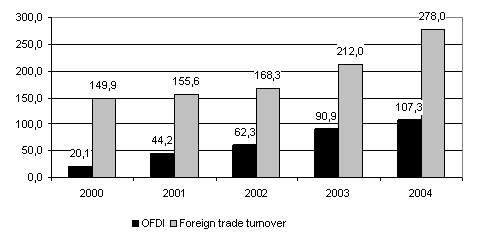
Sources: Central Bank of Russia 2006; Goskomstat 2006.
It is evident that the growth in the Russian OFDI is strongly related to increasing export revenues. The largest Russian exporters also happen to be mostly the main investors abroad. Among Russia’s top 10 foreign investors, seven are natural resource-based companies (Table 2).
Table 2
Russia’s top 10 companies ranked by foreign assets as of the beginning of 2005, USD mn
|
Company |
Industry |
Assets |
Sales | ||
|
Total |
Foreign |
Total |
Foreign | ||
|
Gazprom[72] |
Oil and natural gas |
… |
36 422 |
16 149 | |
|
Lukoil |
Oil and natural gas |
29 761 |
10 663 |
33 845 |
26 428 |
|
Norilsk Nickel[73] |
Non-ferrous metals |
13 632 |
2 618 |
7 033 |
5 968 |
|
Russian Aluminium (RusAl)[74] |
Non-ferrous metals |
11 500 |
2 165 |
5 450 |
4 440 |
|
Mobile TeleSystems |
Telecommunications |
5 581 |
1 214 |
3 887 |
995 |
|
VimpelCom[75] |
Telecommunications |
4 780 |
852 |
2 147 |
45 |
|
Severstal |
Ferrous metals |
5 919 |
666 |
6 648 |
3 954 |
|
Yukos[76] |
Oil and natural gas |
18 514 |
607 |
16 566 |
12 546 |
|
Rosneft |
Oil and natural gas |
25 987 |
319 |
5 275 |
3 438 |
|
OMZ[77] |
Heavy engineering |
901 |
347 |
524 |
272 |
Sources: Company information, authors’ calculations
One should pay attention to the fact that the number of enterprises operating outside these natural resource-based industries, telecommunications in particular, is strengthening among Russia’s main outward investors. The telecommunications companies were responsible for the bulk of the largest acquisitions conducted by Russian corporations outside the natural resource sector in (Table 3).
Table 3
The largest foreign acquisitions by Russian companies in
|
Acquiring company |
Target company |
Country |
Type of assets |
Share, % |
Value, USD mn |
|
Lukoil |
Nelson Resources |
Kazakhstan / Canada |
Oil exploration & production |
100 |
2 000 |
|
Norilsk Nickel |
Gold Fields Ltd |
South Africa |
Gold mining |
20 |
1 200 |
|
Severstal |
Lucchini Group |
Italy |
Steel products |
62 |
574 |
|
RusAl |
Queensland Alumina Ltd |
Australia |
Alumina refinery |
20 |
460 |
|
VimpelCom |
Kar-Tel |
Kazakhstan |
Telecommunications |
100 |
425 |
|
Evraz Holding |
Vitkovice Steel |
The Czech Republic |
Steel products |
100 |
287 |
|
VimpelCom |
Buztel and Unitel |
Uzbekistan |
Telecommunications |
100 |
275 |
|
Lukoil |
Teboil and Suomen Petrooli |
Finland |
Petroleum marketing |
100 |
270 |
|
Lukoil |
- |
The USA |
795 petroleum stations from ConocoPhillips |
100 |
266 |
|
VimpelCom |
Ukrainian Radio Systems |
Ukraine |
Telecommunications |
100 |
254 |
|
MTS |
Uzdunorbita |
Uzbekistan |
Telecommunications |
74 |
121 |
Sources: Numerous company and media sources, authors’ calculations.
Russian metal producers have become notably active in conducting investments *****ssia’s major steel producers (particularly Severstal and Evraz Holding) and non-ferrous metal producers (particularly RusAl and Norilsk Nickel) are among the leading enterprises worldwide, with strong ambitions to expand internationally. As Russia’s WTO membership draws closer, we expect the number of mergers and acquisitions (M&As) in Russia to increase considerably, adding to the international focus of Russian companies.
We estimate that the EU accommodates over a third of Russia’s OFDI stock, and the share of the CIS is around a fifth. Another major recipient of Russian investments is the USA, with an estimated share slightly less than that of the CIS (Kalotáy 2003; Vahtra 2006).
The recent investment trend by Russian companies indicates that the share of the CIS countries is rapidly growing. The aforementioned observation is also supported by the UNCTAD (2005) data on cross-border mergers and acquisitions. Measured by the number of M&A deals, over half of the Russian purchases have taken place within the CIS.
For many Russian companies, the CIS region has been the first step in their internationalisation path. These Russian natural resource-based companies already hold a strong grip on some particular segments of the CIS markets and they have since progressed and moved their focus beyond the CIS. The manufacturing and telecommunications companies have more recently entered into their first investment projects in the CIS region.
The CIS markets are at least as strategic as are Western markets for Russian companies. On many occasions, the energy and infrastructure assets controlled by the Russian companies in the CIS are controversial, due to their political nature. In addition, the Russian companies tend to be the dominant players in several CIS markets, whereas in developed economies they often possess less significant leverage in their respective industries.
To sum up, the recent development signifies both the geographical and the sectoral extension of the Russian OFDI. Additionally, the majority of Russian companies’ foreign M&As have taken place during this millennium, clearly indicating the growing international activity of Russian firms.
The impact of Russia’s WTO membership on the Russian outward foreign direct investment. Russia’s WTO accession has a modest direct impact on the Russian OFDI[78]. In this context, one should bear in mind that Russia no longer has significant controls over their OFDI and capital exports, and therefore, one may argue that the direct impact of Russia’s WTO membership on the Russian OFDI is rather minimal. We believe that the implementation of the full convertibility of the rouble has stronger impact on the Russian OFDI than the WTO membership per se[79].
Despite the fact that the WTO membership does not directly affect Russia’s OFDI, one may argue that the WTO membership indirectly and positively influences the Russian OFDI. One may find at least two significant ways, in which membership indirectly affects the investment outflows from Russia.
Firstly, WTO membership obviously has an influence on the Russian export structure, i. e. in the long-term, WTO membership aids Russia in reducing its natural resource dependency. As outward investment tends to follow export flows, one may assume that the structural change in exports would also change Russian OFDI from their current natural resource-dominated outward investments towards more knowledge-based investments. Here, one should stress that such an indirect impact is to happen in the long term, rather than immediately after Russia’s WTO accession.
Secondly, one should stress the fact that a certain relationship between inward FDI and outward FDI exists. As the Russian WTO membership is likely to increase FDI inflows[80], one may also anticipate that the growing FDI inflow affects the FDI outflows in three major ways: 1) increasing FDI inflow leads to growing FDI outflows already in the medium-term, 2) the access of Russian companies, service and energy companies in particular, becomes easier in the developed West, and 3) the Russian national image as a foreign investor undergoes an improvement.
Increasing FDI inflow leads to growing FDI outflows already in the medium-term: via increasing inward FDI Russia receives modern managerial know-how and advanced technologies, and hence, Russian firms are able to produce more competitive products. Due to the spill-over effect of this inward FDI, other Russian companies not receiving foreign investment may also upgrade their competitiveness. In other words, the inward FDI leads to an enhanced learning curve, not only in those companies with foreign capital but also in other companies, co-operating with foreign-owned firms.
Possessing more competitive products, the Russian corporations are able to increase their market shares in the domestic markets and increase their exports, and hence, improve their financial position. Through a better financial position, Russian firms have an enhanced possibility to conduct investments, both domestically and internationally. It would come as no major surprise, if Russia’s WTO membership would strengthen Russia’s OFDI towards the CIS, as membership improves the competitiveness of Russian firms, making them much more competitive than their rivals within the CIS region.
The access of Russian companies, service and energy companies in particular, becomes easier in the developed West[81]: the internationalisation of Russian banks would benefit from WTO accession, as their operations will become more transparent. With increasing transparency, Russian banks will be better received on the financial markets of the developed West. Most probably, Russian banks will focus on serving their Russian clients abroad, i. e. the Russian banks will probably follow their current clients overseas. The aforementioned internationalisation strategy is supported by earlier empirical findings (Liuhto and Jumpponen 2003a).
One may also assume that the access of the Russian companies towards European energy markets will become less constrained. Consequently, Russia’s outward investments in energy companies within the EU will doubtlessly increase, as there would be less political space for the EU member states to protect their domestic energy markets.
The WTO membership is to bring higher natural gas and electrical energy prices within Russia herself. Higher domestic prices, i. e. subsequent increased revenues, are likely to boost the investments of Russian energy companies in both the domestic market and abroad.
The Russian national image as a foreign investor undergoes an improvement: at the moment, a vicious circle related to Russian outward investors is in existence. Some EU countries, particularly the former socialist states, have been extremely concerned about the growth of Russian investments in their countries due to the assumed political leverage of the Russian State. This has resulted in various restrictive measures towards Russian investors.
In order to avoid this rather negative national image, Russian corporations have invested via front companies based in other countries, such as Cyprus, Switzerland, Ireland, and Luxemburg, in order to obscure their true identity. As these identity changes have usually been detected, these indirect investments have not built trust, but on the contrary, mistrust has deepened. Their WTO membership may offer one crucial way to break the vicious circle and gather Russian corporations into the fold of the most respected investors of the world.
It seems likely that through Russia’s WTO membership, Russia’s outward investments via other countries will be reduced and the transparency of the Russian OFDI will be improved. More transparent investment would be a desired outcome for both Russia and the recipient countries. Moreover, WTO membership would help Russia fight against capital flight and money laundering, and correspondingly, the host countries would be more assured regarding the true identity of the investor.
To conclude, Russia’s WTO accession does not have significant direct impact upon Russian outward direct investment. Despite the situation that no significant direct gains are to be achieved, membership will create an indirectly positive effect on the Russian OFDI. Despite WTO membership not bringing a direct and immediate positive impact on the Russian OFDI, one should keep in mind that WTO membership would augment economic restructuring in Russia. Brisker economic restructuring is necessary, since Russia cannot rely on its natural resources for ever[82].
References
Alfa Bank 2004. FDI in Russia: Russian business is ready for competition – but are competitors prepared to arrive? Press Clippings 29.5.2004.
< http://www. />
Bank of Finland 2006a. BOFIT Weekly 20, 19.5.2006 < http://www. bof. fi/bofit/>
Bank of Finland 2006b. BOFIT Weekly 21, 26.5.2006 < http://www. bof. fi/bofit/>
British Petroleum 2006. Statistical Review of World Energy 2006. <http://www. >.
Central Bank of Russia 2006. <http://www. *****>.
CIA 2006. CIA World Factbook. <http://www. cia. gov>.
European Commission 2004. Communication of the Commission to the Council and the European Parliament on relations with Russia. Brussels.
Goskomstat 2006. <http://www. *****>.
Graham, Edward M. 2005. Russia, Foreign Direct Investment and the World Trade Organization. American Chamber of Commerce in Russia. <http://www. *****>.
Grigoryev L. and Kosarev A. 2000. Capital Flight: scale and nature. A paper presented at the conference “Investment Climate and Russia’s Economic Strategy. Moscow April 2000.
Kalotáy, K. 2003. Outward Foreign Direct Investment from Economies in Transition in a Global Context. Journal of East European Management Studies 8. A special issue edited by Kari Liuhto. Chemnitz.
Kalotáy, K. 2006. Outward Foreign Direct Investment from Russia in a Global Context. Journal of East-West Business 3-4. A special issue edited by Kari Liuhto. Binghampton.
Liuhto, K. 2000. Operations of Russian Firms Abroad - Some Evidence from the Internationalization of Two Russian Energy Giants. In Proceedings of International Workshop. Copenhagen.
Liuhto, K. 2001. East Goes West - The Internationalization of Eastern Enterprises. Lappeenranta University of Technology. Lappeenranta.
Liuhto, K. and Jumpponen J. 2001a. International Activities of Russian Corporations: Where Does Russian Business Expansion Lead? Russian Economic Trends 10/3-4. European Commission. Norwich.
Liuhto, K. and Jumpponen J. *****ssian Gas and Oil Giants Conquer Markets in the West: Evidence on the Internationalization of Gazprom and LUKoil. Journal of East-West Business 7/3. Binghampton.
Liuhto, K. and Jumpponen J. 2003a. The Russian Eagle Has Landed Abroad - Evidence concerning the Foreign Operations of Russia's 100 Biggest Exporters and Banks, Lappeenranta University of Technology, Lappeenranta.
Liuhto, K. and Jumpponen J. *****ssian Corporations and Banks Abroad. Journal for East European Management Studies 8/1. Chemnitz.
Vahtra, P. and Liuhto, K. 2004. Expansion or Exodus? – Foreign Operations of Russia’s Largest Corporations, Pan-European Institute, Turku School of Economics. <http://www. tukkk. fi/pei/pub>.
Pelto, E., Vahtra P., and Liuhto K. 2003. Cyp-Rus Investment Flows to Central and Eastern Europe Electronic Publications of Pan-European Institute, Turku School of Economics. <http://www. tukkk. fi/pei/pub>.
Rutherford, T., Tarr D., and Shepotylo O. 2005. Improved market access for Russia or own liberalization as part of WTO accession: what will raise Russian income and reduce poverty more? A paper of January
UNCTAD 2005. World Investment Report 2005. New York and Geneva: United Nations.
Vahtra, P. 2006. Expansion or Exodus? Trends and developments in Foreign Investments of Russia’s Largest Industrial Enterprises. Electronic Publications of Pan-European Institute, Turku School of Economics. <http://www. tukkk. fi/pei/pub>.
WTO 2006. Russian Federation accession to the WTO. <http://www. unige. ch>.
Hans Ruediger Kaufmann PhD
Associate Professor Intercollege Cyprus
Zorica Zagorac
Hochschule Liechtenstein
The influence of identity on international consumer behavior in transitional settings:
a case study of the Bosnian - Herzegovinian banking market
In a time, in which borders between countries are becoming increasingly open for foreign direct and portfolio investment, enterprises are confronted with new national as well corporate cultures in the host country.
So far identity, a concept from the discipline of social psychology, did not receive much academic attention to explain the success or failure of market entry strategies of international, multinational or global companies into transition countries. Research on the influence of identity on entrepreneurial behaviour in transitional settings (i. e. Kaufmann, 1994, 1995, 1996, 1997, 1998, 2000), the increasing higher level of coherence between brand and clients’ identity and its implications (German, Morgan and Hunt, 2003; Pracht, 2006) point to the high relevance of the identity concept in the field of international consumer behaviour.
The Identity concept. In 1934, Mead (quoted by Cudic, 2001) introduced the concept of identity into social psychology and his book ‘Spirit, Identity and Society’ was very influential for further research to come. According to Mead, “identity is a dynamic phenomenon, which can develop only in social interaction, however, is simultaneously the precondition for its functioning” (Cudic, 2001, p. 35, translated by the authors). Based on this definition the concept experienced differentiations as to social, personal or self-identity, ethnic, national, cultural, political as well as group identity. In 1966, group identity has been described by Erikson (in Cudic, 2001) as the interaction between the self-identity and the belongingness to the group. There is a reciprocal action between the continuous strive for being him-or herself and a continuous participation in specific group features.
Coining the term of the social identity was Goffman in 1969, who understood social identity as a set of social categories, groups and organizations, to those an individual can belong or can be seen as such (Cudic, 2001). Tajfel, in his theory of social identity (SIT), in 1978, and later Turner, in 1986, further developed the concept of social identity (Skrobanek, 2005). According to these authors, an individual’s behaviour cannot be described as an isolated object, but in that processes within a relationship structure are explained from the viewpoint of the individual. Concordantly, social identity “refers to that part of the self-concept being deducted from the knowledge about his/her membership in social groups and from the value of its emotional importance attributed to this membership” (Wagner, 2006). The other part of the self-concept is the personal identity. The core message of the SIT is that each individual strives for a positive social identity. It is a precondition, that the individual identifies with the in-group and that a group is salient in a specific situation. In order to achieve, respectively, maintain a positive social identity members of the in-group are comparing each other with members of out-groups and, consecutively, evaluate the outcome of this comparison. Is the result conducive for the in-group, the positive social identity is maintained. In the opposite case, the member would try to change the features of the in-group in order to achieve a positive social identity. Otherwise, the member would try to leave the group. An individual can be a member of several groups. Categorisations and stereotypes in relation to in - and outgroups play a major role in this context. SIT has been criticized by social psychologists. Skrobanek (2006, p. 5) holds that “instrumental components of a group membership in relation to the strategic self-interest of group members are not considered by SIT”. Also Schiffman and Wicklund (1988, p. 159) question the SIT in several respects: “this conceptualisation is criticized in the following way: 1. Inter - group behaviour is reduced to conflicts between groups; 2. The conceptualisation of social identity is sociological; 3. the theory consists of a co-existence of sociological and psychological variables; 4. The central finding that the discrimination of the out-group leads to the increase of self-assessment can be alternatively explained.” Other social psychologists, on the other hand, criticize the critique of the SIT: “Schiffman and Wicklund (1988) have presented a critique of the social identity theory of Taifel and Turner. It is shown that this critique is based on unjustified assumptions about the theory and its level of confirmation and that the suggested reduction is not appropriate for the subject” (Zick, Wiesmann, Wagner, 1989, p. 172).
Ethnic, cultural and national identity. The borders between social, cultural, ethnic and national identity are fluent and lack a unanimous definition. Based on the definitions of social identity according to Goffmann or Taifel and Turner, ethnic, cultural and national identity would be subcategories of social identity as those reflect a sense of belongingness to a certain group. In this respect, ethnic is synonymous with belonging to a people or testifying a common culture or community (Zwahr, 2003). “Heckmann (1992) describes ethnicity as a general sociological concept, the fact being significant in meaning for individual and collective action that a relatively large group of people are related by the belief in a common origin, by commonalities of culture, history, and current experiences and has awareness of identity and solidarity” (Heckmann, 1992, quoted by Cudic, 2001, p. 40).
The differentiation between ethnic and national identity is difficult due to its reciprocal relationship. Contrarily to ethnicity, the concept of nation is seen to have more complex connotations. Whereas nation is always associated with a political-state and territorial context, ethnicity lacks this political component (Zwahr, 2003, p. 4076). Cultural identity comprises a, by far, larger spectrum than national and ethnic identity. Cultural attributes can not just be formed ethnically or nationally but also in a multi - ethnical and multinational way, like religion, language, and traditions etc. which belong to a cultural identity. The ethnical identity results from identification with a group of the same origin.
The influence of salient identity on consumer behaviour. In 1980, Burke (quoted in Reed, 2000) referred to the individual’s self-concept to constitute of interrelated multiple role identities. This is supported by Stryker holding that the individual possesses several identities, which are outstanding in hierarchical order (salient): „Identity theory incorporates a concept of the person as having self comprised of multiple identities organized in a salience hierarchy” (Stryker, 1981, p. 15). Stryker and Serpe established in 1966 the theory of the identity salience suggesting that all relationships of an individual are based on his/her identities. Hence, besides being dependent on the respective situation the degree of salience of an identity role is influenced by the engagement of an individual for a specific relationship. A distinction to Tajfel’s theory becomes apparent who explains identity constituted group belongingness to become salient by the perception of social inequalities which are interpreted as illegitimate and changeable (Nunner-Winkler, 1998).
In 1995, as one of the first scientists Laverie considered the effects of group activities such as tennis and aerobics on purchasing behaviour and the identity salience interrelating social identity with purchasing behaviour. „Over time, people form and maintain consumption patterns associated with particular activities (Laverie, 1995, p.2). According to Laverie, the affiliation to the group affects the purchasing behaviour not directly, but indirectly by the personal estimations of group members to the product. Latter, again, affects the emotions of the individual to the product. Consequently, the feelings to the product, which one consumes in the context of the group activity lead to the salient identity: „the personal and social appraisals lead to positive feelings which make participation into the activity more important to the self. As the activity becomes more important to the individual, he or she participates in the activity more often” (Laverie, 1995, p. III). Also Laverie (1995, p.2) points out that the realization that products are not only consumed due to bare needs and personal experiences, was already the subject of earlier theses. „ The idea that other people impact the products that we use, and that they evaluate us when we use products, has been suggested for some time (McCracken 1987). In spite of intuitive appeal and everyday instances of this notion, consumer researches have virtually ignored the social consequences of product use (Ward 1974). This void exists because consumers are often viewed as individuals who use products in isolation”. Reed (2002) suggests a repertoire of different external social categories is at the disposal of the individual, which represent a basis for forming the own social identity of the individual. Social roles the individual identifies with can be permanently, like, for example, the role as a mother or a friend, or temporarily, like, for example, the role as a citizen or sportsman. „The term ‚social identity’ refers to the actuated perspective or frame of reference that a consumer processes as part of the repertoire of who they are or want to appear to be” (Reed, 2000, p.40). From this vantage point, the consumer makes judgements and decisions. Beyond that, the consumer makes judgements and decisions which form his/her attitude not in favour of any arbitrary social category but in favour of his/her salient identity. „If a social identity is salient, then there is an increased likelihood that the evaluated content linked to that social identity will impact the formation of a consumer attitude” (Reed, 2000, p.17). Which identity is salient, depends on the situation and the environment of the consumer. As an example, the identity salience of an afro-American consumer in a store is provided. If it concerns a store, in which, except the Afro-Americans only Caucasian consumers buy, the ethnical identity might be salient. On the other hand, the more the social identity becomes self-important or salient the more this will influence consumer attitude. As a precondition, there has to be a relevant functional relationship between the respective social identity and the product/service to be evaluated. Further researching this subject, Underwood, Bond and Bear (2001) related social identity to the process of developing brand equity, particularly of high involvement sports related service brands. Fans identify themselves often to a very large extent with certain sportsmen, particularly with crews reflected by the numerously existing sports associations. As a result of this identification, a victory or a defeat of this crew is often equated with personal victory or defeat.
More recently, Arnett, German and Hunt (2003) refer in the context of Relationship Marketing in the Non profit business to the identity salience theory. According to the authors, the salient identity plays a substantial role in Relationship Marketing, if two criteria are fulfilled: „We argue that in contexts in which one partner is an individual, for example, business-to-consumer marketing, identity salience may be an important construct that mediates relationship-inducing factors, such as reciprocity and satisfaction and relationship marketing success“ (Arnett, German and Hunt, 2003, p.90). Furthermore, beyond a mere economic benefit, the consumer has to gain a social benefit through the business relation. “We argue that identity salience may play a crucial role in contexts in which one of the partners to the exchange receives substantial social benefits. For example, in the clothing industry many consumers use strong brand names as social symbols, which can affect the formation and maintenance of identities (Laverie, Kleine, and Kleine 2002; Solomon 1983)” (Arnett, German and Hunt, 2003, p. 90). Based on these hypotheses, Arnett, German and Hunt developed the ‘Identity Salience Model of Relationship Marketing Success’ for the Non-profit sector. In line with Arnett et al. implying that social identity can not only be addressed but, even more, externally stimulated Reed (2004, p.1) summarizes : „… identity salience – a temporary state during which the consumer’s identity is activated …– can bring to mind attitudes and behaviors consistent with the social identity. This is important because there are a number of potentially controllable environmental and situational stimuli that may evoke or instantiate a particular social identity, thereby making it an important factor in a resulting judgement (see Reed and Forehand, 2003)”.
Consumer identity in Bosnia-Herzegovina. Compared to the 1980s the question of the national and ethnical identity currently gains momentum in the Southeast-European area. Personal networks have increasingly ethno-national character (Brunnbauer, 2002). Ethnical identity is defined, on the one hand, by religion, on the other hand, by an original ethnical one. After the Yugoslavian civil war and after the transition to a new, democratic and free market oriented governmental and state system, the structure and character of all economic units changed. Market entrance activities international companies into the Bosnian and Hercegovinian market are increasing (Eger, Fritz and Wagener, 2006). This situation influenced the attitude and behaviour of humans, also regarding consumption patterns.
The Central Bank of Bosnia Herzegovina responsible for the distribution of the new currency ‘Konvertibilna Marka’, exists since 1997. The control function, which, in general, corresponds with international standard, is exerted by the two entities, the Republic of Serbia and the Federation of Bosnia Herzegovina. The private banks in both partial republics are mainly new establishments or developed from the Yugoslavian state banks. After a wave of new bank establishments a number of relatively small private financial institutions exist albeit with a limited service portfolio and a weak financial basis. Although no private banks existed in the previous Yugoslavia the banking system was quite autonomous from governmental influence (Neuhauss, 2001). In the context of implementing a high performance financial system in Central and Eastern Europe (CEE) transformation processes are an important challenge and, therefore, from a long term perspective, foreign investors play a crucial role (Tkaczynski, 2001).
Research Methodology. The research objective was to investigate the effect of the identity of the customers of Bosnian - Herzegovinian banks on their customer behaviour and the implications on Marketing policies of international banks. Due to the EU-South-East Expansion and the assumed very important role of identity this region was selected. In this exploratory stage of this qualitative case study approach it was perceived that marketing managers of the most influential international banks might be better able to comment on more theoretical, holistic and strategic aspects than local consumers. A preliminary documentary analysis via an internet research provided background information about the banks. The qualitative case study approach is recommendable if relatively few cases shall be researched in-depth (Lamnek, 2005). As a research technique, problem-centred, semi-structured in-depth interviews were chosen. The fact that the interviews were conducted in the mother tongue (Serbian in the Republic of Serbia and Bosnian in the Federation of Bosnia Herzegovina) of the respective marketing managers relates to an ethnographic research approach and increases the reliability and validity of the findings. All the interviews were recorded and later transcribed. Following an interpretation of the statements of the interviewees a comparing systematization took place “with the objective to identify collective action patterns” (Witzel, 1985, quoted by Lamnek, 2005, p. 368). In total, 7 marketing managers of 3 Austrian, one Austrian-Italian and one German bank in Sarajevo and Banja Luka have been interviewed.
Based on the literature review the following hypotheses were generated.
Although, the national and ethnical identity of the citizens of Bosnia Herzegovina are currently pre-dominant due to ethnic conflicts, this should not be seen as a static phenomenon. It is assumed that this situation analogously refers to the customers.
H 1: The customer identity in Bosnia-Herzegovina is in transition.
In international business, particularly, cultural values have a substantial bearing on consumer behaviour. As the salient identity affects the purchasing decision of the consumer it is, therefore, assumed that also in Bosnia-Herzegovina the identity of the customers affects their customer beviour (see: Arnett/German/Hunt,2003; Baer, Bond, Underwood, 2001; Bouchet, 1995; Reed, 2000; Stryker, 1981).
H 2: The identity of bank customers in Bosnia-Herzegovina affects their customer behaviour.
In Bosnia-Herzegovina particularly international banks entered the market arena, mainly by acquiring domestic banks or by establishing subsidiaries. Due to missing conceptional marketing models related to the identity theory, it is not referred to a specific concept but, in a more general way, it is assumed that the international banks adapt their marketing concept to the local customer identity in Bosnia-Herzegovina, whether in a structured or in an intuitive way.
H 3: International banks adapt their marketing strategies to the customer identity in Bosnia-Herzegovina.

|
Из за большого объема эта статья размещена на нескольких страницах:
1 2 3 4 5 6 7 8 9 10 11 12 13 14 15 16 |
