

Партнерка на США и Канаду по недвижимости, выплаты в крипто
- 30% recurring commission
- Выплаты в USDT
- Вывод каждую неделю
- Комиссия до 5 лет за каждого referral
I have a dream that one day, down in Alabama, with its vicious racists, with its governor having his lips dripping with the words of interposition and nullification, that one day, right there in Alabama, little black boys and black girls will be able to join hands with little white boys and white girls as sisters and brothers. I have a dream today!
I have a dream that one day every valley shall be exalted, and every hill and mountain shall be made low, the rough places will be made plain, and the crooked places will be made straight; and the glory of the Lord shall be revealed and all flesh shall see it together.
This is our hope. This is the faith that I go back to the South with.
With this faith, we will be able to hew out of the mountain of despair a stone of hope. With this faith, we will be able to transform the jangling discords of our nation into a beautiful symphony of brotherhood.
With this faith, we will be able to work together, to pray together, to struggle together, to go to jail together, to stand up for freedom together, knowing that we will be free one day. This will be the day - this will be the day when all of God's children will be able to sing with new meaning, -"My country 'tis of thee; sweet land of liberty; of thee I sing; land where my fathers died, land of the pilgrim's pride; from every mountainside, let freedom ring" - and if America is to be a great nation, this must become true.
So let freedom ring from the prodigious hilltops of New Hampshire.
Let freedom ring from the mighty mountains of New York.
Let freedom ring from the heightening Alleghenies of Pennsylvania.
Let freedom ring from the snow-capped Rockies of Colorado.
Let freedom ring from the curvaceous slopes of California.
But not only that:
Let freedom ring from Stone Mountain of Georgia.
Let freedom ring from Lookout Mountain of Tennessee.
Let freedom ring from every hill molehill o0f Mississippi.
From every mountainside, let freedom ring.
And when this happens, when we allow freedom ring when we let it ring from every village and every hamlet, from every state and every city, we will be able to speed up that day when all of God’s children, black men and white men Jews and Gentiles, Protestants and Catholics, will be able to join hands and sing in the words of the old Negro spiritual, “Free at last, free at last; thank God Almighty, we are free at last.”
UNIT 11
PART I
AMERICA IN THE 1970S
Political activism did not disappear in the 1970s, however it was rechanneled into other causes. Some young people worked for the enforcement of anti-pollution laws or joint consumer-protection groups or campaigned against the nuclear power industry. Following the example of blacks, other minorities – Hispanics, Asians, American Indians, homosexuals – demanded a broadening of their rights.
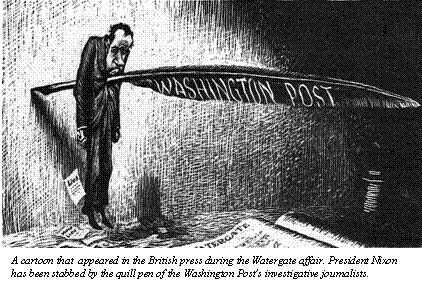

President Richard Nixon () was a Republican, who took office after eight years of Democratic rule. He was much less interested than Kennedy and Johnson in helping the poor. He believed that people should overcome hardship by their own efforts. As President, Richard Nixon was faced with many problems in foreign affairs. The war was still going on in Vietnam, and trouble was brewing again in the Middle East. Nixon worked to do something about these problems. He achieved two major diplomatic goals: reestablishing formal relations with the People’s Republic of China and negotiating the first Strategic Arms Limitation Treaty (SALT I) with the Soviet Union.
Even as the United States was fighting the Vietnam War, relations with the Soviet Union had begun to improve. In 1969, the United States and the Soviet Union were among some 60 countries that signed the Nuclear Nonproliferation Treaty. In it, countries with nuclear weapons promised not to help other countries to build them. That same year, the two powers began talks on limiting defensive nuclear weapons. Out of these talks came the Strategic Arms Limitation Treaty (SALT). In it, the United States and the Soviet Union agreed to limit production of certain missiles.
In June 1969, President Nixon came to Moscow to sign the SALT agreement. He was the first American President to visit here. Nixon said that the United States and the Soviet Union should have closer economic and business ties. A few months later, the United States agreed to sell American wheat and other grains to the Soviet Union. It was the largest export grain order the United States had ever received. All of this was part of a new policy toward the Soviet Union formed by President Nixon and Secretary of State Henry Kissinger. Called detente, it meant a relaxation of cold war tensions between the United States and the Soviet Union. In 1973 Soviet Premier Leonid Brezhnev visited Washington, D. C. He met there with President Nixon, members of Congress, and some American business leaders. During the visit, it was agreed that both the United States and the Soviet Union would work on another SALT agreement. In addition, both leaders agreed that their nations should avoid actions which might lead to nuclear war. There was also agreement for the two countries to work together in the areas of business, science, and culture.
At the same time, President Nixon was also trying to improve relations with the People's Republic of China. On February 21, 1972, he became the first American President to visit the People's Republic of China. Nixon signed a declaration that said Taiwan was legally part of mainland China. It also said that in time American forces would leave there, and that Taiwan's future would be decided by the Chinese themselves. This, more than anything, showed how much United States policy toward China had changed under President Nixon. This policy was continued in the 1970s. In January 1979, the United States formally recognized the People's Republic of China.
But the 1970s was a time of discontent and disillusion for many American people. President Nixon had promised in his 1968 campaign to bring the people together – to unify the country. Nixon said he would follow policies that would heal the wounds of war abroad and violence at home. This represented a search for consensus, or general agreement.
One of the most important problems facing the country in the late 1960s was inflation. Prices rose higher and higher each year, mostly because of the cost of the Vietnam War. To stop inflation, Nixon first called for a tight money policy. In August 1971, he announced his New Economic Policy but it did little to bring about consensus.
The subject of women's rights became more and more an issue in the 1970's. During Nixon's years in office, American women stepped up a long-time struggle against discrimination against 1970 women made up nearly 40 percent of the workforce. Yet they faced discrimination both in the kinds of jobs they could get and in the amount of money they were paid. For example, in 1970 women earned only 60 percent as much as men. Women often were not only limited to lower-paying jobs but were paid less for the same job. To end such discrimination, the National Organization for Women (NOW) was formed in 1966. There were also other groups formed to work for women's rights.
Another area of conflict in the 1970's was the space program. In 1969 the United States had reached Kennedy's goal of landing on the the end of 1972 the United States had made five more moon landings. Although most people admired such feats, some thought that the money could be better used elsewhere. They felt that greater efforts should be made to solve the problems on the earth. In spite of this, Nixon was able to get support for Skylab, which was launched in 1973. This was an orbiting laboratory to test the ability of humans to live and work in outer space. In 1975 the United States and the Soviet Union carried out a joint space mission. An American Apollo and a Soviet Soyuz spacecraft docked together while orbiting the earth. This docking symbolized the spirit of detente between the two powers.
In 1972 Nixon was reelected as President, soon Americans learned of a scandal involving the President and members of his staff. In June 1972 five people had been arrested for breaking into the headquarters of the Democratic National Committee in Washington, D. C. The office was in the Watergate Hotel, and the scandal that followed was called Watergate. Journalists investigating the incident discovered that the burglars were connected to the White House and the Committee to reelect the President. In February 1973 the Senate set up a committee to look into charges of corruption in the 1972 election. In July 1973, it was revealed that President Nixon had recorded his office conversations concerning the Watergate affair. Nixon repeatedly had said that he had not known about the break-in nor had he used his powers to cover it up. The Senate committee hoped that his tapes would bring out the truth. Nixon, however, refused to give up the tapes, claiming executive privilege. After long resistance he finally made them public. The tapes revealed that Nixon was directly involved in the cover up. More and more Americans lost faith in the President, and by the summer of 1974 it was clear that Congress was likely to impeach and to convict the President. On August 9, 1974 Richard Nixon became the only American President to resign his office.
In the middle of Watergate, the American people had received another blow to their faith in government leaders. In October 1973 Vice-President Spiro Agnew resigned from office. He had been charged with accepting bribes both before and during his term as Vice-President. After Agnew left office, Nixon named Republican Gerald Ford as Vice-President. Twenty months later, upon Nixon’s resignation Ford became President. He was the first person to serve as President who had not been elected to either the Presidency or the Vice-Presidency.
Ford became President in a time of crisis. His priority was to restore trust in the government which had been shaken by the Watergate scandal. Besides, economic problems remained serious as inflation and unemployment continued to rise and gross national product fell. At first, Americans greeted Ford favorably. Shortly after taking office, however, President Ford lost some of those good feelings as he pardoned Nixon for any crimes which he might have committed while in office. This meant that Nixon would not have to face criminal charges for his part in Watergate. Ford hoped it would help heal the wounds of Watergate, but most Americans were angered by the pardon.
In public policy, Ford followed the course Nixon had set. He carried on detente with the Soviet Union and worked toward closer relations with China. He also went on working for nuclear arms control and visited the Soviet Union in December 1974.
Under Ford, there was much disagreement over how to make America self-sufficient in energy. Ford favored deregulation. This meant removing price controls on gas and oil. Prices would then rise, and because of this, people would use less fuel. Higher profits from higher prices would aid companies in developing new forms of energy. Ford was not able to get the Congress to pass this measure. However, the Congress did pass the Energy Policy and Conservation Act. This act dealt with saving fuel and finding new forms of energy.
In 1976 the election was won by Democratic candidate Jimmy Carter, former governor of Georgia. Carter had limited political experience, but many voters now preferred an “outsider” – someone who was not part of the Washington establishment. During the campaign Carter made a number of promises. He said that he would balance the budget and cut military spending, create jobs to lower unemployment, "clean up" the government and make certain changes in foreign policy.
He could not control the chief economic problem of the 1970s – inflation. The Organization of Petroleum Exporting Countries (OPEC) had been increasing the cost since 1973, and those increases fueled a general rise in prices.
Once in office, however, Carter had difficulty working with the Congress. One area of conflict was Carter's new foreign policy. He wanted the United States to use its power to uphold human rights all over the world. One way to do it was to cut off military and economic aid to governments which violated these rights. Carter, for example, favored withdrawing aid from Chile, Argentina, Uruguay, and Ethiopia. These were countries ruled by dictators who jailed people opposing them. Carter also urged the white-minority governments of South Africa and Rhodesia (Zimbabwe) to share power with their black-majority populations. President Carter also supported Soviet dissidents, people who spoke out against their government, and the Soviet Union was angered by Carter's policy. Relations between the two countries grew worse after the Soviet invasion in Afghanistan in December 1979. In protest, Carter asked the United States Olympic team to boycott the 1980 Summer Olympics in Moscow.
DISCUSSION
1. How did political activism change in the 1970s?
2. Being a Republican, did President Nixon share Kennedy’s attitudes to social issues?
3. What were the two major tasks that Nixon accomplished in foreign affairs?
4. Speak about the development of US-Soviet relations.
5. What is SALT?
6. What economic challenges did the US face in the 1960s?
7. What were the objectives of NOW?
8. How did American space program develop in the 1970s?
9. What is Watergate? Was it a blow to people’s faith in government?
10. Why did Spiro Agnew resign from office?
11. What were the priorities of the Ford administration?
12. What was the reaction of most Americans to pardoning of Nixon?
13. Speak about the disagreement over energy issues.
14. Why, do you think, Americans voted for Carter in 1976?
15. Speak about Carter’s foreign policy.
PART II
NEW FEDERALISM
 Shifts in the structure of American society, begun years earlier, had become apparent by the 1980s. The composition of the population and the most important jobs and skills in American society had undergone major changes. The dominance of service jobs in the economy became the mid 1980s three-fourths of all employees worked in the service sector as retail clerks, office workers, teachers, physicians, government employees, lawyers, legal and financial specialists. Service sector activity benefited from the availability and increased use of the computer. This was the information age, with hardware and software processing huge amounts of data about economic and social trends. Meanwhile, American “smokestack” industries, such as steel and textiles, were in decline. The US automobile industry reeled under competition from Japanese carmakers such as Toyota, Honda, and Nissan, many of which opened their own factories in the United 1980 Japanese automobile manufacturers controlled a quarter of the American market.
Population patterns shifted as well. After the end of the postwar “baby boom”, which lasted from 1946 to 1964, the overall rate of population growth declined and the population grew older. Household composition also changed. In 1980 the percentage of family households dropped, a quarter of all groups were now classified as “nonfamily households”, in which two or more unrelated persons lived together.
New immigrants changed the character of American society in other ways. In 1965 the character of American immigration policy changed, and the number of immigrants from Asia and Latin America increased dramatically. Vietnamese refugees poured into the US after the war. In 1,000 immigrants arrived, the highest number in 60 years, as the country once more became a heaven for people from around the world.
In the presidential race of 1980 American voters rejected Carter’s bid for a second term, and elected Ronald Reagan, a conservative Republican and former governor of giving Ronald Reagan an overwhelming election victory, the American public expressed a desire for change in the style and substance of the nation’s leadership. He benefited from the accumulated frustrations of more than a decade of domestic and international disappointments. The 69-year-old Republican became the nation's 40th, and oldest, President.
He had reached the presidency by an unusual route. Born in a small town in Illinois, he spent most of his career in entertainment business – first as a radio sportscaster, then as a successful film actor, and later as a television show host and corporate spokesman for General Electric. In that last capacity he began to speak widely on political issues. In 1964 Reagan appeared on national television to deliver an eloquent endorsement of Barry Goldwater (Senator from Arizona and Republican nominee for president); his speech established him almost overnight as the new leader of American conservatives. Two years later Reagan won governorship of California and served two four-year terms.
Reagan seemed to be a man fully in tune with his times. Throughout his presidency he demonstrated the ability to instill in Americans pride in their country, and a sense of optimism about the future. He assumed the presidency promising a change in government more fundamental than any since the New Deal of 50 years before. Reagan succeeded brilliantly in making his own engaging personality the central fact of American politics in the 1980s. Even people who disagreed with his policies found themselves drawn to his attractive image. Known as the “Great Communicator”, Reagan was a master of television and a gifted public speaker.
If there was a central theme to Reagan’s national agenda, it was his belief that the federal government had become too big. He believed that government intruded too deeply into American life. He also wanted his New Federalism to go into effect. First proposed by President Nixon, the plan was to cut the federal government's role in the economy by turning over many of its tasks to state and local strengthening state governments, he hoped to reduce federal spending and build up national defense.
Reagan’s domestic program was rooted in his belief that the nation would prosper if the power of private economic sector was unleashed. Reagan was a proponent of Supply-side economics, a theory which advocates large tax cuts in order to increase private investments and thus increase the nation’s supply of goods and services. Calling upon Americans to "begin an era of national renewal" in his inaugural address, President Reagan outlined his economic program as "a new beginning." In the weeks that followed he urged Congress to support this program. It called for decreases in taxes, reduced federal regulations, and sharp cuts in federal spending – all designed to stimulate the economy and to curb "double-digit" inflation. Democratic leaders strongly opposed Reagan's economic program. They called it Reaganomics ─ policy designed to increase production or favor supply. They pointed out that less money would be taken in by the federal treasury because of the tax cuts, and complained that most of the budget cuts would have to be made in social programs since Reagan proposed to increase spending on national defense. The Reagan administration, supported by conservative members in Congress, sought to make cuts in the amount of federal money being spent for public health, education, and welfare.
Despite the severe cuts in the federal budget, the Reagan administration was unable to achieve all of the results it the early 1982 the Reagan economic program was beset with difficulties. The nation continued to face rising unemployment, high interest rates, serious economic recession, and record budget deficits. The US entered the most severe recession since the Great Depression of the 1930s.
However, the economy recovered more rapidly and impressively than almost anyone had expected. Despite a growing federal budget deficit and the prediction of many economists that the recovery was weak, the economy continued to flourish through 1984 and 1985. The US entered into one of the longest periods of sustained economic growth since World War II. Presiding, like Eisenhower, over a period of relative peace and prosperity, President Reagan and his Vice President George Bush overwhelmingly won reelection of 1984.
In foreign policy, Reagan encountered a combination of triumphs and difficulties. Determined to restore American pride and prestige in the world, he attacked what he claimed as the weakness and “defeatism” of previous administrations which had allowed Vietnam, Watergate, and other crises to paralyze their will to act. The United States, he argued, should again become active and assertive in opposing communism throughout the world. The most conspicuous examples of the new activism came in Latin America. In El Salvador, where the regime was engaged in struggle with communist revolutionaries, the president committed himself to increased military and economic assistance. In neighboring Nicaragua, a pro-American dictatorship had fallen to the revolutionary “Sandinistas” in 1970. The new government had grown increasingly anti-American throughout the early 1980s. Despite substantial domestic opposition, the US administration gave more and more support, both rhetorical and material, to the “contras” – a guerrilla movement recruited and trained largely by the American CIA, drawn from several antigovernment groups and fighting to topple the Sandinista regime.
The administration's greatest foreign policy success, Reagan believed, came in October 1983, when American soldiers and marines invaded the tiny Caribbean island of Grenada to safeguard American lives and to oust an anti-American Marxist regime that took power after the assassination of the country’s elected prime-minister. The invasion was brief, successful, and not particularly costly. It was highly popular with the American public.
In June 1982, the Israeli army launched an invasion of Lebanon in an effort to drive guerrillas of the Palestinian Liberation Organization from the country. The United States supported the Israelis rhetorically, but it also worked to reduce the violence and to permit the PLO forces to depart Lebanon peacefully. An American peacekeeping force entered Beirut to supervise the evacuation. Later, American marines remained in the city, apparently to protect the fragile Lebanese government. But military efforts in Lebanon ended tragically when over 200 Marines were killed in a terrorist bombing in October, 1983. In the face of this difficult situation, Reagan chose to withdraw American forces rather than become more deeply involved in the Lebanese struggle. For a time the administration showed similar restraint in response to a series of terrorist incidents directed against American citizens in Europe and the Middle East. The president made bellicose remarks about several Arab leaders but took no visible action against them. In spring of 1986, however, the administration ordered American naval forces to stage exercises in the Mediterranean, off the cost of Libya (whose radical leader, Muammar Qaddafi, was generally believed to be a principal sponsor of terrorism). Qaddafi claimed the American ships were operating in his territorial waters, a claim the United States denied. In the course of the exercises, Libyan forces harassed the Americans; US bombers then launched a series of retaliatory attacks on Libyan military positions.
Several weeks later, after additional terrorist attacks on Americans and others in which Qaddafi had evidently been involved, American planes staged an extensive bombing raid on the Libyan capital. Several important military targets were destroyed. But the raid also damaged some nonmilitary sites and killed a number of civilians. The bombing was highly popular with the American people, but it evoked strong denunciations throughout the Arab Middle East and from many of America's allies in Europe. Additionally, the United States and other Western European nations kept the vital Persian Gulf oil-shipping lanes open during the Iran-Iraq conflict, by escorting tankers through the war zone.
Relations with the Soviet Union during the Reagan years fluctuated between political confrontation and far-reaching arms control agreements. The president spoke harshly of the Soviet regime, accusing it of sponsoring world terrorism and declaring that any armaments negotiations must be linked to negotiations about Soviet behavior in other areas. The Soviet Union, he once claimed, was the "focus of evil in the world." Relations with the USSR deteriorated further after the government of Poland (under strong pressure from Moscow) imposed martial law on the country in the winter of 1981 to crush a growing challenge from an independent labor organization, Solidarity. Another event that increased US-Soviet tension was the destruction of an off-course Korean passenger airliner by a Soviet jet fighter on September 1, 1983.
The Reagan years in the White House saw unprecedented military spending. The President called for a massive defense buildup, including the placement of intermediate-range nuclear missiles to match and exceed the Soviet arsenal. He also proposed the most ambitious new military program in many years: the so-called Strategic Defense Initiative (SDI), widely known as "Star Wars" (after a popular movie of that name). Reagan claimed that SDI, through the use of lasers and satellites, could provide an impenetrable shield against incoming missiles and thus make nuclear war obsolete – a claim that produced considerable skepticism in the scientific community.
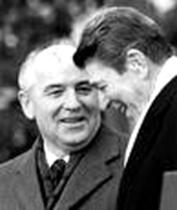
However, Reagan soon found himself contending for the world's attention with Mikhail Gorbachev, installed as chairman of the Soviet Communist party in March 1985. Gorbachev was personable, energetic, imaginative, and committed to radical reforms in the Soviet Union. He announced two policies with sweeping, even revolutionary, implications - Glasnost and Perestroika. Both Glasnost and Perestroika required that the Soviet Union shrink the size of its enormous military machine and redirect its energies to the civilian economy. That requirement, in turn, necessitated an end to the Cold War. Gorbachev accordingly made warm overtures to the West, including an announcement in April 1985 that the Soviet Union would cease to deploy intermediate-range nuclear forces (INF) targeted on Western Europe, pending an agreement on their complete elimination. He pushed this goal when he met with Ronald Reagan at their first of four summit meetings, in Geneva in November 1985. The two leaders met again in October 1986, this time in Reykjavik, Iceland, but they could reach no agreement on arms reduction because of basic differences over SDI. But at a third summit, in Washington, D. C, in December 1987, Reagan and Gorbachev at last signed the INF treaty, banning all intermediate-range nuclear missiles from Europe. This was a result long sought by both sides; it marked a victory for American policy, for Gorbachev's reform program, and for the peoples of Europe and indeed all the world, who now had at least one less nuclear weapon system to worry about.
In June 1987, Reagan called for the removal of the Berlin Wall, appealing directly to Mikhail Gorbachev to remove the physical and symbolic barrier between the two Germanys and the Eastern and Western blocs of Europe. In the year Reagan left office, the Berlin Wall was demolished, followed by the unraveling of the Soviet Union itself.
Two foreign-policy problems seemed insoluble to Reagan: the continuing captivity of a number of American hostages, seized by Muslim extremist groups in Lebanon; and the continuing grip on power of the left-wing Sandinista government in Nicaragua. The most serious issue confronting the Reagan’s administration at that time was the revelation that the US had secretly sold arms to Iran in an attempt to win freedom for American hostages held in Lebanon (Irangate), and to finance the Nicaraguan contras during a period when Congress had prohibited such aid.
The Iran-contra affair cast a dark shadow over the Reagan record in foreign policy, tending to obscure the president's real achievement in establishing a new relationship with the Soviets. Out of the several Iran-contra investigations a picture emerged of Reagan as a lazy, perhaps even senile, president who napped through meetings and paid little or no attention to the details of policy. Reagan's critics pounced on this portrait as proof that the former-movie-star-turned-politician was a mental lightweight who had merely acted his way through the role of the presidency without really understanding the script. But despite these damaging revelations, Reagan remained among the most popular and beloved presidents in modern American history.
DISCUSSION
1. What were the major shifts in American society and economy in the 1980s?
2. Did American immigration policy change at that period? How did it affect the population structure of the country?
3. Who became the 40th US President?
4. Speak about Reagan’s career.
5. Speak about Reagan’s personality.
6. What was the central theme to Reagan’s national agenda?
7. What is Supply-side economics?
8. Did Reagan administration manage to achieve all the economic results it sought?
9. Speak about the US involvement in El Salvador, Nicaragua, and Grenada.
10. Why did American troops enter Beirut in 1982?
11. Speak about Muammar Qaddafi and the conflict with Libya.
12. Speak about Reagan’s attitude towards the Soviet Union. What incidents deteriorated American-Soviet relations in the early 1980s?
13. What is SDI?
14. How did the relations with the Soviet Union change after 1985?
15. Speak about the Iran-contra affair.
PART III
AMERICA IN THE 1990S
The last decade of the 20th century is often called one of the best periods in US history. During almost all that time America was in peace. The frightening and costly military competition with the Soviet Union had ended, the threat of nuclear attack seemed greatly reduced, if not gone. The economy improved from poor to very good. American scientists and engineers made major progress in medicine and technology. The internet computer system created a new world of communications.
America grew by almost 33 million people during the 1990s. Some minority groups grew faster than the white population, one in ten Americans was born in another country. During this decade there was a huge increase in immigrants from Latin America, the Caribbean and Asia. More than 280 million people lived in the United States by the end of the 20th century. The population was getting older, however, and needing more costly healthcare. American families changed, more people ended their marriages. The divorce rate increased, so did the percentage of children living with only one parent.
In 1988 Americans elected George Herbert Walker Bush as their President. He benefited greatly from the popularity of the former President. George Bush was born with a silver spoon in his mouth. His father had served as a US senator from Connecticut, and young George had enjoyed a first-rate education at Yale. After service in World War II, he made a modest fortune of his own in the oil business in Texas. His deepest commitment, however, was the public service, he left the business world to serve briefly as a congressman and then held various posts in several Republican administrations, including emissary to China, ambassador to the United Nations, director of the Central Intelligence Agency, and vice president. He capped this long political career when he was inaugurated as president in January 1989, promising to work for “a kinder, gentler America.” During his campaign Bush promised to continue the economic policies of the Reagan administration. He echoed some of Reagan’s positions in social issues and stressed a commitment to be the “education president”.
The US-Soviet dialogue continued to broaden and deepen during the first year of the Bush administration. At that time a remarkable political change took place in the Soviet Union and Eastern Europe, symbolized by the opening of the Berlin Wall in November 1989. In the two years following that event, the world witnessed the dissolution of the Soviet Union and the end of its dominating influence in Eastern Europe. The Bush administration promoted the concept of a “new world order”, based on a new set of international realities, priorities, and moral principles.
The idea of a “new world order” was challenged when Saddam Hussein, the leader of Iraq, invaded oil-rich Kuwait in August 1990. Financially exhausted by its eight-year war with Iran that had ended in stalemate in 1988, Iraq needed Kuwait’s oil to pay its huge war bills.
Ironically, the United States and its allies had helped supply Saddam with the tools of aggression. Assuming that "the enemy of my enemy is my friend," American policymakers aided Iraq's war against Iran. In the process they helped build Saddam's military machine into one of the world's largest and most dangerous.
On January 16, 1991, the United States and its U. N. allies unleashed a hellish air war against Iraq. For thirty-seven days, warplanes pummeled targets in occupied Kuwait and in Iraq itself. Overwhelmed by the air attacks, Iraq offered almost no resistance, and even sneaked some of its own aircraft out of the country to avoid destruction. The air campaign constituted an awesome display of high-technology, precision-targeting modern warfare. Yet the Iraqis claimed, probably rightly, that civilians were nevertheless killed. On February 23, the dreaded and long-awaited land war began. Dubbed “Operation Desert Storm,” it lasted only four days – the “hundred-hour war.” On February 27, Saddam accepted a cease-fire, and Kuwait was liberated. The US and its allies achieved its military goal, but the victory was incomplete. Saddam Hussein remained in power, repressing the Kurds in the north and the Shiites in the south, both of whom had risen a rebellion after the war.
Despite popularity from his military and diplomatic triumph, when the election was held in 1992, Bush lost. In trying to explain his defeat most analysts agreed that the main factor was a loss of faith in the American Dream. It was evident that millions of Americans had lost confidence in their government, as Presidents had lied to them about Vietnam, Watergate, and Iran-contra. Many members of Congress ignored the needs of citizens and paid attention only to the special interests that contributed money to their election campaigns. And the campaigns themselves often had 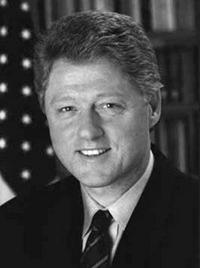 degenerated into “mudslinging” theatricals instead of a discussion of issues.

|
Из за большого объема этот материал размещен на нескольких страницах:
1 2 3 4 5 6 7 8 9 10 11 12 13 14 15 |
