

Партнерка на США и Канаду по недвижимости, выплаты в крипто
- 30% recurring commission
- Выплаты в USDT
- Вывод каждую неделю
- Комиссия до 5 лет за каждого referral
By the late 1950s tensions eased between the United States and the Soviet Union. This change came about after the death of Joseph Stalin in 1953. Soviet leaders who took over after him were more willing to work with Western leaders. In 1959, the new Soviet Premier, Nikita Khrushchev, visited the United States. He believed that the two nations had to try to live peacefully and suggested “peaceful co-existence.” Shortly after this visit, plans were made for a second summit conference in Paris in May 1960.
On May 1, 1960, a special American spy plane, called a U-2, was shot down by a Soviet missile. It had flown 1,200 miles (1,880 kilometers) inside the Soviet Union. The plane had been photographing Soviet military bases. At the Paris meeting on May 16, 1960, Khrushchev spoke out against the spying. He demanded that the United States stop such flights. He angrily accused Eisenhower of planning for war while talking peace. Khrushchev also called for an apology from Eisenhower and a postponement of the meeting, which then broke up. The end of the summit meeting showed that tensions between the United States and the Soviet Union were not over.
DISCUSSION
1. What is a cold war?
2. What did the “iron curtain” separate?
3. What was the objective of the Marshall Plan?
4. What was the result of struggle over Germany?
5. When was NATO established?
6. What countries became its members?
7. Why did the war in Korea break out?
8. How did China influence the result of the war?
9. Which side won the war between South and North Korea in 1953?
10. Why were both the United States and the Soviet Union interested in the Middle East?
11. Was Eisenhower popular as president? Which political party did he represent?
12. What is SEATO?
13. Why did Americans end diplomatic relations with Cuba?
14. How did American-Soviet relations change after the death of Joseph Stalin?
15. When did Nikita Khrushchev visit the USA?
PART II
THE NEW FRONTIER AND THE CIVIL CONFLICT
John F. Kennedy, Democratic candidate in the election of 1960, became the first Catholic and at 43 the youngest person ever to win the presidency. On television, in a series of debates with his opponent Richard Nixon, he appeared able, articulate and energetic. In his campaign, he spoke of moving into the new decade, toward a “New Frontier”. Throughout his brief presidency, Kennedy’s special combination of grace, wit and style sustained his popularity and influenced generations of politicians to come. Once he took office, Kennedy made clear his feelings about a President's role. Unlike Eisenhower, he felt a President should play an active part in meeting the country's needs. In his inaugural address, Kennedy told the American people: “Ask not what your country can do for you – ask what you can do for your country.”
Kennedy offered a program for government action which he called the New Frontier. Only a few of his plans were passed by the Congress while he was in office, however. The minimum wage was raised from $1.00 to $1.25 an hour over two years. More people were covered by social security. Kennedy also established Peace Corps to send men and women overseas to assist developing countries in meeting their needs.
One area in which Congress was very interested was the space program. Americans began to think more about outer space in 1957. That year the Soviet Union launched the first successful satellite – a small object circling a planet – to orbit the earth. It was called Sputnik I. This was a blow to the United States. It led many Americans to fear that the Soviet Union had more scientific knowledge than the United States. Because of this, the National Defense Education Act was passed in 1958. It gave colleges federal money for studies in science and languages. That same year, the National Aeronautics and Space Administration (NASA) was set up to direct the American space program. When President Kennedy took office, he announced that he wanted Americans to land a person on the moon before 1970. That goal was reached by Neil Armstrong and Edwin Aldrin in 1969. On July 20, Armstrong became the first human to step on the moon. As he did so, he said “That's one small step for a man, one giant leap for mankind.” Millions of people around the world watched the event on live television.
In the 1960s and 1970s, the US remained locked in bitter conflict with communist countries. Cuba became the battlefield in the Kennedy years. When Fidel Castro took over the government of Cuba in 1959, many Cubans fled to the United States. Some wanted to return to overthrow Castro. In March 1960, President Eisenhower told the CIA it could train and supply them for such an invasion. Later President Kennedy decided to go ahead with the plan. In April 1961, Cuban refugees began making air strikes against airfields in Cuba. On April 17, more than 1,000 of them landed at the Bay of Pigs, about 90 miles (144 kilometers) from Havana. They hoped the people of Cuba would rise up against Castro. When this did not happen, the invasion failed. This greatly embarrassed the United States and at the same time helped Castro. Some Latin Americans felt the United States had no right to interfere in Cuba's affairs. They spoke out against the United States.
After the Bay of Pigs, Cuba developed closer ties with the Soviet Union. The Soviet Union sent military advisors and supplies to the island and began to set up guided missile sites there. This alarmed President Kennedy and the American military. They felt that to have offensive missiles so close was a threat to the security of the United States. Kennedy warned that if Cuba became a military base for the Soviet Union, the United States would do "whatever must be done" to protect its security. After considering different options, Kennedy imposed a blockade on Cuba to prevent Soviet ships from bringing additional missiles. After several days of tension, during which the world was closer than ever before to nuclear war, the Soviet Union backed down. The two sides finally came to terms. The Soviet Union agreed to remove the missiles in return for the American promise not to invade Cuba.
In addition to the problems over Cuba, the United States and the Soviet Union still did not agree about postwar Germany. A month after the invasion at the Bay of Pigs, President Kennedy and Premier Khrushchev met in Vienna. Khrushchev told Kennedy that they should come to terms that year on a new government for Berlin. If not, the Soviet Union would sign a separate peace treaty with East Germany. Kennedy believed that the Soviet Union wanted to drive the Western powers out of Berlin. So he asked Congress for more money to buy weapons and equipment. In August, the East Germans, with Soviet support, built a fence to seal off the border between East and West Berlin. Then they replaced the fence with a concrete wall topped with barbed wire. President Kennedy's answer to this was to send more American troops to Berlin. When President Kennedy visited Berlin in 1963, he stood near the wall and told the people of West Berlin gathered there that the United States was prepared to defend their freedom.
The Berlin Wall and the Cuban missile crisis made it clear how far apart the United States and the Soviet Union were on many issues. This led many people to fear that the two powers might be heading for war. Such a war would most likely be a nuclear war. These people were strongly opposed to the A-bomb. They were worried about what nuclear testing was doing to the atmosphere. Many Americans began to favor efforts to stop the nuclear arms race.
On November 22, 1963, an event in Dallas, Texas, captured American attention and shocked the nation. President Kennedy was assassinated while riding in an open car during a visit to Dallas, Texas. Later, Lee Harvey Oswald was caught and accused of killing Kennedy. Before Oswald could be brought to trial, he was shot and killed by Jack Ruby, a Dallas nightclub owner. There was much debate about whether Oswald had acted alone or had been part of a conspiracy, or group plot, to kill the President. A special commission investigated the case and after much study it decided that Oswald had acted on his own. Over the years, doubts still remained, however.
During this period the USA was dominated by continued struggles for civil rights and justice. Black leaders felt that the people themselves would have to take action to end discrimination and denial of civil rights. An important turning point came in 1954, when the Supreme Court ruled on the case of Brown v. Board of Education of Topeka. The Court declared that segregation in the public schools denied black students equal protection under the Fourteenth Amendment and ordered that blacks should be allowed to attend any school. This order upset many whites, especially in the South where most public schools were segregated by law. Southern leaders tried many ways to prevent desegregation of the schools. In 1957, the Governor of Arkansas used the National Guard to keep black students from entering Central High School in Little Rock. President Eisenhower acted to back up the Court's order by sending federal troops to Little Rock.
Another turning point was the arrest of a woman named Rosa Parks in Montgomery, Alabama, on December 1, 1955, for refusing to give up her seat in the front of a bus in a section reserved by law and custom for whites. The National Association for the Advancement of Colored People (NAACP) helped to persuade a judge to release Mrs. Parks and planned a course of action to end segregation on buses. Led by a young clergyman Martin Luther King, Jr., blacks in Montgomery began to boycott the city's buses. This was costly for the bus company since most of their riders were blacks. The boycott went on for a year. Finally, in November 1956, the Supreme Court declared that segregation on public buses was unconstitutional. The Montgomery bus boycott showed that nonviolent direct action could produce results. It brought blacks from all walks of life together in an almost religious fellowship. And it produced a black leader – Martin Luther King, Jr., who could move millions to action and touch the conscience of the nation.
Moving on from Montgomery, King led direct nonviolent actions for civil rights in all parts of the country. In the spring of 1963, King went to Birmingham, Alabama, a city with a bad record of discrimination. Parks, eating places, drinking fountains and restrooms were segregated. King organized local blacks to march quietly and nonviolently through downtown areas of Birmingham. At first, the police arrested thousands of marchers. When that failed to stop the marches, the police attacked the demonstrators with clubs, dogs and firehoses. This caused such a public outcry against the white authorities of Birmingham that they had to back down and desegregate their public facilities.
A high point of the civil rights movement occurred on August 28, 1963 when 250,000 people of all races marched in Washington, DC, to demand that the nation keep its pledge of "justice for all". In a moving and dramatic speech, Martin Luther King said "I have a dream that one day on the red hills of Georgia the sons of former slaves and the sons of former slaveholders will be able to sit down together at the table of brotherhood. I have a dream that my four little children will one day live in a nation where they will not be judged by the color of their skin, but by the content of their character." In 1964 Martin Luther King, Jr., received the Nobel Peace Prize.
In 1964 the Civil Rights Act was passed and many Americans hoped that it would mark the beginning of a new age of racial harmony and friendship in the US. But soon they were disappointed as racial difficulties were too deep-rooted to be solved by simple alternations of the law, or by demonstrations and marches. Most black Americans were still worse housed, worse educated, and worse paid than other Americans. Some rejected with contempt the ideas of leaders like Martin Luther King that blacks and whites should learn to live in equality and friendship.
In August 1965, the streets of Watts, a black ghetto in Los Angeles, became a battlefield. For six days police and rioters fought among burning cars and buildings. Thirty four people were killed and over a thousand were injured. The Watts riot was followed by others – in Chicago, Detroit, New York and the autumn of 1966 the civil right movement was divided and in disarray.
In April 1968, Martin Luther King was murdered. He was shot dead in Memphis, Tennessee, by a white sniper. Many blacks now turned to the Black Power movement which taught that the only way for blacks to get justice was to fight for it.
The 1960s was a time of troubles and struggles. Between 1960 and 1970 the number of Americans aged 15 to 24 grew by 50 percent – from 24 million to 36 million. They were the product of the "baby boom" – born during and soon after World War II. This new generation was different. They were the first generation to have lived all their lives under the shadow of nuclear weapons. They were the first TV generation and had enjoyed almost continuous prosperity since their childhood. But at the same time they could see that all the wonderful things in American life still did not solve the ancient problems of justice and equality. And on TV they would see their young President assassinated, their cities smoldering in riots, their generation dying on the distant battlefield of Vietnam, and people starving in Africa and Asia. The world seemed confusing and frustrating as never before.
Different young people reacted in different ways. Some of them joined in the so-called "counterculture", which was opposed to the culture accepted by most Americans. They used drugs, they let their hair grow long, wore beads, fringe jackets, and long dresses. They wanted to look as different as possible from other Americans. They called themselves "hippies" (from the slang expression "hip", meaning knowledgeable, worldly-wise). Hippies often reacted to American life by "dropping out" – by refusing to be a part of it. Other young people organized in a New Left to transform America. Students organized many activities, especially sit-ins, to fight for civil rights.
The university became the center of opposition. Its members thought that by attacking the universities – their rules and regulations, their research contracts to help with the war in Vietnam, and their support of American society – they could make students radical, but their revolutionary aims were vague and negative. Soon colleges and universities were in disarray. Students were picketing, occupying buildings, shouting obscenities, and stopping all classes. They demanded “Student Power”. Across the country, people outside universities wondered what had happened to the American love of learning and the Jeffersonian tradition of free debate. Still, most students seemed less concerned with “revolution” than with the war in Vietnam. The New Left became more and more frustrated as the 1960s wore on.
DISCUSSION
1. Who won the presidential election of 1960?
2. What was the program for government John Kennedy initiated?
3. Was the US interested in development of space programs? What is NASA?
4. Who does the quotation “That's one small step for a man, one giant leap for mankind” belong to?
5. What do we learn from the text about American military operation at the Bay of Pigs in 1961?
6. Why did Cuban-Soviet relations worry Americans? Speak about the American blockade on Cuba.
7. Speak about the construction of the Berlin Wall.
8. How was President Kennedy assassinated?
9. Why is the case of Brown v. Board of Education of Topeka considered as the turning point in the civil rights movement?
10. What happened in Little Rock, Arkansas, in 1957? Why did the President send federal troops there?
11. Speak about the boycott of public transport in Montgomery, Alabama, in 1955.
12. What was Dr. Martin Luther King awarded the Nobel Peace Prize for?
13. When was the Civil Rights Act passed?
14. How did Baby Boomers differ from the previous generation?
15. How did American university life change in the 1960s?
PART III
THE VIETNAM WAR
When President Johnson took office, American foreign policy was still aimed at keeping communism from spreading. Because of this, the US became involved in many different parts of the world during the Johnson years. This put a great strain on American relations with other countries and on the unity of the American people.
American leaders believed it was necessary to stop the spread of communism in Southeast Asia and put forth the domino theory. It went like this: Asia had a lot of unsettled countries, if one of them fell to communism, the countries next to it would soon do the same. They were mostly interested in Vietnam which had been part of French Indochina. American involvement in Vietnam did not begin with President Johnson. When Communist and nationalist rebels fought French colonialism in Indochina after World War II, President Truman sent military aid to France. In 1954 the French were driven out by the soldiers of the communist leader Ho Chi Minh. Like Korea, Vietnam was then divided into two, Communists ruled the North and non-communists the South. The next step was supposed to be the election of one government for the whole country. But the election never took place, mainly because the government of South Vietnam feared that communists would win. Ho Chi Ming set out to unite Vietnam by war. Americans were especially afraid that communist China might try to take control in Southeast Asia as the Soviet Union had done in Eastern Europe. In the 1950s and early 1960s, the US poured money and weapons into South Vietnam. In 1955, the first American advisors were sent to South Vietnam to train their army.
In the early 1960s it was clear that the government of South Vietnam was losing the that time, a group of Vietnamese Communists called the Vietcong were well established in South Vietnam. They fought as guerrillas – bands who make war by harassment and sabotage. In August 1964, after an attack on American warships by North Vietnamese gunboats, President Johnson asked the Congress to allow him to take steps to prevent any future attacks. The Congress replied by passing the Gulf of Tonkin Resolution which allowed the President to use any measures necessary to halt an attack on American forces and to prevent further aggression. President Johnson launched air strikes against North Vietnamese naval bases. The first American combat soldiers were sent to Vietnam in March 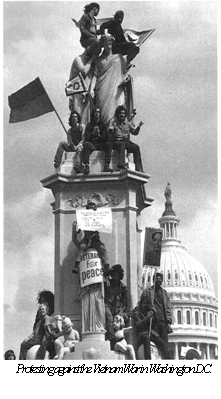 1,000 American troops had arrived. Meanwhile, the Air Force gradually stepped up raided against North Vietnam, first bombing military bases and routes, later hitting factories and power stations near Hanoi. The war was thought to be costing the US about $25 billion a year.
The Vietnam War was one of ambushes and sudden attacks. After an attack the Vietcong would melt away in the jungle, or turn into peaceful villagers. A guerilla war like this meant the Americans often had no enemy to strike back at. As one soldier put it, to find the Vietcong was “like trying to identify tears in a bucket of water”. American fighting men grew angry and frustrated. They spread vast areas of countryside with deadly chemicals to destroy the Vietcong’s supply trails and burned down villages which were suspected of sheltering Vietcong soldiers.
As the number of Americans wounded and killed in Vietnam grew, so did the number of Americans against the war. College students especially were against it. All over the country demonstrations took place. In 1967, more than 100,000 people took part in an antiwar parade in New York City. That same year, more than 50,000 paraded in San Francisco, and some 55,000 marched from the Lincoln Memorial to the Pentagon in Washington, D. C. The Vietnam War caused a split among the American people. Many felt the war was necessary to stop communism. Others felt that it was a civil war which should be settled by the Vietnamese. The Congress also divided between “hawks”, who favored greater military effort, and “doves”, who wanted the war effort to be lessened.
President Johnson saw that by sending American soldiers to fight in Vietnam he had led the US into a trap. The war was destroying his country’s good name in the world and setting its people against one another. In 1968 he stopped the bombing of North Vietnam and started to look for ways of making peace.
In 1969 Richard Nixon was elected to replace Johnson as President. He wanted to end the war in Vietnam without the Americans looking as if they had been beaten. Nixon worked out a plan he called “Vietnamization”. This was a program in which American troops would equip and train the South Vietnamese to take over the fighting so that Americans could withdraw.
The peace talks dragged on, and so did the war. In March 1970, matters grew worse, as a new leader of Cambodia asked President Nixon for aid against Communists in his country. Soon American forces went into Cambodia to attack Communist strongholds. This angered many Americans who were against the war. Huge demonstrations to protest the Cambodian invasion broke out at many American colleges.
Almost three years passed before the agreement was reached on the war. In January 1973 the US, South Vietnam, and North Vietnam and Vietcong finally came to terms. The North Vietnamese and Vietcong agreed to return all American prisoners of March 1973 the last American troops had left Vietnam. But the real end of Vietnam War came in May 1975, when victorious communist tanks rolled into Saigon, the capital city of South Vietnam. The Communists marked their victory by giving Saigon a new name – Ho Chi Minh City.
In Korea, twenty years earlier, the Americans had claimed they had containment work. In Vietnam they knew, and so did everyone else, that they had failed.
DISCUSSION
1. Why did the US become involved in many different parts of the world during the Johnson years?
2. What is the domino theory?
3. When did American involvement in Vietnam begin?
4. After France was driven out of the country, Vietnam was divided into two, wasn’t it?
5. Why did Americans fear the Chinese involvement in Vietnam?
6. When were first American advisors sent to South Vietnam?
7. What was the tactics of Vietcong?
8. What actions did President Johnson take after the Gulf Tonkin Resolution?
9. What was the approximate number of American troops in Vietnam in 1968?
10. Why did one American soldier say the fighting the Vietcong was “like trying to identify tears in a bucket of water”?
11. Did the Vietnam War split American society?
12. What was the objective of the program called Vietnamization?
13. How did many American people react to the news that American troops entered Cambodia?
14. When did the last American troops leave Vietnam?
15. Why did the Vietnamese give their capital a new name – Ho Chi Minh City?
MATCH THE TERMS WITH THEIR DEFINITIONS
1) New Frontier
2) NATO
3) human rights
4) cold war
5) antiwar movement
6) Berlin blockade
7) domino theory
8) Marshall Plan
9) guerilla warfare
10) Brown v. Board of Education
a) the political protest against US policy in Vietnam during the war years
b) the Russian blockade of the western- occupied section of Berlin
c) Supreme court decision that separate schools for black and white students were unconstitutional (1954)
d) hostility and sharp conflict between states, such as in diplomacy and economics, without actual warfare
e) the theory that a certain result will follow a certain cause like a row of dominoes falling if the first is pushed; specifically, the theory that if a nation becomes a communist state, the nations nearby will too
f) a type of combat in which rebels who specialize in sudden, hit-and-run attacks make surprise raids on their enemies
g) the rights and privileges of all human beings, including those stated in the Declaration of Independence and those guaranteed and protected by the Bill of Rights
h) the policies adopted by John F. Kennedy that included Madicare, federal aid to education, creation of a Department of Urban Affairs, a lowing of tariffs between the US and the European Common Market, and programs to help fight unemployment and pollution
i) the post-World War II plan for aid to European countries formulated by General George Marshall in 1947
j) an international organization, founded in 1949 as an alliance between the USA, Canada, and ten western European countries
SUPPLEMENTARY ACTIVITIES
1. Read the text about Abraham Lincoln and John Kennedy? Were there many similarities in the lives of two American presidents?
DOES HISTORY REPEAT ITSELF?
THE LINCOLN AND KENNEDY COINCIDENCES
This strange story is about a series of uncanny coincidences which link two of America's most popular presidents: Abraham Lincoln and John F. Kennedy.
Lincoln was elected to Congress in 1846, Kennedy was elected 100 years later, almost to the day in fact. After their deaths from assassination, both of these presidents were succeeded by Southerners with the surname Johnson. Lincoln was succeeded by Andrew Johnson, who was born in 1808, and Kennedy was succeeded by Lyndon Johnson, who was born in 1908. Both Johnsons have 13 letters in their names and both of them served in the US Senate.
Mary Lincoln and Jackie Kennedy both had children who died while their husbands were in the White House. Both Lincoln and Kennedy studied law. John Wilkes Booth and Lee Harvey Oswald both had fifteen letters in their names, and were both Southerners, were both in their 20s, and of course, both assassins were shot before they could stand trial. Kennedy had a secretary named Miss Lincoln, and Lincoln had a secretary named John Kennedy.
John Wilkes Booth shot Lincoln in a theatre and ran to a warehouse, and Oswald shot Kennedy from a warehouse and ran to a theatre. Stranger still, the car Kennedy was traveling in when he was shot was a Ford Lincoln. Lincoln was shot in Ford's Theatre.
Both assassinations took place on a Friday, and the two presidents were shot in the back of the head while their wives were at their side.
Kennedy and Lincoln were both historic civil rights campaigners who were heavily criticized while in office but were glorified after they died.
On the day of the assassinations Kennedy and Lincoln made strange prophetic statements. Hours before Lincoln was shot, he said to his personal guard, "If somebody wants to take my life, there is nothing I can do prevent it."
And hours before Kennedy went to Dallas in 1963, he said to his wife Jackie, "If somebody wants to shoot me from a window with a rifle, nobody can stop it, so why worry about it?"
And finally, both presidents were said to have been victims of a conspiracy. When Lincoln was shot, the telegraph lines out of Washington, D. C., remained silent for three hours on the orders of a high ranking official who has never been identified. It is thought this information blackout was arranged to give John Wilkes Booth – who was fleeing from the scene of the crime – a head start.
Tom Slemen
2. On August 28, 1963 Dr King helped lead a famous civil-rights march on Washington, D. C. that brought more than a quarter of a million people to the nation’s capital. Thousands of blacks and whites marched behind the black leaders. The march ended in front of the Lincoln Memorial, Dr King was the last speaker. It was here that he made his famous “I have a dream” speech, in which he told about the dream he had for his four children and all children. Read one of the most important speeches in American history.
I HAVE A DREAM
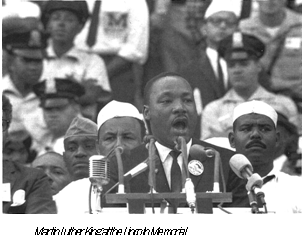 I am happy to join with you today in what will go down in history as the greatest demonstration for freedom in the history of our nation.
Five score years ago, a great American, in whose symbolic shadow we stand today, signed the Emancipation Proclamation. This momentous decree came as a great beacon light of hope to millions of Negro slaves who had been seared in the flames of withering injustice. It came as a joyous daybreak to end the long night of their captivity.
But one hundred years later, the Negro still is not free. One hundred years later, the life of the Negro is still sadly crippled by the manacles of segregation and the chains of discrimination. One hundred years later, the Negro lives on a lonely island of poverty in the midst of a vast ocean of material prosperity. One hundred years later, the Negro is still languished in the corners of American society and finds himself an exile in his own land.
So we've come here today to dramatize a shameful condition. In a sense we've come to our nation's capital to cash a check. When the architects of our republic wrote the magnificent words of the Constitution and the Declaration of Independence, they were signing a promissory note to which every American was to fall heir. This note was a promise that all men, yes, black men as well as white men, would be guaranteed the "unalienable Rights" of "Life, Liberty, and the pursuit of Happiness."
It is obvious today that America has defaulted on this promissory note, insofar as her citizens of color are concerned. Instead of honoring this sacred obligation, America has given the Negro people a bad check, a check which has come back marked “insufficient funds”. We refuse to believe that the bank of justice is bankrupt. We refuse to believe that there are insufficient funds in the great vaults of opportunity of this nation. And so, we've come to cash this check, a check that will give us upon demand the riches of freedom and the security of justice.
We have also come to this hallowed spot to remind America of the fierce urgency of Now. This is no time to engage in the luxury of cooling off or to take the tranquilizing drug of gradualism. Now is the time to make real the promises of democracy. Now is the time to rise from the dark and desolate valley of segregation to the sunlit path of racial justice. Now is the time to lift our nation from the quicksands of racial injustice to the solid rock of brotherhood. Now is the time to make justice a reality for all of God's children. It would be fatal for the nation to overlook the urgency of the moment. This sweltering summer of the Negro's legitimate discontent will not pass until there is an invigorating autumn of freedom and equality.
Nineteen sixty-three is not an end, but a beginning. And those who hope that the Negro needed to blow off steam and will now be content will have a rude awakening if the nation returns to business as usual.
There will be neither rest nor tranquility in America until the Negro is granted his citizenship rights. The whirlwinds of revolt will continue to shake the foundations of our nation until the bright day of justice emerges.
But there is something that I must say to my people, who stand on the warm threshold which leads into the palace of justice: in the process of gaining our rightful place, we must not be guilty of wrongful deeds.
Let us not seek to satisfy our thirst for freedom by drinking from the cup of bitterness and hatred. We must forever conduct our struggle on the high plane of dignity and discipline. We must not allow our creative protest to degenerate into physical violence. Again and again, we must rise to the majestic heights of meeting physical force with soul force.
The marvelous new militancy which has engulfed the Negro community must not lead us to a distrust of all white people, for many of our white brothers, as evidenced by their presence here today, have come to realize that their destiny is tied up with our destiny and they have come to realize that their freedom is inextricably bound to our freedom. This offense we share mounted to storm the battlements of injustice must be carried forth by a biracial army. We cannot walk alone.
And as we walk, we must make the pledge that we shall always march ahead. We cannot turn back. There are those who are asking the devotees of civil rights, "When will you be satisfied?" We can never be satisfied as long as the Negro is the victim of the unspeakable horrors of police brutality.
We can never be satisfied as long as our bodies, heavy with the fatigue of travel, cannot gain lodging in the motels of the highways and the hotels of the cities. We cannot be satisfied as long as the Negro's basic mobility is from a smaller ghetto to a larger one.
We can never be satisfied as long as our children are stripped of their self-hood and robbed of their dignity by a sign stating "for whites only." We cannot be satisfied as long as a Negro in Mississippi cannot vote and a Negro in New York believes he has nothing for which to vote. No. We are not satisfied, and we will not be satisfied until justice rolls down like waters, and righteousness like a mighty stream.
I am not unmindful that some of you have come here out of great trials and tribulations. Some of you have come fresh from narrow jail cells. And some of you have come from areas where your quest – quest for freedom left you battered by the storms of persecution and staggered by the winds of police brutality. You have been the veterans of creative suffering. Continue to work with the faith that unearned suffering is redemptive.
Go back to Mississippi; go back to Alabama; go back to South Carolina; go back to Georgia; go back to Louisiana; go back to the slums and ghettos of our northern cities, knowing that somehow this situation can and will be changed. Let us not wallow in the valley of despair.
So I say to you today, my friends that even though we must face the difficulties of today and tomorrow, I still have a dream. It is a dream deeply rooted in the American dream that one day this nation will rise up and live out the true meaning of its creed - we hold these truths to be self-evident, that all men are created equal.
I have a dream that one day this nation will rise up and live out the true meaning of its creed: "We hold these truths to be self-evident, that all men are created equal."
I have a dream that one day on the red hills of Georgia, the sons of former slaves and the sons of former slave owners will be able to sit down together at the table of brotherhood.
I have a dream that one day even the state of Mississippi, a state sweltering with the heat of injustice, sweltering with the heat of oppression, will be transformed into an oasis of freedom and justice.
I have a dream that my four little children will one day live in a nation where they will not be judged by the color of their skin but by the content of their character. I have a dream today!

|
Из за большого объема этот материал размещен на нескольких страницах:
1 2 3 4 5 6 7 8 9 10 11 12 13 14 15 |
