

Партнерка на США и Канаду по недвижимости, выплаты в крипто
- 30% recurring commission
- Выплаты в USDT
- Вывод каждую неделю
- Комиссия до 5 лет за каждого referral
to ban, to laws against smth., to be let into the country, to give a quota, to reduce immigration, to mark the end of smth.
6. Many factors contributed to the dramatic industrial growth of the nation. abundance of raw materials, energy sources, supply of labor, technological inventiveness, large-scale production, new forms of business organization, to promote national growth
7. The abundance of natural resources encouraged the growth of American industry.
vast deposits of smth., to discover, iron ore, one of the largest producers of smth., rich source of smth.
8. “Yankee ingenuity” also helped business to grow.
to find practical solutions to practical problems, to appear at a dizzying pace, to be introduced, to make major improvements on smth., to make a contribution, important source of power
9. John D. Rockefeller was the king of the growing oil industry.
to set up a refinery, to cut costs, to make deals with smb., lower rates, to compete, to drive out of business, the leading symbol of monopoly
10. Andrew Carnegie and Gustavus “captains of industry”.
far-sighted investments, to control the industry, to sell smth. for less, to compete, to cut the costs, to ship, meat-packing company, slaughter house, storage center, refrigerator car
UNIT 8
PART I
THE AMERICAN EMPIRE
Until the 1880's and 1890's the American people paid attention mostly to what was going on at home and showed little interest in other lands. With the exception of the purchase of Alaska from Russia in 1867, American territorial expansion had come to a virtual standstill in 1848, when the USA gained control of California and the Southwest in the Mexican War. But by the end of the 1800's Americans were looking overseas. As many European nations were expanding their colonial empires, a new spirit entered American foreign policy. Some Americans were eager to build an empire to sell their goods around the world. Others had money they wanted to invest in factories, railroads, mines, and farms in other lands. Others believed it was their duty to bring Christianity to the people of other parts of the world. Politicians, businessmen, newspapers and missionaries joined together to claim that “the Anglo-Saxon race” – by which they meant Americans and North Europeans – had a right and duty to bring western civilization to the peoples of Asia, Africa and Latin America.
American and European interests turned to the islands of the Pacific. The United States and European countries hoped to set up bases there for their warships. The Americans also wanted to use certain islands as stopovers where steamships would take on coal for the long voyage from the United States to Asia and Australia. From 1895 onwards, much of Americans’ attention was focused upon Cuba, which lay only 90 miles from the American the late 1800's, Cuba and Puerto Rico were all that was left of the Spanish empire in the Western Hemisphere. Many Americans had investments in Cuba and followed events there closely. The Cubans, eager to be independent, had revolted in 1868. The war went on for ten years before the Spaniards won it. In 1895 the Cubans revolted again. The rebels raided and burned villages, sugar plantations and railroad depots. The Spanish in Cuba made all Cubans who lived in the countryside move to certain towns, which they could not leave. Conditions in these towns were terrible. As many as 200,000 Cubans died from disease and starvation. Most Americans sympathized with the Cuban rebels. The newspaper reports about such conditions shocked many Americans and turned them more against the Spaniards.
The United States had by now built a modern navy, and in January 1898 the battleship Maine was sent to Havana as demonstration of American power. On February 15, a mysterious explosion sank the Maine in Havana harbor. More than 250 crew members died. It is not clear who or what caused the disaster, but American newspaper headlines and many American politicians blamed the Spaniards. The cry "Remember the Maine" was heard everywhere. The US demanded that Spain withdraw from Cuba and started mobilizing volunteer troops. On April 24, 1898 Spain responded by declaring war on the United States.
The Spanish-American War was fought in two parts of the world. One was Cuba, the other was the Philippines. The Philippines was another big Spanish colony near the coast of Southeast Asia. It was said that President McKinley had to search a globe to find out exactly where it was. But he saw that the island would be useful for the United States to control. From bases in the Philippines American soldiers and sailors would be able to protect the growing number of American traders in China.
The first battle of the Spanish-American War was fought in the Philippines. American warships sank a Spanish fleet that was anchored there. A few weeks later American soldiers occupied Manila, the chief city in the Philippines, and Spanish resistance came to an end.
American soldiers also landed in Cuba. In less than two weeks of fighting, the Spanish were again defeated. Other American soldiers occupied Puerto Rico, another Spanish-owned island close to Cuba. In July the Spanish government saw it was beaten. When peace was signed, Spain gave most of its overseas empire to the United States – Cuba, the Philippines, Puerto Rico and a small Pacific island called Guam. At the same time the US also annexed Hawaii, a group of islands in the middle of the Pacific Ocean. Before this, it had been independent, but Americans owned profitable sugar and pineapple plantations there.
The Spanish-American War greatly changed the position of the United States in foreign affairs. In less than a year, the United States had become a colonial power with millions of non-Americans under its rule. Some Americans were worried by this. After all, they too had once been a colonial people. In rebelling against British rule they claimed that colonial peoples should be free to rule themselves. The principle of self-determination was written in the Declaration of Independence. Filipinos who had fought for independence from Spain were soon fighting against American occupation troops. How could Americans fight against such people without being unfaithful to the most important traditions and values of their own country? Most Americans answered this question by claiming that they were preparing undeveloped nations for civilization and democracy. They built schools and hospitals, constructed roads, provided pure water supplies and put an end to killer diseases like malaria and yellow fever in the lands they now ruled. They continued to rule most of them until the middle years of the century. The Philippines became independent in 1946. In 1953 Puerto Rico became a self-governing commonwealth within the United States. In 1959 Hawaii was admitted as the 50th state of the Union.
Cuba was treated differently. American troops left it in 1902, but the new republic was required to grant naval bases to the United States. The Cubans also had to accept a condition called the Platt Amendment, this said that the USA could sent troops to take control of Cuba any time it believed that American interest were in danger. And it happened many times. In 1906, for example, President Roosevelt set up an American military government in Cuba to stop the revolution. In 1912, 1917 and 1921 American marines were again sent to stop revolution in Cuba. So for years Cuba’s independence was just a pretense.
During the Spanish-American War, the Americans found out how useful it would be to have a canal that cut across Central America, joining the Caribbean with the Pacific Ocean. Such a canal would allow navy ships to go from the Atlantic to the Pacific without going all the way around South America. With naval bases in Cuba and other Caribbean islands, the United States felt it could protect a canal in Central America. At the time, Panama was part of Colombia. The United States wanted a treaty with Colombia to build the canal. They also wanted Colombia to give it a strip of land along both sides of the canal. The US offered Colombia $10 million. But the Colombian government thought the price was too low, they also feared that if they gave up a strip of land along the canal route, they might lose control over Panama. In November 1903, a group of people in Panama who wanted the United States to build the canal staged a revolt. American warships were sent to the area by President Roosevelt. They kept Colombian soldiers from landing in Panama and stopping the revolt. The Republic of Panama was declared and was recognized by the United States. Panama and the United States signed the treaty that gave the United States the right to build a canal for $10 million. It also gave the United States a lease on a strip of land ten miles (16 kilometers) wide along the canal route. The treaty gave the United States sole control of the canal area "forever." The way was clear for the Americans to build their canal and in 1904 they began digging. The canal opened in 1914. Although it was under the control of the United States, ships of all countries were allowed to use it.
Getting the right to build the Panama Canal was part of President Roosevelt's big stick diplomacy. Roosevelt liked to quote a West African saying: "Speak softly, and carry a big stick, you will go far." The saying was applied to his foreign policy. Roosevelt believed that the United States should be willing to use force (a "big stick") to protect American interests.
In March 1909, William Howard Taft took office as President. He went along with Roosevelt's policy of bringing the United States into the affairs of other countries to protect American interests. He did, however, change the policy in some ways. He encouraged American business people to invest more in areas that were strategically important to the United States, such as Latin America. To prevent European control in Latin America, President Taft wanted American banks to guarantee the debts of Latin American countries. Taft's foreign policy was called dollar diplomacy. He tried to use it both in Latin America and in China. It also put Americans in key economic positions in other countries. In this way, Americans would have a say in other countries without using force.
American firms which established themselves in other countries often received a mixed welcome. Their critics accused them of using their economic power to influence foreign governments to follow policies that serve the interests of the US rather than those of the country in which they are working. But foreign leaders often welcomed American investment as a way of obtaining new jobs and technology, and so of improving their country’s living standards.
DISCUSSION
1. Why did many Americans think that they should build an empire in the late 19th century?
2. Why did both American and European interests turn to the Pacific islands?
3. How did Spanish rulers treat Cubans?
4. What happened to the Maine warship?
5. When did Spain declare war on the US? What was the reason for it?
6. How did Spanish rule in the Pacific come to an end?
7. What were the provisions of Peace treaty between Spain and the United States?
8. Why did many Americans see the rule of their country over other as the betrayal of American values?
9. How did the US gain control of the area for building the Panama Canal?
10. What is “Dollar diplomacy”?
PART II
AMERICA IN WORLD WAR I
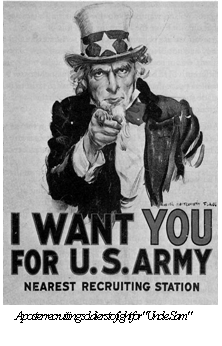 In August 1914 World War I started in Europe. It was the beginning of a struggle that lasted for more than 4 years, brought death to millions of people and changed the history of the world. The main countries fighting in World War I were, on one side, France, Great Britain and Russia, known as the Allies. On the other side the main countries were Germany and Austria, who were called the Central powers.
At first the war was fought only in Europe, but it soon spread all over the world. The United States found it had to decide whether or not to join the fighting. When President Wilson said that they should be “impartial in thought as well as in action”, that was hard for many people to do. In the first days of the war the German government sent its armies marching into neutral Belgium. Americans were shocked when newspapers printed reports (often false or exaggerated) of German cruelty towards Belgian civilians. There was much support in the United States for the Allies. Many Americans of British background sided with Great Britain. Other Americans reminded the people of the close ties between the United States and France since the American Revolution. At the same time, many Americans of German heritage sided with Germany. They felt it had been forced into the war by Russia and France. Still other Americans of Irish background did not like the British and were against American aid to Great Britain. And those Americans who had come from Austria-Hungary and the Balkan countries most often supported their former homelands.
As the war went on, the countries fighting in it found they needed more food and clothing than they could make. They turned to the United States for these and other goods. This led to a sharp rise in American production of wheat, cotton, minerals, food, and munitions, or war materials. Because the United States was neutral, it had the right under international law to trade everything but weapons and other munitions with whomever it wanted. But the British navy blockaded the Central Powers, which cut off much of the American trade with them. As a result, most of the American trade was with the Allies. War loans were another link between the United States and the Allies. In September 1915 President Wilson agreed to allow Americans to make private loans to the countries at April 1917 $2.3 billion had been loaned to the Allies and only $20 million to the Central Powers.
German leaders were determined to stop the flow of armaments to their enemies. They announced in February 1915, that the water around the British Isles was a war zone. All enemy ships that entered the area would be sunk on sight. On May 7, 1915, a big British passenger ship called the Lusitania was hit by a torpedo from a German submarine. As the ship sank, nearly 1,200 people died, 128 of them were Americans. People in the United States were shocked and angered by the sinking. They paid no attention to the German charge that the Lusitania was carrying arms and munitions. President Wilson reacted by sending a strong protest. For a time the Germans stopped the submarine attacks.
In autumn 1916 American voters reelected Wilson as president, mainly because he had kept them out of the war. After the election, Wilson tried to get the Allied Powers and the Central Powers to talk about peace. He appealed to the fighting nations to settle their differences and to make “a peace without victory”. But his efforts failed because each side was sure it was going to win the war before long.
As pressure in the United States grew, Wilson and the Congress tried to keep the country neutral. Then in March 1917, the Germans sank five American merchant ships. This again violated international law. On April 2, 1917, President Wilson asked the Congress for a declaration of war on Germany. On December 7, 1917 the United States also declared a war on Austria-Hungary. Wilson’s aim was not simply to defeat the enemies. He saw the war as a great crusade to ensure the future peace of the world.
The war that the US entered in 1917 was different from any war in which Americans had fought in the past. Such weapons as machine guns, huge cannons, poison gas, and airplanes that carried bombs were being used in greater numbers than ever before. Battles were fought by thousands of soldiers at one time. People and industries had to organize to supply American soldiers fighting in Europe.
Thousands of Americans left their jobs to join the military. Large numbers of people began to leave their homes in one part of the country to seek better jobs. When the war was declared, the American army was a small force of 200,000 soldiers. Millions of men had to be drafted, trained, equipped and shipped across the ocean to Europe. In June 1917, the first American soldiers arrived in France. Called the American Expeditionary Force, they were led by General John Pershing. At first, Americans were used only in small units and as replacements for some French and British soldiers. In the spring of 1918, the Germans launched a last desperate offensive, hoping to reach Paris before the American army was ready to fight. But a few American divisions were available to assist the French and the British in repelling the autumn, Germany’s position was hopeless. The German armies were driven back towards their own frontiers. In October the German government asked for peace. On November 11, 1918, Germans and Allied leaders signed an armistice, an agreement to stop fighting.
President Wilson always insisted that the United States was fighting World War I not against the German people but against their warlike leaders. In January 1918, long before the war was over, he outlined his ideas for a just and lasting peace in a speech to the US Senate. These ideas were called the Fourteen Points. Among other things, the Fourteen Points called for open diplomacy, freedom of the seas, free international trade, disarmament and a just settlement of colonial disputes. The map of Europe would be redrawn to establish independent states for every national group, and the League of Nations would be organized to protect the peace. A great many Americans believed Wilson's plan was a good one. The German government agreed with them. The Germans thought the Fourteen Points would serve as the base for the final peace treaty.
On November 18, 1918, President Wilson announced that he and his advisors planned to go to Paris. There they would take part in the conference that would prepare the treaty ending the war. In Paris, Wilson met the leaders of the three major Allied powers. They made it clear that they had come to punish Germany. They refused to accept Wilson's Fourteen Points as the base for peace. Despite Wilson’s protests, the Allies imposed crushing reparations on Germany and divided its colonies among themselves. After much talk, however, they agreed to make Wilson's League of Nations a part of the final treaty. The Treaty of Versailles was signed on June 28, 1919.
Though Wilson succeeded in establishing the League of Nations, many Americans feared that such a world organization might drag the US into another foreign war. They thought this would upset American foreign policy. Many Senators were angry because President Wilson had not talked to Senate leaders before the treaty was drawn up. They wanted some changes made in the treaty. President Wilson refused. After another trip to Europe he returned to America, tired and ill. But he boarded a special train and set off on a speaking tour of the western US to plead for the League. The tour was never completed. On September 25, 1919, the exhausted Wilson suffered a severe stroke from which he never fully recovered. In March 1920 the Senate voted against the United States joining the League of Nations, and the idea was dropped. As a result, the League of Nations, without the presence of the United States or Russia, remained a weak organization.
World War I marked the end of the United States staying out of affairs in Europe. But the final results of the war upset many Americans. They had gone to war with high ideals, hoping to make the world a better place in which to live. But the peace treaty showed them that the warring nations had not changed their ways. Because of this, Americans wanted to turn again toward a policy of noninvolvement.
DISCUSSION
1. What were the main countries fighting in World War I?
2. Why was it difficult for Americans to remain neutral during the war?
3. What helped the US increase its production of wheat, cotton, food, etc. during the war period?
4. Why did the US enter World War I on the side of the Allies?
5. How did World War I differ from all the wars Americans had fought before?
6. When did first American troops arrive in Europe?
7. When was the armistice between Germany and the Allies signed?
8. What were the ideas expressed by President Wilson in the Fourteen Points?
9. Why did the leaders of the Allied powers refuse to take Wilson’s Fourteen points as the base for the Treaty of Versailles?
10. Did Americans support Wilson’s idea of establishing the League of Nations?
PART III
AMERICA IN THE 1920-S
World War I brought about many changes in American ways of thinking and ways of life. The majority of Americans did not mourn the defeated treaty as they had grown disillusioned with the results of the war. After 1920, the US turned inward and withdrew from European affairs. It also made some Americans suspicious of and hostile toward foreigners. Part of the intolerance of the 1920s grew out of a fear of communism. In 1919, a series of terrorist bombing produced what became known as the “Red Scare”. People who criticized the way American society was organized risked being accused of disloyalty. Under the authority of Attorney General A. Mitchell Palmer, raids of political meetings were conducted, arrests were made and about 500 foreign-born political radicals – anarchists, socialists and communists – were deported, although most of them were innocent of any crime. Other groups such as Jews, Catholics and blacks also were the targets of prejudice in the 1920s. The Ku Klux Klan, revived in 1915, attracted millions of followers.
The growth of intolerance and fear led to a new immigration policy. In 1921, the Congress passed a law which set up a quota for people who wanted to move to the United States. It limited the number of new immigrants from any country to 3 percent of the number from that country who had been living in the United States in 1910. These restrictions favored immigrants from Britain, Ireland, Scandinavia, and Germany. Small quotas were reserved for eastern and southern Europeans, none at all for Asians.
For many Americans, the 1920s became years of prosperity. The end of the war brought an end to government restrictions on business. It also brought a move away from regulations such as those of the Progressive Era. Business people pushed hard for free enterprise. They worked mostly through the Republican Party. All three Presidents who held office in the 1920s were Republicans and supported the ideas of the business leaders.
In the election of 1920, the Republican Party nominated Warren G. Harding for president. He promised the voters a return to “normalcy” and won a landslide victory. After years of reform, high taxes and war the majority of Americans voted for a candidate who seemed to embody old-fashioned American values. This election was also the first in which women throughout the nation voted for a presidential candidate. In 1920 the Congress passed and the states ratified the Nineteenth Amendment which gave women that right.
Harding stated that there should be “less government in business, and more business in government”. He was a well-liked president, but on August 2, 1923 while returning from the trip Harding died in San Francisco. Upon his death, Vice-President Calvin Coolidge became President. Coolidge was liked by business people and the Republican Party. When he ran for presidency in 1924, he won the election. Coolidge believed in thrift, hard work and honesty and was known as a man of few words. Business did well under Coolidge and the newspapers spoke of “Coolidge Prosperity”. He believed that “the chief business of the American people is business” and government should not interfere with private enterprise. Although Coolidge was an immensely popular president he decided not to run for the 1928 election, so Americans voted for another Republican Herbert Hoover who promised them “a chicken in every pot and two cars in every garage”.
The United States was very rich in the 1920s. More goods were produced than in any other time before in the country’s history. A major fact in the boom was the growth of new industries. One of the most important of these was the automobile 1930 3 million Americans were making or selling automobiles. There were 23 million cars and 4 million trucks and buses in the USA. Another industry that grew in the 1920s was aviation, or air transportation.
Other factors also helped bring about a boom economy. The United States was now a consumer society with a booming market for electric appliances (radios, washing machines, refrigerators, ovens, vacuum cleaners, etc.), synthetic textiles and plastics. To make enough electricity to meet the needs of all these new goods, the electric power industry grew greatly.
The United States became the first nation in history to build its way of life in selling vast quantities of goods that gave ordinary people easier and more enjoyable lives. Many Americans bought cars, radios and other new products, often they obtained these goods by paying a small deposit and agreeing to pay the rest of the cost through an “installment plan”. Their motto was “Live now, pay tomorrow”. Business leaders wanted more people to buy more goods and advertising became another factor in the growth of industry in the 1920s.
The businessman became a popular hero. One of the most admired men of the decade was Henry Ford, who had introduced the assembly line into automobile production. Ford was able to pay high wages and still earn enormous profits by manufacturing the Model T – a simple basic car that millions of buyers could afford. “The man who builds a factory builds a temple,” said Calvin Coolidge. “The man who works there worships there.”
To help businessmen the Congress placed high import taxes on goods from abroad. The aim was to make imported goods more expensive, so that American manufacturer would have less competition from foreign rivals. At the same time the Congress reduced taxes on high incomes and company profits. This gave rich men more money to invest.
Some parts of the economy did not do as well as other however. Farmers had produced large quantities of food during World War 1921, however, the countries of Europe no longer needed so much American food. This caused problems for farmers who found themselves growing products they could not 1, 000 of them were bankrupt.
Business fared well in the 1920s but the labor unions did not. Because workers were badly needed for the war effort during World War I, the government had backed their efforts to organize. Wages rose, and the number of workers in the AFL (the American Federation of Labor) grew from 2 million to 4 million. Once the war was over, businesses wanted to hold costs down. But 1919 there was serious trouble between business and labor. That year nearly 4 million workers took part in strikes or work-stoppages.
The 1920s was a time of sharp contrasts. This could be seen in the different life styles of the American people. Many Americans did not accept the new ideas, and their lives went on much as before. Other welcomed the chance for a change to a less-ordered life. Many women worked outside the home, went to college, and entered professions. More Americans seemed to be doing things for fun. Stunts performed in automobiles and airplanes drew a lot of attention. Hollywood movies filled the cinema screens of the world. They showed people a world that was more exciting than their own. A new kind of music called jazz became popular. It had syncopated rhythms and developed from ragtime and blues music. However many Americans did not follow the new styles of living. People who lived in rural areas still felt that hard work, thrift and religion were the best American values. Many were shocked by the changes in the manners, morals and fashion of American youth, especially on college campuses.
Both the excitement and the problems of the changing times could be seen in the literature of the 1920s. Many authors such as Ernest Hemingway, F. Scott Fitzgerald, and Sinclair Lewis who wrote about the sadness of modern life, the carefree lives of the young and the wealthy, criticized people’s dullness and their narrow views. Many intellectuals of that time were dissatisfied with the materialism and the spiritual emptiness of life.
The 1920s also brought a change in attitudes and laws about drinking alcohol. The Eighteenth Amendment (1919) prohibited the manufacture, transportation and sale of alcoholic beverages. People who supported Prohibition claimed that it would stop alcoholism and drunkenness and make the US a healthier and happier country. But many Americans were not willing to give up alcoholic drinks. Millions began to break the prohibition law, making beer and liquor at home or smuggling it into the United States from Canada and Mexico. Disregard of Prohibition was universal, even President Harding drank in the White House. Illegal drinking places called “speakeasies” opened in basements and backrooms all over the country. Speakeasies obtained their alcohol drinks from bootleggers. Bootleggers worked together in gangs, the best known gang was one in Chicago led by the gangster Al Capone. Gangsters fought with one another for control. Much of the profit they made was used to help them take over other kinds of businesses. Gangsters used their wealth to bribe police and other public officials. Al Capone became the real ruler of Chicago. He had a private army of nearly a thousand thugs equipped with machine guns. His income was over 100 million dollars a year.
By the end of the 1920s, most Americans regarded Prohibition as half scandal, half joke. The dishonesty and corruption made them lose their respect both for the law and for the people who were supposed to enforce it. Prohibition was finally given up in 1933, but it had done the United States lasting harm.
The 1920s in the United States are called the Jazz Age because of the popularity of jazz music or the Roaring Twenties because of the exuberant, freewheeling culture of the decade. It is no exaggeration to say that the 1920s formed modern America in many ways, particularly in the field of culture.
DISCUSSION
1. How did the attitude towards foreigners change after World War I? Did it influence American immigration policy?
2. What is the “Red Scare”?
3. Which of the political parties did all the 1920s Presidents represent?
4. What branches industry got rapid development in the 1920s?
5. What was the motto of many consumers in the 1920s?
6. How did the situation in American farming industry change after World War I?
7. Did all Americans accept the new ideas and the new life styles of the Roaring Twenties?
8. What is the Prohibition?
9. Did it bring more good or harm to American Society?
10. Why is this decade often referred to as the Jazz Age or the Roaring Twenties?
UNIT 9
PART I
THE GREAT DEPRESSION AND THE NEW DEAL
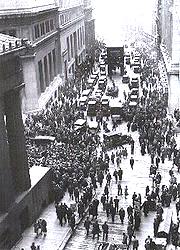 The economic boom in the United States came to an end in 1929. That year a depression set in, which lasted through the 1930s. The worst economic collapse in American history, it hurt a great many Americans. For this reason, it caused many people to change their ideas about the government and the economy. Long after the 1930s, the changes which took place during the depression still were influencing the American people and the government. Because it affected the country so much, the depression which started in 1929 is called the “Great Depression”. At first Americans hoped that the depression would last only a short time. But they found they were wrong, as millions of people lost their jobs. The confidence and hope of the 1920s were replaced by worry and despair.
The Great Depression did not happen overnight. The problems which led to it began in the early 1920s. One problem had to do with American farmers. In the years after World War I farmers did not do well. They were producing more crops and other farm products than could be sold at high prices. So prices were low and farmers made little profit. Since they made little money, they could not afford to buy new farm machinery or other manufactured goods.
Another problem was that the greatest prosperity of the 1920s went to a small number of Americans who already were wealthy. The pay of industrial workers did not grow as much as they hoped. Like the farmers, these workers could not buy many new goods. Finally, low wages resulted in underconsumption. Factories were making more than could be sold. Some industries, like coal, railroads, construction, and textiles, were in distress long before 1929.
Because many people did not have enough cash to buy the big things they needed or wanted, they began to use the installment plan. They bought goods on credit and made payments each month. This helped to keep the economy going. At the same time, however, it helped hide some problems. People sometimes bought things only to find later that they could not afford to make the monthly payments.
Because they were so sure of the economy during the 1920s, many people bought stocks of different companies. Some of the buyers were speculators. Stockbrokers – people who sell stocks – encouraged this kind of buying by allowing people to buy stocks “on margin”. This meant that people could buy stocks without paying the full amount of the purchase price. They paid 10 percent of the price and thought of the rest as a loan to be paid off later. If the company did well, the price of the stock went up, and then the buyer could sell it at a profit and pay off the loan. More and more Americans were eager to get some of this easy 1929 buying and selling stocks – “playing the market” – had become almost a national hobby, prices went up and up. Yet some people began to have the autumn of 1929 the profits of many American companies had been decreasing for some time. If profits were falling, thought more cautious investors, then stock prices, too, would soon fall. Slowly people began to sell their stocks. Day by day their numbers grew and soon so many people were selling stocks that prices did start to fall. On Thursday, October 24, 1929 – Black Thursday – 13 million stocks were sold. On the following Tuesday, October, 29 – Terrifying Tuesday – 16.5 million were sold. The stock market had “crashed”. This collapse of American stock prices was known as the Wall Street Crash that marked the end of the prosperity of the 1920s.
What happened in the stock market had an effect on other areas of the economy. Banks that had invested in the stock market lost a great deal of money. With limited funds many banks could not make loans, which led to less available credit. Since most people no longer could get credit, they bought less than before. Because fewer goods were sold, industries began to produce less. It was also because Americans lost their foreign markets. In the 1920s American goods had sold well overseas, especially in Europe. But countries such as Britain and Germany had not prospered after the war and they had often paid for their purchases with money borrowed from American banks. After the Crash the banks wanted their money back. European buyers became short of cash and American overseas sales dried up almost completely. Goods piled up unsold in factory ware houses and companies reduced production. Before long fewer workers were needed, and people began to lose their jobs.

|
Из за большого объема этот материал размещен на нескольких страницах:
1 2 3 4 5 6 7 8 9 10 11 12 13 14 15 |
