

Партнерка на США и Канаду по недвижимости, выплаты в крипто
- 30% recurring commission
- Выплаты в USDT
- Вывод каждую неделю
- Комиссия до 5 лет за каждого referral
Time proved this to be a (11) … … . The Bill of Rights gave the Constitution a special strength. Many Americans consider the Bill of Rights to be the heart and spirit of the Constitution.
VOICE ONE:
What is this Bill of Rights that is so important to the citizens of the United States? It is contained in the first ten (12) … to the Constitution.
The First Amendment is the basic statement of American freedoms. It protects freedom of religion, freedom of speech and freedom of the press.
The First Amendment guarantees that religion and government will be separate in America. It says Congress will make no law establishing an official religion. Nor will Congress interfere in the peoples’ right to worship as they choose. The First Amendment also says Congress will not make laws restricting the peoples’ right to gather peacefully and to make demands on the government.
The Second Amendment guarantees the peoples’ right to keep weapons as part of an organized militia. The Third Amendment says people may not be forced to let soldiers stay in their homes during peacetime.
VOICE TWO:
The Fourth through the Eighth Amendments all (13) … … … in the criminal justice system.
The Fourth Amendment protects people from unreasonable searches and seizures. If police want to search a suspect’s house or papers, they must get special permission from a judge. The document from the judge must say exactly what police are looking for. And it must describe the place to be searched.
VOICE ONE:
The Fifth Amendment says no one can be (14) … … … for a serious crime unless a grand jury has first examined the evidence and agreed that a trial is needed. No one can be put on trial more than once on the same criminal charge. And no one can be forced to give evidence against himself in court.
The Fifth Amendment also says no one can lose their freedom, property, or life except by the rules of law. And the government cannot take people’s property for public use without paying them a fair price.
VOICE TWO:
The Sixth Amendment says all persons accused of crimes have the right to a fair and speedy public trial by a jury. This guarantees that people cannot be kept in prison for a long time unless a jury has found them guilty of a crime.
The Sixth Amendment also guarantees the right of accused persons to be defended by a lawyer. It says they must be informed of the nature and cause of the charges against them. And it says they have the right to face and question their accusers.
The Seventh Amendment guarantees a person’s right to have a jury decide his legal dispute with another person. The Eighth Amendment bars all (15) … … … ….
The Ninth Amendment provides protection for other rights not stated directly in the Constitution. And the Tenth Amendment says any powers which the Constitution does not give to the national government belong to the states or to the people themselves.
VOICE ONE:
A majority of the states approved the Bill of Rights by the end of seventeen ninety-one. As we have seen, these amendments limited the powers of the national government. As a result, many anti-Federalists ended their opposition. They accepted the new government. Many agreed to help with the job of building the new nation.
President Washington wanted the best men – Federalist or anti-Federalist – to be in his administration. The new nation needed strong leadership. George Washington provided it. General Washington’s work as the first president will be our story next week.
ANNOUNCER:
Our program was written by Christine Johnson and Carolyn Weaver. The narrators were Richard Rael and Shep O’Neal. Transcripts, MP3s and podcasts of our programs are at . Join us again next week for THE MAKING OF A NATION, an American history series in VOA Special English.
PART II
POLITICAL PARTIES AND ELECTIONS
Commentaries:
to vote – голосовать
voter – избиратель, участник голосования
to be bound to vote / to be pledged to vote – взять на себя обязательства проголосовать
(за определенного кандидата)
popular vote – голоса избирателей
electoral vote – голоса членов коллегии выборщиков
to cast votes – голосовать, участвовать в голосовании
Electoral College – коллегия выборщиков
elector – член коллегии выборщиков
a slate of electors – список членов коллегии выборщиков
national convention – национальный партийный съезд для выдвижения кандидата на выборы
nominating convention – собрание по выдвижению кандидатур на выборные должности
primary (election) – праймериз; первичные, предварительные выборы
caucus – предвыборное партийное совещание
a nominee – кандидат; лицо, выдвинутое на должность
to run for presidency – участвовать в президентской гонке
ticket – список кандидатов на выборах
to vote a straight ticket – голосовать за список всех кандидатов от партии
fraudulent voting – фальсификация результатов выборов
voter turnout – количество избирателей в день выборов, явка
poll – 1) избирательный пункт; 2) опрос мнений
to go to the polls – идти на выборы (голосовать)
ballot – избирательный бюллетень
plurality – относительное большинство голосов
majority – абсолютное большинство голосов
constituency – избирательный округ
Historically, three features have characterized the party system of the United States: 1) two major parties alternating in power; 2) lack of ideology; 3) lack of unity and party discipline.
The Constitution says nothing about political parties, but over time the U. S. has in fact developed a two-party system. When the nation was founded, the political groupings emerged – the Federalists and Anti-federalists. Since then, the two major parties − the Democratic and Republican parties have altered in power. Minor parties, generally referred to as “third parties”, occasionally form in the United States, and foreign observers are often surprised to learn that among these are also a Communist party and several Socialist parties. Third parties have won offices at lower levels of government but do not play a role in national politics. However, minor parties often serve to call attention to an issue that is of concern to voters, but has been neglected in the political dialogue. When it happens, one or both of the major parties may address the matter, and the third party disappears.
The Democratic party arose in 1828 and its stronghold since the Civil War has traditionally been industrial urban centers and the southern states. The Republican party was formed in 1854 and originally it was composed mainly of northerners opposing slavery from both major parties of that time, the Democrats and the Whigs, with some former Know-Nothings as well. So the Democrats are associated with labor, and the Republicans with business and industry. Republicans also tend to oppose the greater involvement of the federal government in some areas of public life which they consider to be the responsibility of the states and communities. Democrats, on the other hand, tend to favor a more active role of the central government in social matters. The Democrats’ party symbol is the donkey, the Republicans have the elephant as their symbol.
To distinguish between the parties is often difficult. Furthermore, the traditional European terms of "right" and "left," or "conservative" and "liberal" do not quite fit the American system. Someone from the "conservative right," for instance, would be against a strong central government. Or a Democrat from one part of the country could be very "liberal," and one from another part quite "conservative." Even if they have been elected as Democrats or Republicans, Representatives or Senators are not bound to a party program, nor are they subject to any discipline when they disagree with their party.
While some voters will vote a "straight ticket," in other words, for all of the Republican or Democratic candidates in an election, many do not. They vote for one party's candidate for one office, and another's for another. As a result, the political parties have much less actual power than they do in other nations.
In the U. S., the parties cannot win seats which they are then free to fill with party members they have chosen. Rather, both Representatives and Senators are elected to serve the interests of the people and the areas they represent, that is, their "constituencies." In about 70 percent of legislative decisions, Congressmen will vote with the specific wishes of their constituencies in mind, even if this goes against what their own parties might want as national policy. It is quite common, in fact, to find Democrats in Congress voting for a Republican President's legislation, quite a few Republicans voting against it, and so on.
Elections for President and Vice President of the United States are indirect elections in which voters cast ballots for a slate of electors of the U. S. Electoral College, who in turn directly elect the President and Vice President. The most recent election occurred on November 4, 2008, with the next one scheduled for November 6, 2012.
The national presidential elections really consist of two separate campaigns: one is for the nomination of candidates at national party conventions. The other is to win the actual election. The process of elections is regulated by a combination of both federal and state laws.
The modern nominating process of U. S. presidential elections currently consists of two major parts: a series of presidential primary elections and caucuses held in each state, and the presidential nominating conventions held by each political party. This process was never included in the Constitution, and thus evolved over time by the political parties to clear the field of candidates.
The primary elections and caucuses are run by state and local governments. Some states only hold primary elections, some only hold caucuses, and others use a combination of both. These primaries and caucuses are staggered between January and June before the federal election, with Iowa and New Hampshire traditionally holding the first presidential state caucus and primary, respectively.
Like the general election, presidential caucuses and primaries are indirect elections. The major political parties officially vote for their presidential candidate at their respective nominating conventions, usually all held in the summer before the federal election. Depending on each state's law, when voters cast ballots for a candidate in a presidential caucus or primary, they may actually be voting to award delegates "bound" to vote for a candidate at the presidential nominating conventions, or they may simply be expressing an opinion that the state party is not bound to follow in selecting delegates to their respective national convention. Each party's presidential candidate also chooses a vice presidential nominee to run with him on the same ticket, and this choice is basically rubber-stamped (утверждается автоматически) by the convention.
The formal requirements for voting in the United States are simple. Anyone who is a citizen of the United States of America and at least eighteen years of age is eligible to vote. Additionally, every state but one (North Dakota) requires voters to register to vote a reasonable number of days before the election (usually thirty days). The primary objective of the registration requirement is to prevent fraudulent voting. A secondary effect of requiring voters to register, however, is that only those who are interested and attentive are likely to vote. A month or more before the election day, a voter must find out where to register and then go there and register or he or she will not be able to vote on the election day. Registering to vote, however, was made much easier with the passage of the "Motor Voter" Act of 1993, which allows citizens to register to vote when they renew their driver's licenses or visit local, state or national government offices for other purposes.
On the election day – the first Tuesday following the first Monday in November of the election year (years divisible by four, e. g. 2000, 2004, 2008, etc.), the voters across the nation go to the polls. If the majority of the popular votes in a state go to the Presidential (and Vice-Presidential) candidate of one party, then that person is supposed to get all of that state's "electoral votes." The candidate with the largest number of these electoral votes wins the election. Each state's electoral votes are formally reported by the "Electoral College." In January of the following year, in a joint 45 session of Congress, the new President and Vice-President are officially announced.
Although the nationwide popular vote does not directly determine the winner of a presidential election, it does strongly correlate with who is the victor. In 52 of the 56 total elections held so far (about 93 percent), the winner of the Electoral College vote has also carried the national popular vote.
The election campaign is a time-honored American tradition. Major national, state, and even local elections are elaborate, with multi-million dollar advertising budgets, televised debates, rallies, political conventions, and campaign posters.
Americans are free to determine how much or how little they become involved in the political process. Many citizens actively participate by working as volunteers for a candidate, by promoting a particular cause, or by running for office themselves. Others restrict their participation to voting on the election day, confident that their freedoms are protected. Voter turnout in the 2004 and 2008 elections showed a noticeable increase over the turnout in 1996 and 2000. After having hovered between 50 % and 60% since 1968 and even dipping under 50% in 1996, in 2008 the turnout came above 60% for the first time in 40 years.
Americans have more opportunities to vote than the citizens of any other nation. In addition to congressional elections every two years and presidential elections every four years, Americans have the opportunity to vote for state governors, state legislators, mayors, city counselors, state and local judges and a wide variety of other officials. Certainly, Americans are much more interested in local politics than in those at the federal level. Many of the most important decisions, such as those concerning education, housing, taxes, and so on, are made close to home, in the state or county.
Article Two of the United States Constitution originally established the method of presidential elections, including the Electoral Сollege. This was a result of a compromise between those constitutional framers (создатели) who wanted the Congress to choose the president, and those who preferred a national popular vote.
The Electoral Сollege is composed of presidential electors from each state. The number of electors representing a state is equal to the number of its Senators and Representatives in the U. S. Congress. Additionally, Washington, D. C. is given a number of electors equal to the number held by the smallest state. U. S. territories are not represented in the Electoral College. Altogether there are 538 electors. These electors, rather than the public, actually elect the president and vice-president. Under the terms of the Constitution, the Electoral College never meets as a body. Instead, the electors gather in the state capitals shortly after the election (on the first Monday after the second Wednesday in December) and cast their votes for the candidate with the largest number of popular votes in their respective states (except for Maine and Nebraska). To be successful, a candidate for the presidency must receive 270 votes.
Under the original system established by Article Two of the Constitution, electors could cast two votes to two different candidates for president. The candidate with the highest number of votes became the president, and the second-place candidate became the vice president. This presented a problem during the presidential election of 1800 when Aaron Burr received the same number of electoral votes as Thomas Jefferson and challenged Jefferson's election to the office. In the end, Jefferson was chosen as the president due to Alexander Hamilton's influence in the House of Representatives.
In respond to the election of 1800 the 12th Amendment was passed, requiring electors to cast two distinct votes: one for President and another for Vice President. The Amendment also established rules when no candidate wins a majority vote in the Electoral College. If no candidate receives a majority, the selection of President is decided by a ballot of the House of Representatives.
It may be so that candidates, who fail to get the most votes in the nationwide popular vote in a presidential election, still win that election. In 1876, 1888 and 2000, the winner of electoral vote actually lost the popular vote outright. Numerous constitutional amendments were submitted seeking to replace the Electoral College with a direct popular vote, but none had ever successfully passed both Houses of Congress. In the presidential election of 1824, Andrew Jackson received a plurality, but not a majority, of electoral votes cast. The election was thrown to the House of Representatives, and John Quincy Adams was elected to the presidency.
Constitutionally, the manner for choosing electors is determined within each state by its legislature. During the first presidential election in 1789, only 6 of the 13 original states chose electors by any form of popular vote. Gradually throughout the years, the states began conducting popular elections to help choose their slate of electors, resulting in the overall, nationwide indirect election system that it is today.
It's often been said and does seem to be true: Americans seem almost instinctively to dislike government and politicians. They especially tend to dislike "those fools in Washington" who spend their tax money and are always trying to "interfere" in their local and private concerns. Many would no doubt agree with the statement that the best government is the one that governs least. In the 1984 poll, for example, only a fourth of those asked wanted the federal government to do more to solve the country's problems. Neighborhoods, communities, and states have a strong pride in their ability to deal with their problems themselves, and this feeling is especially strong in the West.
Americans are seldom impressed by government officials (they do like royalty, as long as it's not theirs). They distrust people who call themselves experts. They don't like being ordered to do anything. For example, in the Revolutionary War () and in the Civil War (), American soldiers often elected their own officers. In their films and fiction as well as in television series, Americans often portray corrupt politicians and incompetent officials. Anyone who wants to be President, they say with a smile, isn't qualified. Their newsmen and journalists and television reporters are known all over the world for "not showing proper respect" to governmental leaders, whether their own or others. As thousands of foreign observers have remarked, Americans simply do not like authority.
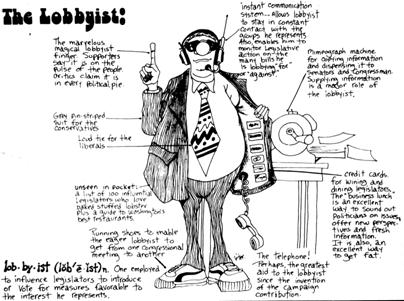
The First Amendment to the Constitution, by asserting the rights of free speech, free assembly and peaceful petition for redress of grievances, provides the legal basis for so-called “special interests” or “lobbies”. Any group can demand that its views be heard – by the public, by the legislature, by the executive branch and (through selective lawsuits) by the courts. Americans, always concerned that their politicians represent their interests, often form "pressure" groups, political lobbies, public action committees (PACs), or special interest groups (SIGs). Such groups seek to influence politicians on almost any imaginable subject. One group might campaign for a nationwide, federal gun-control law, while another group opposes it. Tobacco companies in North Carolina are not too happy about the strong health warnings that must be put on their products. Some religious groups call for pupils being allowed to pray, if they wish, in school, or they campaign against state and federal money being given for abortions. Ethnic groups often want certain foreign policies put into effect with their friends or foes. Tax payers in a number of states have protested against rising taxes and initiated legislation setting limits to taxation. Some labor unions want illegal immigration controlled. And, not surprisingly, some pressure groups want pressure groups stopped and lobby against lobbyists. Such groups of citizens have also helped to weaken the political parties. Each individual politician must pay close attention to the special concerns and causes of his voters. What is amazing is how well so many different governmental groups, with their many ethnic and cultural and business and geographical interests, do seem to manage the affairs of those they were chosen to represent. But then, the great variety of local, regional, and state governments does help to fulfil the wishes of the many different constituencies. If New Yorkers want their city-owned university to be free to any city resident, that is their business. If a small town in the mountains of Colorado decides that snowmobiles have the right-of-way on city streets, that's theirs. And if a county in Arkansas decides that fireworks or hard liquor will not be sold within its limits, well, that's its right, too.
DISCUSSION
1. What are the characteristic features of American party system?
2. The U. S. is a two-party system, isn’t it? Do third parties exist in the country? What are their functions?
3. When was the Democratic Party formed? What is it associated with? What is its symbol?
4. When was the Republican Party formed? What is it associated with? What is its symbol?
5. Are there many differences between the platforms of U. S. major parties?
6. What do you think is the main difference between American and Russian presidential elections? Do Americans directly elect their presidents?
7. What is the process that precedes the actual presidential election?
8. When do primaries and caucuses take place?
9. Who is eligible to vote in the United States? Is voting in the U. S. based on permanent registration of citizens like in many European countries?
10. When does popular vote take place?
11. How has voter turnout changed over the past 40 years?
12. How many electors are there in the Electoral College? How are electors chosen?
13. What are the requirements introduced by the 12th Amendment?
14. What is the electoral vote based on?
15. Can a candidate who hasn’t won the popular election still become president?
16. What is the general attitude of Americans towards the government?
17. How are politicians and officials often portrayed in American films and fiction?
18. Is lobbying illegal in the U. S.?
19. What purposes can lobbyists have? Find examples in the text.
20. How do groups of citizens help to weaken the political parties?
CHOOSE THE CORRECT ANSWER
1. When was the Constitution adopted?
a) March 4, 1787
b) March 4, 1788
c)March 4, 1789
2. What is the Preamble to the Constitution?
a) Declaration of Independence
b) Bill of Rights
c) An Introduction
3. What are the three branches of the federal government?
a) the President, the Supreme Court, the Congress
b) the executive, the legitimate, the judiciary
c) the executive, the legislative, the judicial
4. What is the legislative branch?
a) Congress
b) Senate
c) House of Representatives
5. What is Congress?
a) Senate
b) House of Representatives
c) Parliament
6. How many representatives are there in the House of Representatives?
a) 100
b) 102
c) 435
7. What qualifications must a person meet to be a representative?
a) He must be at least 21 years of age, have been a citizen of the US for at least 7 years.
b) He must be at least 25 years of age, have been a citizen of the US for at least 7 years.
c) He must live in the district of the state he presents.
8. What requirements must a person meet to be a voter?
a) He must be registered for vote and must be at least 21 years of age.
b) He must be registered for vote and must be at least 18 years of age
c) He has to have been a citizen for at least 1 year.
9. How do we know the number of voters in each state?
a) from the Files of the Tax Services
b) with the help of census taken every 10 years
c) by counting the voting papers after the elections
10. How long is a representative’s term of office?
a) 2 years
b) 4 years
c) 6 years
11. How many senators are there in the Senate?
a) 100
b) 102
c) 538
12. What qualifications must a person meet to be a senator?
a) He must be at least 30 years of age, a U. S. citizen for at least 9 years, and live in the state he represents.
b) He must be at least 21 years of age, and live in the state he represents.
c) He has to have been a citizen of the U. S. for at least 7 years.
13. How long is a senator’s term of office?
a) 2 years
b) 4 years
c) 6 years
14. What is a bill?
a) William
b) a proposed law
c) an adopted law
15. Who elects the president and vice-president?
a) The Electoral College
b) The people of the U. S.
c) The Congress
16. What is the Electoral College?
a) All electors of the U. S.
b) The people of the U. S.
c) The Congress
17. Who is an elector?
a) a person who has a right to vote
b) a person who runs for election
c) a person who casts a vote for president and vice-president
18. Which of the following can not the president do?
a) propose legislation
b) declare a war
c) make laws
19. Which of the following cannot the Supreme Court do?
a) say whether a person is guilty or innocent
b) declare legislation unconstitutional
c) declare presidential acts unconstitutional
20. How many Constitutions are there in the U. S.?
a) 1
b) 50
c) 51
UNIT 13
THE NATIVE AMERICAN
 The story of the Native American – or American Indian – is one that is unique, tragic and ultimately inspiring. It is unique because the Indians were the original inhabitants of the American continent and experienced every phase of its European settlement, from the earliest 17th century colonies to the closing of the western frontier at the end of the 19th century. It is tragic because the conflict between the Indians and whites paralleled the experience of traditional peoples throughout the world who have come in contact with expanding, industrialized societies. It is an inspiring story because the Native Americans although dispossessed of much of their land in the 19th century, have survived, asserted their political and economic rights, and succeeded in retaining their identity and culture. Today, Native Americans are full citizens of the United States who are proud to be Americans. However, they are equally proud of their own cultural heritage, and, though it is difficult in the modern world, they are trying to protect and maintain it. Marks of that heritage can be found all over the United States. Many of the names on United States maps – Massachusetts, Ohio, Michigan, Kansas, Idaho and more – are Indian words. The Indians taught the Europeans how to cultivate crops such as corn, tomatoes, potatoes and tobacco. Canoes, snowshoes and moccasins are all Indian inventions. Indian handcrafted artifacts such as pottery, silver jewelry, paintings and woven rugs are highly prized.
About 62 percent of the Indians in the United States live in large cities and rural areas scattered throughout the country. The rest of them live on about 300 federal reservations (land set aside for their use). Together, the reservations comprise 52.4 million acres (21 million hectares) of land, or about 2.5 percent of the land area in the United States. Most reservations are located west of the Mississippi River.
In recent decades, the Native American population has been increasing steadily. Today, there are about 4 million Native Americans. The largest Amerindian tribes today are: Cherokee, Navajo, Chippewa, Sioux, Choctaw, Pueblo, Apache, Iroquois, Lumbee, and Creek.
In 1492, an Italian navigator named Christopher Columbus set sail from Spain in search of a sea route to Asia. Columbus hoped to obtain access to the wealth of spices, silks and gold for which the Asian continent was famous. Six weeks later, his men sighted land. Thinking he had landed in the Indies, a group of islands east of the coast of Asia, he called the people on the first island on which he landed "los Indios," or, in English, "Indians."
Though Columbus had one name for them, the Indians comprised many groups of people. The Indians north of Mexico in what is now the United States and Canada spoke over 300 languages, some of which were as different from one another as English is from Chinese. (Some 50 to 100 of these languages are still spoken today.) They lived scattered across the continent in small bands or groups of bands called tribes. To them, the continent was hardly new. Their ancestors had been living there for perhaps 30,000 years.
Scientists speculate that people first came to North America during the last ice age. At that time, much of the earth's water was frozen in the glaciers that covered large parts of the globe. As sea levels dropped, a strip of land was exposed in the area that is now the Bering Strait. Man probably followed the big game he was hunting across this land bridge from Siberia into Alaska. Over time, these people increased in number, adapted to different environments and spread from the far northern reaches of Alaska and Canada to the tip of South America.
Some groups, such as the peaceful Pueblo of the American Southwest (the present day states of Arizona and New Mexico), lived in busy towns. The Pueblo people were the best organized of the Amerindian farming peoples. They shared many-storied buildings made of adobe (mud and straw) bricks, dried in the sun. Some of these buildings contained as many as 800 rooms, crowded together on top of one another. Their towns were built for safety on the sides and tops of cliffs. The Spanish explorers named both the people and their villages pueblos (Spanish for “town”).The Pueblo made clothing and blankets from cotton which grew wild in the surrounding deserts. On their feet they wore boot-shaped leather moccasins to protect their legs against the sharp rocks and cactus plants of the desert. Long before Europeans came to America the Pueblo were building networks of canals across the deserts to bring water to their fields. They grew corn, squash and beans.
Their neighbors, the Apache, lived in small bands and never became settled farmers. They hunted wildlife and gathered plants, nuts and roots. After acquiring horses from the Spanish, they made their living by raiding food and goods from their more settled white and Indian neighbors. The Apache were fierce and warlike, and they were much feared by the Pueblo.
In the northeastern woods of the North American continent, the Iroquois hunted, fished and farmed. They grew beans, squash and 12 varieties of corn. The people lived in permanent villages, their long houses, covered with elm bark, held as many as 20 families. Each family had its own apartment, on either side of a central hall. The Iroquois were fierce warriors. They surrounded their villages with wooden stockades to protect them from attack by their neighbors. They fought for the glory of their tribe and for the glory of individual warriors. From boyhood on, male Iroquois were taught to fear neither pain, nor death. Bravery in battle was the surest way for a warrior to win respect and high position in his tribe.
Many miles to the west, on the vast plains of grass that stretched from the Mississippi River to the Rocky Mountains, there was another warrior nation. This group called themselves Dakota, which means “allies”. But they were better known by the name which other Amerindians gave to them – Sioux, which means “enemies”. The Sioux grew no crops and built no houses. For food, for shelter and for clothing they depended upon the buffalo. Millions of these large, slow-moving animals wandered across the western grasslands in vast herds. When the buffalo moved, the Sioux moved. The buffalo never remained on the pasture for long, so everything the Sioux owned was designed to be carried easily. Within hours they could take down their tepees, pack their belongings, and move off after the buffalo. They even carried fire from one camp to the next. A hot ember would be sealed inside a buffalo horn with rotten wood. There it would smolder for days, ready to bring warmth from the old village to the new.
The lifestyle of the people of North America’s northwest coast was different again. They gathered nuts and berries from the forests, but their main food was fish, especially the salmon of the rivers and the ocean. Each spring hundreds of thousands of salmon swam in from the Pacific and fought their way up the fast-flowing rivers to spawn. A few months’ work during this season provided the people of the Pacific coast with enough food to last a whole year.
This abundance of food gave the tribes of the Pacific coast time for feasting, for carving and for building. Tribes like the Haida lived in large plank houses with elaborately carved doorposts. The most important carvings were on totem poles, these were specially decorated tree trunks which some tribes placed in front of their houses, but which the Haida made part of the house itself. The carvings on the totem pole were a record of the history of the family which lived in the house.
Some wealthy Pacific coast tribes, like the Haida, had a special ceremony called “potlatch” (the word means “gift giving”). A modern potlatch is a kind of party at which guests are given gifts, but the original potlatch ceremonies went much further. A chief or head of a family might give away everything that he owned to show how wealthy he was and gain respect. To avoid disgrace, the person receiving the gifts had to give back even more. If he failed to do so his entire family was disgraced.
The Amerindian peoples of North America developed widely varied ways of life. Many Indians were fine craftsmen, they made pottery, baskets, carvings and wove cotton and plant-fiber cloth. They traveled in small boats and on foot, never having developed the wheel. Some, such as the Plains Indians, used dogs to pull a load-carrying frame called a travois. Others, such as the Winnebagoes of the Midwest developed a sophisticated calendar that took the motions of both the sun and the moon into account.

|
Из за большого объема этот материал размещен на нескольких страницах:
1 2 3 4 5 6 7 8 9 10 11 12 13 14 15 |
