

Партнерка на США и Канаду по недвижимости, выплаты в крипто
- 30% recurring commission
- Выплаты в USDT
- Вывод каждую неделю
- Комиссия до 5 лет за каждого referral
Market description
Growth of power consumption and production in the First Price Zone in 2011 totaled 2.7%, and 2.5% for IES of Russia. CHPPs accounted for 69% share of demand for electric power production. Shares of HPPs and NPPs were 8% and 23% respectively.
Russian Aggregate Energy Systems (AES) Data for 2011
AES/ Power zones | Production, bln kW/h | Compared with 2009, % | Consumption, bln kW/h | Compared with 2009, % |
East (including isolated systems) | 43.4 | 1.8 | 42.1 | 1.5 |
Siberia (including isolated systems) | 207.0 | – 1.3 | 214.5 | – 1.3 |
Urals | 255.7 | 2.2 | 254.5 | 2.4 |
Mid-Volga Region | 110.3 | 0.7 | 108.0 | 2.9 |
Center | 239.3 | 1.2 | 223.7 | 0.8 |
North-West | 105.8 | 4.4 | 92.5 | – 0.2 |
South | 78.9 | 4.9 | 85.7 | 4.0 |
Average weighted day-ahead market prices for sale in the First price category based on the year results grew by 13% and turned out to exceed an average FTS tariff by 18%.
Equilibrium power prices, RUB/MWh
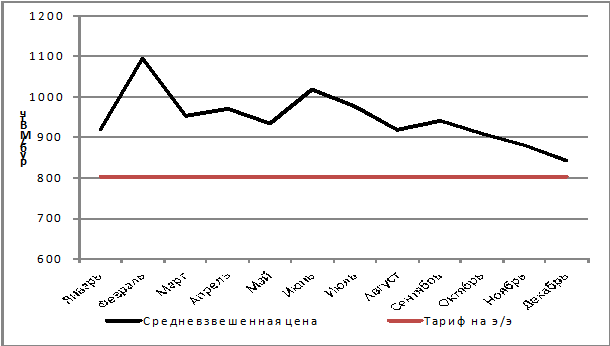
Руб/МВтч | RUB/MWh |
Средневзвешенная цена | Weighted average price |
Тариф на э/э | Power tariff |
According to the results of OJSC TGC-9 activity, the electric energy production in 2011 reduced by 2.8% to 14,060 million kW/h. The previous year electric energy output reduction was the result of TPPs pressure relief following the dispatch schedule.
According to the results of OJSC TGC-9 activity, in 2011 the sales of heat energy from collectors reduced by 5.8% to 37,350 million Gcal. The main factors in heat consumption reduction in the regions of OJSC TGC-9 presence are as follows:
· Reduction of current heat energy use by industrial consumers caused by a drop in own production.
· Abandonment of prospective plans of perspective development plans for industrial consumers.
· Abandonment of investment projects in new construction of residential areas.
Brief review of conduct of business and main pany competitors
OJSC TGC-9 operates in the Republic of Komi, Perm Territory and the Sverdlovsk District being one of the largest producers of electric and heat power in the wholesale market. The company operates in regions with presence of major competitors.
Electric power market:
In accordance with the New Wholesale Electric Energy (Capacity) Market (NWEEM) (since 01.09.2006) OJSC TGC-9 is operating within three markets in the Perm Territory, Sverdlovsk Region and the Republic of Komi (1st non-price zone):
· Regulated contracts market;
· Day-ahead market (DAM) – selling/buying of electric energy with amounts that fall short of / exceed regulated contract ones by competitive prices;
· Balancing market (BM) – selling/buying of competitive price deviations for the system balancing.
Tariffs for electric energy under regulated contract are approved by the FTS. The price for electric energy in the free market is determined by the market. The energy industry reformation incorporates stage by stage liberalization of the power wholesale market, electric energy sale/buy volumes increase at competitive prices and reached 100% since January 1, 2011.
The capacity market was created by RF Government Resolution No 476 of 28.06.2008 as from July 1, 2008. According to this Resolution the capacity trades in the wholesale market not just under regulated contracts but also as the subject of competitive capacity takeoffs, and free bilateral contracts on electric energy and power trading. The liberalization of the capacity market is carried out similarly to the electric energy market liberalization rates.
The main competitors of OJSC TGC-9 in the electric energy (capacity) market:
· Perm Territory:
o Electric power plants of the wholesale generating companies:
o WGC-1 – 45% (Perm SDPP),
o WGC‑4 – 13% (Yaiva SDPP),
o HydroWGC – 17% (Kama HPP, Votkinsk HPP).
o Isolated generating plants of large industrial enterprises – 3%
· Sverdlovsk Region:
o Electric power plants of the wholesale generating companies:
o WGC-1 – 13% (Verhnetagilsk SDPP),
o WGC‑2 – 5% (Serov SDPP),
o WGC-5 – 44% (Reftinsky SDPP, Sredneuralsk SDPP);
o FSUE Rosenegroatom Concern (Beloyarsk NPP branch) - 10%.
o Isolated generating plants of large industrial enterprises – 4% (NMTC CHPP, UVP CHPP, VIPa CHPP, TMP CHPP)
· Komi Republic:
o WGC‑3 – 40% (Pechora SDPP),
o OJSC MBP SLPC CHPP isolated generating plant – 26%.
Power market
SO price requests for CCTs 2011 were accepted from 18.10.2010 to 08.11.2010.
In all the free capacity transfer zones (except the “Center” and “Urals” zones) the top limit of capacity prices for filing of applications for CCTs was set at 118,125 rub./MW per month.
The CCT results were published on 08.12.2012. The price reached 123,000 rub./MW per month in the free capacity transfer zones of Center and Urals, and it was 118,125 rub./MW in other free capacity transfer zones.
Since 2011 the wholesale market of electric energy and power is fully liberalized, but 20-30% of the scope of available power is sold through RCs*(for public and equal categories of consumers) at the FTS tariffs and the other part through:
· Based on the results of competitive capacity takeoffs (CCTs), where the price based on the CCT result is adjusted by the season coefficient;
· OTC-traded Non-regulated electric energy and power contracts;
· Stock exchange-traded Non-regulated electric energy and power contracts.
Heat energy market:
OJSC TGC-9 is producing and transferring heat energy in the Perm Territory, Sverdlovsk Region, and Komi Republic heat energy markets.
OJSC TGC-9 market share in the regions of its presence:
· Perm Territory: Perm (market share – 46%); Berezniki (market share – 55%); Gubakha (market share – 38%); Tchaikovsky (market share – 39%).
· Sverdlovsk Region: Yekaterinburg (market share – 35%), Kamensk-Uralsky (market share – 70%), Krasnoturyinsk (market share – 96%), Pervouralsky (market share – 72%), Nizhnaya Tura (market share – 57%), Kachkanar (market share – 76%).
· Komi Republic: Syktyvkar (market share – 57%), Vorkuta (market share – 62%), Inta (market share – 51%), Sosnogorsk (market share – 46%), Ukhta (market share – 33%).
The main competitors of OJSC TGC-9 in the heat energy market are industrial enterprises with own heat generation facilities. These facilities mainly support own industrial plants. The main advantage of such facilities is the fuel price (they have an option to utilize own process fuel and derived products).
The other competitors in the heat energy market are boiler stations of municipal facilities and private organizations. Their main advantage is the good location in relation to consumers.
Major competitiveness and profitability factors of OJSC TGC-9 in the heat and electric energy markets:
· Heat load:
o Big potential of cogeneration development;
o CHPP loading priority;
o Cost-effective cogeneration.
· Territorial proximity to consumers – in the center of heat and electric loads:
o An option to get supplies from the power plant buses and collectors;
o Provision of several products (steam, gas-air mixture, chemically treated water, etc).
· Location of TGC-9 plants at the hubs of heat and electric energy loads, some of the hubs are deficient.
· Provision of centralized heat supply mostly from OJSC TGC-9 plants (up to 80%).
· Steam pipelines and heat networks availability.
· Proximity to fuel resources: utilized fuel, gas deposits.
2.3. Business priorities of OJSC TGC-9
Development plans. Business priorities of the Company’s activity
OJSC TGC-9 is a multiproduct energy company performing generation and supply of electric and heat energy, transportation of heat energy in the territory of the Komi Republic, Perm Territory and Sverdlovsk Region.
The strategic aim of OJSC TGC-9 is to increase the market value and investment attractiveness of the Company.
In the midterm the Company’s value escalation will be provided by a comprehensive approach to management of the following activities:
· production of heat energy as a basis for generation of competitive electric energy in a combined cycle;
· production of electric energy as a basis for increasing the Company’s value in a high market capacity and with further high profitability of electric energy after liberalization of the electric energy (capacity) wholesale market.
The business of OJSC TGC-9 shall be oriented towards the demands of particular customers of the Company –consumers of heat and electric energy that are mostly major production enterprises.
With this purpose the Company is going to take the following actions in the midterm:
· increase of electric power supply for the needs of consumers on the buses of OJSC TGC-9 electric power plants using the existing base component of heat supply by means of additional loading and expansion of the current electric capacity;
· increase of heat power supply to the major production consumers in the first instance, and to other retail consumers in the second instance by returning lost consumers; replacement of ineffective heat sources, covering of long-range requirements of existing consumers, new construction projects and other actions by means of additional loading and expansion of the current electric capacity;
· increase of electric power supply using the additionally obtained base component of heat supply by means of additional loading and expansion of the current electric capacity.
Under conditions of the world liquidity crisis that is now outlined, the current activity of the Company shall be focused on implementation of an anti-crisis plan aimed to keep the current position, to stabilize the work by reducing internal costs, to increase the labour capacity, to optimize the semi-constant costs, to stiffen the payment discipline, to reduce payables and receivables, to optimize the assets, and to review the investment program.
Report of the Board of Directors of OJSC TGC-9 on the results of the Company’s development by business priorities
During the year 2011 the Board of Directors of OJSC TGC-9 defined the business priorities of the Company and took the following decisions:
· To define the delivery contract between the Company and OJSC Power Machines for equipment delivery and rendering of services on the following projects as a business priority:
1. Reconstruction of Perm CHPP-9;
2. Construction of Novo-Bogoslovskaya CHPP;
3. Reconstruction of Nizhneturinsk SDPP, start-up complex 1;
4. Reconstruction of Nizhneturinsk SDPP, start-up complex 2;
5. Construction of Akademicheskaya CHPP.
· To approve the Company’s Business-Plan for 2011 with the following key indicators:
- EBITDA – 2,416 million rubles.
- Circulating capital increase– 5,840 million rubles.
· To approve of an Investment Program for Priority and Related Investment Projects of the Company for 2011.
· To take note of Company’s strategy targets until 2014.
· To approve of the Work Plan of the Company’s Board of Directors.
· To approve of Company’s interest in the authorized capital of Open Joint-Stock Company Territorial Generating Company No.5, Open Joint-Stock Company Territorial Generating Company No.6, Open Joint-Stock Company Volga Territorial Generating Company.
· To define Company’s interest in the authorized capital of Closed Joint-Stock Company Integrated Energy Systems, Closed Joint-Stock Company IES-Energosbyt, Closed Joint-Stock Company Management Company Energostroyservis, Limited Liability Company IES-Trading, Limited Liability Company Strategic Business Systems, Limited Liability Company Accounting and Financial Service, Limited Liability Company YUNIS as a Company’s business priority.
· To determine the criteria for selection of a general contractor for the priority investment project of Reconstruction of Perm CHPP-9.
· The conclusion of contracts for equipment delivery and service rendering for implementation of projects on Reconstruction of Nizhneturinsk SDPP and Construction of Akademicheskaya CHPP between the Company (Buyer) and Alstom (Vendor) was defined a Company’s business priority.
· New members of the Company’s Audit Committee of the Board of Directors were elected.
· To approve of LLC Management Company Uralenergostroy as a general contractor for the integrated works, including site preparation, construction, assembly and commissioning works with delivery of materials and accessory equipment necessary for implementation of the priority investment project on Reconstruction of Perm CHPP-9.
· To approve a Resolution on additional issue of OJSC TGC-9 securities in the amount of 50,094,714,813,220 (fifty trillion ninety four billion seven hundred fourteen million eight hundred thirteen thousand two hundred twenty) ordinary registered book-entry with a par value of 0.003 (zero dot three thousandth) rubles each and the Prospectus.
· To approve of the Company’s Annual Integrated Procurement Program for implementation of Company’s priority investments projects for 2011.
· To approve of Company’s interest in Limited Liability Company Novo-Bogoslovskaya CHPP, Limited Liability Company Novobereznikovskaya CHPP, Limited Liability Company Akademicheskaya CHPP through incorporation.
· To approve of a new wording of the Regulations on Audit Committee of the Board of Directors of OJSC TGC-9.
· To approve of a new wording of the OJSC TGC-9 Insider Information Regulations.
· To define Company’s interest in CJSC Heat Grid Company a Company’s business priority.
· To define, as a Company’s business priority, acquisition of a land plot of 7.62 ha with the existing immovable property adjacent to the Akademenergo boiler plant for implementation of the Company’s priority investment project – Construction of Akademicheskaya CHPP, in accordance with a report of an independent appraiser in the amount not exceeding 230,000,000 rubles.
· To approve of engaging an independent appraiser to evaluate the purchased assets on a competitive basis, the cost of appraisal services not exceeding 1,000,000 rubles.
· To define, as a Company’s business priority, investment financing for implementation of the following Company’s priority investment projects:
- Construction of Novobogoslovskaya CHPP (start-up complex 1);
- Construction of Novobogoslovskaya CHPP (start-up complex 2);
- Construction of Novo-Bogoslovskaya CHPP;
- Reconstruction of Nizhneturinsk SDPP (start-up complex 1);
- Reconstruction of Nizhneturinsk SDPP (start-up complex 2);
- Construction of Akademicheskaya CHPP.
· For the purposes of minimizing Company’s losses to define cessation of Company’s activities in production, transportation and distribution of heat energy in the city of Syktyvkar a Company’s business priority.
· To approve of the sale of Company’s heat grid facilities in the city of Syktyvkar at a price determined by an independent appraiser, but not less than 160.0 million rubles, net of VAT. To make a remark that, if the price of transaction for sale of Company’s heat grid facilities in the city of Syktyvkar exceeds 300,000,000 rubles, the transaction will require approval by an individual resolution passed by the Company’s Board of Directors.
2.4. Risk Management
This section of the Annual Report provides a description of risks associated with the Company’s activities.
The Company acknowledges existence of risks when conducting its business activities, making efforts to assess these risks and developing mechanisms to manage them. The Company’s risk management system is targeted to ensure strategic and operational stability of business by maintaining risks at an acceptable level for the Company. The Company has been undertaking and will undertake measures to reduce the probability of negative events and the impact of risks on its business when realized.
The given list of factors is not exhaustive and only reflects the point of view and own assessments of the Company.
Industry Risks
The core activity of the Company is the production and sale of electric and heat energy in the territory of the Russian Federation. Since the power industry is an infrastructural element of the Russian economy, the trends of the industry development are greatly determined by the general trends in the social and economic development of the country’s economy as well as other specific features of this industry.
The Company is exposed to the risk of changes implemented in the course of industry restructuring and having negative implications for the Company.
One of the key features of the industry today is the restructuring of the Russian wholesale electric energy market. The Russian wholesale electric energy market has been under restructuring and reorganization since 2001, reforms in the power industry include liquidation of OJSC RAO UES of Russia, liberalization of the domestic electric energy market (WEECM) and start of capacity market. Since January 1, 2011 electric energy on the wholesale electric energy market has been fully supplied at free (unregulated) prices.
Realization of this risk, i. e. introduction of changes in the power industry framework that are negative for the Company, may result in a need to modify the structures and principles of Company operations.
The Company understands the existence and impact of this risk on its performance results, but this risk is beyond the Company’s control. In the event that the current procedures and conditions governing the industry are changed, the Company will plan its business activities taking account of such changes.
Therefore, the Company considers this risk insignificant and believes that negative changes in the course industry restructuring should not materially affect the Company’s activities in the short and mid term.
The Company is exposed to the risk of accidents at its own generating facilities and generating facilities of other companies within the industry.
A key feature of the power industry is a significant wear of fixed assets and lack of investment. According to some estimations, the current wear of fixed assets in the power industry approximates 60%. The volume of retired generating facilities may stand at 75% installed capacity by 2020. Meanwhile, the investment requirements in the period of 2007 to 2020 amount to about $147 bln., but the state is unable to invest this volume of funds in the power industry. The given facts mean potential future interruptions in heat and electric energy production, possible reduction of generating plants’ capacity and possible overall loss of reliability of the heat and power supply system.
Realization of this risk may result in financial loss and liability provided by the applicable laws, in case of an accident at a Company’s CHPP, as well as in a need to generate additional volumes of power in case of an accident at another generating company’s facilities.
The Company is determined to and will be determined in the future to completely fulfill its social commitments to ensure uninterrupted heat and power supply. In order to reduce the possible negative impact of this risk on its activities the Company has provided for such measures as:
· Reconstruction of existing generating facilities,
· Re-equipment of fixed assets,
· Improvement of operating efficiency by implementing programs of production expenses reduction and cost saving,
· Development of a program to improve energy efficiency of activities,
· Construction of new high-performance generating facilities (CCGT, OCGT),
· Insurance.
Besides, the Russian Government has introduced structural changes in the course of restructuring aimed at attracting private investment through the implementation of a mechanism to reimburse the investors for the costs of upgrading and new capacities construction (agreements for the provision of capacity).
Therefore, the Company considers this risk insignificant and believes that negative changes in the course of operation of generating units and electric energy production should not materially affect the Company’s activities in the short and mid term the Company.
The Company is exposed to the risk of reduction in payment collection rates.
Another specific feature of the power industry is the persistent issue of non-payment. Guarantee suppliers that buy electric energy at the wholesale electric energy and capacity market (WEECM) include payers with a low quality payment discipline. Obligations to supply electric energy to such suppliers of last resort are allocated by the industry’s infrastructural organizations equally between all generating companies.
Realization of this risk, i. e. a reduction in payment collection rates, may result in a reduction in Company’s revenues. However, the supply of heat and power to the regions where low-solvency suppliers of last resort operate is an obligation of the Company, even if such buyers are indebted to the Company.
The Company understands the existence and impact of this risk on its performance results. In order to reduce the possible negative impact of this risk on its activities the Company has provided for such measures as:
· Assumption of maximum negative effect of this risk when planning the Company’s activities,
· Conduct of a counterparty credit risk assessment before entering into contract,
· Initiation of legal proceedings to recover the amounts overdue and applicable penalties from the debtor.
Therefore, the Company considers this risk significant but believes that the issue of non-payment by separate buyers of heat and electric energy should not materially affect the Company’s activities.
The Company is exposed to the risk of inappropriate creation and imposition of penalties by gas suppliers.
Key features of the industry include the cyclical nature of demand for electric energy and the dependence of demand for the electric energy generated by the Company on weather factors and water levels.
The demand for electric energy is subject to daily, weekly and seasonal fluctuations, which entails corresponding variation of electric energy prices during such periods. The Company experiences a higher demand for its products in the cold time of the year from October to March, while the warm time of the year is associated with a lower level of demand. This cyclic nature of demand determines better financial performance of the Company in the first and fourth quarters as compared with the second and third quarter performance.
The level of sales and earnings may also be negatively affected by such weather factors as unusually high temperatures for the season during the autumn and winter months as well as the water related factors such as increased water level in rivers meaning a higher power generation by HPPs.
Realization of this risk may result in uneven power generation as well as unpredicted changes in power demand. Reduction in demand may cause reduction in Company revenues against the forecasted level, which, taking into account the Company’s obligations to maintain even gas consumption, may also entail imposition of penalties by gas suppliers. An upswing in demand may also result in imposition of penalties and limitation of gas consumption on the part of gas suppliers.
The Company understands the existence and impact of this risk on its performance results. In order to reduce the possible negative impact of this risk on its activities the Company has provided for such measures as:
· Maintaining price and demand fluctuation statistics,
· Maintaining weather conditions and water level statistics,
· Assumption of most negative fluctuations in the demand and prices for electric energy caused by seasonal, weather and water related factors when planning the Company’s activities,
· Diversification of gas suppliers,
· Providing for possible deviations from the even gas consumption when entering into contracts with gas suppliers,
· Initiation of and participation in legal proceedings on imposition of penalties by gas suppliers,
· Maintaining the stocks of alternative fuel.
Therefore, the Company considers this risk significant but believes that the issue of cyclical nature of demand and its dependence on weather and water related factors should not materially affect the Company’s activities.
The Company is exposed to the risk of negative changes in prices for energy resources and for delivery thereof in the domestic market and the risk of negative changes in prices for equipment and other material and technical resources in the domestic and foreign market.
The industry is peculiar for the high share of energy costs in power production costs, which makes the power industry development dependent on the trends in the raw material and equipment markets.
In order to provide for its activities the Company procures raw material. The raw material for the Company’s CHPPs is the gas, fuel oil and coal, and the main energy resource used in the power production is the gas. The fuel for producing heat and electric energy is procured on the domestic Russian market only.
Realization of this risk, i. e. an increase in the fuel price, may result in an increase of the fuel component in the tariff, which, subject to maintaining tariffs at a competitive level, may result in a reduction in the Company’s net profit.
In order to limit the possible negative impact of this risk on its activities the Company has provided for such measures as:
· Improvement of operating efficiency by implementing programs of production expenses reduction and fuel saving,
· Development of a program to improve energy efficiency of activities,
· Construction of new high-performance generating facilities (CCGT, OCGT)
· Diversification of raw material suppliers,
· A tender-based selection of raw material suppliers,
· Entering into long term contracts for the supply of energy resources.
Moreover, the gas pricing is under state regulation, and sharp swings in the price specific of exchanged traded commodities are unlikely to occur.
In order to provide for its current activities as well as to ensure commissioning of new generating capacities the Company procures equipment and other material and technical resources on the domestic and foreign markets.
In order to reduce the possible negative impact of this risk on its activities the Company has provided for such measures as:

|
Из за большого объема этот материал размещен на нескольких страницах:
1 2 3 4 5 6 7 8 9 10 11 12 13 14 |
