


Партнерка на США и Канаду по недвижимости, выплаты в крипто
- 30% recurring commission
- Выплаты в USDT
- Вывод каждую неделю
- Комиссия до 5 лет за каждого referral
EXERCISE 2. Polish up your comprehension.
Complete the sentences of the text using the words in the box.
1. evolving processes - развертывающийся процесс
2. appeal - привлекательность (просьба, призыв, апелляция)
3. over-arching - всеобъемлющий
The Three Functions of the Negotiation Process
There are certain functions that are generally applicable to the evolving processes of negotiation. One is diagnosis: trying to … … what the problem is, what the other … is susceptible to in the way of appeals, what the ingredients of the situation are, what the other side …, and what one wants oneself. Second is formulation: finding an over-arching principle or formula which will … the problem, since problems can be defined in many … . А workable principle will be... … for an agreement. For example, exchanging security for territory was established as an overarching formula for trade-offs … Egypt and Israel. Finally … … the function of applying this general principle to а particular detail out of which one can construct an agreement between … … . Experience shows that these functions must be … … in order for the negotiation process to be effective.
1. wants; 2. the basis; 3. the parties; 4. ways; 5. between; 6. find out; 7. carried out; 8. there is; 9. define; 10. side; |
EXERCISE 3. Practice your abilities in discussion.
Read the article to find out the main ideas and make up a plan of it in written form. Discuss some points mentioned below the text in pairs, expressing agreements or disagreements, exclamations, additions as well as summarizing your ideas (use the material of section 2). Then retell it using your plan.
1. litigation –спор, тяжба
2. thereby – около того, посредством этого
3. trust - доверие
4. caucus - закрытое собрание, политика подтасовки выборов, давление на избирателей
5. for the sake - ради
6. mediation - посредничество
7.bilateral - двусторонний (trilateral - трехсторонний, multilateral - многосторонний)
8. conciliation - примирение, умиротворение
Common Confusion about the Negotiation Process
The process of negotiation often is confused with other decision-making process such as litigation. Many people have a perception of how the litigation process works, and they conduct themselves in the negotiating process much like they believe people should conduct themselves in the litigation process. As а result, they are far too adversarial and argumentative, thereby creating unnecessary problems for themselves.
The second confusion is the belief that the essence of negotiation is extremely complex when in reality the essence is quite simple and very human. The negotiation process provides the parties or disputants an opportunity for parties to exchange promises and commitments through which they will resolve their differences and reach an agreement. Trust is key to the success of any negotiation. Groups and individuals will not exchange promises or commitments that they really expect to see fulfilled with groups or individuals they do not trust. When trust is low, communication is low. When communication is low, mutual education cannot take place, and education is the most constructive thing that can take place in any negotiation.
The third confusion is the idea that negotiation is а simple process. People believe that all you do is sit there, and if you are not the spokesperson, you take а few notes, make а few comments, and caucus, and the negotiations somehow go forward.
The described position has been expanded (and then checked) successfully from bilateral relationships (commercial transactions, labor-management relationships) to trilateral relationships (as in partnerships with three principals) to multilateral relationships (environmental, community and international disputes) and expanded further tо include various neutral third-party involvement, such as conciliation, mediation, fact-finding, and arbitration.
1. What is the difference between litigation process and negotiation? Is it crucial?
2. What is the essence of the negotiation?
3. Do you believe negotiation is а simple or very complex process? Prove your position.
4. How and where could the position mentioned by the author be applied?
5. Do you consider mastering the negotiation (bargaining) to be important for your future profession and why? Is it true for any field of activity.
EXERCISE 4. Train your thinking and communicating.
Translate one of the passages out of the text from English into Russian using your dictionary in written form. Discuss current economic or political actions of the state officials or business leaders in solving complex problems in terms of given rules.
Rules of thumb – практические правила
Some Rules of Thumb
1. A valid distinction can be drawn between relationship issues (such as those of perception, emotion, ability to communicate, mutual understanding, confidence and trust) and the substantive issues or merits of negotiation (such as questions of price, date, specifications, and other terms of a possible agreement).
Rules of thumb:
- Deal with both sets of issues concurrently, but separately.
- Do not try to obtain concessions by threatening a relationship. (Threatening a relationship damages it; even getting a concession will not repair the damage.)
- Do not try to improve a bad relationship by making concessions. (Appeasement does not work; rewarding bad behavior is more likely to generate more bad behavior.)
- Disagree without being disagreeable. (The more serious the difference, the more important it is to be able to communicate effectively.)
- Insist that maintaining an effective working relationship connotes neither approval nor disapproval of conduct.
2. A valid distinction can be drawn between statements of position (demands, claims of right, things to be insisted upon) and the underlying interests which those positions are intended to serve (wants, needs, concerns, hopes, and fears).
Rules of thumb:
- Look behind positions for underlying interests.
- Avoid arguing about positions. (It tends to lock you both in.)
- Talk about interests, theirs and yours.
- See the negotiation task as one of reconciling legitimate interests, not compromising position.
3. A valid distinction can be drawn between generating options
(a range of possibilities that may be worthy of consideration) and making decisions (committing oneself to accept or reject a given option).
Rules of thumb:
- First generate many possible ways of resolving a difference; decide later.
- Each side should generate range of options privately before getting involved in formal negotiations.
- Where possible, the parties should engage in side-by-side joint brainstorming, free from making any commitments.
- 4. A valid distinction can be drawn between focusing discussions on what the parties are willing or unwilling to do and what the parties ought to do, as measured by some objective criteria (such as precedent, law, custom, expert option or minimum cost).
Rules of thumb:
- Insist upon talking about what the parties ought to do.
- Convert a contest of will (in support of unprincipled, stubborn positions) into a battle for legitimacy (as each side seeks to demonstrate that it is more willing than the other to accept a result dictated by respect for fair and impartial principles).
- Jointly search for fair standards to which both parties can defer.
EXERCISE 5. Increase your skills in translating and rendering.
Translate one of the passages of the texts from Russian into English in written form. Look through the text and render it in English.
|


1. Необходимость знания культурно-специфического этикета для внешнеэкономической деятельности, персонала продаж и рекламных сообщений как внутри страны, так и за ее пределами вполне очевидна.
Этикет, как правило, представляет приемлемые формы поведения в социальных ситуациях. Так, широко распространенный обычай трепать ребенка по голове в Америке, был бы неприемлем на Востоке, где гoлова считается священной.
Поведение, рассматриваемое как грубое или неприятное в одной культуре, может быть вполне приемлемым в другой. Распространенная и приемлемая американская привычка (для мужчин) — сидя, перекрещивать ноги, показывая подошву туфли, чрезвычайно оскорбительна в восточных странах. В этих странах подошву ноги или туфли никогда не показывают.
Отношение к чаевым может иметь различное этическое значение, демонстрируемое следующим примером. Во время своего визита в Китай президент Рейган купил несколько сувениров. Он отдал продавцу 10 юаней (4,35$) за покупку стоимостью 5 юаней и сказал тому оставить сдачу себе. Униженный торговец бросился за президентом и вернул ему сдачу.
Чаевые не разрешены в Китае и воспринимаются многими как оскорбление.
2. Особенностью японского этикета является то, что японский управляющий никогда не скажет «нет» во время прямых переговоров, так как это оценивается в японской культуре как невежливость. Вместо этого он скажет «это будет очень трудно», что на самом деле значит «нет». Японец, отвечающий «да» на просьбу, часто имеет в виду «да, я понимаю просьбу», а не «да, я согласен выполнить просьбу».
Западная культура рассматривает прямой взгляд в глаза собеседника как свидетельство открытости намерений, искренности и прямоты. Однако в восточных культурах, в Японии и в мусульманских странах прямой взгляд расценивается как агрессивность, грубость, нескромность или бесстыдство.
Итак, в отличие от различий вербального языка, различия в невербальных формах поведения чаще воспринимаются неверно. Собственный невербальный язык кажется естественным, а чужой - неестественным. Именно поэтому следует избегать ошибок в понимании, интерпретации и передаче невербальной информации.
PART 2.
EXERCISE 1.
A. Check your understanding
Read and translate the text carefully, looking up any new words in a list below or in a dictionary. Then retell it.
1. terms of reference – круг полномочий
2. suspicion – подозрение
A Four Stage Process
The pre-negotiation process may be reviewed as a complex stage.
Defining the Problem. The first stage is defining the problem. How people define the problem begins to determine what they will do about it. Trying to negotiate without recognizing that the negotiation will be impossible until the parties share some common definition at the problem leads to failure. The point to that efforts to deal constructively with the problem must begin with efforts to establish a common enough definition of the problem to assure that parties to a negotiation would at least be addressing the same issues.
Commitment to negotiate. The second phase in the process is producing a commitment to a negotiated settlement. Before leaders will negotiate they first have to come to the judgment that the present situation no longer serves their interests. This judgment can be complicated by the introduction of a time factor for instance. In addition to judging that the status qui is unacceptable, each party must judge that the substance of a fair settlement is available. They also need to believe there is no possibility of overcoming suspicion and achieving a secure and peaceful relationship with their adversaries. A third factor contributing to a commitment to a negotiated settlement is a judgment that the balance of forces will permit such a settlement We need to understand a lot more about how to analyze the balance of forces in a pre-negotiating situation and how they can be charged.
Arranging the Negotiation. The third phase is arranging a negotiation. Whereas the commitment to negotiate is a real decision the effort to arrange a specific negotiation tends to focus on more detailed terms of reference for the negotiation. This phase, along with the fourth, has received far more attention in the literature on negotiation and requires less attention. The central aim in this phase is to reach agreement on the objectives and procedures for the negotiation. One can leave in this phase for months and even years.
Negotiation Itself. The final stage of the process is negotiation itself. Negotiation lies only as the forth phase in a prolonged process where the pre-negotiating phase may take much more time and effort than the negotiation.
B. Increase your vocabulary.
Work with the synonyms and the words with a close meaning:
I. In this section you should use your dictionary. Match the words in the given list (1-10) with their equivalents in the bubbles (a - q). Find out as many words as you can.
1. to charge; 2. an aim; 3. to solve; 4. a problem;
5. negotiation process; 6. to recognize; 7. a definition;
8. to overcome; 9. to negotiate; 10. to permit;
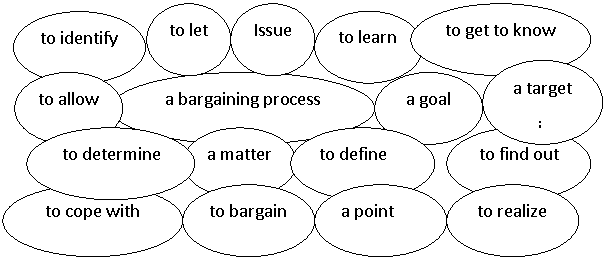 |
П. Substitute the words in italics for the most suitable ones from the list of the equivalents mentioned above.
1. The central aim in this phase is to reach agreement.
2. A fair solving is available in such bargaining situation.
3. Now the point is to deal constructively with the problem.
4. The negotiation process tends to focus on more detailed terms to negotiate.
5. The other party has shared some common definition at the problem.
6. They may believe that there is no possibility of overcoming difficulties.
7. The balance of forces will permit such a settlement.
8. They were trying to negotiate without recognizing a very important information.
Ш. Work with the problems given below trying to use as many equivalents as you can.
1. Why is it important to establish a common enough definition of the problem?
2. What would the leaders first do before they start the negotiation?
3. What do the leaders need to believe?
4. What is the central aim in the phase of arranging a negotiation?
5. How long may the pre-negotiation period continue?
EXERCISE 2. Polish up your comprehension.
Complete the sentences of the text using the words in the box.
1. to cope with - справляться с чем-либо, преодолевать
2. to be aware - знать, сознавать, отдавать себе отчет в чем-либо
Anyone coping with the negotiations will be painfully aware that negotiation is not … … element in … conflict – getting to negotiation may be much more … than working toward agreement once actual … begins. Moreover, if we try to use only the techniques of the negotiating table in this phase we may well … the instruments of influence that could make a difference.
Removing … … to negotiation is … … first task in the process of moving towards negotiated … . That may … different approaches and instruments than those required at the … ... .
1. the critical; 2. negotiation; 3. require; 4. agreement; 5. the only; 6. the obstacles; 7. resolving; 8. overlook; plex; 10. negotiating table; |
EXERCISE 3. Practice your abilities in discussion.
Read the article to find out the main ideas and make up a plan of it in written form. Discuss some points mentioned below the text in pairs, using agreements or disagreements, exclamations, additions as well as summarizing your ideas (for the purpose use the material of section 2). Then retell it using your plan.
1. to persuade - убеждать, уговаривать
2. to commit oneself - компрометировать себя, принимать обязательства
3. settlement - решение, урегулирование
4. acutely - остро, проницательно
5. hurdle - препятствие, барьер
6. buzz - жужжание, гул
The Pre-Negotiation Phase
А Larger Process. Crucial as it is, around-the-table negotiation is only the last stage of а larger process for resolving major international conflicts by peaceful means. In many cases, persuading the parties to а conflict to commit themselves to а negotiated settlement is even more complicated, agonizing, and time-consuming than reaching agreement once negotiations have begun. This is said with а full understanding of how difficult reaching agreement can be.
People involved in negotiation need to think in terms of а process which deals with the obstacles to negotiation as well as the hurdles in negotiation. Unless we enlarge our scope somehow, we're not constructing а theory that is going to be as useful as it might be to the company presidents or the other high officials of state in conducting their policy in different fields of activity.
In urging that we enlarge our scope, we’re acutely aware that we’re walking into the academic buzz so called а "definitional problem." When are we talking about negotiation and when are we talking about the conduct of international relations? As it is said in the popular book “Practical negotiator” "Long before the first formal session begins, the negotiation process begins with the decision made by each party to explore the possibility of negotiating." The question is what do we do before the decision is made? A three-stage model is presented in the mentioned book, which begins with what they call the "diagnostic phase" in which efforts are made tо bring about negotiations. Our argument is simply to reach back even further and more extensively into the period before а decision to negotiate is made and to analyze it in added detail
1. Give your grounds on the importance of the pre-negotiation phase.
2. Discuss the reasons for both sides in the bargaining process to explore the possibility of negotiating (psychological or political, historical or economic, profit, interest, professional obligations etc.)
EXERCISE 4. Train your thinking and communicating.
Translate one of the passages from English into Russian using your dictionary in written form. Discuss your experience of being stabilizer, destabilizer or quasi-mediator in a course of any dispute. Put 10-15 questions to the text. Have (guide) a conversation using your questions in pairs.
1. settled by adjudication – урегулировано через судебное решение
Stabilizers, Destabilizers, and Quasi-Mediators
1. Within each team, members usually hold quite different attitudes. Some tend to settle at any cost. They may be called "stabilizers." They seek agreement with the other side to avoid the disruptive consequences of nonsettlement. Depending on the context of the case, stabilizers see nonsettlement as reverting to lengthy, expensive, or disruptive alternatives, such as litigation, strikes, demonstrations, riots, and wars. These people usually understand negotiation to be а stabilizing process and bring others to the negotiation table in the hope that nonsettlement could be avoided. А second general type, the "destabilizers," do not particularly like the negotiation process. Destabilizers tend to disagree with most of the proposals of thei|г own team and all of the counterproposals of the other side. They would rather see the dispute settled by adjudication than by compromise on а given position.

|
Из за большого объема этот материал размещен на нескольких страницах:
1 2 3 4 5 6 7 8 9 10 11 12 13 |
