


Партнерка на США и Канаду по недвижимости, выплаты в крипто
- 30% recurring commission
- Выплаты в USDT
- Вывод каждую неделю
- Комиссия до 5 лет за каждого referral
In the middle on each team there is а third type, the "quasimediators," who play several roles. They are usually spokespersons charged with responsibility for the success of the effort. To those sitting across the table they may simply look like other negotiators, but within their own team they often act as а mediator between the faction of stabilizers and the faction of destabilizers.
2. Internal Team Negotiations. Resolution of differences between the stabilizers and destabilizers is а prerequisite for effective negotiation with the other side, as well as for reaching accommodation with the team's own vertical hierarchy. When а team is considering making an offer, for example, the stabilizers will probably want to present а generous package while the destabilizers may not want to offer anything. The quasi-mediator must begin to explore with the stabilizers why the concessions might be excessive and probably unacceptable to the team's vertical hierarchy and to discuss with the destabilizers why the proposal may be good and why the team should not be so rigid, since the costs of nonsettlement may be unacceptable. Much like а neutral third-party mediator, the quasi-mediator may choose to meet joint1у and separately with the stabilizers and nonstabilizers.
EXERCISE 5. Increase your skills in translating and rendering.
Translate one of the passages of the texts from Russian into English in written form. Look through the text and render it in English.
|

1. Символы, или знаки, настолько значимы в менеджменте, маркетинге, торговле, бизнесе в целом и прочих сферах деятельности, что существует специальная сфера знаний — символьный менеджмент. Различные культуры имеют различные символы для коммуникации. Ошибки в распознавании значений, приписываемых цвету или другим символам, могут вызвать серьезные осложнения во взаимопонимании у представителей разных культур.
Значения чисел, цветов и других символов
Белый | Символ скорби или смерти на Среднем Востоке; счастья, чистоты в США |
Лиловый | Ассоциируется со смертью во многих латиноамериканских странах |
Голубой | Оттенок женственности в Голландии; мужественности в Швеции, США |
Красный | Нежелателен или негативен в Чаде, Нигерии, Германии; позитивен в Дании, Румынии, Аргентине. Невесты носят красное в Китае, но это цвет мужественности в Великобритании и Франции |
Желтые цветы | Знак смерти в Мексике; неверности во Франции |
Белые лилии | Намек на смерть в Англии |
Число 7 | Неблагоприятно в Гане, Кении, Сингапуре; благоприятно в Европе, США, Латинской Америке, Марокко, Индии, Чехословакии, Никарагуа, на Среднем Востоке |
Число 13 | Негативно в Eвpoпe, Латинской Америке, на Среднем Востоке |
Треугольник | Негативен в Гонконге, Корее, Тайване; позитивен в Колумбии |
Сова | Мудрость в США; несчастье в Индии |
Олень | Скорость, грация в США; гомосексуальность в Бразилии |
2. • Если бы вы видели малыша, одетого в розовый наряд, вы бы, скорее всего, предположили, что ребенок — девочка. Если бы наряд был голубой, вы подумали бы, что ребе-
нок — мальчик. Эти предположения будут точны в США, но не будут таковыми во многих других частях мира, например таких, как Голландия.
• Один производитель продуктов понес потери в Малайзии, потому что доминирующий цвет компании, используемый в торговой марке, - зеленый и этот цвет ассоциировался в данной стране с джунглями и болезнью.
• Ведущий американский производитель мячей для гольфа был в полном недоумении, когда безрезультатно пытался проникнуть на японский рынок. Его ошибкой была упаковка мячей для гольфа в пачки по четыре. Четыре — это символ смерти в Японии.
• «Pepsi-Cola» потеряла свою доминирующую долю на рынке в Юго-Восточной Азии, уступив ее компании Coke, когда поменяла цвет своего охлаждающего и торгового оборудования от глубокого синего до «голубого цвета льда». Светло-голубой ассоциируется в Юго-Восточной Азии со смертью и скорбью.
• Большинство китайских деловых путешественников были шокированы во время инаугурации консьержских услуг «United Airlines» для пассажиров первого класса на Тихоокеанские маршруты. Чтобы отметить событие, каждый консьерж гордо носил белые гвоздики на своем костюме — восточный символ смерти.
3. КАКИЕ ПОДАРИТЬ ЦВЕТЫ
В некоторых странах Западной Европы нужно быть крайне осторожным в отношении того, чтобы дарить женщинам на праздник хризантемы. В Испании, Франции, Греции, Германии, Венгрии их приносят в связи с печальными событиями. В Италии хризантемы кладут только к памятникам или на могилы. Осторожность нужно проявлять и в отношении гвоздик. Их ни в коем случае нельзя дарить француженкам: в этой стране считают, что гвоздики приносят в дом несчастье. Во Франции принято дарить цветы белого цвета.
Совсем необязательно дарить большие букеты цветов, можно ограничиться маленькими букетиками или даже одним цветком, как это часто делают в Эстонии.
Полученные в подарок цветы тотчас же ставят в вазу.
В больницу нежелательно брать цветы с сильным или резким запахом.
Во многих странах мира бытует мнение, что дарить следует только нечетное количество цветов, а дарить букеты желтого цвета — неприлично.
PART 3.
EXERCISE 1.
A. Check your understanding
Read and translate the text carefully, looking up any new words in a list below or in a dictionary. Then retell it.
1. an aspiration - сильное желание, стремление, дыхание
2. to generate - создавать, производить, генерировать
3. credible - похвальный, делающий честь кому-либо
4. ingenious - изобретательный, искусный, остроумный
5. to project oneself into - перемещаться, переноситься, проектировать
6. to figure out - вычислять, понять, постичь
7. to dovetail - согласовывать, увязывать, подходить подгонять плотно
8. brainstorming work - мозговой штурм
9. pay off - расплатиться, рассчитаться с кем-либо, покрыть полностью
10. well-crafted - искусный, хитрый, ловкий, мастерский
11. refine - очищать, совершенствовать
12. an option - выбор, право выбора
How Analysis Can Help
One of the things that we do is to make an outline of how analysis can help.
We ask a number of questions to prepare for negotiations and then generate proper ideas. What happens if you don’t come to an agreement? What are the other alternatives? It isn’t so easy to identify the alternatives and cost them out. What is the best alternative to a negotiated agreement? What are some of your aspirations in these negotiations? How do you project yourself into the position of the other party? What are their opportunities? What is their best alternative to a negotiated agreement? What can we find out about how they negotiate, about their responsibility, etc.? What are the conventions for this type of negotiation? How honest are they? How open are they? How adversarial? Can negotiation be done in stage? Does it have to be done all at once? How credible are commitments? Do they say this is the bottom line and then back down?
Various elements can be discussed: opening gambits, the dynamics of the negotiation dance, closing the deal, etc.
In this case there was a seller and a buyer, and if the seller gets more, the buyer gets less. So the number of a one issue problem is that if one side wins more, the other side wins less. But, of course, both sides can lose if there is a zone of agreement and they cannot identify it or agree where to settle it.
Interests and Positions. People do not often tell you about their interests, but you can guess if you put yourself to their shoes. In fact, a mediator gets his power by having an ingenious solution, figuring out and knowing the interests of both sides and making them dovetail. So does the negotiator. A lot of brainstorming work, a lot of good ideas, can pay off and can lead to a well-crafted option taking the interest of the other side into account.
We should Generate More Theory. The kind of hard thinking about negotiation that has been missing is theoretical thinking. It is not just collecting anecdotes or data about how negotiators in fact negotiate. We need to sort those facts into useful categories. We need some hypotheses about cause and effect. We need to go back and forth between facts and generalizations, constantly refining the generalizations and testing them against experience.
B. Increase your vocabulary.
Work with the synonyms and the words with a close meaning:
I. In this section you should use your dictionary. Match the words in the given list (1-7) with their equivalents in the bubbles (a - q). Find out as many words as you can.
1. to generate, 2. to refine, 3. aspiration, 4.well-crafted, 5. to project,
6. to figure out, 7. an option
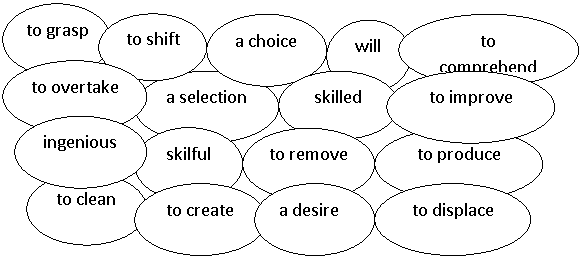 |
П. Substitute the words in italics for the most suitable ones from the list of the equivalents mentioned above.
1. Their aspirations in these negotiations are rather vague for us.
2. We should constantly refine the generalizations and test them in the course of pre-negotiation period work.
3. A lot of brainstorming work can lead to a well-crafted option taking the interest of the other side into account and generating proper ideas.
4. Can you project yourself into the position of the other party when negotiating or discussing something?
5. In fact, a mediator gets his power by having an ingenious solution, figuring out and knowing the interests of both sides and making them dovetail.
Ш. Work with the problems given below trying to use as many equivalents as you can.
1. How analysis can help in the negotiation process?
2. How would you reveal interests and positions of the other party if the adversary does not tell you about them?
3. Why should we generate more theory?
EXERCISE 2. Polish up your comprehension.
Complete the sentences of the text using the words in the box. Answer the questions below the text checking your comprehension.
1. numerous - многочисленный
2. inextricably - запутанно, сложно, неразрешимо
3. to give in - регистрировать, уступать, сдаваться
4. academics - теоретические, академические, научные
5. gap - пробел, промежуток, щель
How the Technique and Practice of Negotiation Was
Lately Worked out in the U. S.
Probably nо subject is as … today as the technique and practice of … and mediation. The problems of the world are increasingly complicated and numerous. The fates of nations and … are inextricably linked as communication and technology bind us together. At the same time, war (as an extension of diplomacy) has become an unthinkable alternative, and people are … … а way tо fight violence without giving in tо it.
All too frequently in the past, diplomats and … have been left to learn the art of negotiation on their own. Few concerned attempts have to help practitioners to share what they learned and to work … with academics who are trying to investigate the field and tо test various theories and … of negotiation.
Therefore, when the Center for the Study of Foreign Affairs was established in late 1982, it was decided that one of its areas would be … … and negotiation and that an attempt would be made to … … … between the practitioner and the academic … … …. The Center, а part of the Foreign Service Institute, provides а … … Foreign Service officers tо reflect and work … … … of interest and encourages cooperation between the State Department and the foreign affairs community. Its approach, and the approach of the Foreign Service Institute in general, is … … the best of the practitioner's … … … and the best of the theoretical and conceptual work of the academic.
1. conflict resolution; 2. bridge the gap; 3. peoples; 4. to synthesize; 5. closely; 6. methods; 7. facility for; 8. negotiation; 9. in this field; 10. important; 11. on research projects; 12. looking for; 13. negotiators; 14. experience and skill; 15. been made; |
1. Why is the technique and practice of negotiation so important today?
2. In which way did the diplomats and negotiators learn the art of negotiation?
3. What did academics do in this field?
4. Which institutions in the US were involved in solving the problem of researching and studying negotiation?
5. What is the main approach of the institutions to the problem?
EXERCISE 3. Practice your abilities in discussion.
Read the article to find out the main ideas and make up a plan of it in written form. Discuss some points mentioned below the text in pairs, expressing agreements or disagreements, exclamations, additions as well as summarizing your ideas (for the purpose use the material of section 2). Then retell it using your plan.
1. an ambience - охват
2. to orchestrate - оркестровать
3. cuisine - кухня
4. а ploy – дело, проделка, работа
5. to convey – передавать, сообщать
6. а load – груз, бремя
7. an agenda – повестка дня
8. а magnanimity - великодушие
9. ambiguous - двусмысленный
10. to resort - прибегать
11. stalling tactics – тактика введения в заблуждение, уклонения
12. tо protract - выдвигаться
13. premature - преждевременный
14. explicitly – внешне выраженно, имея второй смысл
15. irreconcilable – непримиримый, противоречивый
Facilitating Maneuvers
The Chinese unquestionably prefer tо negotiate on their own territory as it facilitates their internal communications and decision-making procedures and maximizes their control over the ambience of а negotiation. They will purposefully orchestrate all aspects of the environment — press play, the mood of their officials, banquet toasts, the quality of the cuisine, and sight-seeing excursions — tо create а context favorable tо their purposes.
When the Chinese wish to develop а relationship with а foreign government, political or trade officials they use а variety of diplomatic and negotiating ploys tо facilitate agreement and minimize differences. They may use а trusted intermediary tо convey positions tо а foreign government in advance of а negotiation in а deniable or face-saving manner and in order tо "load” the agenda of their foreign counterpart. Accordingly, they used the Pakistani government in 1971 tо communicate their initial positions tо the Nixon Administration in advance of Kissinger's secret visit tо Beijing. They can show magnanimity when they want tо strengthen а relationship, as in 1980 when they offered Secretary of Defense Harold Brown the opportunity tо purchase certain rare earth metals which they knew the U. S. government needed.
They can express differences bу indirection and subtlety of language tо minimize confrontation or draw out their interlocutor with ambiguous yet suggestive formulas. For to "the Japanese formula" — without spelling out in precise detail what this "formula" entailed. They may resort tо stalling tactics tо protract а negotiation when premature closure would be unfavorable to their interests or lead tо а deadlock. Or they may reach а partial agreement on issues where compromise serves their ends, but explicitly reserve their position on irreconcilable differences for negotiation at а later time in more favorable circumstances. For example, in late 1978 the Chinese agreed tо the U. S. formula for establishing diplomatic relations on all points except continuing American arms sales tо Taiwan. On this issue they publicly indicated that — while agreeing tо normalize — they сould not accept the U. S. position and reserved the intention tо negotiate the difference of view at a later date.

|
Из за большого объема этот материал размещен на нескольких страницах:
1 2 3 4 5 6 7 8 9 10 11 12 13 |
