

Партнерка на США и Канаду по недвижимости, выплаты в крипто
- 30% recurring commission
- Выплаты в USDT
- Вывод каждую неделю
- Комиссия до 5 лет за каждого referral
Learning Objectives:
At the end of this topic you will be able to;
1.4.1 Resistors
þ understand that resistance can be increased by connecting resistors in series;
þ understand that resistance can be decreased by connecting resistors in parallel;
þ select and use the equation  to perform calculations involving the combined resistance of two resistors in series;
þ select and use the equation  to perform calculations involving the combined resistance of two resistors in parallel;
þ describe how fixed and variable resistors can be used in voltage dividers;
þ describe how potentiometers can be used as variable resistors and voltage dividers;
þ use the colour and printed code to work out the value and tolerance of a resistor;
þ select appropriate preferred values from the E24 series;
1.4.2 Light Dependent Resistors (LDRs)
þ state that the resistance of an LDR falls as light intensity increases (non-linear);
1.4.3 NTC Thermistors
þ state that the resistance of ntc thermistors decreases as temperature increases (non-linear);
1.4.4 Switches
þ distinguish between the following types of mechanical switches:
push, toggle, reed, micro, tilt, rotary
1.4.1 – Resistors
Using resistors to control and limit current
If you used the Alpha Kit during Topic 1.2, you would have used 6V, 0.06A bulbs in the Alpha ch bulbs are designed to work on a 6V supply. When 6V is applied across a bulb, its filament offers sufficient resistance to keep the current down to 0.06A and the bulb lights up to its specified brightness. At working temperature, the filament provides a resistance of about 100Ω.
If we were to connect the same bulb to a 12V battery, this resistance would only be sufficient to keep the current down to about 0.12A. This high current would probably burn out the filament, and the bulb would be destroyed. Extra resistance is required in the circuit to limit the current to 0.06A. This extra resistance could be provided by connecting two such bulbs in series across the supply (See fig 1a).
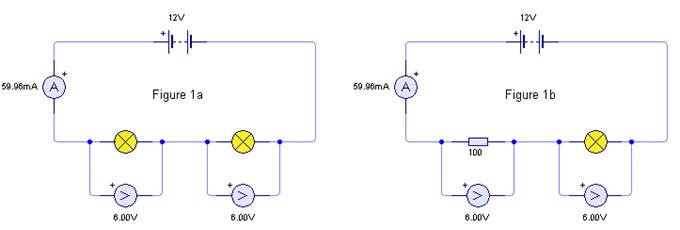
The second bulb provides an extra resistance of about 100Ω. The same effect could be produced by using a fixed resistor of value 100Ω (Fig 1b). The wide range of resistor values offered by manufacturers enable us to limit the current through a component to almost any desired value.
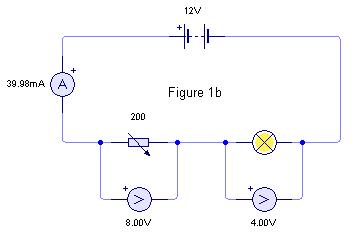
If the current flowing through a component has to be very precisely set, a variable resistor is used as shown below.
Potentiometers
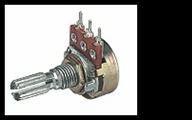
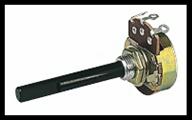
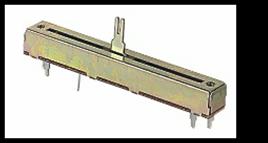
Potentiometers can be used for dividing up a voltage into any value between zero and the full supply voltage. A potentiometer consists of a circular conducting track, made of carbon or resistance wire, over which a sliding contact moves.
The voltage to be divided is connected across the end of track tags and the output voltage is taken between one of these tags and the wiper tag.
|
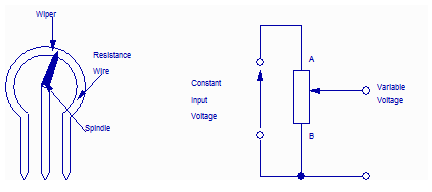
When the wiper is at position A the full supply voltage is available at the output. At position B the output voltage is zero.
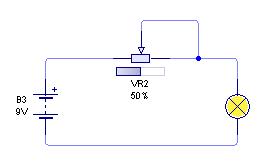
Potentiometers can also be set up to act as variable resistors in circuits. In this case the wiper tag is connected to one of the end of track tags and the unit is used as shown opposite.
The following pictures show some of the different types of potentiometers available.
|
|
|
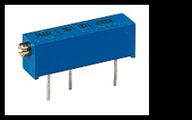
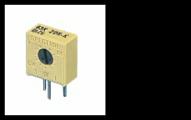
Presets
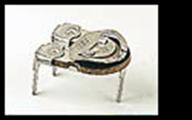
These are similar to potentiometers but are usually smaller and have to be adjusted using a screwdriver. They are designed to be inserted into a circuit then adjusted to the required value. Once accurately set they are usually sealed so that they do not change from this value. The following pictures illustrate the difference between presets and the continuously variable type.
|
|
|
Selecting a resistor
If you turn to the resistor section in any electronics supplies catalogue you will find a wide range of values and types on offer. After calculating the ideal value of the resistor required in a circuit you must consider the following points before making your selection.
(a) Preferred values
It is very unlikely that you will be able to find your ideal value within the range of values. Manufacturers only produce certain preferred values. You have to select the nearest value of resistor within the range.
In the E24 series, the 24 preferred values are:
10, 11, 12, 13, 15, 16, 18, 20, 22, 24, 27, 30, 33, 36, 39, 43, 47, 51, 56, 62, 68, 75, 82, 91
together with multiples of 10 of these values, up to about 10MΩ. The increase between values in E24 is about 10%.
If we multiply each of the values above by 10 we get the next 24 available resistor values:
100, 110, 120, 130, 150, 160, 180, 200, 220, 240, 270, 300, 330, 360,
390, 430, 470, 510, 560, 620, 680, 750, 820, 910
Followed by
1k, 1.1k, 1.2k …………… and so on up to 10MΩ.
(b) Tolerance
This provides an indication of how much above, or below, the stated value the resistor might be. A 1.5kΩ resistor with a tolerance of ±5% could be as low as 1425Ω or as high as 1575Ω, since 5% of 1500 is 75Ω.
Compare the tolerance of carbon film and metal film resistors in your catalogue.
Carbon Film Tolerance = ....................................................
Metal Film Tolerance = ....................................................
Which type of resistor offers the closest tolerance? .................................
(c) Wattage
You will find that the same type, and value, of resistor is offered at different wattage. The resistor with a power rating just above your required power rating should be selected. A power rating of 0.25W is sufficient for most of your practical work.
Compare the size of similar resistors but with different power rating.
(d) Stability
This gives an indication of how well the resistor behaves when physical conditions change.
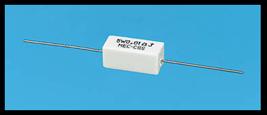
Types of Resistor
The following types of resistors are commonly found in electronic systems.
|
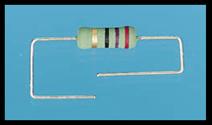
(a) Wire wound
|
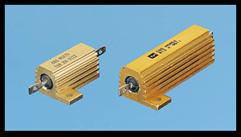
These are made by winding a piece of resistance wire e. g. constantan or nichrome, on to a ceramic former and coating it with an insulating material such as varnish.
Advantages | Disadvantages |
1. Can be made very accurate. Tolerance of 0.1% available. | 1. Tend to be bulky and heavy. |
2. Value does not change much when resistor heats up. | 2. Rather expensive. |
3. Capable of dissipating high power. |
This type of resistor is used where close tolerance or high power dissipation is required. Values are available up to about 22kΩ with a power dissipation capability of up to 50W.
|
(b) Carbon film
|
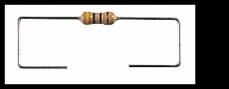
In this type of resistor a film of graphite is deposited on a ceramic former. A helical groove is cut into the carbon. The value of the resistor is determined by the size of the groove, the thickness of the film and the size of the former.
Advantages | Disadvantages |
1. Easy to manufacture, and cheap. | 1. Rather poor temp stability |
2. Good tolerance e. g. 5% |
(c) Metal film
|
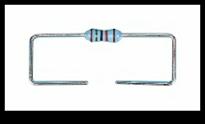
These are manufactured in a similar way to the carbon film resistors but the conducting film is made from metal (e. g. nichrome) or metal oxide.
They have all the advantages of the carbon film type and have much better tolerance and temperature stability than carbon film type.
Resistor Colour Code
The value of the resistor and its tolerance can be worked out from four colour bands on its body.
N. B. Some resistors especially metal film resistors use a five band colour code. Details can be found in suppliers catalogues. Only the four band code will be tested in the examinations.

|
Из за большого объема этот материал размещен на нескольких страницах:
1 2 3 4 5 6 7 8 9 |
