


Партнерка на США и Канаду по недвижимости, выплаты в крипто
- 30% recurring commission
- Выплаты в USDT
- Вывод каждую неделю
- Комиссия до 5 лет за каждого referral
Министерство образования, науки и
Молодежной политики Краснодарского края
Государственное бюджетное профессиональное образовательное учреждение Краснодарского края «Кропоткинский техникум технологий и железнодорожного транспорта»
СБОРНИК ТЕХНИЧЕСКИХ ТЕКСТОВ С ЗАДАНИЯМИ
для профессии 23.01.09 «Машинист локомотива»
КРОПОТКИН 2016
Протокол №________ Зав. МО ____________ «____»_________________ 20_____ г. | |
Заместитель директора по научно-методической работе______________ «____»_________________ 20_____ г. |
Одобрено в качестве учебно-методических материалов для аудиторной работы студентов по дисциплине “Иностранный язык” методическим советом
Протокол №_____ от «____»_________________ 20_____ г.
Председатель методического Совета _________________________
Рецензенты:
, преподаватель иностранного языка
Иностранный язык: сборник технических текстов с заданиями для профессии 23.01.09 Машинист локомотива
содержание
АННОТАЦИЯ | 4 |
Задание №1 Moscow underground | 5 |
Задание №2 Moscow underground (part 2) | 7 |
Задание №3 Experimental bridge | 9 |
Задание № 4 The channel tunnel | 12 |
Задание № 5 Stone blower for pneumatic ballast injection | 14 |
Задание № 6 The importance of drainage in producing stable track | 15 |
Задание № 7 How to avoid traveling | 17 |
Задание № 8 Dialogues | 21 |
Задание №9 From the history of railway transport (Part 1) | 24 |
Задание №10 From the history of railway transport (Part 2) | 28 |
ТЕМАТИЧЕСКИЙ СЛОВАРЬ | 31 |
СПИСОК ИСПОЛЬЗОВАННОЙ ЛИТЕРАТУРЫ |
АННОТАЦИЯ
Сборник технических текстов с заданиями составлен на основе государственного образовательного стандарта 2016 г. и соответствует тематике преподаваемого предмета.
В сборник включено 15 практических заданий, на каждое из которых отводится 2 часа аудиторного времени.
Данный сборник текстов предназначен для студентов профессиональных образовательных учреждений и основной целью работы по нему является развитие у коммуникативной компетенции во всех видах речевой деятельности.
Результатом выполнения практических работ будут:
знания:
- лексический (2000 лексических единиц) минимум необходимый для чтения и перевода (со словарем) текстов технической и профессиональной направленности
умения:
- понимать основное содержание несложно звучащих текстов или диалогов по изучаемым темам; выражать своё отношение и мнение к высказываниям; делать сообщения с наиболее важной выбранной информацией; рассуждать, делать выводы по прочитанному материалу; выборочно понимать и извлекать информацию в неадаптированных технических текстах; пользоваться двуязычными или одноязычными словарями и другой справочной литературой.
В практических работах Ваши знания оцениваются следующим образом:
Оценка | «5» (отлично) | «4» (хорошо) | «3» (удовлетворительно) | «2» (неудовлетворительно) |
% выполнения практическойработы | 100-90 | 89-80 | 79-75 | менее 75 |
Перечень практических заданий приводится в содержании.
ЗАДАНИЕ №1
1. Опишите отношения между словами в паре (антоним, синоним, ни то ни другое).
1) term/ semester 7) different/ similar 13) to get/ to receive/ to obtain
2) strong/ weak 8) a number of/ several 14) to include/ to comprise
3) state/ private 9) to achieve/ to reach 15) to include/ to exclude
4) to train/ a train 10) to listen to/ to hear 16) to comprise of/ to consist of
5) to study/ to learn 11) to increase/ to grow 17) to increase/ to decrease
6) different/ various 12) to provide/ to supply 18) up-to-date/ out-of-date
2. Вставьте в пропуски слова.
l) This situation ___ my presence. 2) The academic year in all Russian higher educational
institutions is ___ into two terms. 3) Must the students of your Institute ___ all the lessons or can they choose the most interesting ___? 4) The Internet is a global computer ___ having millions of users all over the world. 5) This shop sells ___ cars ___ motorbikes. 6) The operation of Metro doesn't ___ on the weather conditions. 7) This commercial bank has a number of ___ in the Volga region. 8) Hurry up, if you don't want to ___ the lecture. 9) Vacations never ___ very long. 10) The Japanese company ___ the first pocket-size color TV set. 11) Safe ___ of freight and passenger trains requires a reliable system of signaling. 12) Next ___ we'll have a course of lectures on Philosophy. 13) Last year there
was one case when a student ___ his exam in English. 14) This station is the ___ stop of our train. 15) Rudolf Diesel ___ an engine, which was one of the remarkable engineering ___ of the 20th century.16) The river ___ the city into two parts. 17) The ___ «radar» is composed of the first letters of «radio, detection and ranging».
achievements, attend, both…and, branches, developed (2), depend, divides, divided, failed, last(2), miss, network, operation, requires, subjects, term(2)
3. Переведите текст.
MOSCOW UNDERGROUND
For the first time the idea of building the underground railway in Moscow was discussed before the revolution. However, the construction of the first section (from Sokolniki to Central Park) was initiated only in 1932. It lasted 3 years and was called the record period by the world press. The Russian engineers carefully studied the existing underground systems abroad before working out their own project, which represented a significant improvement of the London system.
The engineering difficulties were great mainly because much of the soil was composed of running sand. Fortunately, most of the running sand lay close to the surface and it was found possible to use out-and-cover method of construction under many of the streets. However, in the city center where the line is 100ft or deeper, the construction of tunnels was necessary.
The Moscow Underground consists of a circle line, which runs round the city center, several radial lines crossing the city and connecting with each other and the lines running to the countryside. Some constructional work is still going on. Now the length of the underground lines has reaches about 300 km.
4. Ответьте на вопросы по содержанию к тексту.
1. Was the possibility of constructing Metro in Moscow discussed before the revolution for the first time?
2. Did the building of the Moscow Underground begin in 1917?
3. Did the project of the Moscow Metro represent a significant improvement of the London system?
4. Were all lines constructed, using cut-and-cover method?
5. Does the Moscow Metro consist of a circle line and two radial ones?
6. Is the construction of the Metro still going on?
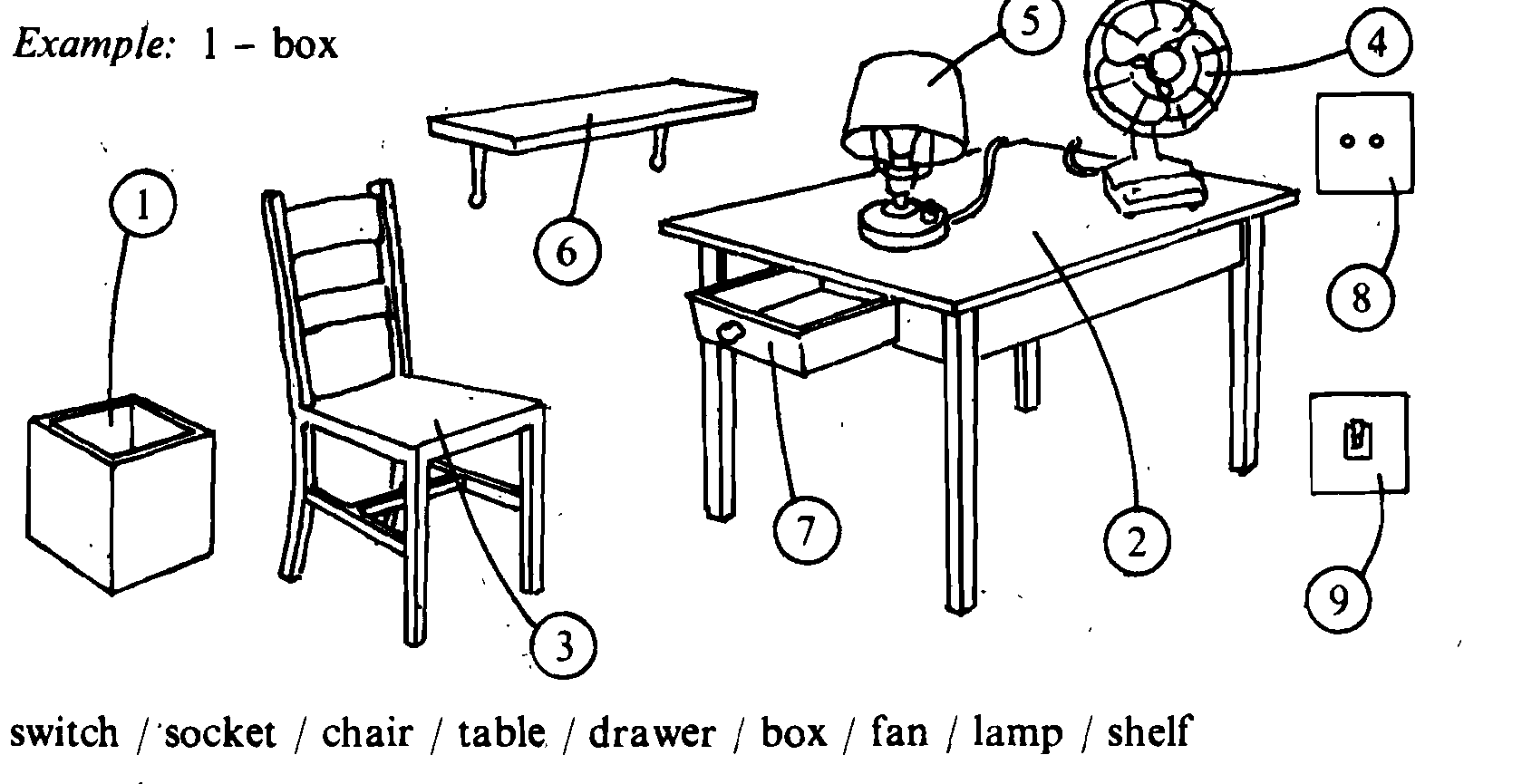
5. Назовите предметы.
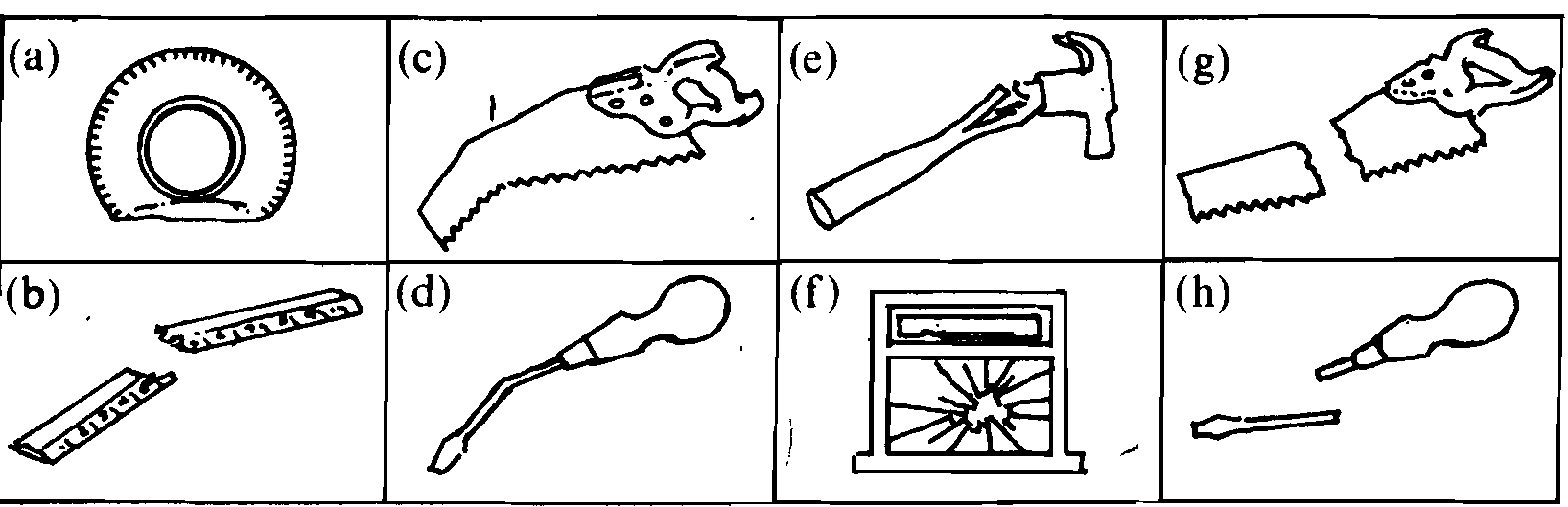
6. Соотнесите предложения с картинками.
Example: 1 The ruler is broken - picture (b)
1 The ruler is broken. 5 The screwdriver is bent.
2 The hammer is broken. 6 The saw is broken.
3 The screwdriver is broken. 7 The window is broken.
4 The tyre is flat. 8 The saw is bent.
ЗАДАНИЕ №2
1. Образуйте от данных глаголов две формы Participle I. Полученные причастия переведите на русский язык.
Model: to read – a) reading – читая, читающий;
b) having read – прочитав
1) to use; 2) to make; 3) to develop; 4) to forget; 5) to burn; 6) to transport; 7) to receive; 8) to feel; 9) to study; 10) to carry; 11) to go; 12) to try; 13) to think; 14) to cover; 15) to speak.
2. Переведите текст.
MOSCOW UNDERGROUND (part 2)
At present, the Moscow Metro handles more than five million passengers each day. During peak hours trains run at a speed of 90 km/h with the intervals of about 80 seconds. One train takes up to 1,500 passengers. For greater safety of travel, all trains are inspected every 6-9 hours of running. Being in operation for about 13 hours daily each Metro train covers the distance equal to that from Moscow to St. Petersburg. The trains servicing the Underground are supplied with low voltage direct current. The current is obtained from the third rail by special devices that are mounted beneath the motor coaches. Rolling stock is completely replaced approximately once every four years.

|
Из за большого объема этот материал размещен на нескольких страницах:
1 2 3 4 5 6 7 8 |
