


Партнерка на США и Канаду по недвижимости, выплаты в крипто
- 30% recurring commission
- Выплаты в USDT
- Вывод каждую неделю
- Комиссия до 5 лет за каждого referral
a) vertebrae
b) shoulders
c) arms
d) fingers
2. The fundamental unit of every living thing is....
a) the body
b) the cell
c) the anatomy
d) the organ
3. ... is the organ of the digestive system.
a) nerve
b) brain
c) heart
d) esophagus
4. The peritoneum is the double – folded... surrounding the abdominal cavity
a) jaw
b) blood
c) membrane
d) list
5. Nerve tissue conducts... all over the body
a) microorganisms
b) impulses
c) food
d) blood
6. The bones form the... of the body
a) framework
b) arm
c) leg
d) skull
7. The bones of the... include the spinal column, the ribs and the breast bone
a) trunk
b) elbow
c) leg
d) skull
8. There is a number of movable... in the skull
a) frameworks
b) arms
c) ribs
d) bones
9. The arm ... the body at the shoulder.
a) excludes
b) includes
c) joins
d) makes up
10. The spinal column … vertebrae.
a) divides
b) contains
c) separates
d) constitutes
5. Самоконтроль по ситуационным заданиям.
1. You are delivering a lecture in anatomy. Explain the structure of the trunk to the students.
2. Your task is to make up a crossword. What skeletal part of the body would you chose for it? You should use not less then ten words.
6. Перечень практических умений по изучаемой теме.
1. Владеть навыками монологической и диалогической речи, использовать новую лексику, уметь вести беседу по изучаемой теме.
2. Владеть навыками изучающего чтения, извлекая необходимую информацию.
7. Рекомендации по выполнению НИРС.
1. “Congenital and acquired bone diseases”
2. “The differences between the male and female human skeletons”
8. Рекомендованная литература по теме занятия.
основная: Английский язык: Учебник для медицинских вузов и медицинских специалистов
дополнительная: англо-русские, русско-английские словари, грамматические справочники.
Приложение 1
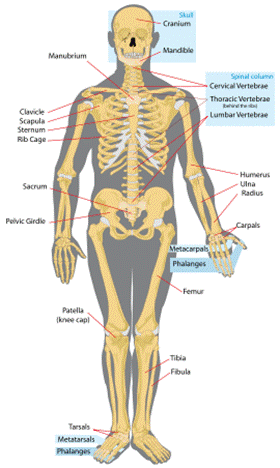 The human skeleton consists of both fused and individual bones supported and supplemented by ligaments, tendons, muscles and cartilage. Fused bones include those of the pelvis and the cranium. Osteocytes are present in the bone matrix. Osteoblasts and osteoclasts are present at the edges of bone matrix and are involved with bone matrix production and absorption respectively. Bones all have an arterial blood supply, venous drainage and nerves. The non-articular surfaces of bones are covered with a tough fibrous layer called the periosteum, and the articular surfaces of bones are covered with a smooth layer of articular cartilage. Spaces within some bones, generally the larger bones, are filled with bone marrow responsible for generation of blood cells, known as haematopoiesis.
Early in gestation, a foetus has a cartilaginous skeleton from which the long bones and most other bones gradually form throughout the remaining gestation period and for years after birth in a process called endochondral ossification. The flat bones of the skull and the clavicles are formed from connective tissue in a process known as intramembranous ossification, and ossification of the mandible occurs in the fibrous membrane covering the outer surfaces of Meckel's cartilages. At birth a newborn baby has approximately 300 bones, whereas on average an adult human has 206 bones (these numbers can vary slightly from individual to individual). The difference comes from a number of small bones that fuse together during growth, such as the sacrum and coccyx of the vertebral column. The sacrum (the bone at the base of the spine) consists of five bones which are separate at birth but fuse together into a solid structure in later years. An infant is born with zones of cartilage, called epiphyseal plates, between segments of bone to allow further growth. Growing is usually completed between ages 13 and 18, at which time the epiphyseal plates of long bones close allowing no further growth.
The skeleton has six main functions:
1. Provide shape and support The skeleton provides the framework which supports the body, and maintains its shape. The joints between bones permit movement.
2. Attachment The bones of the skeleton provide an attachment surface for muscles and tendons which together enable movement of the body. Ligaments often connect bones across a joint to provide stability. Microscopic fibres called Sharpie's fibres connect teeth to the bone of their sockets.
3. Movement Movement in vertebrates is dependent on the skeletal muscles, which are attached to the skeleton by tendons. Without the skeleton to give leverage, movement would be greatly restricted.
4. Protection The skeleton protects many vital organs: The skull protects the brain, the eyes, and the ears, the spine protects the spinal cord, the ribs, spine, and sternum protect the lungs and the heart, the clavicle and scapula protect the shoulder, the ilium and spine protect the digestive and urogenital systems and the hip, the patella and the ulna protect the elbow and the knee, and the carpals and tarsals protect the wrist and ankle.
5. Blood cell production The skeleton is the site of haematopoiesis – the generation of blood cells, which takes place in red bone marrow.
6. Storage Bone also serves as a mineral storage deposit in which nutrients can be stored and retrieved. Calcium, especially, can be released by dissolution of bone tissue under the control of 1,25-dihydroxyvitamin D3 (a form of vitamin D) during periods of low calcium intake.
Занятие 6
1. Тема: «The Muscles».
2. Формы работы: подготовка к практическим занятиям, подготовка материалов по НИРС.
3. Перечень вопросов для самоподготовки по теме практического занятия.
Знать лексический минимум по теме, основную медицинскую на иностранном языке, грамматический материал: времена группы Continuous,
модальные глаголы, уметь использовать знания лексико-грамматического материала, владеть иностранным языком в объеме, необходимом для возможности коммуникации и получения информации из зарубежных источников.
Задания.
1. Изучающее чтение и перевод текста “ Types of Muscles ”
2. Ответьте на вопросы.
1. How many types of muscular tissue are there?
2. How do we sometimes call smooth muscles?
3. What is another name of striated muscles?
4. What is the difference between the cardiac and skeletal muscles?
5. Why do we call muscles the active part of the motor apparatus?
6. What groups of muscles are there?
7. How many skeletal muscles are there in the human organism?
8. What structure do the skeletal muscles have?
9. What is the function of the tendons?
10. What muscles are necessary for manipulating the bones of the skeleton?
3. Написание аннотации текста “Skeletal muscle structure”
4. Повторение грамматического материала времена группы Continuous (Active Voice), модальные глаголы can, must, may, Функции и перевод слова that (those).
Термин «Continuous» в переводе на русский язык означает продолжительный, длительный.
Группа времен Continuous состоит из трех времен: Present Continuous, Past Continuous, Future Continuous.
Времена группы Continuous образуются при помощи вспомогательного глагола to be (в настоящем, прошедшем или будущем времени) и причастия I смыслового глагола:
Present Continuous | Past Continuous | Future Continuous |
Утвердительная форма |
I am working I was working I shall be working
You are working You were working You will be working
He is working He was working He will be working
She is working She was working She will be working
It is working It was working It will be working
We are working We were working We shall be working
You are working You were working You will be working
They are working They were working They will be working
Вопросительная форма |
Am I working? Was I working? Shall I be working?
Are you working? Were you working? Will you be working?
Отрицательная форма |
I am not working. as not working. shall not be working.
You are not working. You were not working You will not be working.
4. Самоконтроль по тестовым заданиям данной темы.
1. Поставьте глаголы в правильную форму.
1 Jane...... (wait) for me when I...... (arrive).
2 'What...... (you/do) this time yesterday?' 'I was asleep.'
3 '...... (you/go) out last night?' 'No, I was too tired.'
4 Let's go out. It...... (not/rain) now.
5 'Was Carol at the party last night?' 'Yes, she ……...(wear) a really nice dress.'
6 Julia is very good at languages. She...... (speak) four languages very well.
7 How fast…….(you/drive) when the accident...... (happen)?
8 Hurry up! Everybody...... (wait) for you.
9 John……..(take) a photograph of me while I...... (not/look).
10 '...... (you/listen) to the radio?' 'No, you can turn it off.'
11 We were in a very difficult position. We...... (not/know) what to do.
12 'How is your English?' 'Not bad. It...... (improve) slowly.'
13 I haven't seen Alan for ages. When I last...... (see) him, he ...... (try) to find a job in London.
14 I...... (walk) along the street when suddenly I...... (hear) footsteps behind me. Somebody...... (follow) me. I was frightened and I...... (start) to run.
15 When I was young, ...... (want) to be a bus driver.
2. Дополните фразы, используя модальные глаголы:
1 It's later than I thought. I. ...... go now.
a) might b) have to c) can d) may
2 In Britain many children...... wear uniform when they go to school.
a) must b) have to c) can d) may
3 When you come to London again, e and see us.
a) can’t b) have to c) can d) may
4 Last night Don became ill suddenly. We...... call a doctor.
a) must b) had to c) can d) may
5 You really...... be lazy if you want to pass the examination.
a) must b) have to c) can’t d) may
6 I'm afraid e tomorrow. I will be busy.
a) can’t b) have to c) can d) may
7 I'm sorry e yesterday. I was busy.
a) can’t b) have to c) can d) couldn't
8 Paul doesn't like his new job. Sometimes he...... work at weekends.
a) can’t b) has to c) can d) couldn't
9 Caroline...... go away next week.
a) can’t b) might c) can d) couldn't
10We couldn't repair the car ourselves. We...... take it to a garage.
a) can’t b) had to c) could d) couldn't
11 You've been travelling all day. You...... be very tired.
a) must b) have to c) can d) may
12 You're going on holiday next week. You...... be looking forward to it.
a) must b) have to c) can d) may
13 It rained every day during their holiday, so they...... have had a very nice time.
a) must b) have to c) couldn’t d) may
14 Congratulations on passing your exam. You...... be very pleased.
a) must b) have to c) can d) may
15 Bill and Sue go away on holiday very often, so they be short of money.
a) mustn’t b) has to c) might d) need
16 We've got plenty of time. We...... hurry.
a) must b) have to c) needn’t d) need
17 We have enough food at home so we...... go shopping today.
a) must b) needn’t c) can’t d) may
18 Jim gave me a letter to post. I...... forget to post it.
a) mustn’t b) have to c) can d) may
19 There's plenty of time for you to make up your mind. You...... decide now.
a) mustn’t b) have to c) can’t d) may
20 You...... wash those tomatoes. They've already been washed.
a) mustn’t b) needn’t c) can’t d) may
5. Самоконтроль по ситуационным заданиям.
1. You want to go in for sport. What kind of muscles are you going to develop?
2. You are taking an anatomy examination. The question in your card is “What is the difference between the cardiac and skeletal muscles?” Give the explanation.
6. Перечень практических умений по изучаемой теме.
1. Владеть навыками монологической и диалогической речи, использовать новую лексику, уметь вести беседу по изучаемой теме.
2. Владеть навыками изучающего чтения, извлекая необходимую информацию.
3. Владеть навыками написания аннотации.
7. Рекомендации по выполнению НИРС.
1. “Types of muscles”
2. “Muscle activity in an anaerobic and aerobic environment”
8. Рекомендованная литература по теме занятия.
основная: Английский язык: Учебник для медицинских вузов и медицинских специалистов
дополнительная: англо-русские, русско-английские словари, грамматические справочники.
Skeletal Muscle Structure
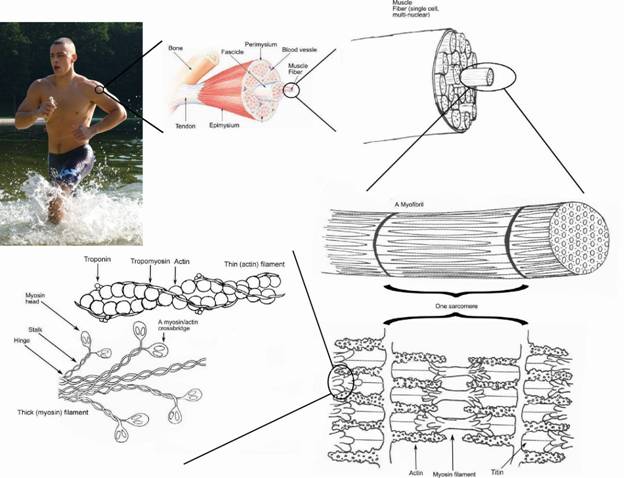 Muscle (from Latin musculus "little mouse") is contractile tissue of the body and is derived from the mesodermal layer of embryonic germ cells. It is classified as skeletal, cardiac, or smooth muscle, and its function is to produce force and cause motion, either locomotion or movement within internal organs. Much of muscle contraction occurs without conscious thought and is necessary for survival, like the contraction of the heart, or peristalsis (which pushes food through the digestive system). Voluntary muscle contraction is used to move the body, and can be finely controlled, like movements of the eye, or gross movements like the quadriceps muscle of the thigh. There are two broad types of voluntary muscle fibers, slow twitch and fast twitch. Slow twitch fibers contract for long periods of time but with little force while fast twitch fibers contract quickly and powerfully but fatigue very rapidly.
Skeletal muscle structure. Skeletal muscle fibers are multinucleated, with the cell's nuclei located just beneath the plasma membrane. The cell is comprised of a series of striped or striated, thread-like myofibrils. Within each myofibril there are protein filaments that are anchored by dark Z lines. The fiber is one long continuous thread-like structure. The smallest cross section of skeletal muscle is called a sarcomere which is the functional unit within the cell. It extends from one Z line to the next attached Z line. The individual sarcomere has alternating thick myosin and thin actin protein filaments. Myosin forms the center or middle of each sarcomere. The exact center of the sarcomere is designated the M line. Thinner actin filaments form a zig zag pattern along the anchor points or Z line. Upon stimulation by an action potential, skeletal muscles perform a coordinated contraction by shortening each sarcomere. The best proposed model for understanding contraction is the sliding filament model of muscle contraction. Actin and myosin fibers overlap in a contractile motion towards each other. Myosin filaments have club-shaped heads that project toward the actin filaments. Larger structures along the myosin filament called myosin heads are used to provide attachment points on binding sites for the actin filaments. The myosin heads move in a coordinated style, they swivel toward the center of the sarcomere, detach and then reattach to the nearest active site of the actin filament. This is called a rachet type drive system. This process consumes large amounts of adenosine triphosphate (ATP). Energy for this comes from ATP, the energy source of the cell. ATP binds to the cross bridges between myosin heads and actin filaments. The release of energy powers the swiveling of the myosin head. Muscles store little ATP and so must continuously recycle the discharged adenosine diphosphate molecule (ADP) into ATP rapidly. Muscle tissue also contains a stored supply of a fast acting recharge chemical, creatine phosphate which can assist initially producing the rapid regeneration of ADP into ATP. Calcium ions are required for each cycle of the sarcomere. Calcium is released from the sarcoplasmic reticulum into the sarcomere when a muscle is stimulated to contract. This calcium uncovers the actin binding sites. When the muscle no longer needs to contract, the calcium ions are pumped from the sarcomere and back into storage in the sarcoplasmic reticulum.Control of muscle contraction. Neuromuscular junctions are the focal point where a motor neuron attaches to a muscle. Acetylcholine, (a neurotransmitter used in skeletal muscle contraction) is released from the axon terminal of the nerve cell when an action potential reaches the miscoscopic junction, called a synapse. A group of chemical messengers cross the synapse and stimulate the formation of electrical changes, which are produced in the muscle cell when the acetylcholine binds to receptors on its surface. Calcium is released from its storage area in the cell's sarcoplasmic reticulum. An impulse from a nerve cell causes calcium release and brings about a single, short muscle contraction called a muscle twitch. If there is a problem at the neuromuscular junction, a very prolonged contraction may occur, tetanus. Also, a loss of function at the junction can produce paralysis. Skeletal muscles are organized into hundreds of motor units, each of which involves a motor neuron, attached by a series of thin finger-like structures called axon terminals. These attach to and control discrete bundles of muscle fibers. A coordinated and fine tuned response to a specific circumstance will involve controlling the precise number of motor units used. While individual muscle units contract as a unit, the entire muscle can contract on a predetermined basis due to the structure of the motor unit. Motor unit coordination, balance, and control frequently come under the direction of the cerebellum of the brain. This allows for complex muscular coordination with little conscious effort, such as when one drives a car without thinking about the process.
Занятие 7-8
1. Тема: «The Cardiovascular System».
2. Формы работы: подготовка к практическим занятиям, подготовка материалов по НИРС.
4. Перечень вопросов для самоподготовки по теме практического занятия.
Знать лексический минимум по теме, основную медицинскую на иностранном языке, грамматический материал: времена группы Perfect уметь использовать знания лексико-грамматического материала, владеть иностранным языком в объеме, необходимом для возможности коммуникации и получения информации из зарубежных источников.
Задания.
1. Отработка лексико-грамматического материала. Различные формы глагола сказуемого. (№1 - №3 стр. 64)
2. Изучающее чтение и перевод текста “The Cardiovascular System ”
3. Ответьте на вопросы.
1. What is the cardiovascular system?
2. How many chambers does the human heart have?
3. What does the right heart do?
4. What size does the heart have?
5. How much does the human heart weight?
6. What do we mean by the arteries?
7. What is the aorta?
8. What are systole and diastole?
9. How do we call narrow veins?
10. What is the function of the largest artery in the human body?
4. Выявление ключевых мыслей для составления резюме текста.
5. Подбор антонимов, синонимов, английских эквивалентов к латинским словам (упражнения №, стр. 68).
6. Описать работу сердечно-сосудистой системы пользуясь рис.3 и планом:
- The structure of the heart
- The functioning of the heart as the pump.
- The process of nourishment of the body.
7. Отработка лексико-грамматического материала. Степени сравнения прилагательных. №17 (стр. 68). №2 (стр. 70)
8. Чтение и нахождение изученных грамматических явлений в тексте “The Cardiovascular System” (стр. 70).
9. Дайте более полную информацию к данным суждениям используя информацию из текста.
1) The blood capillaries are absent in some parts of the body.
2) The veins are more immune to disease than the arteries.
3) Phlebitis is due to some infection.
3. Изучающее чтение и перевод текста “The Cardiovascular System ”
10. Ответьте на вопросы.
1. What is the centre of the cardiovascular system?
2. Where is the human heart situated?
3. Are the walls of the capillaries thick?
4. What is the pulmonary vein?
5. What does the blood consist of?
6. What do the walls of blood vessels contain?
7. What is the most important difference between vessels and the capillaries?
8. What is the main function of the vena cava?
11. Аннотация текста “The Human Heart”
12. Составление ассоциограммы к слову «Heart»
13. Поисковое чтение и ответы на вопросы по тексту “Angina Pectoris”
1. What is angina pectoris?
2. What are the types of angina?
3. What are the causes of angina pectoris?
4. Where does the patient feel the pain?
5. How long does the pain usually last?
6. Where does the pain radiate to?
7. What factors may cause an attack?
8. What are the main drugs for treating angina pectoris?
14. Повторение грамматического материала времена группы Perfect (Active Voice), степени сравнения.
Степени сравнения.
Три степени сравнения: положительная, сравнительная и превосходная.
Односложные прилагательные и некоторые двусложные прилагательные образуют сравнительную степень путем прибавления к положительной степени суффикса - еr [q], а превосходную степень — путем прибавления суффикса -еst [qst].
При образовании степеней сравнения при помощи суффиксов -еr, -est соблюдаются следующие орфографические правила:
Если прилагательное в положительной степени оканчивается на немую букву - е, при прибавлении суффиксов -er и -est эта буква отпадает:
pale бледный, paler бледнее, palest самый бледный.
Если прилагательное в положительной степени оканчивается на согласную букву с предшествующей гласной, имеющей краткое чтение, то в сравнительной и превос-ходной степени эта конечная согласная удваивается:
big большой, bigger больше, biggest самый большой
Многосложные прилагательные и большинство двусложных прилагательных образуют сравнительную степень при помощи слова more [mo :] - более, а превосходную степень - при помощи слова most [moust] - самый, наиболее. Само прилагательное при этом остается без изменения:
dangerous more dangerous most dangerous
опасный более опасный самый опасный
difficult more difficult most difficult
трудный более трудный самый трудный
Некоторые прилагательные образуют степени сравнения от других корней:
Положительная степень | Сравнительная степень | Превосходная степень |
good хороший better ['betq] лучше best [best]
(наи) лучший
bad плохой worse [wq:s] хуже worst [wq:st]
(наи) худший
little маленький less [les] меньше least [li:st]
(наи)меньший
 many много more [mo:] больше most [moust]
much много больше всего
4. Самоконтроль по тестовым заданиям данной темы.
plete the sentences.
1. Would you like something to eat?-No, thanks. I have just ….. lunch.
a) have b) has c) had d) have been
2. Do you know where Julia is? - Yes, I have just……… her.
a) seen b) saw c) see d) has seen
3. What time is David leaving?- He has already ………..
a) leave b) leaving c) left d) leaves
4. What's in the newspaper today?- I don't know. I …… not read it yet.
a) have b) has c) had d) have been
5. Is Ann coming to the cinema with us? - No, she ……… already seen the film.
a) have b) has c) had d) have been
6. Are your friends here yet?- Yes, they have just …………
a) arrives b) arrive c) arrived d) will arrive
7. Jim is on holiday. He's............... to Italy.
a) been b) was c) gone d) is
8 Hello! I've just................ to the shops. I've bought lots of things.
a) been b) was c) gone d) is
9. Alice isn't here at the moment. She's....... to the shop to get a newspaper.
a) been b) was c) gone d) is
10. Tom has................. out. He'll be back in about an hour.
a) been b) was c) gone d) is
2. Put the verb in the correct form.
1. My parents (be) to the USA many times.
2. I (buy) a new dress last week.
3. We (not / have) a holiday last year.
4. ... it (stop) raining yet?
5. Don't worry about your letter. I (send) it the day before yesterday.
6. I (lose) my glasses. I had them when I came to the college.
7. When Jill (finish) school?
8. When I was a child, I (always / be) late for school.
9. I can't find my umbrella. I think somebody (take) by mistake.
10. Are you tired?
-Yes, a little. I (paint) the ceiling since morning.
plete the sentences.
1. Public transport in London is ……. in Europe.
a) expensive b) more expensive c) expensiver d) the most expensive
2. Go to the library if you need …… information.
a) full b) fuller c) more full d) fullest
3. Do you think Americans are ……. than English people?
a) nice b) nicer c) more nice d) the nicest
4. The 22nd of December is ….. day in the year.
a) short b) shorter c) more short d) the shortest
5. The problem was …… than we expected.
a) serious b) seriouser c) more serious d) the seriousest
6. Let’s go by train. It’s much.
a) cheap b) cheaper c) more cheap d) cheapest
7. The wall of the arteries and veins are …… then those of capillaries.
a) thick b) thickest c) thicker d) as thick as
8. The capillary tubes which contain blood are the……. arteries.
a) small b) smaller c) smallest d) the smallest
9. Small veins join and form ……. ones.
a) large b) larger c) largest d) the largest
10. Pressure in the venous system is …… one.
a) low b) lower c) lowest d) the lowest
4. Read the situations and write sentences with just, already or yet.
1 After lunch you go to see a friend at her house. She says 'Would you like something to eat?'
You say: No, thank you. I have …. had lunch.
2. Joe goes out. Five minutes later, the phone rings, and the caller says 'Can I speak to Joe?'
You say: I'm afraid he has ……...gone out.
3. You are eating in a restaurant. The waiter thinks you have finished and starts to take your plate away. You say: Wait a minute! I haven’t finished …………
4. You are going to a restaurant this evening. You phone to reserve a table. Later your friend says 'Shall I phone to reserve a table?'
You say: No, I have…………done it.
5. You know that a friend of yours is looking for a job.
You ask her: Have you …………found a job?
5. Самоконтроль по ситуационным заданиям.
1. You are writing a letter to a friend. In the letter you give news about yourself and other people. Use the words given to make sentences. Use the present perfect.
Dear Chris,
Lots of things have happened since I last wrote to you.
I / buy /a new car…………………………………………………...
my father / start / a new job……………………………………
I / give up / smoking……………………………………………
Charles and Sarah / go / to Brazil…………………………….
5. Suzanne / have / a baby …………………………………
2. You are giving an anatomy lecture. The topic of your lecture is “The cardiovascular system”. Accentuate student’s attention on the differences and similarities between functions of arteries, vein and capillaries e. t.c..
3. Отреагируйте на следующее обращенное к Вам высказывание: "If I had my way I'd make health catching instead of disease." (Robert Ingersoll)
4. The patient you are examining complains of the pressing pains in the heart and this pain radiates to the neck, shoulder and lower jaw. The patient looks pale and exhausted. Diagnose the disease and give the evidence of this diagnosis.
6. Перечень практических умений по изучаемой теме.
1. Владеть навыками монологической и диалогической речи, использовать новую лексику, уметь вести беседу по изучаемой теме.
2. Владеть навыками изучающего чтения, извлекая необходимую информацию.
3. Владеть навыками написания аннотации.
7. Рекомендации по выполнению НИРС.
1. “The Blood Circulation”
2. “Network of blood vessels”.
8. Рекомендованная литература по теме занятия.
основная: Английский язык: Учебник для медицинских вузов и медицинских специалистов
дополнительная: англо-русские, русско-английские словари, грамматические справочники.
Приложение 1
Cardiovascular system, comprising both the heart and the blood vessels, circulates blood throughout the body. It carries essential supplies of food and fuel to every living cell and exchanges them for potentially harmful waste products. The adult circulation consists of thousands of mites of tubing containing about 10 pints (4.7l) of blood. The blood is kept flowing round the body by the pumping action of the heart.
Blood is made up of a pale yellow liquid (plasma) containing dissolved nutrients and wastes, plus blood cells, hormones, proteins and other substances. Must numerous of these cells are the disk-shaped red blood cells. Their color comes from the presence of the substance hemoglobin, which combines with oxygen. When red corpuscles changed with oxygen approach body cells, the oxygen is delivered in exchange for the waste product carbon dioxide. Other two-way transportation of materials takes place between the body cells and the plasma, and all unwanted substances are carried away in the blood for excretion by the kidneys, lungs, and liver. Plasma also contains white blood cells, which help to fight infection, and platelets, which are involved in blood clotting.
In its passage through the body, blood is carried in tubes known as arteries and veins. Most arteries transport oxygen-rich (oxygenated) blood, whereas most veins transport carbon dioxide-rich (deoxygenated) blood. The largest artery is the aorta, which stems directly from the heart. The aorta and other large arteries have thick walls lined with muscle. Blood flow is assisted by the contraction of this muscle and the impetus given by the heartbeat. The "push" from the heart can be felt as the pulse wherever large arteries run near the body surface.
As they penetrate the tissues, arteries split into narrow branches called arterioles, which in turn divide into capillaries. It is through the very thin capillary walls that the blood gives up its oxygen and nutrients and receives carbon dioxide and wastes. Deoxygenated blood in the capillaries flows into narrow veins (venules) and then into veins. The two largest veins, the venae cavae. return this blood to the heart. Veins have thin walls compared with those of arteries, and blood moves through the veins much more slowly. Blood flow in the veins is assisted by the action of muscles in surrounding tissues, and back-flow is prevented by one-way valves.
The deoxygenated blood delivered to the heart along the veins is no use to body calls until it has been recharged with oxygen. To ensure reoxygenation, the circulation has a second "loop." In this part of the system, blood rich in carbon dioxide travels from the heart along the pulmonary artery to the lungs, where carbon dioxide is exchanged for oxygen breathed in. The pulmonary artery is the only artery to carry deoxygenated blood. The newly oxygenated blood is carried back to the heart along the pulmonary vein, the only vein to transport oxygenated blood.
Приложение 2
The Human Heart
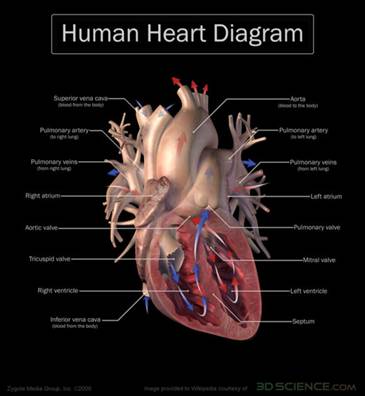 The heart is a muscular organ about the size of a clenched fist. The structure and action of the heart are designed to serve the two loops of the circulation. Inside, the heart is divided vertically by a muscular wall. On each side of this wall Is an upper chamber (atrium) and a thicker, lower chamber (ventricle). Blood moves through each side of the heart systematically. Deoxygenated blood is delivered into the right atrium. It then enters the right ventricle, from where it is pumped out into the pulmonary artery and to the lungs. Oxygenated blood returning in the pulmonary veins flows into the left atrium. This blood enters the left ventricle and is then pumped into the aorta for circulation.

|
Из за большого объема этот материал размещен на нескольких страницах:
1 2 3 4 5 6 7 8 |
