


Партнерка на США и Канаду по недвижимости, выплаты в крипто
- 30% recurring commission
- Выплаты в USDT
- Вывод каждую неделю
- Комиссия до 5 лет за каждого referral
Persons who finish the general secondary school, receive a secondary education certificate, giving them the right to enter any higher educational establishment. Entrance examinations are held in July and August. Institutions are headed by rectors; the faculties are headed by the deans. One has to study at the institute for 5 years. Higher educational institutions train students in one or several specializations.
Упражнение 6. Найдите английские эквиваленты русским словам.
1. education a) в возрасте
2. compulsory b) образование
3. middle c) средний
4. at the age d) платный
5. free of charge e) обязательный
6. fee-paying f) аттестат о среднем
образовании
7. primary g) декан
8. secondary education
certificate h) бесплатный
9. еntrance examinations i) вступительные
экзамены
10. dean j) начальный
Упражнение 7. Найдите антонимы.
1) to enter the university a) high school
2) primary school b) free - paying
3) free of charge c) elder
4) junior d) to fail exam
5) the beginning of the term e) pre-school education
6) to pass exam f) to graduate from the
university
7) school education g) the end of the term
Упражнение 8. Выберите предложения, соответствующие содержанию текста.
1) Pre – school consists of kindergartens and lyceum.
2) Compulsory education is for children from 6 (7) to 18 years
of age.
3) When students complete high grades they can continue to
study for 2 years or go to professional schools.
4) The public education system in Russia incorporates general
school and high school.
5) After the 9th form pupils have to take examinations.
6) Entrance examinations are held in July and August.
Упражнение 9. Соотнесите слово с его определением. 1) university 2) specialized school 3) academic year 4) school-leaver 5) library 6) primary school |
b) a person who finishes a general secondary school c) a place where students can get any necessary look d) high educational establishment e) a school for junior students f) school specialized in certain subjects g) a period of study including two or three terms |
Упражнение 1. Прочтите и переведите текст.
Education in Great Britain
The system of education in Great Britain is determined by the National Education Acts. Schools in England are supported from public funds. There are several basic features of public education in Britain. Firstly, there are wide variations between one part of the country and another. Secondly, education in Britain reflects the country’s social system: it is class - divided and selective. The first division is between those who pay and those who do not pay. The English school syllabus is divided into Arts and Sciences, which determines the division of the secondary school pupils into study groups. The National Education Act of 1944 provided three stages of pulsory schooling in England and Wales lasts 11 years, from the age of 5 to 16. After the age of 16 a growing number of schoolchildren are staying on at school, some until 18 or 19, the age of entry into higher educational universities. British University courses are rather short, generally lasting for 3 years. The cost of education depends on the college and speciality which one chooses.
In some areas of England there are nursery schools for children under 5 years of age. Some children between 2 and 5 receive education in nursery classes or in infant classes at primary schools. Most children start school at 5 at a primary school.
A primary school may be divided into two parts – infants and juniors. At 7 children go from the infant schools to the junior schools. They study reading, composition, history, geography, nature study. Art and music, physical education, swimming are also on the timetable. The pupils are streamed according to their abilities to learn into A, B, C streams.
After the age of 11 most children go to comprehensive school the majority of which are for both – boys and girls. About 90% of all state – financed secondary schools are of this type. Most other children receive secondary education at grammar and secondary modern schools. At 18 most public school – leavers gain entry to universities.
The academic year at Britain’s Universities, Polytechnics, Colleges of education is divided into three terms, which usually run from the beginning of October to the middle of December, from the middle of January to the end of March, and from the middle of April to the end of June or the beginning of July.
There are 46 universities in Britain. English Universities greatly differ from each other. They differ in date of foundation, size, history, tradition, general organization, methods of instruction, and way of student life. After three years of study a university graduate gets the Degree of Bachelor of Arts, Science, Engineering, Medicine, etc. Later he may continue to take the Master’s Degree and then the Doctor’s Degree. Research is an important feature of university work.
Упражнение 2. Выберите правильные предложения.
1. The system of education in Great Britain are determined by the
National Education Acts.
2. The system of education in Great Britain is determined by the
National Education Acts.
3. A primary school may be divided into two parts – infants and
juniors.
4. A primary school may be divided into three parts – infants and
juniors.
5. There is 46 universities in Britain.
6. There are 46 universities in Britain.
7. The pupils are streamed in to A, B, C, D streams.
8. The teachers are streamed to A, B, C, D streams.
Упражнение 3. Вставьте предлоги.
1. After the age of 11 most children go to comprehensive school the majority … which are … both – boys and girls.
2. … some areas of England there are nursery schools for children … 5 years … age.
3. There are 46 universities … Britain.
4. … three years of study at the university a graduate leave it … the Degree of Bachelor of Arts, Science, Engineering, Medicine, etc.
5. … 90% of all state – financed secondary schools are of this type.
(about, for, of, in, with, under, after)
Упражнение 4. Выберите глаголы, которые могут употребляться со следующими существительными.
1. education
a) to get | b) to do | c) to go | d) to send |
2. exams
a) to read | b) to write | c) to pass | d) to make |
3. school
a) to receive | b) to go to | c) to have | d) to get |
4. lectures
a) to deliver | b) to do | c) to test | d) to send |
5. research
a) to have | b) to make | c) to be | d) to do |
6. university
a) to graduate from | b) to finish | c) to complete | d) to stop |
7. general education certificate
a) to receive | b) to do | c) to make | d) to buy |
Упражнение 5. Подберите односложные ответы к каждому вопросу.
1) How long do you have to study at the institute in Russia? |
2) What do persons who finish the general secondary school receive? |
3) How long are British University courses? |
4) When do most Russian children start schooling? |
5) How many universities are there in Britain? |
6) What is an important part of university work? |
7) What new types of school appeared nowadays? |
a) Secondary education certificate. |
b) Three years. |
c) At six or seven. |
d) For five years. |
e) Forty six. |
f) Research. |
g) Gymnasiums and colleges. |
Упражнение 6. Вставьте пропущенные слова в предложения.
1. Many students take an active part in the ….
a) concerts b) social work c) discos
2. There is a … at the university.
a) swimming pool b) scientific society c) large cinema
3. Compulsory education is for children from 6 to … years of age.
a) 15 b) 18 c) 17
4. After the 9th form pupils have to take ….
a) exams b) lectures c) classes
5. High educational institutions … students in one or several specializations.
a) teach b)study c) train
6. The academic year in Great Britain is divided into three ….
a) terms b) months c) weeks
The Future Indefinite (Simple) Tense
Будущее неопределённое (простое) время
Обозначает:
однократные, повторяющиеся или постоянные действия и состояния, относящиеся к будущему времени.
Часто употребляется со словами tomorrow, next week (month, year).
My friend will go to London next Sunday.
Образуется:
при помощи вспомогательных глаголов shall (для 1 лица единственного и множественного числа) и will (во всех остальных случаях).
В последнее время will употребляется во всех лицах. Обычно употребляется сокращенная форма вспомогательных глаголов, присоединяемая к личному местоимению или существительному-подлежащему.
Вопросительная форма Future Indefinite образуется по общему правилу путем постановки вспомогательного глагола перед подлежащим, а основы инфинитива смыслового глагола – после него.
Отрицательная форма Future Indefinite образуется при помощи отрицательной частицы not, которая ставится между вспомогательным глаголом и основой инфинитива смыслового глагола.
Сокращенные формы: shall not = shan’t и will not = won’t, а так же – I’ll not (you’ll not и т. д.).
утвердительная форма | вопросительная форма | отрицательная форма |
I shall/will work He’ll, she’ll, it’ll work We’ll, you’ll, they’ll work | Shall/will I work? Will he, she, it work? Shall we work? Will you, they work? | I shall/will not work He, she, it will not work We shall not work You, they will not work |
Упражнение 7. Укажите номера предложений, сказуемые которых стоят в форме Future Simple Tense.
1. I knew the results. 2. Will you be in Moscow tomorrow? 3. Did he spend his holidays in Washington or in New York? 4. He always smokes before lunch. 5. The children will help mother to do the washing-up. 6. The Wilsons normally have breakfast at 7 o’clock. 7. I will stop here for a moment to get some petrol. 8. It was a good place for dancing.
Упражнение 8. Раскройте скобки, употребляя глаголы в форме Future Simple Tense.
1. I (to see) them next Saturday. 2. They (to be) here tomorrow. 3. We (to have) the test in a week. 4. She (to spend) holidays in the country. 5. The journey (to take) three hours. 6. I (to open) the door for you. 7. I (to go) to school tomorrow? 8. They (to come) back next week? 9. We (to leave) Kiev this evening? 10. You (to wait) for me? 11. Nick (to finish) school next year? 12. She (to agree) with you? 13. I (not to swim) tomorrow. 14. He (not to play) in the garden. 15. The weather (not to be) fine on Sunday. 16. We (not to be) busy in the evening. 17. Sheila (not to get) passport next year. 18. Why your father (to help) you? 19. When she (to study) English? 20. How we (to get) there? 21. How long the journey (to take)?
Упражнение 9. Переведите предложения. Поставьте их в отрицательную форму. Задайте общий вопрос к каждому предложению.
1. They will go to the restaurant. 2. I will have steak for dinner. 3. Mary will have fish. 4. Kate will go sightseeing. 5. I shall stay at home. 6. Barbara will come home late. 7. Nick will come here again next month. 8. The library will open at 8 o’clock. 9. Sam will bring some tapes and we shall listen to music and dance. 10. I think we shall order some light wine and shall take something very delicious. 11. The weather will be unpredictable next day. 12. It will be warm and sunny. 13. They will play chess tomorrow. 14. I will get a medical checkup. 15. We shall come to our place next Sunday. 16. She will dance tomorrow. 17. They will take care of the garden next summer.
Упражнение 10. Задайте к предложениям специальные вопросы, используя вопросительные слова в скобках.
1. They will eat eggs for breakfast. (what?) 2. She will go to the cinema after school. (where?) 3. You will eat apples tomorrow. (who?) 4. My daughter will go to the village next summer. (when?)
5. He will spend summer very merrily. (how?) 6. We shall come home so late tomorrow because we shall be very busy. (why?)
Упражнение 11. Раскройте скобки, употребляя глаголы в Present, Past или Future Simple Tense.
1. I (to go) to bed at 10 o'clock every day. 2. I (to go) to bed at 10 o'clock yesterday. 3. (to go) to bed at 10 o'clock tomorrow. 4. I (not to go) to the cinema every day. 5. I (not to go) to the cinema yesterday. 6. I (not to go) to the cinema tomorrow. 7. You (to watch) TV every day? 8. You (to watch) TV yesterday? 9. You (to watch) TV tomorrow? 10. When you (to leave) home for school every day? 11. When you (to leave) home for school yesterday? 12. When you (to leave) home for school tomorrow? 13. My brother (to go) to work.
Упражнение 12. Переведите предложения на английский язык.
1. Каждое утро он включает телевизор. 2. Прошлым летом я был очень занят и не поехал на Алтай. 3.Через 2 года у меня будет много денег.4. Им понравился вчера концерт? 5. Кто позаботится о детях в будущем? 6. Как часто ты ходишь к зубному врачу? 7. Она не умеет работать на компьютере. 8. Кто придумал Санта Клауса? 9. Что твои соседи делали вчера вечером? 10. По вечера молодые люди слушают громкую музыку. 11. Мы поедем на железнодорожный вокзал встречать маму.
Speaking
Упражнение 13. a) Say who you will see next morning (day) on the way to the college.
Example: I will see our doctor on my way to the college next morning.
b) Tell the group what games you will
play next summer (winter).
Example: I will play chess next summer.
Упражнение plete the sentences.
Example: He has dinner at three o'clock every day, but tomorrow he will have dinner at four.
1. He goes home at one o'clock, but tomorrow. . .
2. She takes three notebooks to school, but tomorrow…
3. Every summer he lives in the country, but next summer. . .
4. My uncle comes to our house every Sunday, but next Sunday he. . .
5. My father works from nine till five, but next week. . .
6. She goes to bed at ten o'clock, but tomorrow. . .
Упражнение plete the sentences and make a story. Use the Future Indefinite Tense.
In August I ... at a camp. The camp... in a big forest. We... to the forest every day. Our teacher... us many birds in the forest, and I
… the names of many birds. We … in the little river near our camp.
In the afternoon we … volleyball, basketball and other games. I … table tennis well. I... very nice time at the camp. My friend Nick... many pictures of us.
Упражнение 16. Ask and answer the questions. Work in pairs.
1. My sister will wear her new blouse. (when?)
2. I will have a lot of work to do. (why?)
3. Mary will have many good friends. (who?)
4. He will repair his bicycle in the morning (with whom?)
5. My father will go home by car. (when?)
6. She will take medicine. (how often?)
7. I am going to travel. (where?)
8. They will publish some books in July. (how many?)
Упражнение 17. Describe using the Future Simple Tense:
1. what this family will do at breakfast tomorrow in the morning;
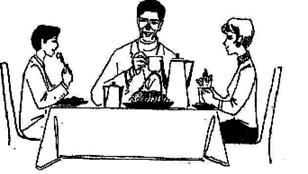
2. what you will do tomorrow in the morning, in the afternoon and in the evening.
1.4 Изучение иностранного языка
Урок 1.4.11
Страны и национальности. Языки мира.
Упражнение 1. Выучите названия стран и их столиц.
Australia – Австралия Canberra – Канберра
Austria – Австрия Vienna - Вена
Belgium – Бельгия Brussels - Брюссель
Bulgaria – Болгария Sofia - София
Canada – Канада Ottawa - Оттава
China – Китай Beijing - Пекин
France – Франция Paris - Париж
Germany – Германия Berlin - Берлин
Greece – Греция Athens - Афины
Hungary – Венгрия Budapest - Будапешт
India – Индия Delhi - Дели
Italy – Италия Rome - Румыния
Japan – Япония Tokyo - Токио
The Netherlands – Нидерланды Amsterdam - Амстердам
Poland – Польша Warsaw - Варшава
Romania – Румыния Bucharest - Бухарест
Sweden – Швеция Stockholm - Стокгольм
Switzerland – Швейцария Bern - Берн
The United States of Ameriсa - США Washington – Вашингтон
Упражнение 2. Найдите названия языков в этой головоломке.
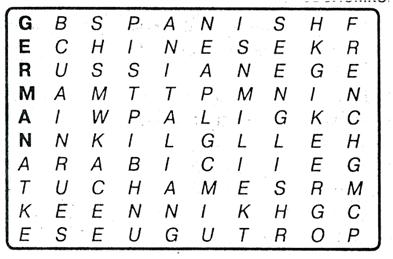
Упражнение 3. Обозначьте столицы государств.
Canberra is the capital of Australia.
 Canberra France
Paris Greece
Buenos Aires India
Athens Argentina
Ankara Australia
Delhi Turkey
Rome Spain
Madrid Italy
Упражнение 4. Найдите 10 слов, относящихся к странам и национальностям.

|
Из за большого объема этот материал размещен на нескольких страницах:
1 2 3 4 5 6 7 8 9 |
