


Партнерка на США и Канаду по недвижимости, выплаты в крипто
- 30% recurring commission
- Выплаты в USDT
- Вывод каждую неделю
- Комиссия до 5 лет за каждого referral
Omsk artists show their love to the city in their own picturesque way. We can easily recognize the brush of our popular artists K. Belov, K. Chshekotov, V. Volkov, T. Kozlov, P. Mukhin and try to understand the canvases by N. Brukhanov, N. Tretyakov, we always admire landscapes by V. Kukuytsev, A. Sapozhnikov, I. Sevokhin, R. Cherepanov, graphics by Zheliostov, A. Chermoshentsev, talented works by Kichigin and others. Though their works are different they all invite us to pay more attention to our native city, show us its beauty.
A. Lieberov is the real singer of Siberian nature. His pastels are so deep and so lyrical, you can't take you eyes off of them. Many today's artists are his apprentices. Alexey Lieberov organized the artistic-graphic faculty of the Pedagogical University, opened the Lieberov centre.
Omsk dwellers and guests of Omsk are invited by exhibition halls of the Omsk Artists' Union, here you can also buy the pictures you like. More than 100 artists are members of the Union. But not all of them are able to find their own spectators. According to this in 1991 by the City Administration was opened the municipal museum "Art of Omsk".
The idea of Russia artistic culture development through all possible assistance of provincial artistic life, its special artistic aura was taken as a principle. The author of this idea art critic V. Tchirkov has been studying the artistic "local spirit" for many years and showed the unique city feature consisting of the powerful level of young artists that didn't have until recently the output to a wide audience of spectators.
Best works by S. AIexandrov, M. Gerasimov, S. Tyrkov, A. Titov, N. Molodtsov, G. Dashkova, T. Koltyukhina, applied artist V. Novokshonov and others were collected. (Over 2000 exhibits in total.)
The city has great scientific potential. The names of academician the Honorary citizen of Omsk V. Bisyarina, academician N. Milachshenko, corresponding member of Medical Academy L. Poluektov, Honorable Science and Technics Workers K. Artemiev, T. AIexeeva, D. Krinitsin, V. Mezentsev, K. Tolmachev, social anthropologist I. Tomilov are well known in Russia and abroad.
Omsk is theatrical city. It has 5 state and 3 municipal theatres for 1200 thousand city dwellers. It's hard to buy tickets for many plays and today in the developing market relations when many theatres in different cities close, here in Omsk in the beginning of the nineties there opened 4 more theatres.
Theatricality of the city was formed by many generations of enthusiasts. We can find its sources in the fair show-booths and in the private theatre which appeared in the Omsk fortress by the order of the Siberian Corps commander lieutenant-general I. Springer in 1764 "to polish young people". In winter 1there were staged first plays and in the middle of the 19th century amateur plays were staged in Siberian Military School, there also were performances in Omsk jail. Historians say that F. Dostoyevsky took part in staging the play "Violet and Miroshka".
Today the leading city theatre — the Academic Drama Theatre occupies the premises built in with the money gathered from the city dwellers. The building was reconstructed many times and is an architectural monument now.
During different years Omsk Drama gave to Russia Vladimir Torsky, Vazlav Dvorzhetsky, Vladimir Rautbart, Spartak Mishurin, Mikhail Ulyanov. In recent years on its stage were shone the talents of People's artists Aleksey Teplov, Sergey Filippov, Nozhery Tchonishvily, Alexander Shchegolev, Boris Kashihn. The theatre's "hours of triumph" was the time when its artistic leaders were Yakov Kirzhner, Arthur Khaikin, and later Gennady Trostenetsky. Exactly at that time the theatre discovered new authors, new plays, twice became the State prize winner, was awarded the title of academic and Order of the Red Banner of Labour.
It's difficult to buy tickets to Omsk Drama. Not long ago the theatre opened a chamber stage, named after the People's artist of Russia, State prizes winner Tatyana Ozhigova.
Since the middle of the eighties, when borders have been opened theatre actively invites foreign producers and often tours abroad. The theatre was invited to the World Theatre Festival, performed in Geneva, Warsaw and Poznan, in Remscheid, got into close creative contacts with the Milwaukee (USA) repertoire theatre. There are international conferences and symposia at the theatre. But the main thing is that the theatre is beloved by Omsk dwellers.
The former Operetta Theatre received the status of Musical Theatre at the end of 1981 together with a new building erected in the center of the city by the project of Moscow architectural workshop.
The modern outward appearance, spacious foyers with pictures by the leading city painters, large but cozy auditorium, stage equipped with up-to-date sound and light devices create the special theatrical atmosphere.
But the essence is not in the building, it's in the best creative traditions, in the cast. There are about fifty soloists - vocalists in the cast and a perfect orchestra at the theatre, conducted by the chief conductor, Honoured Art Worker of Russia, Udmurtia State prize winner E. Rozen. The ballet troupe created by the cares and endeavors of the Honoured Art Worker of Russia, honorary citizen of Omsk V. Tulupova was filled to great extent by young graduates of specialized schools. The ballet is now lead by the experienced master S. Kolesnik. The theatre's chorus is multitudinous and harmonious thanks to creative cares of the chief choirmaster T. Bobrova.
Having stable creative group, the theatre collected extensive repertoire of different genres. It includes the classic opera plays, ballets, operettas.
It's hard to find among the inhabitants of Omsk the person to whom the Theatre of Children and Youth is not familiar. Not so long ago it was called the Theatre of Young Spectators and its removal to the new building was a big event in the cultural life of youth.
During last 10 years this theatre is headed by the artistic leader V. Rubanov, who was awarded the title of Honoured Art Worker of Russia Federation recently. He has formed the troupe of really creative persons sharing the same views. Among them are Honoured Artist of Russia V. Kiseleva, Honoured Culture Worker I. Abramov, leading actors S. OIenberg, A. Goncharuk and many others.
It's always animated and merrily at the Theatre of puppet, actor and mask "Harlequin". It's the theatre for the smallest children, and they unlike adults don't suppress their emotions and respond to everything happening on stage very spontaneous. Because there are fairy-tale's heroes from "Teremok", "Little Red Riding Hood", "One Inch Maid", "Three Little Pigs", who play, live, struggle with evil and children want to help them very much.
"Harlequin's" plays are known to both children and adults. Some time ago the theatre staged for them "Mess-Mend", and together with the musical theatre presented them with opera buffo "The Blue Beard".
The theatre owes its indubitable success to the leading actors- puppeteers, Honoured Artists of Russia Emira and Edward Urakovs, actors Valery and Nina Isaevs, G. VIasov, N. Kuznetsova, chief producer B. Salmachev, production designer O. Verevkina.
Four years ago enthusiasts who couldn't imagine their lives without a theatre, headed by S. Rudzinsky — young and with no doubt talented producer, staged their first performance although they didn't have neither permanent place of their own, nor necessary means. But their enthusiasm and professional skills were highly estimated by the community and spectators and the troupe became the federal Fifth Theatre.
The municipal theatre of drama and comedy the Gallery is young and talented. It was born due to the love to the theatre of a group of actors, unquestionable organizing talent of its artistic leader V. Vitko and cares of the City Administration. The theatre's orientation to the staging of home plays creates the definite image, forms the spectators' interest. The Gallery is always full and critics confirm that "...it smells like Russian spirit". Based on N. Leskov's work the musical play "Left-hander" was on for some seasons. Very popular is fair-show based on the D. Averkin's play "Frol Skobeev", filled with joy and popular humor; psychologically deep stage research by F. Dostoevsky "Village Stepantchikovo". The play "Uncle Vanya" is full of mild Chekhov lyricism.
Its fifth anniversary season the theatre celebrated with the plays by Sukhovo-Kobylin "the Marriage of Kretchinsky" and "the Marriage of Belugin" by A. Ostrovsky.
The name of Lyubov losifovna Yermolaeva is well known to Omsk theatre-lovers. Over 30 years she was in charge of people's theatres of Agricultural University and the Maluntsev palace of culture. Studiousness, ability to get people "infected" with theatre, amazing responsiveness to the creative search — all that helped former amateurs to become professional actors, poets, pressmen and simply people enamoured of theatre.
Only its first anniversary has celebrated in the 280th anniversary of the city the experimental Lyceum Theatre. It's unique. It's headed by the Honored Artist of Russia V. Reshetnikov. All directors - pedagogues are highly professional persons and the actors are the school children and pupils of Lyceums, learning theatrical secrets. They are taught the basis of stage movements, speech, history and theory of theatre. During last year they staged 4 new productions — one for each age group. They were shown at best city stages and each meeting with spectators was a success.
The city is distinguished by its musicality. The city musical environment is formed by children art schools, the Shebalin Musical College, the Omsk State Philharmonic Society with its wonderful symphony orchestra and the State Russian Peoples Chorus, created in the fifties by E. V. Kalugina — connoisseur and collector of folk song.
The musical enquiries of citizens were fully satisfied when in the beginning of nineties new city troupes were created. Among those were municipal brass band, Russian chamber orchestra "Lad", Russian folk dance ensemble "Irtysh" and the very young "Credo".
The special social-cultural milieu in the city is created by holidays. Most of them were born in Omsk and became traditional. The most bright and light feeling of life give the children's festival - concerts "The Glass Shoe", the annual city holiday "All Colors of the Rainbow".
And how wonderful are winter holidays with the bright sun and strong Siberian frost! They include the New Year holiday with obligatory merry ice sledges and fortresses, with troika rides and Siberian fun competitions, Shroventide with its fairs, skomorokhs and traditional pancakes.
The City Day is of a special interest. It's held in the beginning of August. All city parks of culture and rest with their carnival and concert programs take part in this holiday. And finally the general fireworks prepared by special scenario finish the holiday.
The Soul of Russia that's the name of a holiday born in 1992 on the City Administration's initiative. It's the holiday of Russian original national culture revival. This holiday includes creative meetings, scientific conferences on problems of revival and development of national cultures, festive gatherings in the streets and many concerts held by professionals and amateurs. The holiday of folklore song and dance which became international now is the organic part of it.
Теxt V
Omsk Region is located in the southern part of the West Siberian Plain midway along the Irtysh River. Its surface is a rolling plain with elevations of 100-140 m; ridged uplands (crests) are typical of the southern half of the region, while broad expanses of swamp are characteristic of the north. There are also many lake basins and sinks. The region has a moderately cold continental climate with long, severe winters and short summers. The average January temperature is about -20°C, and the average July temperature is +20°C.
|
E Еmblem |
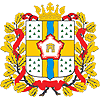
The region extends 450-500 km from north to south, which leads to considerable variation in climatic conditions. Whereas the northern part of the region receives annual precipitation of 400-500 mm and is considered relatively moist, the arid southern part receives 300 mm or less. Other indicators change accordingly: average annual temperature varies from -1.1°C in the north to +0.4°C in the south; the frost-free period, from 90-100 days in the north to 115-120 days in the south, and the vegetation period, from 153 to 162 days.
|
Flag |

All rivers belong to the basin of the Irtysh River, which flows through the region for more than 1000 km. The water content of the Irtysh at the city of Omsk based on average long-term discharge rates is equal to 865 m3/s. Its largest tributaries within the region are the Om and Tara rivers. The river network is sparse in the south and fairly dense in the north; the rivers are mainly snow-fed and have a pronounced spring runoff. Lakes in the south are mostly saline, while those in the north are generally fresh.
The predominant soils are black earths (chernozems), which cover 23.6% of the region (3.3 million hectares), followed by boggy (21%), alkali and brackish (15.6%), podzolic (13.3%), degraded alkali (7.3%), meadow (5.8%), gray forest (5.7%), and sod-podzolic soils (3.6%). Chernozems are the most developed soils.
Most of the region's vegetation is characteristic of the steppe and forest steppe zones, except for the north, which is in the taiga forest subzone. Forests cover more than one-quarter of Omsk Region, with the predominant species being pine, cedar, spruce, fir, birch, and aspen. In the southern part of the forest zone, mixed forest gives way to a belt of deciduous birch and aspen forests, which gradually changes southwards to the "parkland" of the forest steppe zone. The most valuable game and fur animals of the forest zone are squirrels, Siberian weasel, ermine, fox, roe deer, moose, wolf, and bear. The fox, varying hare, and steppe polecat are typical inhabitants of the forest steppe, while the red-cheeked ground squirrel lives on the steppe. Large numbers of ducks and geese are summer residents of the lakes and old riverbeds. Black grouse, gray partridge, and wood grouse are encountered in the forest steppe and forest zones.
HISTORY
In historic times, many different peoples migrated through the central Irtysh region where forest and steppe cultures mingled. The native Ugrian population (the ancestors of the modern Hungarians) assimilated with the Huns in the 4th and 5th centuries A. D. during the Great Migration. In the Middle Ages, the southern territory of Western Siberia was part of various nomad empires from the Western Turkic Kaganat to the Siberian Khanate and was the birthplace of the Siberian Tatar culture. The region was fairly densely populated during this period, as evidenced by hundreds of archeological and historical monuments, e. g., the burial mounds (kurgans) in Ust-Ishim, Tebenda, Aitkulovo, and other places.
The historical fortunes of many Eurasian peoples-Indo-Europeans,
Samodians, Finno-Ugrians, Mongolians, and Turks-were linked with the territory of present-day Omsk Region.
The southern forest steppe zone was suitable for farming and cattle herding; it was also a migration route for various tribes, and many trade routes passed through it. The north was attractive for its forests and furs. Mongols, Jungars, Kalmyks, Magyars, Mansis, Khantys, Kimaks, Teleuts, Shors, Uzbeks, Tajiks, Nogais, and Turkmen are only some of the nations who lived in the Irtysh region in the pre-Russian period.
The history of Russian settlement and development of the Irtysh region is connected above all with the legendary Cossack leader (hetman) Ermak Timofeevich (late 16th century), although Russian traders from the Pre-Urals had visited the Siberian Khanate as early as the 15th century. A raid by a small detachment of Ermak's Cossacks on the lands of Khan Kuchum in 1581 began the "Sunward" movement, a process of Russian colonization of Siberia unprecedented in its rapidity.
After defeating Kuchum, Ermak made a number of campaigns to southern Siberia between 1582 and 1585. During that time (), he reached the boundaries of present-day Omsk Region and the towns of Tebenda and Tashetkana, whose residents voluntarily acknowledged his authority. The southernmost point reached by Ermak's forces was the small town of Ust-Shish. In 1594, a few years after Ermak's death at the mouth of the Bagai River, troops of Prince Andrei Eletsky founded the city of Tara, which became an outpost of Russian colonization of Western Siberia in the 17th and 18th centuries.
Settlement of the region by Russian farmers and Cossacks began in the north and during the 17th century did not go beyond the boundary between forest and steppe. There were frequent battles between Russians and nomads. Jungar forces besieged Tara in 1635, but the townspeople beat off the attack and saved the city.
In spring 1716, after returning from a campaign to the upper Irtysh, a Cossack detachment of Colonel Ivan Bukhgolts (an associate of Peter the Great and a participant in the battle of Poltava) founded Omsk fortress at the mouth of the Om River with the consent of Tobolsk Governor M. Gagarin. The fortress became the main outpost of the southern boundaries of the Russian Empire in the 18th century. During that time, Omsk functioned as a fortress and was the principal base of the Presno-Gorkovskaya line of outposts (named after the lakes) and a sturdy defender of the developing agricultural settlements against Jungar expansion. The Tara revolt of 1722-an antifeudal uprising of Cossacks and Old Believers brutally suppressed by a military expedition from Tobolsk-was an important event in the history of 18th-century Siberia.
POPULATION
About 2 people live in Omsk Region, 65% of them (about 1 people) in urban areas. The city of Omsk has a population of 1 people.
Ethnic composition: Russians, 81.0%; Germans, 6.0%; Ukrainians, 4.9%; Tatars, 2.2%. Employment by economic sector (as a % of total employment): industry, 25.5% (29.9% in the Russian Federation); agriculture 18.9% (12.8%); trade, 9.8% (9.1%); culture, 12.9% (13.6%); management, 2.0% (2.3%).
NATURAL RESOURCES
Mineral resources include clay, sand, and deposits of marl and peat in northern districts. Omsk Region has abundant water resources. There are more than 2000 rivers and streams with a total length of 8000 km and nearlylakes, including 245 salt lakes. The largest lake is Lake Saltaim. Bogs cover more than 3.5 million hectares, or more than 25% of the region's total area.
As the region is located within the forest, forest steppe, and steppe zones, it has a variety of soils. Soil characteristics in the forest zone change from north to south. Gray forest, peat bog, and valley soils predominate in the northern part, but change to chernozems and meadow chernozems to the south. Chernozems are widespread in the steppe zone, but alkaline and saline soils are also encountered. More than 25% of the region's agricultural land is exposed to wind and water erosion.
Forests are one of the region's most important resources. The forest cover varies from mixed coniferous and softwood forests in the forest zone to forest steppe parkland consisting of birch and aspen groves between open expanses of meadow and steppe vegetation. An almost complete absence of trees and fewer varieties of herbaceous plants compared to the forest steppe characterize the steppe zone. More than 80 species of medicinal herbs grow in the region.

|
Из за большого объема этот материал размещен на нескольких страницах:
1 2 3 4 5 6 7 8 9 |
