


Партнерка на США и Канаду по недвижимости, выплаты в крипто
- 30% recurring commission
- Выплаты в USDT
- Вывод каждую неделю
- Комиссия до 5 лет за каждого referral
coaxialcable - коаксиальный кабель ( электрический провод, применяемый в сетях, имеющий соосное (коаксиальное) расположение центрального проводника, окруженного изолятором, и внешнего проводника, выполненного в виде проволочной оплетки; снаружи покрыт еще одним защитным слоем изолятора; менее подвержен помехам и ослаблению сигнала по сравнению с другими типами кабеля )
wires – провода
cable - кабель
headend – головной узел (в компьютерной сети)
amplifier – усилитель
Cordless telephones = wireless telephones
bentpipes - коленчатые трубы
relay – радиорелейная
EXERCISE 3
Match the following phrases with their Russian meanings:
fiber-optic hair-thin strands "backbone" link AM (amplitude modulation) FM (frequency modulation) high-capacity links Communications satellites orbit geostationary geosynchronous orbit scatter |
амплитудная модуляция; магистральная линия связи; магистральный канал связи; геосинхронная орбита; частотная модуляция; двигаться или вращаться по орбите распылять, рассеивать; жила (кабеля) толщиною с волос; высокоэффективные связи; геостационарный; волоконно-оптический, оптоволоконный; |
EXERCISE 4
Make up your own sentences with the word combinations and phrases from exercise 2
EXERCISE 5
Answer the questions
What was the original medium for telecommunications? What is still the primary means for telephone connections? What did the Wireline transmission start from? What is the main purpose of coaxial cable?Text II
Fiber-Optic Cables
EXERCISE 1 Find the mistake in each line. It can be either the usage of article, modal verb, adverb, grammar tenses, nouns, pronoun or preposition.
0 Fiber-optic cables use specially treated glass that could 1transmit signals on the form of pulsed beams of laser 2light. Fiber-optic cables carry much times more 3informations than copper wires can and they can transmit 4some television channels or thousands of telephone 5conversations in the same time. Fiber-optic technology 6have replaced copper wires for most transoceanic routes 7and in areas where large amounts of datum are sent. This 8technology uses laser transmitters for send pulses of light 9via hair-thin strands of special prepared glass fibers. 10New improvements promises cables that can transmit 11millions of telephone calls over an single fiber. Already 12fiber optic cables provides the high capacity "backbone" 13links necessary to carry from the enormous and growing 14volume to telecommunications and Internet traffic. | 0__ could - can_________ 1_____________________ 2_____________________ 3_____________________ 4_____________________ 5_____________________ 6_____________________ 7_____________________ 8_____________________ 9_____________________ 10____________________ 11____________________ 12____________________ 13____________________ 14____________________ |
EXERCISE 2
Read and translate the text. Make up the questions to it. Retell the information.
Wireless telecommunications use radio waves, sent through space from one antenna to another, as the medium for communication. Radio waves are used for receiving AM and FM radio and for receiving television. Cordless telephones and wireless radiotelephone services, such as cellular radiotelephones and pagers, also use radio waves. Telephone companies use microwaves to send signals over long distances. Microwaves use higher frequencies than the radio waves used for AM, FM, or cellular telephone transmissions, and they can transmit larger amounts of data more efficiently. Microwaves have characteristics similar to those of visible light waves and transmit pencil-thin beams that can be received using dish-shaped ch narrow beams can be focused to a particular destination and provide reliable transmissions over short distances on Earth. Even higher and narrower beams provide the high-capacity links to and from satellites. The high frequencies easily penetrate the ionosphere (a layer of Earth’s atmosphere that blocks low-frequency waves) and provide a high-quality signal.
Text III
Radio waves
EXERCISE 1
Read and translate the text
Radio waves are known to be general means of data transport in communication engineering. Radio waves were reported to be discovered by Henry Hertz in 1887. He was conducting experiments in his laboratory: two spheres were placed on the top of two rods and charged oppositely, the scientist observed a spark between them. Close to those spheres there was placed another piece of wire with neutrally charged spheres on its ends. Hertz could see a spark between them too. This strange phenomenon proved that radio waves really existed.
In Russia there were conducted experiments in order to discover radio waves. Alexander Popov succeeded in developing a device which proved the existence of radio waves. It was a lightning detector which determined the stroke of lightning. All these experiments justified ability of radio waves to be transmitted in the open field without special conducting means (wires).
When alternating current passes through a piece of wire, electromagnetic field is produced around it. This electromagnetic field fluctuates according to changes in electric current. The fluctuations can spread to great distance very quickly, their speed being close to light speed (about 300000 km/s). If there is a piece of wire or an aerial in the distance, it can receive these fluctuations. Data transportation takes place. Hence, radio waves are a form of electromagnetic radiation, created whenever a charged object (in normal radio transmission, an electron) accelerates with a frequency that lies in the radio frequency (RF) portion of the electromagnetic spectrum. In radio, this acceleration is caused by an alternating current in an antenna. Radio is the wireless transmission of signals, by modulation of electromagnetic waves with frequencies below those of visible light.
Radio waves have specific features: frequency and period. Fluctuation frequency of a radio wave f Hz is a number of fluctuations per a unit of time. Fluctuation period T sec is a time of one full fluctuation. Radio waves are divided according to the frequency range:
Low-frequency with fluctuation rate is about 30 kHz – 300 kHz;
Mid range – about 300 kHz – 3 MHz
High frequency – over 3 MHz
Radio frequencies occupy the range from a few tens of hertz to three hundred gigahertz, although commercially important uses of radio use only a small part of this spectrum.
To transmit data there are used special wave bands because wave transmission of certain frequency depends greatly from surrounding environment and noises. That is why radio waves are usually classified according to the following wave bands: long (kilometric) waves, medium (hectometric) waves, short waves, ultrashort waves (UHF), metric waves, microwaves, centimetric (infrared) waves, millimetric (visible light) waves, and submillimetric(X-rays and gamma rays) waves. Since the energy of an individual photon of radio frequency is too low to remove an electron from an atom, radio waves are classified as non-ionizing radiation.
One can often hear of radio waves in our everyday life. The most common example of receiving and transmitting radio waves is cellular phones. Radio waves help to transmit data from satellites to TV system and broadcast system. Even micro ovens (or SHF – Super High Frequency ovens) in our kitchens use radio waves to warm food.
EXERCISE 2
Words and expressions to be remembered:
Data transport – передачаданных
spark – вспышка, разряд
coherer – радио, когерер
contentious – спорный
hindsight – ретроспектива, взгляд в прошлое
bandwidth – полоса пропускания
topublicize – объявлять, предавать гласности
lightningdetector – обнаружитель молнии
amplitude-modulated - aмплитудно-модулированный
to fluctuate – колебаться
full fluctuation – полноеколебание
wire - провод
frequency-частота
time spread - период
non-ionizing radiation – неионизирующееизлучение
EXERCISE 3
Answer questions about the text.
1.Who discovered the existence of radio waves?
2.What is a nature of a radio wave?
3.How does data transportation take place?
4.What definition of a radio wave can you give?
5.What specific features do radio waves have?
6. How are the wave bands usually classified?
7.What is a wave band?
8.Where are radio waves used?
EXERCISE 3
In the picture you can see the way that original sound passes before it becomes reproduced sound. Describe this way in your own words.
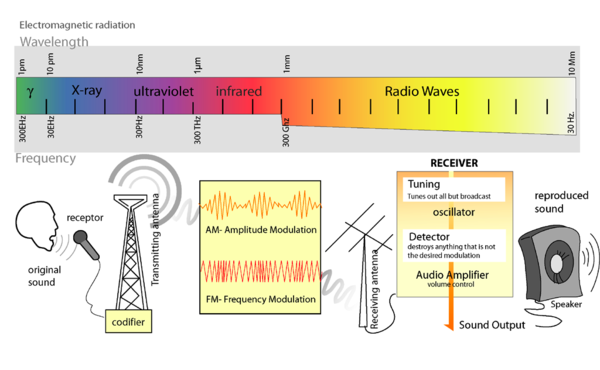
Fig.1 Electromagnetic spectrum and diagram of radio transmission of an audio signal.
EXERCISE 4
Work in pairs. Ask and answer questions about the inventions of the scientists.
A: What happened in 1894?
B: Alexander Popov invented the first radio.
A: What happened in… ?
The identity of the original inventor of radio, at the time called wireless telegraphy, is contentious. The controversy over who invented the radio, with the benefit of hindsight, can be broken down as follows:
1894 - Alexander Popov built his first radio receiver, which contained a coherer (detecting device consisting of tubes filled with iron filings).
1895, May 7 - Further refined as a lightning detector, it was presented on the Russian Physical and Chemical Society.
1893 - Nikola Tesla developed means to reliably produce radio frequencies, publicly demonstrated the principles of radio, and transmitted long-distance signals. He holds the US patent for the invention of the radio defined as "wireless transmission of data."

|
Из за большого объема этот материал размещен на нескольких страницах:
1 2 3 4 5 6 7 8 9 10 11 12 13 14 15 16 17 18 19 20 21 22 23 24 25 26 27 28 29 30 31 32 33 34 35 36 37 38 39 40 41 42 |
