

Партнерка на США и Канаду по недвижимости, выплаты в крипто
- 30% recurring commission
- Выплаты в USDT
- Вывод каждую неделю
- Комиссия до 5 лет за каждого referral

Effect of external business environment factors that do not depend on the company management efforts
|
 |


|
|
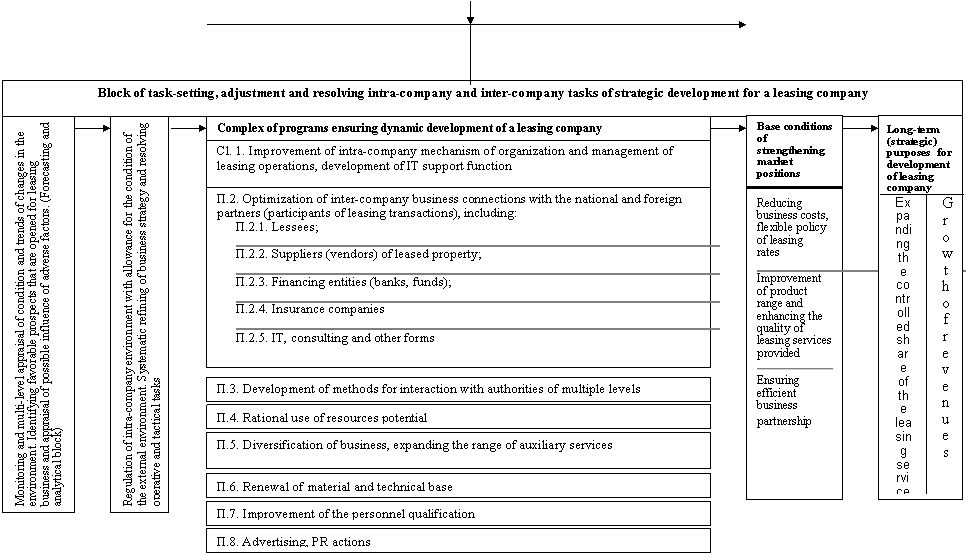
Fig. 11. Flow chart of dynamic development of leasing companies to be achieved
Continuous dynamical processes are being observed in the external environment. Some particular factors are declining while the others tend to increase. One part of these processes opens new opportunities for a leasing company and forms favorable conditions for it. The other part, on the contrary, creates extra difficulties and restrictions. To be able to successfully survive in the long-term prospective, management of a leasing company should be able to forecast constraints and new opportunities.
In strategic planning, when studying the external environment, it is necessary to identify the (emerging) threats and opportunities in such external environment. To be able to successfully cope with threats and efficiently take opportunities, it is not enough to just predict them. One may be aware of a threat though may appear not being able to oppose it and thereby fail. It is possible to assume new opening opportunities but lack potential for their implementation, and hence, fail to use them. This potential characterizes strengths and weaknesses of a leasing company, the opportunity of its successful development in the long-term prospect. Therefore, when performing analysis of internal environment it is necessary to discover, what strengths and weaknesses are specific for each subdivision and the company as a whole.
Such comprehensive analysis should be focused on the identification of threats and opportunities that may arise in the external environment in relation to a leasing company. SWOT method can be used for such task - this is abbreviation made of the first letters of the following English words: Strength, Weakness, Opportunity, and Threat. This method makes it possible to review the external and internal environment; to identify the links between the strengths and weaknesses that are inherent to a particular leasing company, external threats and opportunities. This assumes first of all, identification of strengths and weaknesses, threats and opportunities, and then identification of their interconnections, which further can be used for development strategy determination.
The analysis of functioning conditions for leasing makes it possible to assert the following: characteristics of their positions strengths may include the following:
availability of necessary financial, material and other resources;
competence of the company management and personnel in leasing, marketing, logistical and investment areas;
knowledge of leasing know-how;
ability to promptly raise finance required for a particular leasing transaction;
tested and proven system of business partnership and good reputation of the company;
Protection from competitive pressure and business risks;
High quality of work and strict compliance with contractual terms;
attractive price quotations for services,
flexible pricing policy and low costs;
ability to provide additional services and diversify business;
competitiveness and liquidity of the leased property;
efficient marketing, management, modern technologies and operations schemes;
Propensity to innovations and other.
Weaknesses of the positions held by leasing companies may include the following:
low technological level and insufficient resources;
insufficient managerial experience and lack of qualified professionals, insufficient motivation in work and high turnover of staff;
insufficient knowledge of leasing and associated services market, poor marketing and logistical abilities,
poor advertising;
limited opportunities for prompt mobilization of financial resources for leasing transactions;
high prices for rendered services and low profitability of work;
existence of serious problems in business;
Inability to resist to competition pressure and insufficient protection from business risks;
outdated technologies, principles and schemes of operation, disregard to diversification problems;
low efficiency of interaction with partners with excessive dependence on them and other deficiencies that compromise the leasing company reputation.
Favourable opportunities, which must be foreseen and monitored by the lesser management may be identified as follows: opportunity for entering new markets (segments) of leasing and associated services, expansion of positions on the existing markets; acceleration of the market growth, a participant is a leasing company; exit of competitors from the market; establishing more efficient business ties and integration of business; reduced interest rates for bank loans, obtaining additional support and guarantees from the government, optimization of tax, customs, tariff and amortization (depreciation) policy; increase of economic stability of business partners; improvement of IT support; reduction of prices for leased objects and others.
Probable threats for the company management: emergence of new competitors and growth of sales of the substitute products (services); decrease of investment activity in the economy and slumped growth rates of the market, which participant is the lessor; deterioration of macroeconomic support system; increase of probability, scope and types of business risks, decreased level of protection against them; decreased efficiency of business partnership and deteriorating economic situation of partner firms; change of the lessees requirements; increasing negotiating power of leasing subjects (sellers, lessees), cooperating with the leasing company and others.
Each particular leasing company can supplement the characteristics of external and internal environment by other data that reflect the real situation. The integrated systematized structure of strengths and weaknesses of the leasing companies, and also the threats and opportunities created for them from the side of the external environment is presented in Appendix 3.
Having precisely identified the list of weaknesses and strengths of a leasing company, the threats and opportunities that arise for the leasing company it is necessary to identify the connections between them. For this purpose we designed the matrix for analysis of opportunities and threats arising for the leasing company (see Fig. 12).
In the left part of the matrix there are two sections that are identified (strengths, weaknesses), into which accordingly we shall include all leasing company characteristics that have been identified at the first stage of the company analysis. In the upper part of the matrix there are two section that have been selected (opportunities and threats), into which we have included all identified prospects for change of operating conditions.
Prospects of change in conditions Specifics operation condition of leasing company | Opportunities 1, 2, 3. … | Threats 1, 2, 3. … |
Strengths.. | A | C |
Weaknesses.. | B | D |
Fig. 12. Matrix of the analysis of opportunities and threats for the leasing company with allowance for strength and weakness of its positions
On the crossections the following positions are formed:
Field "A" (strength and opportunities);
Field "B" (weakness and opportunities);
Field "C" (strength and threats);
Field "D" (weakness and threats).
On each field in the process of the analysis it is necessary to select pair combinations, which should be taken into account in the process of design of the strategy for economic behavior of a leasing company.
On the basis of the analysis of combinations in field "A" it is necessary to design a strategy for use of strengths of a leasing company to obtain a useful effect from the opportunities, which emerged in the external environment. For combinations on field "B" the strategy should be designed in such a way so that on the basis of the emerged opportunities to attempt to overcome the existing weaknesses in the company. If the set of combinations is located in field "C", the strategy of the lessor should assume the use of its strength for elimination of the threat. In case of combinations in field "D" the company management should design a strategy, which would enable it to eliminate the weakness of its position and to try to prevent the arising threat.
When maintaining competitive position and designing the company investment strategy, leasing companies should bear in mind that opportunities and threats may change polarity. Thus, a non-realized opportunity may become a threat if used by a competitor. And on the contrary, a successfully prevented threat may create a strength for the leasing company if competitors have not eliminated such threat.
To successfully apply the above methodology of the analysis of business prospects it is important to identify the threats and opportunities and to appraise the relevance of each of the identified threats and opportunity for the lessor in order to take them into account in its strategy.
Improvement of economic stability, investment activity and competitive ability of the leasing companies is achieved not only through their intra-company efforts, but also through establishing multiple efficient ties with business partners.
Material risks and developing models of economic behavior of investors and leasing companies determine the change of many forms and methods of their performance. In conditions of high uncertainty of the environment the forms of establishing inter-company ties should be modified. For minimization of risks there has been proposed a technique for organization of mutual relationship with the lessees on the base of the ordering and standardization of their functions.
Selection of partners among lessees is possible on the basis of a stage-by-stage comprehensive appraisal of their opportunities in the realization of particular investment projects. The expediency of business ties can be appraised by the special technique of the analysis of the market prospects for investment projects and by multiple factor appraisal of the opportunities for potential lessees in realization of such projects. The technique includes multi-criteria review of:
the market segment occupied by the potential lessee partner;
financial condition of the lessee (solvency, liquidity, sources of finance and dependence on credit resources);
production potential of the lessee (production facilities and supplies, technological opportunities, reliability of rights to use the production floor space on which it is expected to install equipment, profitability of production);
staffing support for the lessee (qualification, skill level and specialization of personnel, conformity of vocational training of the operating personnel and managerial staff to the requirements of the investment project);
efficiency of organizational and managerial structure of the lessee;
condition of procurement and distribution system and the level of logistics function, rationality of the geographical location of the potential lessee;
Attitudes of the lessee to the quality of production and to its own image; principles of market behavior and business ethics (characteristics of the proprietor);
level of the lessee's cooperation with competitor leasing companies;
condition and trends for development of the market segment for operating in which the appropriate fixed assets may be transferred to the lessee (scale of segment, dynamics of its development, level of competition);
competitive ability (by price / quality ratio) and potential demand for the products, which are scheduled for production by the leased equipment;
Rate of return on the invested capital for the investment project, payback period and possible risks; some other aspects.
Multi-criteria characteristics can be systematized into the following three big blocks:
opportunities of the potential lessee;
quality, competitive ability and demand for the product, which is to be manufactured under the investment project;
integrated indicators of the efficiency of the investment project and the associated risks.
Grouping of criteria for appraisal of the prospects of the leasing relationship is shown on Fig. 13.
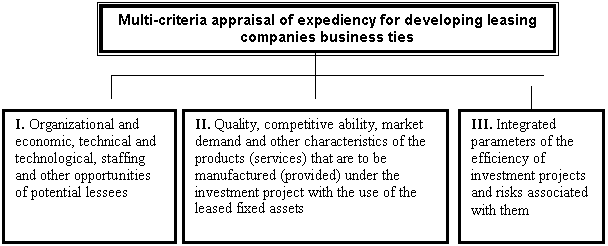
Fig. 13. Classification of the criteria applied to appraisal of the prospects for leasing relationship
Setting up and development of leasing companies does not exclude their voluntary associations on a contractual basis, for example, into trade associations and in other unions.
Sinergy strategy, which is inherent to business partnership, assumes that interacting business entities, investment companies and leasing companies obtain additional benefits through the account of coordinated use of resources and owing to other factors. Synergy-based approach makes it possible to obtain more meaningful economic results for each cooperating structure in comparison with those obtained without such interaction. Motivation and consequences of association of leasing companies are shown in Fig. 14.
Development of leasing operations requires improvement of methods for managing leasing companies operations, and also administrative toolkit for other participants of leasing operations if such development was neglected. The known techniques that are used for calculation of leasing payments are focused on the interests of the lessor, whereas productivity of leasing operations requires comprehensively taking into account and integrating the interests of all cooperating participants of leasing relationship.
To enhance the performance efficiency of leasing companies it is necessary to activate the potential of innovational management as a tool for optimization of lessee enterprises operations. Innovative management, which is focused on upgrade of business and based upon the investment opportunities (in particular, on leasing opportunities), should be taken as an element of strategic management of an enterprise development on the basis of systematic renewal of fixed assets and implementation of innovations.
Key principles of efficient innovation activities
 |
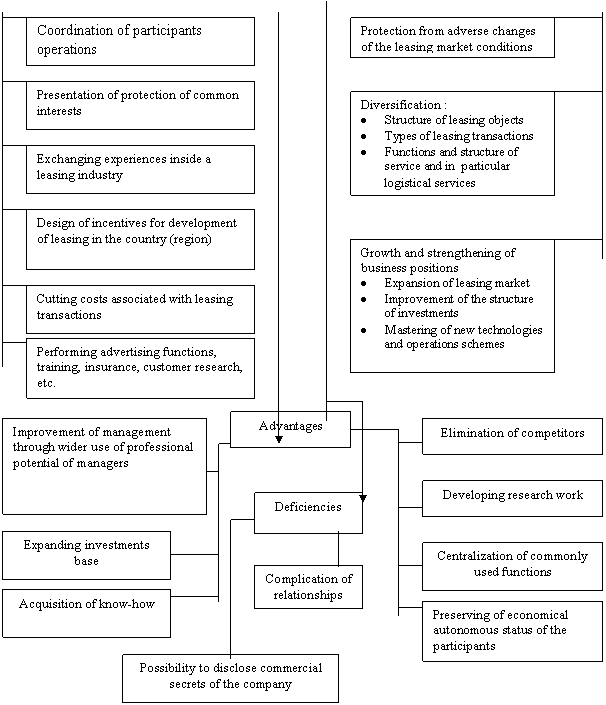 |
Fig. 14. Motivation and consequences of joining the system of leasing companies
performed by lessees:
Systematic approach and integrated approach;
Purposefulness and priority ranking;
Coordination and timing.
Key stages of innovation management:
search for, selection and systematizing of new technological, design, organizational and economic ideas and solutions;
appraisal of opportunities, expenditures and results of the practical implementation of innovations on the basis of the development of investment processes; design of detailed implementation program, for example, with the use of leasing opportunities;
organization of practical implementation of innovations;
control over the implemenation process, analysis and adjustment of economic behavior with allowance for results of innovations and modernization of production.
Creation of and functioning of a complex and flexible system for control of innovation processes that are focused on modernization of production and enhancement of the efficiency of business assumes a point-to-point mechanism for regulation of innovations starting from the point of the emergence of new solutions and through to the point of their implementation. Those subdivisions of companies that are dealing with technical policy and innovations should operate in accord with each other and on the basis of continuous coordination to be performed by a dedicated department. One of the possible options for such department could be a task group for innovations, investments and analysis of development prospects. Such group should be assisted by specialists from the major units. The methodology and principles of innovation management with the use of investment processes, in particular, with the use of leasing, are applicable for a wide range of business entities for the purpose of renewal of production facilities.
Russian lessees show a steadily growing interest to the expensive but better quality import equipment. Thus, in "SDM-leasing" company the share of leasing of foreign equipment in 2003 accounted to about 60 % of the total volume of transactions, in "Petroleasing-Management" this share accounted to over 80 %.
As for leasing transactions in foreign trade sector it is observed that suppliers of import equipment normally provide full range of services, longer periods of warranties, buy-back guarantee, and also promote contracting of export-import agencies and western financial institutions for financing of leasing transactions. The national suppliers have not yet adapted to the market and rational business partnership in the leasing sector.[72]. It is rather difficult to obtain discounts from them, whereas foreign firms offer all sorts of various discounts, as well as commodity credit, deferrals and multiple services. It is easier to obtain finance under their products, especially from foreign lenders. Foreign suppliers understand that it is necessary fist of all to grant finance to the Russian buyers in order to maintain trade with Russia. Bearing these circumstances in mind, it is possible to recommend to expand the scope of leasing transactions in the foreign market and to optimize methods of participation in leasing transactions performed by the national suppliers.
When effecting leasing transactions within the framework of cross-border business transactions it is necessary to take into account that the laws regulating leasing business in many countries have their national specifics. Such specifics imply that all procedures and regulations related to leasing transactions need to be thoroughly reviewed in those countries whose companies may become participants of leasing transactions. If such procedures and regulations are exactly taken into account it will be possible to select optimal terms for investment business partnership.
3.2. Design and implementation of investment projects on the level of a single company
Active participation of the government in financing of major investment projects designed by the national companies assumes existence of precisely set criteria that serve a basis for identifying the necessary level of interference by the government. This paragraph deals with indirect influence of the government on the economies of companies development where the government provides finance for major investments projects. The key criterion for successful investment policy of a company is economic efficiency of a given project for the government.
Availability of sinking funds enables a company to finance solely repair of old equipment or replace such equipment for similar new equipment. Normally current profit is not sufficient for modernization. If a serious modernization of production is necessary, a company has to choose among the following alternatives: to search for a strategic investor who would invest its own funds, to obtain a loan from a bank; to purchase the equipment on leasing terms. Where a bank loan is obtained from some particular companies, the following problem arises: fundamental modernization of production under today's conditions requires substantial funds and the payback-period of such modernization is 5 years and more. Therefore, it is a huge problem to obtain a bank loan in the developing countries with underdeveloped banking system and high credit risks. In case of leasing Russian companies it is necessary to pay the cost of the equipment within a short period of time. In case of fundamental modernization, given the time costs of installation work and start-up of production facilities, the leasing sharply deteriorates economic characteristics of the project. In such situation the government must pursue a policy that would create incentives for investments into production faculties of the recipient company and must become an active participant of this process.
Let us review the situation where the government takes an active position in the investments. Investment means loans granted by the government for a certain investment project, which is related to manufacture of products (for example, construction of a factory) on interest accrual basis or means investment of funds in exchange for a certain participatory share in such project. The government has the following options for financing of investment projects:
· in case of the budget surplus, the government may invest the available surplus funds into production facilities of this or that particular company;
· the government may obtain credit abroad;
· the government may issue securities to raise the required funds.
The option related to the budget surplus, as shows the experience of the less developing countries is not sufficiently applicable to the Russian companies. It cannot substantially change the situation because the amount of available surplus will be insufficient for investment into the necessary number of projects at the same time. Therefore, option 1 and option 2 are reviewed in detail in this paragraph.
Let us review the following situation. A company has designed a major investment project for production development, for example, for construction of a factory to be up to all applicable global standards.
· to implement the project it is required to obtain credit to the amount of 30 billion roubles. The credit should be repaid within 5 years. The credit is granted at 10 % annual interest (simple interest).
· Start-up by date: 2 years.
· The project is recouped after 3 years of the enterprise operation.
· No inflation, i. e. the exchange rate stays within 30 roubles per 1 dollar.
Let us review the first option: the government obtains the loan from abroad to finance the project. This option is shown on Fig. 15 (external credit) and on Fig. 16 (return of external credit) and it implies the following: dollars are promptly exchanged by the authorized bank into roubles; the stock exchange provides intermediary services at no cost; the credit is obtained and repaid instantly.
Fig. 15 illustrates the following scheme: the government obtains a credit to the amount of 1 billion dollars from a western bank under an investment project that satisfies the aforesaid conditions. The funds are credited to the account with the authorized bank, which exchanges these funds at the stock exchange by withdrawing 30 billion roubles and receiving 1 billion dollars. Therewith, effect Д1 occurrs: dollar exchange rate is up, rouble exchange rate is down. The banks, which have purchased the dollars, obtain 1 billion dollars of available funds (effect Д2). The funds are invested into the project. The result of this stage is as follows: the banking system of the country obtained 1 billion dollars; the quantity of roubles in the national economy has not changed. E1 effect is worth mentioning here. This effect occurs in the both options. It implies that the funds invested into the project, start working for the economy, thereby creating a multiplication effect.
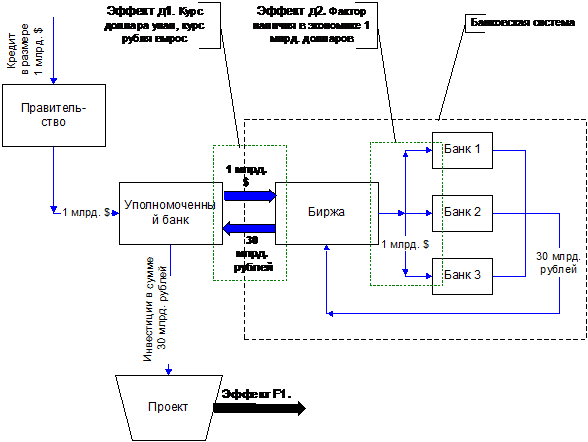
Figure 15. Lending scheme under which a credit is obtained from abroad
Fig. 16 illustrates the processes associated with the credit return. After 5 years the amount of 45 billion roubles (30 billion of the principal and 15 billion roubles of interest) are removed from the project and credited to the account of the authorized bank from other banks. The authorized bank sells this money to the stock exchange having removed 1.5 billion dollars from the turnover and having included 45 billion roubles into the turnover. Therewith effect Д3 occurrs: rouble exchange rate is down, dollar exchange rate is up. The banks, which have purchased roubles, obtain 45 billion roubles of available cash (effect Д4). Therewith, the total quantity of roubles in the banking system has not changed, and 1.5 billion dollars are transferred to the western creditor bank (effect Д5)! The result of this stage is as follows: 1.5 billion dollars were removed from the national banking system.
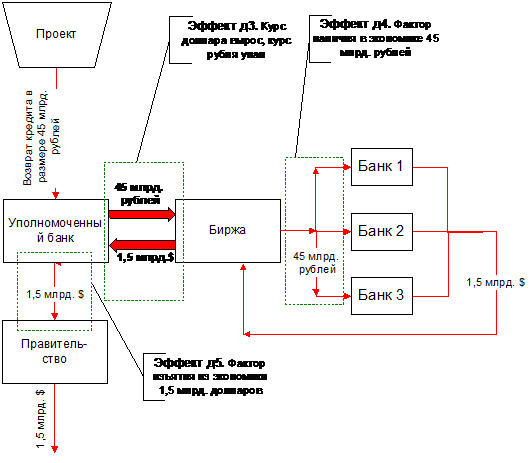
Fig. 16. Lending scheme: repayment of foreign credit
Influence of the aforesaid effects on the economy is shown in Table 16.
This is just the first level of the reviewed influence, which is produced on the national economy by a big credit obtained and repaid. On the second level of our review it is necessary to take into account the fact of the extended period of obtained repaid credit. Under such scenario the funds are remitted step by step and by installments; the influence of all aforesaid effects will be smoothed and some particular effects may not even occur at all.
Table 16.
Effects arising in a situation where a foreign credit is obtained
Effect | Origin of effect | Description of effect | Result |
Д1 | USD dollar exchange rate is down, the rouble exchange rate is up | The upsurge of the exchange rate is caused by 1 billion dollars inflow at the financial market. | Exchange rate may change by any value but there is a possibility to determine threshold levels of the credit that cause negligible influence on the national economy (for example, 1.5-2 % of the Central Bank reserves) (0) |
Д2 | Factor of 1 billion dollars staying in the national economy | Influences the behavior of importers and exporters. | The origin of the influence depends on the current market condition and is therefore equal to zero as average. (0) |
Д3 | The US dollar exchange rate is up, the rouble exchange rate is down | The upsurge of the exchange rate, which is caused by 45 billion roubles inflow at the financial market | It is possible to rely on the ignorable small change of the exchange rate as there is a possibility to calculate the threshold levels of the loan under which their influence on the national economy is ignorably small (for example, 1.5-2 % of the Central Bank reserves) (0) |
Д4 | Factor of 45 billion roubles staying in the national economy | The quantity of roubles in national economy does not change (no issue). | The effect does not influence the national economy howsoever. (0) |
Д5 | Factor of 1m 5 dollars removed from the economy/ | Negative influence. | 1 billion dollars of the principal and 0,5 billion dollars of the accrued interest shall be removed from the state budget to the benefit of the western lending bank (-) |
Let's consider option two under which the government performs a limited currency issue (Fig. 17 and Fig.18).

|
Из за большого объема этот материал размещен на нескольких страницах:
1 2 3 4 5 6 7 8 9 10 11 12 13 14 15 16 |
