

Партнерка на США и Канаду по недвижимости, выплаты в крипто
- 30% recurring commission
- Выплаты в USDT
- Вывод каждую неделю
- Комиссия до 5 лет за каждого referral
* 1995 - in trillion roubles.
by business entities who normally carry some particular innovations. The key factor for such strategies implementation is presented by the investments that are being transformed in the investment sphere, while the conception is taking a tangible shape.
The level of investment sphere development determines the potential for development of any particular economic system. Creation of a powerful potential for investment sphere in free market conditions depends on the whole set of business entities, who are focused not only on innovations but also on the market demand. Subjects of entrepreneurial activities are individuals and legal entities of private sector, state-owned and public companies. Their activity level in many respects determines the rates of quality structural transformations in the industries of the national economy and enhancement of the national economy competitive ability.
The important role in the structure of investment sphere is played by the institutes of market infrastructure that ensure its functioning. On micro level such institutes include: investment and innovational funds, banks, business incubators, industrial & financial groups dealing with scientific and technical innovations, etc. On macro level these are the Russian funds for business support and development, and venture funds. Development of the market infrastructure within the framework of investment sphere makes it possible to speed up transformation of innovations into real objects and to ensure increase in value of fixed assets. Fig. 2, Fig. 3 and Table 2 show the structure of investments presented in the cross section of goods manufacturing industries and industries providing multiple services.
Investment sphere is economic space for transformation of innovations into the method for enhancement of production efficiency and competitiveness of products, which determines its key role in reproduction and development of economic system.
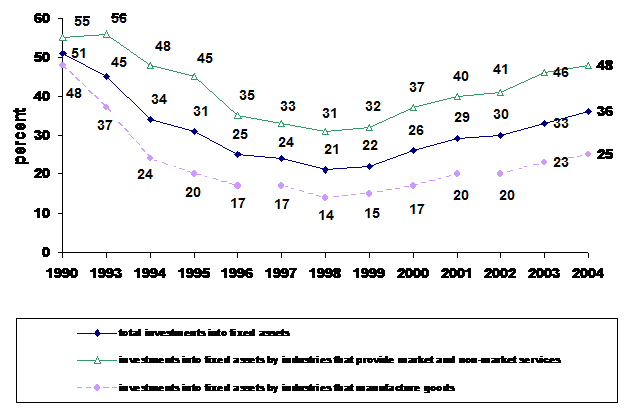 Fig. 2. Indexes of physical volume of investments made into fixed capital
(1990 = 100)
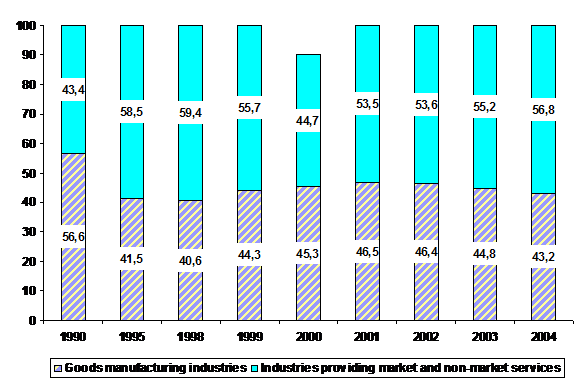
Fig. position of investments into fixed capital, by industries that manufacture goods and provide market and non-market services
Table 2
Dynamics of investments into fixed assets in the period from 1990 to 2004.
In the then effective prices; billion roubles;
Years of investments made | 1990 | 1995 | 1998* | 1999 | 2000 | 2001 | 2002 | 2004 |
Investments into fixed capital - total | 0,2 | 266,9 | 407,1 | 670,4 | 1165,2 | 1504,7 | 1762,4 | 2729,8 |
including those made into the industries that: | ||||||||
manufacture goods | 0,1 | 110,5 | 165,1 | 297,3 | 527,5 | 699,4 | 817,5 | 1179,7 |
provide market and non-market services | 0,1 | 156,4 | 242,0 | 373,1 | 637,7 | 805,3 | 944,9 | 1550,1 |
Source: Investitsii v Rossii (Investments in Russia), 2005: Statisticheskii sbornik (Statistical digest)/Rosstat. - M., 2005, page 41
* prior to 1998 – trillion roubles.
Our review of the national and overseas companies[3] (the list of the largest companies of Russia is presented in Annex 2) showed that investments are related to long period of their use in the investment sphere. Therefore, cash flows and flows of assets (in the form of investment outlay) require future costs be discounted to the current period, i. e., to establish the current equivalent of the amount to be paid in the future. This process is called discounting of costs. Methodical approaches to valuation of investment projects with allowance for time factor are reviewed in section 3.4.
Investment market - is an element of reproduction of cumulative investment product, a form of realization and movement of its parts - it reflects both direct (production - investment market - consumer), and reverse (consumer - investment market - production) links between the subjects of the investment sphere. As such it is an objective form of organization and functioning of investment sphere. The specific feature of the investment resources that are circulating in the market is that they may be completed (building machines, erected buildings, structures, etc.), and uncompleted (construction-in - progress, etc.) by nature either they may exist in a form of investment projects and financial (portfolio) investments. Within the framework of the investment market the following submarkets are distinguished: market of building products; market of labor and work contracts; market of investment projects; market of financial (portfolio) investments, etc. Each of them has its own specific features in terms of investments flows, which are determined by types of investment resources.
The integrating function of the investment market is that it integrates the sphere of capital construction, financial and innovation spheres, and also investment intermediaries. This function ensures expanded reproduction of social capital. Despite the regulatory role which is played by the market in the investment sphere, the market is not able on its own to resolve many problems connected with intensification of business entities investment activities, neither it is able to do that on the level of a particular company. Therefore, intervention of government is necessary in the investment processes, which implies design of macroeconomic regulators, efficient investment policy targeted to creation of favorable investment climate in the country. Investment strategy and priorities of the investment policy of the government are reviewed in cl. 1.2.
We proposed to expand the tools for management of investment sphere[4] in the national companies:
- by design of investment policy with the use of Management-by-Objectives method;
- by substantiation and by enhancing of legal base that stimulates the increase of productivity in the use of investment resources;
- by granting tax benefits, optimization of tariffs and rates, and also preferential investment credits for the purpose of investments into fixed assets;
- by formation of mechanisms of guarantees, insurance of investments;
- by maintaining control and increase of responsibility for target-oriented use of investment resources at all levels of entrepreneurial activities, also at the level of particular companies.
Our proposed system of measures is capable to expand the contents of investment policy of business entities and give a more precise classification of investments[5]. Precise and full classification of investments plays a big role in the formation of investment policies by the national and foreign companies [6]. This allows to efficiently influence the object of management and make the most optimal selection of management tools taking its specifics into account.
Investments are classified by multiple attributes, proceeding from the purposes and targets of management. "Real investments" term is used with reference to investees. Real investments include economic resources invested into real assets: into industrial assets, i. e. fixed assets and circulating assets, into their expansion, reconstruction, modernization; industrial and social infrastructure (houses, buildings, structures); into intangible assets having a monetary equivalent (securities, patents, technical and technological innovations, projects, other objects of intellectual property), and also into leasehold and other rights.
Investments are also classified into "direct" and "indirect" (portfolio) investments - by type of participation of business entities in investments. Direct investments assume directly invested funds by investor itself into various investees. Such investments are made by sufficiently prepared and experienced investors who have complete information about investee and have precise understanding of the investment mechanism.
Portfolio investment means investment which is effected via other persons and is understood as investment of financial intermediaries. If the investor lacks the required qualification for selection of investees and future management of investments, such investor shall purchase securities issued by investment and financial intermediaries (investment funds, etc.). Investment funds accumulate investment resources and then select the most optimal objects for investment. They participate in management of such investees. Generated earnings are distributed between clients.
Investments are classified into short-term (up to 1 year) and long-term investments. Investments are also classified by national and territorial type into domestic (national) and outward (foreign) investments. Investments are grouped by forms of ownership into private, state, mixed-type, foreign and joint investments. Private investments include those formed out of funds of private, corporate enterprises and organizations, and individuals, including equity capital and raised capital.
Let us review different points of view of some particular national economists concerning the aforesaid classification of investments.
In the course of lectures titled "Investments" by E. R.Orlova the following classification types of investments are given[7] (Table 3)
Table 3
Classification of investments by various attributes
Classification attributes of investments |
Types of investments |
By forms of organization | Investment project - existence of a certain investee is assumed and generally realization of a single form of investments is expected. Investment portfolio of a business entity includes multiple forms of investments made by a single investor |
By objects of investment activities | Real long-term investments (capital investments) into creation and reproduction of fixed assets, into tangible assets and intangible assets. Short-term investments into circulating assets (inventories, stocks, securities, etc.). Financial investments into government securities and corporate securities. |
By forms of ownership rights to investment resources | Private; Governmental; Foreign; Joint. |
By character of participation in investments | Direct investments – a direct investment of funds into a tangible object. Indirect investments – existence of an intermediary (portfolio investments). |
By direction of activities | Seed money. Investments directed to survival of the investee in the future. Investments intended for retaining of positions held in the market. Investments intended to increase production efficiency. Investments into expanded production (extensive investments). Investments into creation of new manufacturing facilities (innovation investments). Reinvestments. |
Similar classification attributes are proposed in the handbook for experts and businessmen [8]. I. V.Sergeev and I. I.Veretennikova classify investments by: attribute of the purposes of the future investees; by forms of fixed capital reproduction; by source of finance; by direction of use [9].On the contrary, A. I. Deyeva classifies investments by: payback period and a life cycle of investments; by type of property investments; by degree of investment compulsory nature; by industry; by risk level and by some other attributes.[10]
Volumes of various types of investments in the Russian Federation in 2000 and 2004 years are given in Table 4.
The key participants of investment process, including the government represented by the federal authorities, regional and local authorities, enterprises and individuals, may participate in investment process on the side of supply and demand.
In conditions of the market-oriented economy the circle of the participants of this process has been substantially expanded. A network of business banks, lending institutions, investment funds, investment companies, insurance companies has emerged and they are independent in taking decisions on investments. In our opinion, their participation in the investment process still should be even in a greater extent determined by the government and by regional and local authorities. This means:
Table 4
Characteristics of the core indicators of the investment activities in the Russian Federation
period Types of investments | 2004. | 2000 in % of the total | |
Billion roubles | in % of the total | ||
Investments into non-financial assets (without small businesses) | 2754,6 | 100 | 100 |
including: | |||
investments into fixed capital | 2729,8 | 99,1 | 98,4 |
investments into intangible assets | 13,8 | 0,5 | 1,5 |
investments into other non-financial assets | 11,0 | 0,4 | 0,1 |
Financial investments of entities (exclusive of small businesses) | 4867,6 | 100 | 100 |
Including: | |||
Long-term investments | 853,5 | 17,5 | 22,8 |
Short-term investments | 4014,1 | 82,5 | 77,2 |
Investments of Russian companies into investees abroad, USD million | 33773 | 100 | 100 |
including: | |||
direct investments | 2064 | 6,1 | 2,5 |
portfolio investments | 76 | 0,2 | 0,2 |
other investments | 31633 | 93,7 | 97,3 |
Foreign investments into the Russian economy, USD million | 40509 | 100 | 100 |
including: | |||
Direct investments | 9420 | 23,3 | 40,4 |
Portfolio investments | 333 | 0,8 | 1,3 |
Other investments | 30756 | 75,9 | 58,3 |
therefrom: | |||
trade credits | 3848 | 9,5 | 14,1 |
other credits | 26416 | 65,2 | 43,2 |
credits granted by governments of foreign countries secured by guarantees of the RF Government | 34 | 0,1 | 0,2 |
Other | 458 | 1,1 | 0,8 |
Source: Investtitsii v Rossii. 2005: Statistics digest /Rosstat. – М., 2005, pages 40, 113, 146, 174

|
Из за большого объема этот материал размещен на нескольких страницах:
1 2 3 4 5 6 7 8 9 10 11 12 13 14 15 16 |
