

Партнерка на США и Канаду по недвижимости, выплаты в крипто
- 30% recurring commission
- Выплаты в USDT
- Вывод каждую неделю
- Комиссия до 5 лет за каждого referral
|
Plekhanov Russian Academy of Economics
GRETCHENKO Alexander Anatolievich
CORPORATE INVESTMENt MANAGEMENT
Monograph
Moscow
2007
УДК 65
ББК 65.290-2 д 73
Г71
Reviewer: Valeriy Zuev – Professor of Lomonosov Moscow State University
Wladimir Andreff - Professor at the University Paris 1 Panthéon Sorbonne
Gretchenko A. A.
Corporate investment management. Monograph. Science editor V. I. Osipov
- M.: Национальный институт бизнеса, 200c.
ISBN 65-4
The monography is considered of pressing questions of investment processes development in the Russian economy, the analysis of efficiency of forms and methods of management of domestic and foreign investments in Russian companies.
The requirements to investment processes in conditions of globalization are specified, the basic directions of a state policy on formation of the effective mechanism of management by investment activity of the largest Russian and transnational companies are offered. Methodical recommendations on development of tools of the multilevel mechanism of management by investments are presented.
For experts of the enterprises and the financial organisations, engaged investment activity, science officers, students and teachers of economic high schools, risk-managers
© Gretchenko A. A., 2007
CONTENTS
INTRODUCTION………………………………………………………... | 2 | ||
Chapter I. | ТHEORETICAL AND METHODOLOGICAL PRINCIPLES OFCORPORATE INVESTMENT MANAGEMENT | 4 | |
1.1. | Investment activities in the system of economic relations ……..…………………………… | 4 | |
1.2. | Investment activity of entities in the context of national economy state regulation. | 24 | |
1.3. | Systems of corporate investment management: structural specifics.……………….…… | 35 | |
Chapter II. | Analysis of trends in corporate investment management……….……………………………………….. | 48 | |
2.1. | Russian companies in the global investment process……………………………………….…….. | 48 | |
2.2. | Foreign practice of corporate investment management | 61 | |
2.3. | Analysis of the Russian practice of foreign investment management in the national companies …………… | 76 | |
2.4. | Methods of state regulation of structural investments processes in the national and foreign companies | 85 | |
Chapter III. | Development of corporate investment management (on the example of leasing companies) | 100 | |
3.1. | Strategy of company dynamic development and optimization of business partnership methods. | 100 | |
3.2. | Design and implementation of corporate investment projects ………………………………. | 115 | |
3.3. | Improvement of methods for feasibility study of investment projects ………………….. | 125 | |
Conclusion………………………………………………………………. | 137 | ||
Reference index…………………………………………………….. | 147 | ||
Appendices …………………………………………………………… | 154 |
INTRODUCTION
Investment policy has one of the key priorities in development strategy of domestic and foreign companies who plan their long-term presence in the domestic and foreign markets. It is critical for companies operations irrespective of a company size, industry, form of incorporation, etc.
Transition of Russia to the market-driven model of business entailed the necessity to form a new ideology of investment process by the national economic science. Investment process under conditions of the centrally-planned economy was regulated and performed exclusively by the government. On the contrary, private individuals and legal entities (both domestic and foreign entities), subjects of market infrastructure, including business and specialized banks, finance companies, consulting firms and others play the ever increasing role in investment activities of today's Russia.
Investors in Russia encounter a lot of problems which explains a relatively small inflow of global foreign investments. In 2004 they totaled USD 40.5 billion, including USD 9.4 billion of direct investments. 2years saw a trend towards a certain growth of these parameters. Nevertheless they are much lower than similar parameters in many countries. This is indicative of the necessity to form promptly a more favorable domestic environment for investments.
At the current stage the industrial and economic potential of Russia can be preserved, efficiently implemented and reproduced solely in the event if a relevant economic mechanism for investment process control is created both on the state level and on the level of particular constituent entities (subjects) of the Russian Federation. Efficient investment policy in this instance becomes a backbone factor for successful implementation of social and economic tasks set by the Russian companies.
Substantiation of methods for investment processes management is referred to the pressing issues of today in this area.
This monograph:
- substantiates the principles of regulating investment processes, such principles ensuring innovational development of companies, their stability, dynamical growth and optimization of their structure within the framework of systematic approach;
- analyzes foreign practice of investment activity and possibilities for implementation of same for the national companies, as well as conditions, factors and consequences of attracting foreign investments into the Russian economy, the relevant form and methods of their regulation in the best national interests;
- gives methodical recommendations for improvement of both current and strategic management of companies, organization of their business partnership in the investment sector;
- on the base of the leasing companies taken for a case - study it substantiates the appropriate directions for development of investment management systems, gives propositions for decreasing investment risks and for development investments management system at the level of business entities;
- designs relevant scenarios for government credits to be obtained for major investment projects, such scenarios expanding investment opportunities and improving efficiency of structural transformations management in the Russian companies.
The concept of "corporate investment policy" is defined by us as a system of interrelated measures targeted to produce a managing effect in political, legal, economic and organizational aspects on the formation and achievement of such policy medium-term and long-term objectives. We have systematized scientific methods of finance management and reviewed the existing systems of investment management for national and foreign companies as well as the trends of their development. The monograph deals with classification conditions of investment attractiveness for foreign partners in multiple segments and groups of national companies. Conceptual approaches to the formation of business model for corporate investment management are based on the combination of parameters that describe the scheme for structuring and forming a company business.
Chapter 1. ТHEORETICAL AND METHODOLOGICAL BASICS OF
CORPORATE INVESTMENT MANAGEMENT
1.1. Investment activities in the system of economic relations
Under the Russian legislation, investments (the term originated from Latin term "invest" -contribute) mean cash, securities, other property, including proprietary rights (interest) that have a monetary equivalent, which are invested into the objects of entrepreneurship and (or) other activity for the purpose of generation of profits and (or) for deriving some other useful effect. Investments are understood as investment of economic resources for the purpose of creating and further deriving net profits exceeding the total initial value of investments (invested capital). Capital gain should be taken as a compensation for withheld consumption of investor’s own capital in the current period, it shall reward the investor for the risk incurred and shall compensate losses to be caused by inflation in the future period.
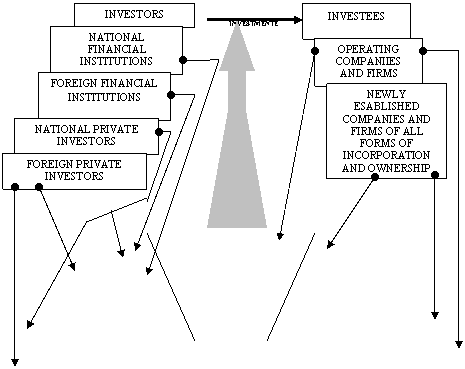
Investments are realized through investment environment, which is a group of participants of investment processes, their economic relations and interests realized in the course of attracting and using multiple types of investment resources. Fig. 1 shows the structural & motivational scheme of investment process that illustrates interaction between the key players, their interests, conditions and mechanisms of such process implementation.
The range of the investment market players includes prospective investors and investees. Their interests are determined by the role each of them is to play in the implementation of a particular bination of their roles may vary greatly.
 |
 |
 |

modernization
of
obtaining production obtaining
 top the original
 rate of return capital

 capturing increase
|

 market turnover
 |  |
realization of
improvement national
of economy regulation projects
efficiency of investment

 process
 |
Fig. 1. Structural and motivation scheme of investment process
Interests of the agents of investment activities do not always concur and very often they came into conflict with each other. In practice, apart from the key participants, a big number of intermediaries may be involved, i. e. other stakeholders or persons concerned, including legal entities and individuals. Timeframe of investments and consequently, efficiency of investment process, depend on them in many respects. Intermediaries, who pursue their own purposes, quite often came into conflict with the interests of key participants of investment process. As a result the investment process is getting substantially complicated. Its essential purpose is design of the most appropriate alternative option to suit the interests of all its participants.
The government in this process can act in the role of:
an investor of capital (mainly for socially focused projects, which satisfy the needs of the government);
a buyer of industrial products, utilities services;
a proprietor of a part of the state-owned property;
an intermediary (for example, for tenders held for investment projects).
The key role of the state is managing capital markets, establishing rules and norms of its functioning.
Investment process is the most critical mechanism of reorganization of proportions and complex structural transformations in a country national economy and is a key link of a national economic policy. Actually, all activities in the field of development of industrial sphere and changes in the social and cultural complex are determined by investment activities.
Investment sphere is functioning within the framework of an integral economic system and is a component of such system. Therefore, it is regulated by common market-oriented rules and concepts (demand and supply concept, money turnover concept, competition rule, economic equilibrium rule, etc.) as well as by the laws and regulations enacted by the government.
The structure of investment sphere includes a complex of multiple industries, firms, companies, and enterprises that are functioning within an economic system. This structure determines specifics of investment flows, their directions and form. Economic relations in this sphere that are related to flows and use of limited investment resources and also those related to temporality of their transformation into certain economic benefits enable us to refer them to a separate subsystem of investment economic relations.
Currently a system of concepts has been established to describe processes and phenomena occurring in the investment sphere[1].
The following concepts are most frequently used in scientific research: "investments", "investment resources", "investment activity", "investment market", "investment potential", "investment policy", "investment demand and supply", "propensity to invest", "investors", "investment risk", "investment projects and programs".
Economic contents of investment sphere are represented by a subsystem of economic relations established between its subjects in relation to the formation, realization and return of investments within their life cycle.
Reinvestment cycle is a cycle of investments between accumulation of investment resources and their full return. At a macroeconomic level it is made up of the amounts of individual circular movements in all firms, companies, enterprises and reflects movement of value, which is invested into various investees, and specifically:
- into newly established and modernized fixed assets;
- into circulating assets;
- into securities;
- into special cash deposits;
- into R&D deliverables;
- into property rights;
- into rights to intellectual property and other objects.
The key place in the investment sphere is given to investment market, in which investment demand and supply are generated. Management of investment relations implies efficient application of market laws. Successful functioning of investment sphere is possible when all its elements are coordinated and focused on the key figure of the investment market, i. e. on investee, and certainly, with protection of rights and interests of investors, irrespective of their specific forms of ownership.
Table 1 shows the role of investors of various forms of ownership in development of the national investment sphere for the period from 1995 to 2005. The detailed description of investment processes by form of ownership and by investee industry are included into Appendix 1.
Investment activity is a major component of economic activity as a whole because it determines the prospects for development of economic system as a whole, its structural relevance and economic growth. In the opinion of economists [2]this is the area of economic relations, where the strategy is being implemented
Table 1
Structure of investments into fixed capital, by forms of ownership
at the then applicable market prices
Period Forms of ownership | 2005 | 1995* | 2000 | |
billion roubles | in % of the total figure | in % of the total figure | ||
Total investments into fixed capital | 2688,4 | 100 | 100 | 100 |
Including investments grouped by forms of ownership: Russian ownership | 2122,9 | 79,0 | 97,3 | 86,3 |
State ownership | 652,0 | 24,3 | 31,3 | 23,9 |
Municipal ownership | 121,3 | 4,5 | 6,3 | 4,5 |
Public and religious organizations (associations) ownership | 2,4 | 0,1 | 0,1 | 0,1 |
Private ownership | 905,7 | 33,7 | 13,4 | 29,9 |
Consumer cooperative ownership | 2,1 | 0,1 | - | 0,1 |
Russian mixed-type ownership | 439,4 | 16,3 | 46,2 | 27,8 |
Foreign ownership | 197,1 | 7,3 | - | 1,5 |
Jointly owned Russian and foreign ownership | 368,4 | 13,7 | 2,7 | 12,2 |
Source: Osnovnye pokazateli investitsionnoi i stroitelnoi deyatelnosti v Rossiiskoi Federatsii v 2005 godu, No: Statistics digest / Rosstat. - M., 2005, page 8; Investitsii v Rossii. 2005: statistics digest / Rosstat. - M., 2005, page 46

|
Из за большого объема этот материал размещен на нескольких страницах:
1 2 3 4 5 6 7 8 9 10 11 12 13 14 15 16 |
