

Партнерка на США и Канаду по недвижимости, выплаты в крипто
- 30% recurring commission
- Выплаты в USDT
- Вывод каждую неделю
- Комиссия до 5 лет за каждого referral
Russia realistically is able to compete with other countries worldwide at the level of capital investments offerings around 10-15 billion dollars if such investments volume is proposed by global investors to our country. Receiving many alternative offers on a more favorable conditions than in Russia, foreign investors are not in a hurry to invest into the Russian economy. The close neighbors of Russia intercept the flows of western investments. Therefore, participation of Russia in the global investment processes is one of the major tasks for the Russian state economic policy.
Russia was and is rather attractive* to foreign investors. In total GDP of all emerged markets the share of Russia is more than 25 %. Russia has more natural resources (USD 10.2 trillion), than Brazil (USD 3.3 trillion), Southern Africa (USD 1.1 trillion), China (USD 0.6 trillion) and India (USD 0.4 trillion), put together. In a favorable investment climate Russia will be able to realize within the nearest 10-15 years USD 200-300 billion of capital funds to be invested into reconstruction and modernization of production to bring it up to the standards of the global and domestic markets. To overcome the crisis phenomena Russian fuel & energy complex alone will require about USD 100-140 billion. The active part of production assets consumes USD 20-25 billion per year for replacement and modernization. For this purpose it is necessary to reallocate to Russia about the tenth part of the total international direct investments, which amount to USD 240-250 billion in the recent years.[54].
Revival of investment activity of the national companies is a task of a nation-wide scale and is referred to the first priorities of the state economic policy. It is necessary to create a most favored nation treatment to develop the system for managing the national companies investment activity and to enable them to use the positive experience accumulated by foreign partners.
2.2. Foreign practice of corporate investment management
The system of regulation of investment processes abroad has its substantial specific features. Corporate investment management practice in the advanced developed countries (USA, EU, Japan) is different from that of the less developed countries and countries with transitive economy. Many foreign approaches can be used in Russia as well, with allowance for its national features and adaptation to them. We reviewed methods of investment processes intensification that are used in China, India, Mexico, Poland and in some other countries. These methods are very close to the methods used in Russia. A special attention should be attached to the investment management experience, which is accumulated in China, in connection with big similarity of starting positions in transformation of Russia and China economies, and also with allowance for obvious distinctions in the efficiency of foreign investments attracting policy.
Experience, which is accumulated by China in attracting direct foreign investments, is capable to play the role of powerful catalyst of economic growth. We shall elaborate in detail on the analysis of "Chinese miracle", i. e. on the increased trust to the Chinese economy from the part of foreign business community and on how foreign investments are affected the dynamics of the Chinese economy development.
The transformations consistently carried out by China since 1978, ensured high rate of economic growth and resulted in radical transformation of the national economy. From the beginning of the reforms the average growth rate of real gross national product accounted to 9.5 %, and the income per capita has grown five times. The non-public sector of China economy currently generates up to 60 % of its gross domestic product. The main driving power of the so impressing breakthrough is the policy of the step-by-step increasing openness of the national economy. The key elements of the "open doors" policy are: trade liberalization and attraction of direct foreign investments.
Their inflow to China has grown from virtually zero mark at the beginning of the reforms to USD 40-45 billion per year in the second half of 90-s. In 2002 this parameter achieved the absolute record for all years of transformations and amounted to USD 52.7 billion. For the period of the reforms direct foreign investments in percent of GDP have grown to 5 %. China became the second recipient of DFI in the world after the US, and China is the absolute leader in this area among the developing countries. China accounts to about 25-30 % of DFI inflow in this group of countries.
The positive experience, which has been accumulated by China, shows that investment resources stimulate GDP growth through increase of the total capital investments into the national economy. This component generated about 0,4 % of the annual GDP growth in the 90-s. Therewith the contribution of direct foreign investments into GDP growth was the highest in those provinces that attracted the greatest volume of foreign investments. Direct foreign investments facilitated the GDP growth due to the positive effect produced on the total productivity of production factors. In 90-s such investments annually increased this parameter by 2.5 %. This effect was most significant in those provinces, which received the biggest share of direct foreign investments. Direct foreign investments increased the potential opportunities of GDP growth in China by nearly 3.0 %.
Foreign investments made their contribution to GDP growth both directly through creation of companies with 100% foreign capital (which, in addition, created the additional demand for products of local companies that were associated with their production), and indirectly, i. e. through positive influence produced by companies with foreign capital on the national companies. It is about the implementation of new technologies and management skills that are becoming increasingly important as cooperation ties are strengthening and expanding between foreign and national companies.
Entities with 100% foreign capital became the most dynamical and productive companies in the national economy of China. The volume of their production in the industrial sector was growing four times faster than in other companies, and labor productivity almost doubles the level achieved by the companies in public sector.
Foreign investments facilitated creation of new jobs, which also became an important factor in their influence on the China economy. Employment rate in the companies with 100% foreign capital for 90-s has doubled and achieved 6 million persons or 3 % of the total number employed in the cities of the country.
Direct foreign investments in China generated a big sector of the national economy and that sector is focused on exports of produced goods and petition in this sector is the most hard, which ensures outstripping rates of its development in comparison with the national economy as a whole. As a result of the above the growth rates of foreign trade in China, since 1978 exceeded 4.5 times this parameter of the total global trade, and the share of China in the global exchange of goods increased more then five times from 0.9 % in 1978 to 4.9 % in 2002. The most important role in this achievement was played by companies with foreign capital. Since 1985 their share in exports increased from 1 to 50 %, and they accounted to over a half of the total growth in exports and to one third of the imports growth for the aforesaid period.
For the years of the reforms the volumes of export and import in the China GDP have grown substantially which was much facilitated by consistent liberalization of foreign trade. With allowance for the interests of the national economy the average rate of the customs tariffs in the country was gradually decreasing from more than 50 % in the early 80-s to 12 % after admission to WTO. During the lengthy negotiations about admission to WTO the Chinese part was lucky to provide the necessary protection of strategically important industries of its national economy. Having protected its high priority sectors against dangerous competition China at the same time practically completely exempted from import duties those domestic products that are produced by the industries in which the government deems it necessary to stimulate competition with foreign goods. China may be regarded as a bright example of the implementation of rational, weighted policy of liberalization of foreign trade and investment policy ensuring support for the national manufacturers and at the same time stimulating inflow of direct foreign investments that are focused on the creation of export-targeted manufacturing facilities.
The prevailing part of direct foreign investments in China is allotted to manufacturing industries (60 %); and the rest of them are allotted to real estate (24 %), to transport and trade (6 %)).[55]Among processing industries more than a half of these investments flows to labor-intensive sectors (textile industry, manufacture of clothes, food industry, and furniture industry). Those industries that require substantial technological and capital investments, the same as in Russia, are not very attractive for foreign investors, who seek to use competitive advantages of the country and derive maximum possible benefits from such advantages for the time being. In China such benefit is cheap labor, in Russia it is cheap natural resources. Foreign investments required additional macroeconomic measures targeted to stimulate capital investments into knowledge-intensive production. In this connection both China and Russia face many respects similar problems. Nevertheless, China has a substantial advantage in that the foreign capital in strategically important high technology and hi-tech industries flow much easier and faster, than in Russia. The Russian companies basically have to deal with the necessity to seek for new partners from abroad who do not fully understand the rules of efficient business dealings in our country.
Low labor costs in China became a particular important factor for attraction of direct foreign investments from Hong Kong and Taiwan in response to the growth of similar costs in these regions. Such developments facilitated fast formation of China as a big player in the global market of labor-intensive products. The quality of Chinese labor was not a decisive factor for inflow of direct foreign investments.
Labor costs in China as well as in Russia, are rather low today, but the share of highly skilled personnel in the total number of staff employed is substantially higher in Russia. Nevertheless, the inflow of direct foreign investments in Russia is currently much less than that in China. It is possible to assume, that when the potential of cheap mass production in China is exhausted with increasing labor costs owing to improvement of workers professional skills, the Chinese companies will encounter problems with attraction of investments from abroad.
The main form of direct foreign investments in the country currently became companies with 100% foreign capital which facilitates further inflow of capital to China. At the early stage of reforms the only allowed form of realization of direct foreign investments used to be joint-stock companies and cooperative joint ventures (except for the enterprises registered on the territory of the free economic zones - FEZs). This form was seen by the authorities to be the most suitable for attraction and development of high panies with 100% foreign capital on the territories, which are not included into FEZs, were allowed solely in 1986.
Thereafter investments began to flow to companies with 100% foreign capital, which account to more than a half of incoming direct foreign investments in the country.
It appears to be useful to use the experience of China in creation of FEZs, which in this country became a sort of testing grounds for design of the most efficient methods for attracting and utilization of foreign capital. Obviously, we should not overestimate not fully successful experience of creation of free economic zones in Russia in the early 90-s and in the mid 90-s.
It is necessary to competently use the new interesting opportunities, for example the favorable geographical position of the Kaliningrad region inside the expanding European Union. Obviously, more advanced countries of Europe will invest capitals into economies of new members of EU and the prospect will arise for attracting a part of such inflows of capital into the Russian enclave by way of implementation of joint projects with foreign companies operating within the territory of the Baltic states.
Factors stimulating inflow of direct foreign investments to China are specific for all countries with transitive economy, and conditionally they can be classified into the following three groups: structure of economy; liberalization and preferential policy; cultural and legal environment.
The huge size of the Chinese market (about 1.5 billion individual consumers) is more important for European and American TNCs who invest money in creation of their own production facilities focused on the huge home market. Investors from Hong Kong and Taiwan who invest into export-oriented manufacturing industries, are mostly attracted by cheap labor and liberalization of foreign trade.
The scale and dynamics of direct foreign investments inflow to China show some kind of multiplication effect in this area. This effect is observed both in the country as a whole, and in its particular provinces. Having accumulated a certain "critical mass" of foreign investments it becomes easier for the provinces to attract extra capital resources. Foreign investors consider the presence of other foreign businessmen in the region as a positive sign. Economy of scale enables TNCs to place funds more efficiently. The possibility arises to exchange with information and to share infrastructure facilities. This partially explains the existing concentration of direct foreign investments in the coastal regions where transport channels have been traditionally oriented to foreign markets and all necessary infrastructure facilities are available. The coastal territories of Hong Kong and Taiwan have become the biggest recipients of direct foreign investments and for the recent 20 years they appreciably outperformed those provinces that do not have access to the sea. Understanding the importance of developing the infrastructure for successful attraction of foreign partners, the central Chinese authorities delegated a big portion of decision-making powers on the issues of capital investments to local self-government institutions. The preferential policy pursued in China includes tax privileges and special privileges to foreign investors. The most typical tax privileges for the companies with foreign capital include decreased profit tax and tax holidays. These are available to all such companies in SEZs, for the companies with foreign capital in the industries focused on exports and use of high technologies outside of SEZs, as well as for national companies without foreign capital, who operate in SEZs. The companies operating in SEZs enjoy a substantial liberty in taking management decisions, they do not encounter excessive control over movement of goods and may carry out foreign trade operations actually without any panies operating in SEZs may pursue a more flexible policy in the sphere of employment and use of land. Additional tax privileges are granted for transfer and reinvestment of revenues for companies with foreign capital who perform in the field of high technologies and engaged in export operations. Substantial discounts are also granted to them for use of land.
Preferential policy pursued in China, especially within the framework of SEZs, has created conditions for stage-by-stage experiments in the sphere of economic transformations. Without such policy the inflow of direct foreign investments to the country would be substantially less, taking into account, that the operating environment in which the Chinese companies outside of SEZs were to perform, would be featured by big number of restrictions. The pursued policy brought substantial incomes to the Chinese economy having allowed reforms to be implemented and become a stimulus for attracting foreign investments that facilitated production growth. However in course of time such policy transformed into the source of distortions and inequalities which was reflected in the complex taxation system, which has certain skews; in the appreciable difference of incomes in various regions of the country, and also in the created corruption possibilities.
As a result of the above, investors from Europe and USA enter the Chinese home market much less frequently than do their colleagues from Hong Kong and Taiwan. Good knowledge of local culture enables the latter to bypass bureaucratic hindrances whereas the European and American investors are forced to seek for Chinese partners in order to achieve the same purposes.
Another problem is extreme irregularity in geographical distribution of direct foreign investments. The East region of the country absorbs up to 88 % of total direct foreign investments; the central region attracts about 9 %; and the western region attracts 2 %. This situation is the result of the "open doors" policy, which was started from experiments with some particular regions. This disproportion has not been eliminated by now.
Russia and China have much in common in the field of investment problems. Inconsistent economic policy and frequent change of government in Russia in 90-s adversely affected the formation of the country’s investment image. Serious opportunities for Russia's entry on a higher level of interaction with the global economy were lost. It is not by chance that Russia is sometimes called "the country of catching up development"[56]. Many partners who may well come to Russia, would re-target their business to China, i. e. would wait for stabilization of political and economic situation in Russia.
The Chinese experience prompts a useful adjustment of approaches in the investment policy of the Russian companies. This means the necessity to maintain political and economic stability in the country, and to ensure predictability of acts of authorities and "transparency" of the national legislation.
Active economic cooperation with China will enable the national companies to contact foreign partners in the Chinese market to attract a part of financial flows into the Russian economy.
It is worth considering the experience of some foreign companies who actively use a set of macroeconomic control tools in managing their investment business. These control tools are actually the public institutes. Control tools affect the scale and price of credit resources, and the latter affect the volume of investments.
Effect of control tools may be reflected in the USA at the level of changes of bank discount rates in basis points whereas in Russia the national economy virtually does not react to changes in basis points.
The commonly recognized idea of national economic development is based upon the concept of investment multiplier, which was introduced by Keynes and became known due to his theoretical research in macroeconomics.
The theoretical substantiation of the multiplication process enables foreign companies to construct a graphic model of "paradox of thrift": change of the amount, which households would like to save up, may cause no influence on the actual level of savings”.[57]
Some particular Russian economists maintain the opinion that "paradox of thrift" and the conclusions made on its basis are logically inconsistent.[58] For example, it has been demonstrated that the condition precedent for multiplication of any random volume of investments is prevailing 100 % utilization of production capacities.[59] The practice shows that production capacities of some particular companies are normally slack. Thus, the average utilization of production capacities in the US for the recent 10 years varies within the range of 74 %-86 %. As a result, solely big investments are able to initiate the multiplication process.[60] Probably, these errors of the theory may serve the explanation for its little usefulness in practice for design of not only state investment policy, but also corporate investment policy. For example, in France the attention was concentrated on the small number of industrial companies engaged in reconstruction and modernization of manufacturing industry and agriculture and with the possibility to obtain revenues in foreign currency. The design of medium-term (five years) plans of social, economic, scientific and technical development of the country was started within the framework of indicative planning concept. Then the new period started - it was the period of policy targeted to encourage big-scale commercial production. In conditions of hard competition with foreign companies it was decided to improve competitive ability of the national companies operating in the French market and for this purpose to encourage formation of one or two major companies in each industry. Such big companies were formed within the framework of the state "industry-scale" plans by way of mergers. "Industry-scale plans", as a whole, cannot be said successful (though some attempts in the electric power industry brought positive results). At the latest stage of industrial policy of the "left-wing" government supervised by the "right-wing" president () both the course continuity signs and new features were also observed that reflected the country transition to a qualitatively new phase of social, economic and political development. State procurements as a tool of the formation of guaranteed and predictable market for multiple national companies currently retain their important role in France. Nevertheless, education, employment, internal stability, judicial bodies, culture and telecommunications, as well as preservation of environment are becoming increasingly important in the budgetary appropriations.
The tools of the state stimulation of R&D for the needs of industrial companies are given currently the top strategic priority among the tools of the national industrial policy, which is becoming increasingly oriented on ensuring the global competitiveness of the country on the base of development of the nation innovational potential.
Investment policy of some particular companies in the Great Britain is reviewed below.[61] In the period since 1997 year the purposes of the UK current investment policy have been as follows: improvement of competitive ability; development of innovational, scientific and technical potential of companies to achieve a steady economic growth and high labor productivity.
Alongside with granted subsidies and tax privileges (traditional tools), the government gives more attention to creation of the market infrastructure, development of free competition, assisting mid-sized and small enterprises, exporters, IT services to business, programs in the field of general and vocational education and training.
Economic management mechanism is being changed and decentralized. Thus, regulation procedures have been simplified, control over wages, prices and dividends has been cancelled, labor market has been substantially deregulated, certificates for industrial construction have been canceled, the role of the local development institutions has increased.
The Great Britain is a leader in the field of liberalization of foreign trade under the influence of membership in the EU and globalization of the world economy. The role of the government in this sphere currently includes quality controls, information and consulting services to exporters, their stimulation, especially for success in sales of high technology products. Authorities consider foreign investments as an important source of extra jobs, means for obtaining new technologies, industrial and administrative experience. Investment policy of both the government and English companies, which is entirely based on Keynesian theory, does not bring positive results in practice. Governments use methods and ways for the formation of the investment management system that proved to be relevant in practice on the example of some particular companies.
If the methods recommended by modern economic theories do not work without failures in such economically advanced countries as France and Great Britain they are moreover unsuitable for the countries with a transitive economy, including Russia.
Japan is one of the examples of successful development of investment management system and intervention of the government into this process. After the Second World War Japan was in occupation and its economy was fully ruined.
In the postwar period the government of the country faced the problem with restoration of the country in conditions of insufficient investments and obsolete industrial complex. It decided to develop the national industry on the base of the big industrial structures and also on the newly established national companies. The economic development, which was carried out consistently and in centralized manner, at the initial stage was mainly imitator by nature. The top priority (with the appropriate concentration of resources) was given to applied research directed to adaptation of the borrowed technologies to the local production conditions, and in particular, to the developments enabling the companies to substantially increase commercial effect on each specific technology implemented into commercial production.
In 1957 the Information Centre of Science and Technologies was created on the basis of the Agency for Industrial Science and Technologies of Japan. The centre analyzed about 11 thousand magazines and journals per year, including 7 thousand foreign editions, about 15 thousand scientific reports, 500 reports of scientific conferences and more than 50 thousand patents from which 40 % were Japanese; 30 % - American; 7 % - French; and 7 % of them were Russian. As a result of this analysis more than 50 thousand annual resumes and reviews were generated. Openly available results of the analysis performed by the centre enabled the firms and companies to plan their production development on the base of precise benchmarking. Actually the data obtained by the centre could be used solely by major industrial firms and companies that had sufficient funds for modernization of manufacturing facilities and for implementing their established development strategy.
The government: "put seeds into soil", i. e. allocated "sowing money", enabling the private companies to "cultivate" "matured plants" of them;
granted big credit resources to banks and low credit interests;
granted tax privileges and preferences;
attached a special attention to educational sphere.
Highly qualified specialists were required for use of high technologies and their "analytical" improvement. Therefore it was necessary to ensure the appropriate university training of experts in Japanese and in foreign universities. A huge role in training of such highly skilled staff was played by the government. A similar situation is observed in the modern Russia with regard to the implementation of the national project in the field of education.
In the final chapter of this monograph we review the directions for development of the investment management system on the example of the national leasing companies [62]*. We shall review in more detail the appraisal of the investment opportunities provided by leasing. We shall characterize its specifics and analyze foreign approaches to management of investment transactions of the given class.
In Germany, Netherlands and Denmark macroeconomic investment regulators are concentrated primarily in financial and tax aspects of leasing operations.
In the Great Britain and Australia legislation regulates relationship between the parties to leasing contracts. Regulatory function is performed with allowance for cost of a leasing project in question and its composition of subject.
A big group of countries (France, Italy, Spain, Portugal, etc.) treats regulation of leasing transactions as a tripartite complex of relationship. For them it is typical to cover the whole set of mutual relationship arising in the course of leasing transactions, i. e. the relationships between a lessee and a leasing company, and also the relationships between a lessor and a manufacturer (the seller).
Share of leasing in the countries with developed market-oriented economy accounts to about 20 % of the total capital investments while in Great Britain, USA, and Ireland leasing transactions account to over 30 %.[63]
|
Fig. 8. Structure of movable property items in the European
leasing market in the late 90-s
The main property items of the European leasing market: automobiles; equipment; machinery and devices; motor transport vehicles, computers and office equipment; planes, jets, vessels, cargo and railway transport. Structure of this market at the end of XX - th century is shown in fig. 8.[64]
The key items of the European property leasing market are: offices, industrial buildings, retail premises, hotels and other facilities (see fig. 9).[65]
The prevailing reason for leasing market emerging abroad is its advantage as a sales tool and credit & financial tool.
|
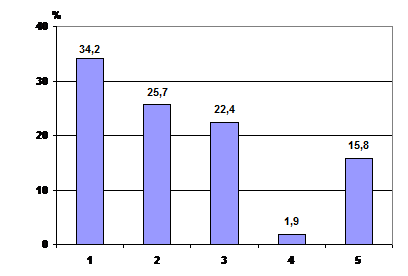
Fig. 9. Structure of the European property leasing market in the late 90-s
Development of leasing in many countries was facilitated by: a disproportion in sphere of manufacture and trade; discrepancy between effective demand and supply in the market of machinery and equipment; change of tax, amortization and customs legislation.
The government stimulates development of leasing operations by creating conditions that stimulate development of investment management and by keeping the risks in this sphere down to a minimal level. Thus, leasing during decades has been recognized to be a strategically important direction of the US state economic policy. Attempts were undertaken to equal leasing by its economic content to the usual lease by way of cancellation of some privileges, but the government stimulated investments into purchase of fixed assets and into renewal of production facilities on the basis of leasing.
Table 13 shows key parameters of the global leasing market in the early years of the XXI-st century.
Table 13
Overall specification of the global leasing market in the early years of the XXI-st century
Annual volume of leasing operations, billion dollars. | 500 |
Total portfolio (assets) of leasing companies (estimate) | USD 1.5 trillion. |
Share of leasing in the investments into fixed assets (average weighted value) | 17-18 |
Share of leasing in the global gross domestic product (average weighted value) | 1,60-1,65 |
Share of the international leasing in the exports of machinery, vehicles and accompanying services | 4-5 |
Source: Belous A. P. Mirovoi rynok lizinga na rybezhe XX i XXI vekov: evolutsiya, basic parameters and trends. // Technologuii leasinga i investitsii. 2002, No. 2.
2.3. Review of the Russian practice of foreign investments management in the national companies
Entry of Russia into the world economy implies integration of the reformed national economy into the system of international relations, which will make it possible to realize the Russian national interests with peak efficiency. Therewith it is necessary, in our opinion, a reasonable vigilance in connection with projects copying western models. Though economy and investments are not merely production and distribution relations but they reflect historical experience of the nation as well.
Analysis of experience accumulated in investment management activities in the biggest national companies ("Gazprom", oil company "LUKoil", TNK-BP, RAO "UES of Russia", "Mosenergo", Autovazs, KamAZ, "Severstal'", Novopolipetsk metalworks", "Wimm-Bill Dun", "Nizhnekamskneftekhim", OAO "RZHD", "Aeroflot - Russian airlines", AFK "Systems" showed that during the recent years their executives and financial managers resolved the following two key managerial tasks:
- creation of an effective system of operative management - setting up distribution channels, creation of internal motivation system, implementing procedures of regular management, separation of manager functions and functions of proprietor, etc. This task is resolved in majority of the successfully operating companies;

|
Из за большого объема этот материал размещен на нескольких страницах:
1 2 3 4 5 6 7 8 9 10 11 12 13 14 15 16 |
