

Партнерка на США и Канаду по недвижимости, выплаты в крипто
- 30% recurring commission
- Выплаты в USDT
- Вывод каждую неделю
- Комиссия до 5 лет за каждого referral
Transformation of economic foundations (economic basis) in Russia has substantially changed its investment policy. The state support of the enterprises has been lately provided on the principles of a gradual transition from irretrievable budgetary financing to reimbursable crediting.
Investment policy in the USSR was targeted on complete regulation of investments and investment process by the state whereas currently the point at issue is governmental support of this process. In the first case economic relations were created mainly on the state ownership to means of production. In the period of the reforms the economic relations are increasingly based on diversified forms of ownership to both means of production, and to results of work. Thus, economic and political conditions serve the fundamental basis of the investment policy.
Fundamental economic bases are established in the system of laws, decrees and other documents enacted by the government and reflecting new economic relations being formed.
In the pre-reform period the centralized approach prevailed in the investment policy. Currently, just the opposite is the case, i. e. the state is governed by the principle of decentralization of investment process, and, hence, is focused on decentralized investment resources.
The logic of the investment policy implies state support for investment projects that are critical for the country. Instead of the irrevocable transfer of investments they are distributed primarily on a reimbursable basis.
The transition to the market-oriented economy affected also the formation of organizational structures in the investment complex. The organizational and administrative structure of investment sphere has changed dramatically. The investment policy is getting more innovational by nature, which in the long term will make it possible to overcome the trend towards the increasing technological degradation of the Russian economy, and also the falling competitive ability of the domestic products in the foreign and local markets. Investments without innovations in the long term cause decreasing competitive ability of goods and services.
to improve the investment activity of the national companies it is necessary:
to ensure integrity of the investment and innovation policies;
to appraise technological level of the existing manufacturing facilities;
to implement obligatory technological appraisal of the investment projects;
to provide state support to the investment projects that meet the current and future technological level;
at several times increase the share of the resources allocated for implementation of innovation programs including federal, regional and interstate programs, especially, on the directions where Russia occupies the leading position worldwide or is positioned among the leaders in R&D programs and projects;
to fully use the potential of conversion of hi-tech sector of the defense industrial complex;
To increase the share of the equipment, tools and implements in technological structure of capital investments and the share of the investments into mechanical engineering [21] in the industry-split structure of capital investments, also through strengthening of the state budgetary support for conversion and development of innovative technology and engineering.
Privatization was to become the most important tool of investment policy [22].At its first stage the privatization was targeted to distribution of the state-owned property (with its subsequent concentration in the hands of a relatively small number of private owners) and actually this stage was not connected with investments. At its second, i. e. monetary stage the privatization had a fiscal nature primarily and virtually did not generate inflow of investments, it did not result in the formation of any efficient owners group. At the third stage the focus of privatization policy should be shifted towards investment tenders and bids and more than a half of the investments should be allocated to realization of efficient investment projects that are able to increase competitiveness of products.
Multiple economic levers should be implemented to attract the national private capital and savings of the population into the sphere of reproduction investments[23]:
accelerated amortization with target-oriented use of amortization fund;
tax exemption of the profit, which is used for investments and innovations;
tax exemption of the purchased process equipment;
support in the form of preferential investment credits for highly efficient projects, for which contracts have been awarded upon results of selection of bids;
grant of governmental guarantees for obtaining credits;
insurance of investment projects, etc.
Special attention should be attached to small and secondary innovation and venture business, which is a key channel for the formation of efficient group of owners engaged in entrepreneurial activities, ensuring production of highly competitive products, promptly reacting to changes in demand and creating new jobs [24].
It is necessary to change the system of priorities of the state investment policy and to shift this policy towards strengthening of its regulatory function. This policy should become the most important direction in the state management of the national economy, which implies:
- improvement of legislative base for investment activity, adoption of legislative package to create a stable legal treatment for both Russian and foreign investors;
- formation of favorable economic conditions for transition to investment stage of privatization, for functioning of the stock market, investment and building markets, for minimization of inflation rates;
- development of the system of efficient institutes (investment banks, funds, leasing companies, corporations, insurance companies, governmental experts in investments) which would be able to ensure efficient functioning of the investment market;
- improvement of IT and staffing support for investment process; implementation of the appropriate system of training and re-training of specialists in the field of investment business, investment design, project management; creation of multimedia databases for investment projects and programs in Russia and abroad, which should be included into domestic and global information networks.
1.3. System of corporate investment management: structural specific features
In conditions of a market-driven economy companies on their own do the following: design their development strategy; set directions of their activities, decide on what particular product should be sold and to what particular buyers, where and how such product should be manufactured; they may change their industry and their business profile. In this situation the set of the functions performed by companies becomes substantially expanded. It is necessary to be able to formulate targets, to sell, to promote brands, to survey the markets, to produce, to develop new products, to buy, to build relationship with authorities, etc. Accordingly, the primary task for their managers becomes a search for a balanced position, for correct proportions between each function of management. And production function is not a key function among them.
Tab. 9 shows the biggest national companies in terms of market capitalization. Successful managers understand that their company can develop if it is prepared for this at the local level. This means that a company must be able to promptly master the most sophisticated equipment, ready to promptly raise finance and administrative resources for purchase of a business; chief executive must be assured that having concentrated on a new investment project, his company will operate smoothly and without failures. Creating favorable
Table 9
The biggest Russian companies in terms of their market capitalization
company | сapitalization (million roubles) | сapitalization (million dollars) | |
1 | Gazprom | 24 | 90200,8 |
2 | "LUKOIL" oil company | 19 | 41557,8 |
3 | OAO "Surgutneftegaz" | 3 | 34429,1 |
4 | Sberbank Rossii | 7 | 17090,5 |
5 | "Sibneft" oil company | 6 | 16621,1 |
6 | GMK "Norilsky nikel'" | 8 | 15492,6 |
7 | "Mobilnye telesistemy" | 5 | 14763,0 |
8 | RAO "UES of Russia" | 4 | 14003,4 |
9 | Tyumenskaya oil company | 1 | 11493,2 |
10 | Sibirsko-Dalnevostochnaya oil company "Sidanko" | 5 | 10168,2 |
11 | AFK "Sistema" | 5 | 9684,0 |
12 | "Vympelkom" | 8 | 8490,2 |
13 | Novolipetsk metallurgical combine | 3 | 6973,1 |
14 | Nova TEK | 2 | 6722,4 |
15 | "Tatneft'" | 3 | 5405,3 |
16 | "Severstal" | 8 | 4529,4 |
17 | "Mechel" | 6 | 4058,6 |
18 | "Baltika" brewery | 4 | 3572,6 |
19 | Lebedinsky mining-and-processing integrated works | 99864,5 | 3496,7 |
20 | "Slavneft - Megionneftegaz" | 92668,5 | 3244,7 |
Total | 9196228 | 321996.79 |
Prepared by the author on the basis of the data: http: // www. *****/ratings/expert400/1996/list/
conditions for development of their company, managers concurrently resolve the day-to-day management problems.
To form a logical scheme of business development and management executives must obtain a business model of their company. This term "business - model" is rather frequently used by executives of big national companies, and it is differently construed. In our understanding, "business model" is a combination of several parameters describing the basic scheme of a company business to be set up.
The key parameters describing a business model:
- size of the company, its portfolio of products and services;
- management scheme;
- scheme of interaction with contractors and partners;
- principles of industrial organization.
Parameters by themselves are not so essential in a business model as their mutual coordination; rigid coherence of components with each other sets precise logic to the whole business of the company.
Most of the Russian companies are forced in the new operation conditions adjust their management structure. The investment policy designed by them implies formation of such organizational management structure to give their financial managers a toolkit to control situations connected with uncertainty of external factors effect.
Mechanism of investment processes management, i. e. investment management is based on scientific knowledge, including knowledge of management accumulated during thousand of years of financial and business practice and presented in the form of concepts, theories, principles, methods and forms of management. Managers must identify factors and conditions under which business aсtivities of their companies become more efficient in modern conditions. Systematized knowledge of management obtained by financial managers will make it possible to timely and with good quality manage the day-to-day operations, including investment processes, and also to forecast the developments and accordingly to develop investment strategy on this basis at the level of their company and at all levels of business operations.
The transition to the market-driven economy expands possibilities for application of scientific methods of financial management with regard to investment management. Financial management is a process of integration in course of which management of business and investment activities is performed by way of task-setting and design of the appropriate methods for attaining them; it implies performing functions of planning, organization, coordination, stimulation, regulation, control and the analysis. Thus, financial management is the ability to achieve the set targets by way of directing labor activities, intellectual power and by using motivation of business behavior. With reference to the investment processes the task of the multi-level management is creating necessary conditions for all business entities to boost their investment activity for the purpose of enhancement of the national economy, for generation of extra profits and for resolving of social problems.
The ability to set and achieve the targets is the art of knowing precisely what exactly is necessary to be achieved and how to achieve that in the best possible way[25].
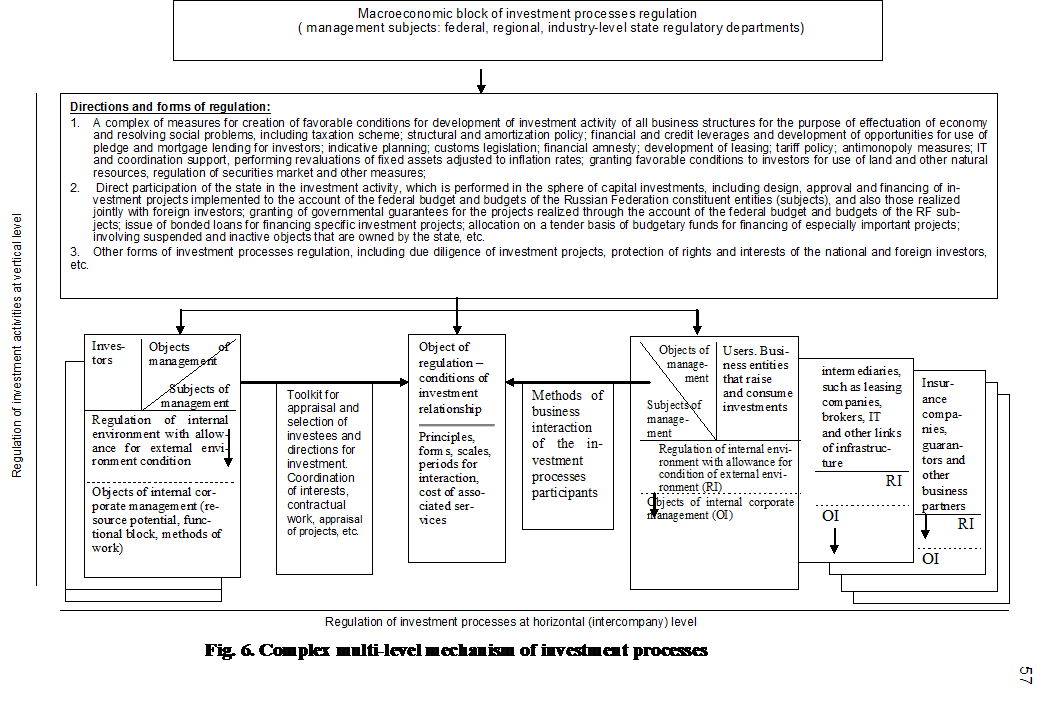
Efficient and integrated management of investment processes is possible solely on the base of a continuous and inter-related perfection of the forms and methods of investment management in the cross-section of its key blocks constituting the integral multi-level system. These are:
- block of macroeconomic (federal, regional, industry-level) regulation of investment processes;
- block of local corporate investment management;
- block of local corporate investment interaction (optimization of business communications).
The complex multi-level mechanism for regulation of investments is given in Figure 6.
Regional investment policy, which plays important role in the integral investment management system implies a system of measures at the level of a single region, which facilitates mobilization of investment resources and determination of the directions for their most efficient use in the interests of this region. Such policy should be designed with allowance for specifics of economic and social policies, geographical position, weather, climatic and demographic conditions and other factors. Industry-specific investment policy also plays a big role in the complex investment management mechanism.
Industry specifics have a material relevance for finance management of particular companies, firms, and enterprises. Many enterprises are currently subsidiaries of mother companies, holding companies, financial and industrial groups and other associations of enterprises, which are often located in other regions. In these instances regional investment policy sometimes come into conflict with the industry-level policy and financial, legal and other problems arise in the course of the formation of investment policy of the companies. The key problem of state regulation of investments is elimination of possible contradictions, harmonization of interests and coordination of common efforts in the investment sphere. Problems and specifics of investment management at a company level are discussed in section 2.4.
The model of integral system of multi-level regulation of investment activities on the example of leasing relationship[26], in mutual coordination with the complex of tasks for its optimization is shown in figure 7.
Tasks for optimization of the complex system of leasing management:
- ensuring rationality of interaction between the subsystems (see Fig. 7);
|
 А
А
|


|
|
|
|


|
- identifying and appraising the factors affecting the efficiency of regulatory effect of the toolkit*: Ар, Лрв, Лрп, Лпр, Лпрвn in the above subsystems;
- design and realization of the mutually coordinated measures for development of the elements of the leasing processes management.
Investment management mechanism at the level of a single company (micro level) is a complex system of financial, legal, organizational and economic measures implemented with allowance for interrelation of the state (regional, industry-specific) interests, interests of business partners and directed to the achievement of long-term objectives of investment activity in the sphere of the company economic and social development.
Position of companies, firms, enterprises and organizations is changed radically in transformed economy. Becoming a full-fledged subject of commodity-money relations, having economic independence and being fully responsible for results of its activity, a business entity should create its management system to ensure highly efficient operations with investments, competitive ability and a steady position in the market.
Administrative machinery of any companies makes their integral component and is associated with the concept of their management. The key task of management is effective utilization and coordination of all resources (capital, personnel, premises, equipment, materials, work, information) for achievement of its purposes.
The ever increasing relevance of management factor in modern conditions, the resulting increased role of social status of the persons performing administrative functions, served the basis for "managerial revolution" concept: authority transfers from proprietors to managers.
Economic condition of companies and their development prospects, rationality of investment policy are hugely dependent on activity of chief executive and on his or hers personal qualities.
Chief executive should possess:
- high professionalism, knowledge of theory and practice of management, entrepreneurial spirit;
- ability to organize business in a clear-cut manner;
- ability to appraise new technical, investment and administrative approaches and to find the fields for their application;
- high overall cultural level and culture of market relationship. Local and foreign experience show that the role of chief executive is very high in companies investment function development.

|
Из за большого объема этот материал размещен на нескольких страницах:
1 2 3 4 5 6 7 8 9 10 11 12 13 14 15 16 |
