

Партнерка на США и Канаду по недвижимости, выплаты в крипто
- 30% recurring commission
- Выплаты в USDT
- Вывод каждую неделю
- Комиссия до 5 лет за каждого referral
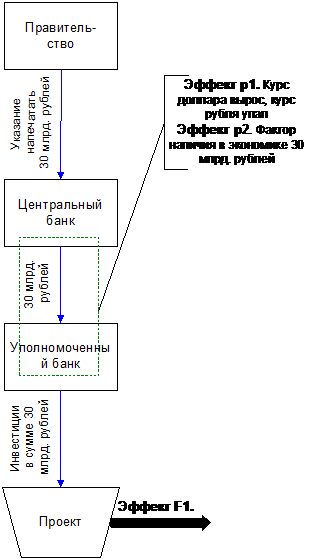
Fig. 17. Theoretical scheme of crediting: loan raised by way of issue
The government takes a decision under which the Central Bank issues 30 billion roubles for the investment project that satisfies the aforelisted conditions (Fig. 17). By now no legislative powers are vested on the Government to instruct the Central Bank and to influence the process of issue. Nevertheless, taking very seriously the necessity to ensure independence of the Central Bank, the author maintains the opinion, that to ensure the development and economic growth processes, it is necessary for the Government, in the instances stipulated by the law, to be able to effect limited, target-oriented issues of money. To this end, of course, it would be required to create a new legislative base and to enter amendments into the laws. In theoretical option of the scenario the funds shall be credited to the account with the authorized bank. The bank will obtain more available funds and the banking system will have more roubles (effect Р2 -effect Р1 occurs - the rouble exchange rate is down, while the dollar exchange rate is up. The funds are transferred to the project. The result of this stage is as follows: the national banking system has received 30 billion roubles.
In 5 years 45 billion roubles from the project shall be transferred to the authorized bank (fig. 18). The bank shall return the money to the Central Bank (effect Р3). The result of this stage is as follows: 45 billion roubles were removed from the national banking system.
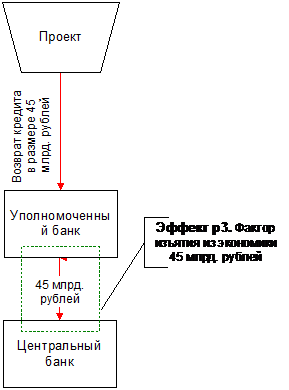
Fig. 18. Theoretical scheme of lending - repayment of a loan by way of an issue
Influence of the aforesaid effects on the economy is shown in Table 17.
The same as in the case with the credit obtained from abroad, in case of stage-by-stage financing of the project, under which it is expected to transfer the funds by installment, Р1 effect may be leveled out completely.
Table 17.
Effects that occur in case if the government arranges a limited issue
Effect | Effect | Influence | Total |
Р1 | USD exchange rate is up, RUB exchange rate is down. | The upsurge in the exchange rate caused by 30 billion rubles inflow in the market. | The exchange rate may change by any value but the possibility exists to calculate the threshold levels of the loan, at which the influence on the economy is negligible (for example, 1.5-2 % of the Central Bank reserves) (0) |
Р2 | Factor of 30 billion USD available in the economy. | Отрицательное влияние – возможно возникновение инфляции. | Inflation effect is possible (-). This possibility can be eliminated by calculating the threshold value of the issue. |
Р3 | Factor of 45 billion rubles withdrawn. | Positive influence: the state budget received 15 billion roubles of revenues, 30 billion roubles have been returned to the Central Bank. | The state has replenished the budget by 15 billion roubles. (+) |
Let's compare the results obtained. When a loan is obtained from abroad for crediting the investment project, 1 billion dollars are "injected" into the national economy, and after 5 years outflow of 1.5 billion dollars occurs. In case of the limited issue the influence on the economic situation is caused by the following 2 effects: injection of 30 billion roubles into the national economy and this implies the possibility of inflation during 5 years, employment rate growth (F1); further withdrawal of 45 billion roubles after 5 years. Investments into a company's major projects may create the multiplier effect with at high degree of probability.
Thus, under certain conditions (the possibility to create such conditions needs to be reviewed in detail) in terms of its investment policy implementation, a limited issue of money is more profitable for the government rather than foreign credits. When the policy of raising funds from abroad is pursued another problem arises: several investment projects require many loans and they facilitate growth of the country's debt burden.
To solve the above reviewed problem it is required to find answers to the following questions:
· to what conditions should a company's investment project satisfy in order to become an investee for the state?
· whether any conditions exist under which it is more profitable for the government to finance the investment project through an issue rather than through a credit obtained from abroad? If they do exist, then the following question is relevant.
· what are criteria for choosing between the option of finance raised through a foreign credit and the option of a limited issue?
It is expedient to design a technique of calculating the maximum amount of finance for an investment project. Excessive use of issues for crediting investment projects may create an undesirable inflation rate; it would also be required to create a new legislative base and to make modifications into some particular existing regulations and laws.
To find the answers to the above questions it is required to conduct a detailed research with preparation of the appropriate simulation models. With the help of such models it is required to work out the key schemes for government lending of investment projects.
If the certain conditions exist for the government to see it more profitable to finance an investment project through a monetary issue rather than through a foreign credit, the government obtains the possibility to create incentives for unlimited economic growth. The state investment activity in development of perspective directions of production operations of some particular companies will be most efficiently combined with such investment policy of companies that provide for scientific appraisal of the developed and implemented investment projects efficiency.
3.3. Enhancement of methods for appraisal of investment projects efficiency
One of directions for efficient development of the national companies is analysis of the efficiency of investment projects developed by them as a necessary condition precedent for accurate substantiation of possible options for investments into transactions with tangible assets. Let us review the conceptual approaches to the evaluation of a company investment projects.
For the purpose of the analysis to obtain a more accurate appraisal it is required to take into account that: invested funds vary as per their time cost characteristics, i. e. 1 rouble, which is invested today, costs more then a ruble received in the future; investments may be effected in a lump sum and also may be recurring during a certain period of time; the process of return from implementation of investment projects is rather long, which is associated with a whole range of risks.
Investments and return of invested capital, as a rule, are stretched in time period, therefore to compare them we should use the discounting method, which is based on the concept of time value of money. This method is presented as follows:
Let us assume, that an investor has at the moment a certain amount Cо. Having invested this amount into some project for the purpose of generating income at the rate of (r) per annum, next year the investor will receive the amount
С1 = Со + r · Со + Со (1 + r) .
In this context the today’s Со roubles are equivalent to С1 roubles of the next year, where С1 is expressed through Со by the following formula. In reversed manner, if we express Со from it through С1, we shall obtain the formula that expresses the current value of the next year’s money:
С1
Со = ────
1 + r
Similarly, Со amount for the two years will become
С2 = С1 (1 + r ) = Со (1 + r)2,
i. e., the today’s Со rouble amount is equivalent to С2 rouble amount, which is obtained by this formula, after two years. Therefore, the today’s value of the money, which will be obtained after two years, is expressed by the following formula:
С2
Со = ─────
(1 + r)2
In similar manner, the today’s Со rouble amount is equivalent to Сt rouble amount after t years, if
Сt
Со = ───── .
(1 + r)t
Investment projects should be evaluated on the base of their technical feasibility, economic efficiency (it shall be estimated by way of comparing the profit with costs) and ecological safety.
On the base of a roundup value among the methods of investment estimates it is possible to identify the following:
- absolute methods which use roundup values in the form of absolute values of the difference between the capital investments and the current costs of project implementation as well as absolute values of its results evaluation;
- relative methods by which roundup values are calculated as a ratio between the cost estimate of the results and the aggregate costs;
- temporary methods by which the payback period is estimated.
Сriteria used in analysis of investment business can be classified into the following two groups depending on the time parameter taken into account: criteria based on discounted estimates and criteria based on accounting estimates.
The key criteria include: Net Present Value (NPV); Profitability Index (PI); Internal Rate of Return (IRR); Modified Internal Rate of Return (MIRR); Discounted Payback Period (DPP); Payback Period (PP); Accounting Rate of Return (ARR).
In the process of evaluation of investment project efficiency it is required to weigh different parameters against each other and this is performed by discounting of them to a particular year (normally to a starting year). As the incomes (costs) arising in various years even if they have a similar value, have different economic value, economics of a project are based on discounting, i. e. discounting all costs, results and effects to a reference point, which is common for each particular set of estimates. Discounting method is used for estimating the current value of the future expenses and incomes. Therefore the discounting rate is sometimes referred to as "cost of capital", which is frequently defined as required return on the invested capital.
The key approaches serving a basis for methods of valuation of investment projects in which the given criteria are used.
Method of discounted value is based on calculation of integrated economic effect from an investment project. This parameter performs the function of a project expediency (or inexpediency) criterion and is called "net present value" (NPV).
Net current revenue from an investment project is calculated by the following formula: NPV = PV - IC. This calculation is based on comparison of the amount of the discounted cash investments (IC) with the total amount of discounted net cash receipts that have been generated for a forecasted period (PV). As inflow of cash receipts and investments is sequenced in time, it is discounted to the current point in time by means of discount factor, which is fixed by investors themselves on the basis of the appropriate threshold rate of return selected for a particular investment project.
n I t
IC = ∑ ─────
t=0 (1 + r ) t
Let us assume that the forecast is made to the effect that investment (IC) will generate within (t) years annual revenues equal to Р1, Р2, …, Рt, then the total value of the discounted revenues (Present Value - PV) shall be calculated by the following formula:
n Pt
PV = ∑ ─────
t=0 (1 + r ) t
A positive value of NPV is indicative of a project expediency, and in comparison between the alternative projects the most profitable shall be the one with a greatest NPV.
NPV in many respects is determined by the rate of return selected for calculation and the value of rate of return depends on: particular purpose of investment and conditions of a project implementation; inflation rate in the national economy; level of investment risk; alternative opportunities for capital investments; financial considerations representations of the investor.
It is accepted that for different classes of investments it is possible to select different values of discounting rate. Investments targeted to maintain the investor's market positions are estimated at the standard rate of 6 %, while investments into renewal of fixed assets are estimated at 12 % rate, investments made for costs saving purpose are estimated at 15 % rate, investments made to increase corporate revenues are stimulated at 20 % rate, and venture capital investments are estimated at 25 % rate. The applicable rate is dependent on a project risk level. Thus, for the projects based on new technologies the applicable rate is 24 %.
NPV reflects the predictive estimate of a change in economic potential of a business entity in case if a project under review is approved. This parameter is additive in space and time aspect, i. e. NPV of various projects is possible to be summarized. This is a very important property, which makes it possible to differentiate this criterion from other criteria and also makes it possible to use it as a key criterion in the analysis of investment portfolios optimality.
Method of calculation of accounting rate of return is in fact deduced from the previously described method. Profitability of investment project is a ratio of discounted incomes (return) to investment outlay discounted at the same date or a ratio between the current value of future cash flows and the initial expenditures.
For real investments that continue for several years PI value is calculated by the following formula:
t= n (CF) t
∑ ─────
t=0 (1 + r ) t
PI = ———————
t=n (Co) t
∑ ─────
t=0 (1 + r ) t
wherein: | (CF) t | - financial result of a year (t), which is calculated without the initial investments (if they fall on this year); |
t= n (CF) t Σ ———— t=0 (1 + r ) t | - return of capital (initial investments): the amount of financial results CF distributed by years, starting from the date of the first investments; | |
(Co) t | - initial investments (original capital) in a year (t), commencing from the inception date of investments; | |
t= n (Cо) t Σ ———— t=0 (1 + r ) t | - invested capital (initial investments). |
For financial (non-recurring) investments formula PI is simplified as follows:
t= n (CF) t
∑ ─────
t=0 (1 + r ) t
PI = ———————
Co
wherein: Со – non-recurring investments into financial assets (invested capital).
It is obvious that if: PI > 1, the project may be accepted; PI < 1, then the project should be rejected; PI = 1, the project is neither profitable, nor unprofitable, i. e. return on capital invested is equal to invested capital.
Excess over 1.0 value of the project profitability means that it has some extra profitability at the interest rate in question. The case where profitability of the project is less than 1.0 it means that it is inefficient at the given interest rate.
Unlike NPV, profitabilty index is a relative value, which characterizes the level of revenues per unit of expenditures. The higher is the value of this parameter, the greater is the return on 1 rouble invested into a given project. Due to this circumstance criterion PI is convenient when it is required to select a single project in a set of alternative projects that have approximately identical NPV values (if two projects have identical NPV values, but different volumes of the required investments it is obvious, that the project ensuring a greater efficiency of investments is more advantageous), or when it is required to make up a portfolio of investments for the purpose of NPV total value maximization.
Method of calculation of internal rate of return is based on the detailed analysis of investment projects. Appraisal of investment projects is performed on the basis of Internal Rate of Return of the investment in question (IRR is internal profitability, internal payback), which has the value of discount factor (r) at which NPV of the project is equal to zero for the whole investment period:
IRR = r, at which NPR = ƒ (r) = 0.
If we take that IC = CF0, then we shall obtain IRR from the equation:
n CF t
∑ ─────── = 0
t=0 (1 + IRR ) t
The purpose of calculating internal rate of return in the analysis of efficiency of planned investments is as follows: IRR shows the expected profitability of the project, and consequently shows the maximum admissible relative level of expenses that may be associated with the given project. For example, if the project is fully financed from a loan granted by a business bank, then IRR value shows the upper boundary of the allowable level of bank interest rate, which if exceeded, shall render the project unprofitable.
Internal Rate of Return (IRR) and reinvested internal rate of return make it possible to identify the best option of investments, therewith RIRR smoothes down the optimistic and pessimistic expectations of investors. As a result of estimation of a set of projects it was discovered that in case of efficient investments both parameters are higher than the loan interest rate (Eк): Eк < RIRR < IRR, and on the contrary, if investments are not efficient, the loan interest rate is higher than these parameters: Eк > RIRR > IRR. The Accounting Rate of Return (ARR) shows, by what percent it is possible to increase investments or decrease revenues, with the project still retaining its attractiveness for the investor. If the investor requirements are just to ensure that income must by η times exceed the interest rate charged for use of credit (cost of credit), then the maximum share of credit (К max ) in the investments shall be calculated by the following formula:
PI
К max. = ———
n
Normally any business entity finances its operations from multiple sources. It has to pays interest, dividends, and other fees for use of financial resources invested into the entity operations, i. e. it incurs some reasonable costs. The parameter that characterizes a relative level of such costs with regard to long-term sources of funds is Weighted Average Cost of Capital, WACC. This parameter reflects the minimum return, which is achieved in the entity on the capital invested into its operations, its profitability and shall be calculated by formula of average arithmetic weighed value.
Economic essence of IRR criteria is that a company can take any investment-related decisions, which level of profitability is not below the current value of "cost of capital". The latter shall be understood as either WACC, if the source of funds is not expressly indicated, or as the price of the target source, if any. IRR criterion is compared exactly with SS value and IRR shall be calculated for a particular project, while the connection between them is as follows:
If: IRR > CC - the project can be accepted; IRR < CC - the project should be rejected; IRR = CC - the project is neither profitable, nor unprofitable.
The required value of IRR may be calculated by trial and error method, by graphical method or by more accurate mathematical methods.
The method of calculation of investments payback period is also rather useful for evaluation of investment projects efficiency.
Payback period (РР) is one of the most commonly used indicators, especially for a preliminary evaluation of investments efficiency. This indicator is understood as duration of the period during which the amount of net revenues discounted on the date of investments completion is equal to the amount of such investments. The main drawback of the payback period as an indicator of capital investments efficiency is that it does not take into account the whole period of production operating cycle, and consequently it is not influenced by the revenues that are to be generated after the payback period. The value of payback period, obviously, should be used merely as a restriction for a decision-taking process rather than a criterion for selection of an investment project, and if a payback period is greater than a certain landmark value taken such investment project may be excluded from the list of projects under review.
This method is one of the most simple and commonly used worldwide in analytical practice as it does not imply timing of cash receipts. The algorithm of calculation of payback period depends on the uniformity of distribution of anticipated costs and revenues from investments. If revenues are allocated uniformly by years with regular intervals, the payback period is calculated by division of the lump sum of costs at the annual revenue. A fractional value shall be rounded up towards increase to the nearest round figure. If the revenue is distributed with irregular intervals, the payback period shall be calculated by direct calculation of the number of years during which the invested amount will be repaid though cumulative revenue.
It is possible to identify a set of situations in which the method based on calculation of the payback period is rather expedient. In particular, this may be a situation when the management of a business entity is mostly concerned about liquidity, rather than profitability of the project - the main thing is that the investments must be recouped and as soon as possible. The method is also good, when investments are associated with a high level of risk. Therefore, the shortly the payback period, the less risky is the project. Such situation is specific for those industries or businesses that are featured by high probability of fast technological changes. Therefore, unlike NPV, IRR and PI criterion PP makes it possible to obtain estimates, rough, though, about liquidity and level of risk for a project. The concept of a project liquidity is conditional here: it is considered, that among the two projects the one with a less payback period has a greater liquidity. As to the comparative evaluation of projects risk levels on the base of PP, the logic of reasoning is as follows: receipts in the future years after the project inception are more difficult to forecast, i. e. they are more risky as compared with receipts of the first years; therefore from the two projects the one with less payback period is less risky.
Method of Accounting Rate of Return calculation has two specific features: it does not assume discounting of revenue values; the revenue is featured by net profit PN (profit less for deductions to the state budget). The algorithm of calculation is simple enough, that's why this parameter in widely used in practice: ARR is calculated by way of division of average annual revenue (ARR) at average investment value. ARR is calculated in percent.
This parameter is compared with to the return on capital invested, which is calculated by division of total net profit of a business entity at the total amount of funds invested into its business (result of average net balance). In principle it is possible to establish a special threshold value with which ARR shall be compared, or even their systems, which is to be differentiated by types of projects, by level of risk, by responsibilty centers, etc.
The method based on ARR has a number of significant deficiencies that are preconditioned basically by the fact that it does not take the time component of cash flows into account. In particular, this method does not differentiate between projects with a similar amount of average annual revenue but with varying amount of revenues by different years, and also between the projects having a similar average annual revenue but still generated during a different number of years.
Sensitivity analysis of an investment project under the adopted concept of its possible implementation includes the following stages:
1. Selection of a key parameter, i. e. a parameter in relation to which the estimate of sensitivity is performed. Such parameters should be IRR and NPV, which most accurately characterize feasibility of an investment project. When selecting a key indicator it is necessary to take into account, that NPV is relative in the event if the investor is already identified and the interest rate for the loan is already agreed to calculating the discount rate. The value of IRR characterizes efficiency of a project as a whole, i. e. it is more appropriate to be selected as a key indicator. If an investor or a person who is implementing the project, is concerned in sensitivity of today’s cost of the project in absolute figures, then the net present value NPV shall be selected as a key parameter of sensitivity analysis; if the efficiency of the project as a whole is a point at issue, the internal rate of return (IRR) shall be selected.
2. Selection of the key factors in relation to which it is required to determine sensitivity of the key parameter (NPV or IRR), and hence, of the investment project as a whole.
There may be a lot of such factors but most interesting are changes in those factors that most obviously determine the economics of an investment project: cost of products (sales volume); capital investments; production costs; joint influence of capital investments and production costs; calculation of values of a key parameter when the key factors change.
The total value of key factors applicable where estimates are performed under a project is equal to 1. When each factor increases or decreases against the design value it is required to calculate the cash flows that are specific for them and on the basis of them it shall be required to calculate the values of the key indicator. A change in relative factors is effected in unit fractions.
Analysis of the results calculated by various methods shows the following picture: even in relation to a single project the decision for its approval is not always obvious, because selection of the required criterion may under certain conditions help “substantiate” this or that particular decision. It is obvious, that the situation is sharply complicated if it is required to evaluate several projects. Contradictions arise between criteria of various groups - those based on discounted and non-discounted estimates. Variances are possible also inside a group of homogeneous criteria.
As regarding PP and ARR criteria, they are absolutely independent from each other and given the circumstance that different threshold values may be established in a company for these criteria, the possibility of contradictions arising between them shall not be excluded. Interrelations between the criteria based on discounted estimates are more complicated. The essential role here is played by this circumstance, whether it is about a particular project or an investment portfolio, which may include both independent and mutually excluding projects. A particular project is a special case of a portfolio of independent projects. In this particular case NPV, PI and IRR criteria result in similar recommendations concerning the approval or rejection of a project. A project, which is acceptable on the base of either of these criteria, shall be acceptable on the base of other criteria. The reason for such concurrence is that there are obvious interrelations between NPV, PI, IRR and CC parameters:
Where NPV > 0 at the same time IRR > CC and PI > 1;
Where NPV < 0 at the same time IRR < CC and PI < 1;
Where NPV = 0 at the same time IRR = CC and PI = 1.
The great variety of available investment options is not limited to some particular projects that are not related to each other. Frequently such situation arises when it is necessary to make a choice between several investment projects that are available for implementation. There may be various reasons for this situation, such as limitation of available financial resources, which means that some of generally acceptable projects will have to be put aside for the future. A situation is also possible when the sources of funds and their availability are not identified precisely in advance or a change occurs in the course of time. In this instance it is required to rate the projects by priority, irrespective of whether they are independent from each other or are mutually excluding projects.
In all aforesaid situations it is not always possible to draw an unambiguous conclusion. Therefore, to take a final decision it is necessary to obtain additional formal or informal criteria.
Methods based on discounted estimates are from theoretical point of view though to be more substantiated as they take into account the time component of cash flows. At the same time they are rather more labor intensive in terms of parameters calculation.
The main conclusion is the following: among all of the reviewed criteria the most acceptable for taking investment decisions are obviously NPV, IRR and PI criteria. Notwithstanding the aforementioned interrelation between these parameters, in the course of appraisal of alternative investment projects the problem of criterion choice is not eliminated. The main reason for this is that NPV is an absolute parameter, while PI and IRR are ratios.
Research in the field of financial management showed that in case of a contradiction it would be preferable to use NPV criterion. There are the following two main arguments in favor of this criterion:
NPV gives a probabilistic estimate of a gain in a business entity capitalization in the event if the project is approved; this criterion fully meets the main purpose of management personnel: accumulation of economic potential of the company, more exact market - based estimate of equity capital;

|
Из за большого объема этот материал размещен на нескольких страницах:
1 2 3 4 5 6 7 8 9 10 11 12 13 14 15 16 |
