

Партнерка на США и Канаду по недвижимости, выплаты в крипто
- 30% recurring commission
- Выплаты в USDT
- Вывод каждую неделю
- Комиссия до 5 лет за каждого referral
Table 7
Composition of investments into non-financial assets
In percent of total
Directions of investments
Years | Investments into non-financial assets, total | also including: | ||
Investments into fixed capital | Investments into intangible assets | Investments into other non-financial assets | ||
1998 | 100 | 98,5 | 1,0 | 0,5 |
1999 | 100 | 98,6 | 1,2 | 0,2 |
2000 | 100 | 98,4 | 1,5 | 0,1 |
2001 | 100 | 99,1 | 0,7 | 0,2 |
2002 | 100 | 98,6 | 0,5 | 0,9 |
2003 | 100 | 98,9 | 0,5 | 0,6 |
2004 | 100 | 99,1 | 0,5 | 0,4 |
2005* | 100 | 98,1 | 0,9 | 0,7 |
Source: Investitsii v Rossii. 2005: Statistics digest/ Rosstat. - M., 2005, page 40.
* In 2005 R&D and engineering costs accounted to 0.3 %.
- increased increments in fixed assets, and hence, increase of entity real value.
At macro level it is possible to judge on investment status on the base of the following measures:
- total amount of investments in all industries of the national economy;
- investments share in a country total domestic product;
- volume of real investments, including investments into real sector of economy;
- a share of real investments directed to replacement of fixed assets and a share of real investments directed to fixed capital increment.
Investment into real sector of economy is primarily connected with innovations implemented in engineering, technology and plant management. The key function of investments into fixed capital are innovational, which provides for fixed assets upgrade through the account of R&D and new technologies.
Investment and innovational processes are closely interconnected, and investment processes is a condition precedent for realization of innovational processes. Investments that are not directed to innovations and invested into fixed assets may appear to be inefficient, even harmful and may extend the period of production of obsolete products.[11] Implementation of innovations in production industries entails modernization of the main potential of the national economy, increases labor productivity, and consequently brings savings of supplies and materials and labor resources of the country, and also creates a multiplication effect. As a result, growth of GDP is achieved and such growth exceeds the initial investment outlay.
To calculate the multiplication effect of investment it is possible to use the following system of parameters[12]: national income, GDP, GNP; industrial output; volume of agricultural production; productivity of public labor.
The outstripping growth rates of the aforesaid parameters exceeding the growth rates of investments characterizes the created multiplication effect. Volumes of investments, types and forms of investment are determined by the level of a country industrial development. It is not by chance that the world biggest financial institutions are concentrated in the industrial developed countries.
Today economic growth is inconceivable without actively implemented achievements of scientific and technical progress and without intellectualization of the major factors of production. According to the forecasts in XXI century intellectualization of labor and computerization of production will become a first priority factor of the global competition. Currently the share of new knowledge embodied in technologies, equipment, education of staff, in production management accounts in the advanced countries to about 70-80 % of the GDP increment and requires high level of the government participation in stimulation of scientific and technical progress. For Russia the enhanced role of its economy intellectualization is a decisive factor for optimization of the structural reorganization in the national economy and for ensuring its stable growth.
Decentralization of the national investment resources in Russia, which is caused by denationalization and privatization of property, has strengthened the isolation of economic interests of the Russian companies. As a result of the above the investment process became spontaneous and often fragmented by nature. Thus, the current economic interests quite often exceed the long-term interests connected with investment of high technologies. This was facilitated also by economic and political instability in the society. Therefore, outflow of capital to the sphere of speculative transactions with securities became a response to unfavorable market conditions in the real sector of economic activities. A substantial portion of cash was frozen on the accounts of enterprises and companies. It is worth noting that the critical situation arose in households sectors, where in that period growth of population savings was not accompanied by the appropriate growth of investments.
The greatest loss to the Russian economy and to the national security was inflicted by criminalization, by developed illegal business and corruption of state bureaucracy. Capital flight via these channels amounted to USD 20 billion per annum.[13] Officially reported investments of the Russian entities into economy of foreign countries in 2004 year amounted in 2004 year to over USD 33, 7 billion. [14].
Curtailing of investments entailed destruction of the country's production potential and increased expansion of the foreign capital in the Russian market.
To escape from the situation it is necessary to retarget the investments to the critical directions of the national economy development, and for this purpose the contents of the strategy and priorities of investment policy as the most important direction in the state management of the national economy must be clearly stated.
1.2. Investment activity of entities in the context of the national economy state regulation
A company is a legally independent business entity, it sets up is purposes and targets of social and economic development within the framework of which and on the base of its independently selected and sound investment policy a company is carrying out its investment activity. A company's investment policy is focused on long-term objectives and is being implemented in the course of its day-to-day business and financial operations.
Formation of a company investment implies:
- identifying its effective period to be appropriately adjusted taking into account its purposes and stages to its financial policy;
- design of the most efficient ways for implementation of strategic purposes of investment activity;
- taking into account the results of the company financial and business performance and a range of social effects.
Outline scheme of the formation and implementation of a company investment policy is given in Fig. 4.
Absolutely independent corporate investment policy is simply impossible, as it is implemented in close interrelation with the state (industry, regional) policies and those of many other business entities. [15] All participants of investment processes are dependent on each other in their system relationships.
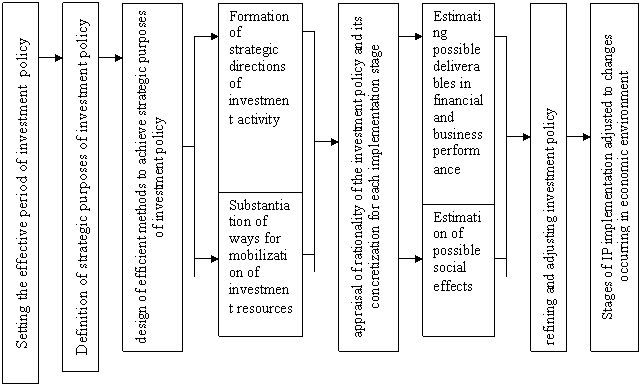
Fig. 4. Scheme of formation and implementation of corporate
investment policy (IP)
The complex analysis of the national companies shows that all of them in the formation of their investment policies and investment management process take into account the whole system of legal, economic, financial and organizational activities carried out both by the government via its supervisory authorities (including regional and industry specific departments) and by business partners and competitors.
Effectuation of investments implies a strategic approach in design of investment policy. A model of investment policy should incorporate elements of the overall strategic approach and investment design.
Principles of strategic approach dictate the necessity to conduct research of the external environment that affects the investment activity of the Russian companies. We review parameters of the environment in terms of the tools that are used for affecting companies activities and from the standpoint of the subjects that affect it.
In the first instance the external environment includes economic, social, technological, legal and state & political parameters.
In the second case the external environment of the company consists of consumers, suppliers of resources, competitors, public organizations, agents of the state economic policy.
Favorable factors and threats imposed by the external environment influence the formation of a company investment strategy as well as on the system of its purposes. A company should invest into the projects that resolve the problem with isolation of its market and strategic area, and this problem is in the balancing of the market and resource orientation. The following step in the formation of investment policy is a choice of directions for investment activity and the sources of investment.
The first priority directions of investments are as follows: development of integrated links by geographical and/or industry criteria; development of company marketing network; increase of HR, financial, organizational potential; realization of energy-saving technologies.
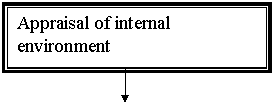
The key sources of investment: resources of the regional development funds; resources raised from private placements; funds obtained in the process of the creation of strategic alliances with the Russian and foreign companies; foreign investments; tax concessions. Strategic planning of investments should be considered as a mechanism for design of a company investment policy.[16] Investment policy of a company is a time-phased and resource-balanced list of strategic investment actions. The algorithm of the formation of corporate investment policy is given in Fig. 5.
A corporate investment policy should be also understood as identifying the key strategic investment purposes and tasks set by a company, approval of its business directions and allocation of resources to achieve its strategic purposes. The economic component in the design of a company investment policy is understood as a selection of the most efficient distribution of strategic resources for achievement of its strategic purposes. That means that a company's parameters of external environment, its potential strengths and weaknesses should be taken into account. A company investment policy (or a system of interrelated measures that ensure management functions in political, legal, economic and organizational aspects) determines the medium-term and long-term objectives
 |  |
Identifying favorable opportunities Identifying strengths
and threats and weaknesses

 |









Fig. 5 Algorithm of investment policy formation
of a company and the main ways for achieving them.[17] It is designed on the base of social & economic and scientific & technical forecasts and is based upon for selection of investment strategy, design of investment programs and projects, offering criteria for their valuation and selection. It is critical in conditions of a long investment cycle, multiple factors and high variability of market conditions.[18]
Investment policy shall be designed[19] at all levels of economic activity. At macro level it shall be designed for enterprises, firms, companies, banks, and funds, which are implementing investment projects, –efficient investment policy implies design and consistent realization of strategy with allowance for varying market conditions.
Investment policy at mezo level is no less important - at regional and industry level of management. This policy should take into account the prospects for development of local units, industries, sectors of the national economy, should serve a basis for design of target-oriented programs, selective strategy for support of the most promising investment projects.
As regarding the macro level, it is possible to asserts that the design and implementation of state investment strategy at the federal (nation-wide) level helps to concentrate limited budgetary funds and support measures on the most promising industries and regions to support the dynamic equilibrium in economic development as a whole, its transition into a new qualitative condition with minimal losses.
The biggest national companies participate in transnational processes. Therefore, international investment policy of the whole global community (concept of sustainable development), regional associations (CIS, European Union), some particular international global financial institutions (World and European Banks of Economic Development and Reconstruction, International Monetary Fund, Global Ecological Fund, etc.) has a special importance.
On the one hand, investment policy should be long enough (with allowance for the periods of design, implementation and payback of investment projects), and on the other hand, it should be alternative, flexible, allowing timely adjustments for varying market conditions. The tasks and methods of this policy implementation vary at different phases of business cycle. In the phase of crisis and depression when survival strategy prevails, the purpose of investment policy is preservation, support and strengthening of the most viable and promising part of the fixed capital, able to ensure production of competitive products. In phases of revival and economic recovery the break-through strategy prevails. In this respect a special attention should be attached to work titled "Russia - 2050: Strategy of innovational break-through”.[20]
During investment boom the task is to ensure timely and complex realization of investments and innovations to facilitate the development of the new and expansion of the created positions in the already existing market niches. In the phase of maturity (stable development) state support may be minimal; innovations and investments are realized by market method in accordance with the policy designed at the level of business entities. Thus, investment policy of the national companies should cover a sufficiently long period of time in order to timely reflect the changes of direction at various stages of a business cycle.
All elements of investment policy play their specific role in its structure and composition, i. e. the policy itself is an integral complex system. Measures of economic and political & economical nature play a decisive role in the investment policy. The last mentioned measures create a material basis for the formation of investment policy. As a result a change of the forms of ownership occurs: the prevailing state-owned type of ownership is transformed into diverse other forms of ownership, including private ownership and mixed-type ownership. This makes the Russian economy becoming increasingly a mixed-type economy (Tab. 8)
Table 8
Structure of the investments by form of ownership
In the then current prices, in percent of the total
Period form of ownership | 1995. | 2000. | 2002. | 2005. |
Total investments | 100 | 100 | 100 | 100 |
also including by forms of ownership: Russian | 97,3 | 86,3 | 85,7 | 79,0 |
State | 31,3 | 23,9 | 20,2 | 24,3 |
Municipal | 6,3 | 4,5 | 4,7 | 4,5 |
Public and religious organizations (associations) | 1,5 | 0,1 | 0,1 | 0,1 |
Private | 13,4 | 29,9 | 42,0 | 33,7 |
Consumer cooperatives | - | 0,1 | 0,1 | 0,1 |
Mixed Russian | 46,2 | 27,8 | 18,6 | 16,3 |
Foreign | - | 1,5 | 3,6 | 7,3 |
Mixed Russian and foreign | 2,7 | 12,2 | 10,7 | 13,7 |
Source: Osnovnyye pokazatyeli investitsionnoi i stroitelnoi deyatelnosti v Rossiskoi Federatsii v 2005 godu. №1(69): Statistical digest /Rosstat. – М., 2005, p. 8; Investitsii v Rosii. 2005: Statistical digest / Rosstat. – М., 2005, p. 46.

|
Из за большого объема этот материал размещен на нескольких страницах:
1 2 3 4 5 6 7 8 9 10 11 12 13 14 15 16 |
