

Партнерка на США и Канаду по недвижимости, выплаты в крипто
- 30% recurring commission
- Выплаты в USDT
- Вывод каждую неделю
- Комиссия до 5 лет за каждого referral
To get a better understanding of the role and relevance of the forms and methods of modern management of investment activity at a micro level we shall review the key elements of management evolution. At early stages of capitalist production entrepreneur as the owner of business managed his enterprise and resources himself. Technological progress, increased production capacity and innovation opportunities on the boundary of XIX and XX centuries sharply complicated the management process, and management was segregated into a special
field of activity which required special knowledge. F. Tailor made a huge contribution to the creation of science and management. His proposed rationalization of relationship in production sphere radically changed the organization and management and substantially increased management efficiency. Studies of F. Tailor are used even nowadays by the national and foreign firms. He selected four groups of administrative functions: choice of purpose, choice of means, preparation of means, and control of results.[27]
Taylor's contemporary A. Fayol designed principles of management. All operations in a company were segregated by him into six groups: technical, commercial, financial, protection of property and persons, accounting, and administrative operations. Management was referred to the sixth group[28]. Management, according to A. Fayol means:
- to foresee (to study the future and to establish the program of actions);
- to organize (to build a double organism of the enterprise, such organism having both material and social aspects);
- to manage (to cause corporate staff start working);
- to coordinate (to connect and unite acts);
- to supervise (to see that all us done in accordance with the established manner and given orders).
The issues of management and operation of firms, enterprises, companies, their investment policy in market conditions are given much of attention in modern scientific literature [29].
In the course of the evolution of theory and practice of management various problems were focused. In 50-60-s of the XX-th century the organizational management structure was primarily focused on. In 60-70-s the issues of strategic planning were most mencing from 80-s the trend has been observed among the leading western firms towards shifting from strategic planning to strategic management. A relatively new stage in the development of management is integration of the theory of management and the theory of marketing, and this integration has created the market-based concept of management.
The transition from the command economy to the market-oriented economy forces the Russian experts to carefully study the experience of market economies functioning in the developed countries in order, whenever possible, to use those elements of the market-oriented economy that were successfully tested in other countries, and also including the appropriate toolkit ensuring efficient business of the market operators and operations in the investment sphere.
Management of the national companies and their resources management in the market-driven economy are in many respects more complicated than in a centralized command system. This is due to their rights and responsibilities being expanded and owing to the necessity to more flexibly adapt to the changes in investment environment, which is understood as a set of variables beyond the entity and its managers' control. These are business entities that have relationship with the entity owing to the tasks performed by the entity: finance and investment entities, leasing companies, suppliers, management bodies, consumers and, certainly, competitors. There exists a somewhat a secondary range of variables of external environment - these are the factors that do not directly affect the entity's business activity, also including investment activity, but influencing important strategic decisions of the entity management. The key role here is played by financial, economic, political, legal, social, cultural, technological, ecological, physical and geographical factors.
The role of the external environment factors increases with the complication of the whole system of relationship in the society (social, financial, economic, and political), making the environment of management. Condition of the external environment dictates today the strategy and tactics of management in the Russian companies. Therefore, the situation-based approach to management is required today, including management of investments. Internal corporate environment is the answer to multiple external influences. The central aspect in this approach is diagnostics of the situation, i. e. precisely defined specific set of the factors influencing the entity operation in the given period of time. The task of management in these conditions is realization of the managing function providing adaptation of the business entity to external realities. This determines the efficiency of investment processes at the micro level.
Internal corporate environment is being formed under the influence of variables directly affecting conditions of business activities. These are organizational structure of a company, functions performed by its subunits, forms and methods with the help of which such functions are realized, and also the resource potential, which makes it possible to carry out investment business.
Management of the national and foreign companies today has a multi-purpose nature, i. e. along with the strategic purposes it is necessary to resolve many day-to-day and operative problems such as economic, investment, social, organizational, technical, scientific, etc. Alongside with recurring, traditional problems it is often required to take decisions on unforeseen situations, etc.
Classification of management purposes makes it possible to concretize the task of objectives definition and use relative tools and methods for the appropriate classes of purposes (for example, the tools used in strategic planning can be used in investment, innovation and industrial management).
The purposes and targets of management currently require a complex systematic approach to definition of their structure, irrespective of a company size, profile and form of ownership.
Management systems built on the basis of prediction of changes and on the basis of flexible and prompt decisions are becoming more frequently used. Obviously, they can be defined as entrepreneurial management systems because they take into account the uncustomary nature and unexpectedness of future development.
National entities (companies, firms, enterprises) tend to use strategic planning methods more actively. Sudden and sharp changes in the external environment, in technologies, investment sphere, and in competition are taken as reality of the modern economic life that requires management techniques. As a result the decentralization elements develop in management structures and change them. Organizational mechanisms tend to adapt better to identifying new problems and development of new solutions, rather than to control of the already adopted solutions.
Today the investment sphere sees new arising purposes and tasks, which were not earlier resolved or even set up by business entities on their own. Transition of the national business entities to the market-oriented economy means they are getting into a zone of high economic uncertainty and risk. Having obtained rights to independently operate in the local and foreign markets, Russian companies encountered for the first time the problems of investment flows optimization, strategic planning, management of property complex, and financial management. Some business entities discontinue their existence, while other entities are at the stage of formation Forms of ownership are changing in accordance with results of privatization, new business ties are being set up and market-driven management mechanisms are developing.
Methods of micro-and macroeconomic regulation of the national economy are radically changing as well; new relationships are being formed, both between business entities, and inside particular entities. The same fully goes for investment relationships.
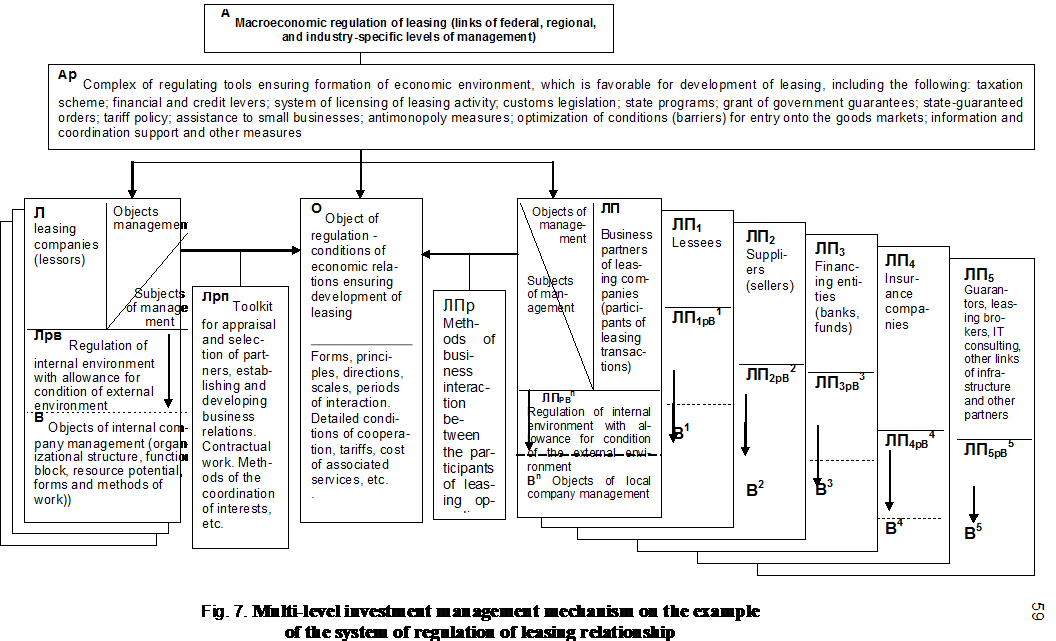
Federal and regional interventions became to be targeted mostly on macroeconomic transformations, while decentralization of management and transfer of key regulatory levers to a micro level is becoming a typical trend with business entities acquiring economic independence on the basis of property relations.
The aforesaid circumstances cause the necessity of the formation and functioning of business entities as and open, socially oriented systems. The concept of companies as open systems means intensification of the orientation to the market and to consumers. Each entity, which is functioning in today's Russia, must aspire to independently resolve its internal problems and issues of the whole range of relationships and ties with external environment. The following tasks fell beyond the competence of the Soviet enterprises while today they are the core tasks of the Russian enterprises: marketing research; formation of investment policy; due diligence of investment projects; expanding foreign economic relations; setting-up business communications.
CHAPTER 2. ANALYSIS OF TRENDS IN CORPORATE INVESTMENT MANAGEMENT
2.1. Russian companies in the global investment process
All countries in today's world are involved in the processes of international investment cooperation.[30] It was stated at the international forum of legal profession, which was held in Moscow under the title "Globalization, state, law, XXI-st century” that even Cuba and Republic of China start to raise direct foreign investments into their economies.[31] Such investments are stimulated in some particular countries by the opportunity to use absolute infrastructural advantages, such as low labor cost, low ecological standards, high qualification of workers and favorable taxation treatment for investors. One of the examples here are the increased direct investments of the American and European companies into South Korea economy.[32]
International investment capital flows play a more significant role in the globalization processes than in international trade of goods and services. The international capital flow facilitates the ever increasing dependence of national economies.
The prevailing share of direct investments inflows and outflows will continue to be generated in the zone of industrial and post-industrial core of the global economy.[33] In Russia financial and banking sector, services sector (first of all, IT services), pharmaceuticals, biotechnology, electronics, knowledge-intensive mechanical engineering twill remain the key spheres for attraction of such investments in the foreseeable future. Geostrategic industries such as oil and gas extraction, some sectors of mechanical engineering, some particular sub-industries of agrarian and industrial complex will preserve their attractiveness for investors. Shift of the global capital flows towards the advanced countries is temporary phenomenon. The wave of cross-border mergers in the advanced part of the global economy and consequences of financial crisis *, which spoiled reputation of some developing countries and countries in transition, are declining. A continuously increasing number of developing countries increase the investment attractiveness of their countries in the course of their national economic reforms, and Russia (with some reservations) may be referred to such countries as well.
After investment boom declines the countries in the West will most likely see stabilization of gains from annual foreign investments at the approximate level of 10-12 % as a long-term 2010 the volume of capital flow will presumably achieve USD 1.7-2.1 trillion, while in 2015 it will increase to USD 2.8-3.7 trillion.[34] A special importance in the international regulation of foreign investments is seen in the further liberalization of international economic relations. This was acknowledged once again by financial crisis. These events did not entail a serious economic crisis of a global scale because the world community acting within the framework of multilateral GATT/WTO agreements resisted the temptation to protect their home markets from the inflow of cheap goods from the countries, which currencies devaluated in 1997 and 1998. The chain reaction of protectionist policy could capture a greater part of the global market in the same way as it happened in 20-s of the XX-th century. The unfavorable scenario was prevented no doubt by the rules of conduct that had been established between the countries of the global community by 90-es and owing to WTO acting as a global institute, which enforced compliance with such rules[35]. Some particular countries did used protective measures, but they mainly acted within the framework of GATT. Nevertheless, the threat of relapse of protectionist trends has not been eliminated until now.
Forecasts of development of the global economy is a churly job. For example, in the beginning of the XX-st century Argentina showed great prospects for the future as it was rated the 10th by GDP per capita. Today Argentina is on the 60-th position. In 1960 Philippines outperformed Taiwan and South Korea, while currently Philippines lag behind them six and four times accordingly. In the early 60-ies Ghana was the richest country in Africa (by GDP per capita it was on the same position as Greece and Japan), however, the forecasts for its future growth did not came true either.[36]
The key role in the investment life of the global community is played by the US transnational corporations (TNCs) [37]. About a half of the US exports is generated by the US and foreign TNCs. A greater portion of payments related to transfer of new technologies is affected inside TNCs (accounted in the US to 80 %). The key feature of TNCs is availability of direct foreign investments. The total amount of direct foreign investments accumulated by the US TNCs exceeds 4 trillion USD, while their sales volume makes 25 % of the global sales, one third of the products manufactured by the US TNCs is produced by their foreign entities. The volume of sales generated by TNCs foreign entities already exceeds the total global exports.[38] The US occupy the top position in the attracted direct foreign investments. On the example of the US it is possible to observe the following trend - the high development level a country has the more direct foreign investments it invests, and the more investments is attracted by it. Thus, in the list of 100 major investment firms ("World Investment Report"), the US companies are unbeatable leaders. The top position by foreign assets is occupied by "General Electric" (it has foreign assets of 97.4 billion dollars). Five US companies are rated in the top ten of TNCs, i. e. a half of the top ten TNCs have their headquarters in the USA.
Competitors of the US TNCs are similar financial and business groups of the European Union. Their total umber (of the seven EU counties) is 45.
Direct foreign investments in the short-term and medium-term prospect will continue growing. The global leader in terms of attracted foreign investments is currently the USA, which outperformed even more the closest competitors. In the USA foreign investments account to 10 % of the gross national product; in Europe as a whole they make 15 %, in Russia they amount to 1,5 %. In the mid of 90-ies of the last century the second position was occupied by with China, which combines in itself the features of the biggest developing and the biggest transitive economy. However, in the late 90-ies the second place was occupied by the Great Britain, while China was outperformed by Sweden.[39] A significant regrouping of forces was observed in the group of developed countries. Until late 90-s of the XX-th century EU states were the biggest source of direct investments and capital cross flows were effected between them. Unlike the American investors they showed interest to capital recipients in other regions. In the European capital became more active both inside the EU and outside of it, first of all in the US market. So, due to active investments of the national firms into the US economy England in 1998 for the first time outperformed the global leader and took the top position as a source of direct foreign investments.
Globalizing events occurring in the international investment process are primarily connected with the Iraq events. Flight of investment assets is reported in Germany. The ever increasing number of the German companies are moving their headquarters from Germany to other European countries. German capitals move to France, Hungary, Switzerland, Poland, Austria, Great Britain, Czechia, Holland and Ireland. 1500 German firms have already "established" in Switzerland. 2200 German firms are registered in, 2000 in Hungary, 1500 are registered in Poland, over 1000 German firms are registered in Austria and Great Britain, and 1000 firms in Holland and Czechia, each.[40] Even big boys of the German industry "are on the move". Thus, in October, 2002 electrotechnical monster Siemens, whose 80 % of turnover accounts to the regions outside of the Germany, announced about relocation of its headquarters to Salzburg. The concern reconsiders its plans for investments in Germany and is considering a possibility to invest abroad. Steelmaking giant Thyssen Krupp is going to transfer its production facilities abroad and a similar solution is adopted by car manufacturers.
Following the example of the big concerns the population with medium sized incomes start moving abroad. According to the survey conducted by the Working Community of Independent Entrepreneurs (ASU), 7 % of them have already decided to transfer their headquarters abroad, while 32 % of them are looking at the same possibility. The overwhelming majority of the medium-sized and small-sized firms have already decided to discontinue their investment activities in Germany. They are forced to move from Germany by high taxes: profit tax is charged at 40 % rate, whereas in Switzerland profit tax is charged at 25 %; in Great Britain at 30 %, in Holland at 35 % and in France at 37% rate.[41]
The Russian share in the global volume of attracted foreign investments accounted in 2005 to not more than 0, 5%, while its accumulated foreign investments accounted to less than 0, 3% . Russian received investments from more than 110 countries.[42] The leading top ten investor countries accounted to more than 80% of the annual investments (table 10).
table 10
List of the key investor countries for the period from 1995 to 2004.
1995. | 2000. | 2004. | ||||||
No. | countries | 100,0 | No. | countries | 100,0 | No. | countries | 100,0 |
36 | Luxembourg | 0,13 | 12 | Luxembourg | 1,85 | 1 | Luxembourg | 20,81 |
4 | The Great Britain | 6,13 | 8 | The Great Britain | 5,46 | 2 | The Great Britain | 17,25 |
17 | Cyprus | 1,34 | 3 | Cyprus | 12,21 | 3 | Cyprus | 13,51 |
8 | Netherlands | 2,85 | 4 | Netherlands | 11,36 | 4 | Netherlands | 12,61 |
6 | France | 3,62 | 7 | France | 6,78 | 5 | France | 5,76 |
1 | USA | 27,9 | 1 | USA | 14,54 | 6 | USA | 4,56 |
3 | Germany | 10,3 | 2 | Germany | 13,4 | 7 | Germany | 4,28 |
2 | Switzerland | 14,6 | 5 | Switzerland | 7,15 | 8 | Switzerland | 3,85 |
9 | Austria | 2,71 | 17 | Austria | 0,72 | 9 | Austria | 2,0 |
23 | Virgin Islands | 0,56 | 13 | Virgin Islands | 1,25 | 10 | Virgin Islands | 1,98 |
Source: Investitsii v Rossii. 2005: Statistical digest. /Rosstat. – М., 2005, page 145.

|
Из за большого объема этот материал размещен на нескольких страницах:
1 2 3 4 5 6 7 8 9 10 11 12 13 14 15 16 |
