


Партнерка на США и Канаду по недвижимости, выплаты в крипто
- 30% recurring commission
- Выплаты в USDT
- Вывод каждую неделю
- Комиссия до 5 лет за каждого referral
In this regard, to support the development of small and medium enterprises in the trade, including in rural areas, it is necessary:
1) providing financial support to entrepreneurs by providing tools through EDF "Damu" subsidies for reimbursement of the costs of marketing research;
2) Financial support through tools EDF "Damu" in terms of interest rate subsidies on loans for combining small retail formats ("store") under a single brand and a single product line and pricing, including for the purchase of commercial equipment, and the provision of leasing for the acquisition of fixed assets on favorable terms;
3) to support the cooperation of small and medium-sized businesses through stimulating the creation of sales and purchasing cooperatives, through guidance by the cooperation.
Marketing cooperatives enable producers to accumulate offers several manufacturers, and with acceptable unit cost to create a single distribution system, which will allow members of the cooperative: get into new regions and sales channels (including meet the requirements in terms of trade networks and delivery times, quality, labeling ); receive more favorable conditions in trade companies; reduce risks, reduce the cost of financial resources for these enterprises. Purchasing cooperatives can combine the demand of several small and medium retailers, which will: create an efficient distribution system, can reduce unit costs, including build warehouses; obtain better terms from suppliers through economies of scale; remove the intermediary link in the supply chain and exit directly to the producers; introduce modern IT-systems; create and promote a single brand that can compete with brands online players; reduce risks, reduce the cost of financial resources.
Increasing the attractiveness of exchange and e-commerce.
The development of stock trading:
1) to amend the law of the Republic of Kazakhstan "On Commodity Exchanges" in determining the scope of the compulsory share of the goods of the annual volume of production to be implemented through the commodity exchanges;
2) develop and approve a list of commodities;
3) to develop recommendations for the development of public procurement through trading.
The development of electronic commerce.
In order to create conditions for the development of e-commerce and the development of telecommunications and electronic payments in 2011 - 2012 years is required:
1) study the issue of reduction of transaction costs for banking transactions by clearing for retailers;
2) to develop proposals for the creation of a cashless electronic payment system on the Internet with a suitable module for integration in the online stores, which unites all the second-tier banks in a single processing center (similar Webmoney, Paypal);
3) to develop a proposal to create a single electronic trading platform of the Republican.
Building a system to work with stakeholders trading activities.
Improving legislation.
In order to update the national legislation, bringing it in line with modern requirements in the area of trade, from 2010 to 2013 should:
1) make an inventory of regulatory legal acts of all levels, establishing the regulation of commercial activities that will identify existing gaps in legislation, contradictions and outdated regulations;
2) establish a clear classification of all kinds of modern retail formats (hypermarkets, supermarkets, discounters) and define the main characteristics of each format. This classification will be developed on the basis of existing international classifications.
Implementation of the system scheduling commercial properties.
In order to ensure sustainable public trading objects satisfying local demand, taking into account the peculiarities of urban development and the continuing need to balance between different formats and sizes of commercial facilities will be introduced a system of development planning (placement) retailers, following the example of Russia and European countries (UK, France) .
In this regard, in 2011, you must:
1) develop and approve the specification by providing the residents of retail space (in square meters or 1,000 units) and remotely trading networks. Planning should be based on town planning legislation, development plans, taking into account the interests of small and medium enterprises and to a balance between the different formats of stores and markets.
2) develop and adopt guidelines on placement retailers. Local executive bodies on the basis of national guidelines will develop local plans / requirements for the siting and operation of retail businesses, taking into account the interests of small and medium bsequently, measures will be taken to encourage the construction and development of the missing trade formats. Local executive bodies may contribute to the opening of new retail facilities, such as discount stores, through preferential allotment of land, attracting domestic investors, development of project documentation for the release documentation approvals from investors at various levels, to simplify licensing procedures and establishing a deadline for the development of initial permits (by example Russian experience). It will also consider the possibility of introducing the principle of "one window" to simplify the process of obtaining permits for the construction of commercial facilities;
3) to provide for the competence of local executive bodies function in planning and development of trade infrastructure.
Gradual strengthening of the infrastructure requirements of trading markets
World trade practice shows that even in the most highly organized system of trading service occur markets and street trading, but their share in total sales is insignificant.
In Kazakhstan, with increasing standards of living and changing preferences of the population in favor of higher quality goods and services, the share of turnover in the markets is reduced. Nevertheless, a certain proportion of the markets will remain, as they provide vulnerable populations regarding available products and specific products, unrealizable in other retail formats, and also allow small producers to sell their products on their own. In this regard, it is necessary on the one hand, to accelerate and streamline the process of retraining markets in other areas of trade and services, and on the other hand, to create conditions for the modernization of functioning markets, bringing their maximum level to international standards.
To this should be analyzed for compliance with the applicable requirements of the classification, subsequent to develop and approve new republican requirements for the trading markets, taking into account the phased upgrade them for five years. According to the requirements of each market should be appropriate to the type and category of not less than the prescribed him according to location. Most High requirements will apply to markets located in the city of republican status. In the regional centers of the requirements for the market should be less severe, but more rigid than in other cities, regional centers and rural areas.
Draft Plan of modernization trading markets until 2014 *
Category I
2011-2012 с 2014 года
 |
Category II
2011-2012 с 2014 года
 |
Category III
2011-2012 с 2014 года
 |
Note: Category 1 - the city of republican significance, Category 2 - Regional centers and other towns, Category 3 - Regional centers and the countryside.
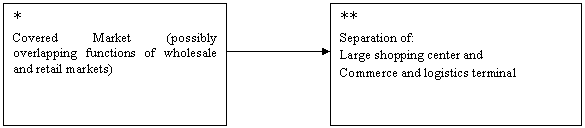
The symbol "*" indicates a gradation within the category, making it easier to interpret.
Defining criteria for compliance should be on the basis of review of determinations of industry associations specially created advisory councils at the local executive bodies, including as government representatives, business community and experts of industry associations, public associations.
In this case all trading markets should be located in a convenient location, integrated into the life of the village, as they have not only economic but also social functions. In many cities, there is a tendency transfer markets outside the city limits, which means the loss of their traditional functions and their performance. In this regard, the decision on the location of markets must take into account all the consequences, not only the development plan of the city.
In order to strengthen the infrastructure requirements of markets, from 2011 - 2012 years, it is necessary:
1) Conduct a certification of all functioning trading markets of the republic;
2) to analyze the state of the commercial markets for compliance with the applicable requirements in order to identify the causes and factors hindering modernization;
3) to develop the classification requirements of markets, taking into account the phased upgrade them.
Improvement of public policies regulating the activities of municipal markets and fairs
One of the instruments of state policy aimed at supporting socially disadvantaged groups is the development of the activities of public markets, as well as assistance in organizing trade fairs. Utility markets should be used as the support of domestic producers of non-food goods, providing at minimum cost rental space, given that most of the products traded today at municipal markets, refers to non-food products.
In this regard, from 2010 to 2014 should:
1) an analysis of the current activities of municipal markets, their influence on the pricing policy of regions, the cost structure;
2) adopt guidelines for the organization of the activities of public markets, including the method for determining rents for retail space;

|
Из за большого объема этот материал размещен на нескольких страницах:
1 2 3 4 5 6 7 8 9 10 11 12 13 |
