


Партнерка на США и Канаду по недвижимости, выплаты в крипто
- 30% recurring commission
- Выплаты в USDT
- Вывод каждую неделю
- Комиссия до 5 лет за каждого referral
spontaneous, largely spontaneous demand, lack of regular customers as a class / category;
one-sided development of the club system is restricted, as a rule, only the discount cards;
the absence of a centralized system of personnel training.
It should also be noted that the catering mainly engaged in small business, whose actions are based on the overall economic development, improving the solvency of the population.
Thus, this sphere is more dependent on changes in demand, its needs. Its further development is more related to self-regulation through the development of public associations and organizations whose activities are aimed at raising standards of service, quality environment for customers.
Foreign trade
Foreign trade refers to trade between the two countries, including export (export) and (or) import (import). In a market economy, foreign trade operations are carried out independently by enterprises and agencies. In this case, the state through the use of instruments of foreign policy (customs tariff policy, non-tariff policy, the application of measures to protect the domestic market for imported goods, the development of trade relations through agreements) regulates foreign trade flows.
From 1 January 2010, Kazakhstan jointly with the Russian Federation and Belarus functioning of the Customs Union. The main task of the Customs Union is to form a single customs territory, which in respect of goods originating in the territory, as well as products from third countries released for free circulation on it, do not apply customs duties and restrictions of economic character. In this case the State party apply common customs tariff and other common measures regulating trade with third countries.
The structure of foreign trade
Kazakhstan Customs Union countries are among the main partners, their share in the foreign trade of the Republic is 18% and is stable.
In general, the dynamics of foreign trade of Kazakhstan in the last 5 years is characterized by growth. In 2005 turnover amounted to 45.2 billion. US dollars, then in 2009 the level of foreign trade increased by 58.4% to $ 71.6 billion US dollars. For comparison, in the Russian Federation turnover in 2009 is amounted to 469 billion US dollars (more Kazakh turnover 6.5 times) and in Belarus - 49.8 billion US dollars.
The share of foreign trade in the directions. The share of trade turnover with CIS countries Kazakhstan in 2009 amounted to 26.3% (or 18.8 billion. US dollars), and the share of trade with foreign countries amounted to 73.7% (or 52.7 billion US dollars). Significant changes in the structure of foreign trade in the context of the directions of trade flows over the past five years did not happen. Among the major trading partners of Kazakhstan in 2009 were:
- EU (40.2% - 28.8 billion US dollars);
- Russia (17.4% - 12.4 billion US dollars)
- China (13.2% - 9.5 billion US dollars)
- Ukraine (4.8% - 3.4 billion US dollars)
- USA (2.8% - 2.0 billion US dollars).
The foreign trade balance. Kazakhstan's foreign trade balance is positive due to the significant volume of export. So in 2009 the surplus amounted to 14.8 billion US dollars, an increase of 40.9% compared with 2005 (10.5 billion US dollars), which is achieved due to the growth of exports to non-CIS countries. Thus, the balance of trade with CIS countries is, on the contrary, negative and is (-5.3) billion US dollars, lower than in 2005 at 30%.
It should be noted that the surplus is a favorable factor for the growth rate of the national currency. However it is achieved mainly due to growth in exports of raw materials, especially energy products (69.5% of total exports).
Import
Major suppliers. According to the Kazakh customs statistics in 2009 compared with 2005, imports increased from 17.4 billion US dollars to 28.4 billion US dollars, i. e. at 63.7%. The main suppliers in Kazakhstan in 2009 were non-CIS countries, which accounted for 57.5% of total imports.
Imported goods in Kazakhstan. The main products imported in Kazakhstan in 2009, are:
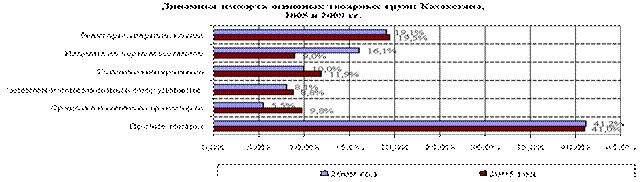
Source: CCC MF RK
Import structure suggests that in Kazakhstan mainly imported finished products, equipment, vehicles.
Goods imported into Kazakhstan from member countries of the Customs Union. According to the Kazakh customs statistics on the share of imports from Russia account for 31.3%, or 8.9 billion US dollars, while the share of imports from Belarus - 1.3% or 367.1 million US dollars.
The main products imported into Kazakhstan from Russia are:
crude oil - 16.3% (1.4 bn. USD or 6.1 million tons);
oil products - 7.1% (635.9 million US dollars, or 1.5 million tons);
tubes of iron or steel - 5.2% (458.2 million US dollars or 192.9 thousand tonnes);
metal of iron or steel - 1.5% (134.8 million US dollars, or 26.4 thousand tonnes).
Thus, most of the imported goods are a finished product that is used for end-use, except crude oil processed at the Pavlodar petrochemical plant.
The main products imported from Kazakhstan in the Republic of Belarus:
pneumatic tires of rubber Added - 10,3% (37,7 million US dollars or 500.7 thousand pieces);
sugar beet - 8,6% (31,5 million US dollars or 55.9 thousand tonnes);
Milk and cream, concentrated - 7.4% (27.1 million. US dollars, or 18 thousand tons);
aircraft (helicopters, airplanes) - 5.6% (20.6 million US dollars or 4 pieces);
Tractors - 5.0% (18.5 million USD or 1028 pieces);
machinery or equipment for harvesting or threshing machinery - 5.0% (18.3 million. US dollars);
freight vehicles - 4.3% (15.8 million US dollars or 96 pieces);
butter - 4.2% (15.3 million US dollars 5 or 810.3 tons).
From Belarus also mainly imported finished products. The highest proportion in the food products (milk, sugar), and engineering products.
Prior to the establishment of the Customs Union customs tariff policy of Kazakhstan mainly the interests of consumers and in fact did not stimulate the development of domestic production. As a result, today there is a significant proportion of imports of goods that have the potential for production in the country. Furthermore, this characteristic applies mainly to consumer goods and products used in industrial production.
Thus, the increase of customs and tariff protection to an average of 10-20% will have a positive impact on the industry of mechanical engineering, metallurgy, building materials, chemical and petrochemical, light industry and pharmaceutical perspective. Food production today is represented on the market of the country and its main competitors are the products of the CIS countries, including the countries of the Customs Union, in respect of which customs duties shall not apply. Thus, for this type of production requires additional incentives.
Exports
The main buyers. According to the Kazakh customs statistics, in 2009, exports amounted to 43.2 billion republics. USD increase compared with 2005 (27.8 million. US dollars) to 55.1% is associated with an increase in deliveries to foreign countries (an increase of 53, 1%). It should be noted that these countries are the main buyers of Kazakh goods, and their share accounting for 84.3% of total exports (or 36.4 million. US dollars), while the share of CIS countries in total exports of Kazakhstan is 15.7 % (or 6.8 million US dollars).
Goods exported from Kazakhstan. Export supplies of Kazakh products are mainly raw materials. Thus, the export of energy products (oil and oil products) is 69.5% (30 billion US dollars); iron - 6.9% (3 billion USD); products of inorganic chemistry - 5% (2.1 billion. US dollars); ores, slag, ash - 4% (1.7 billion USD). A similar structure of exports was in 2005 and practically unchanged.
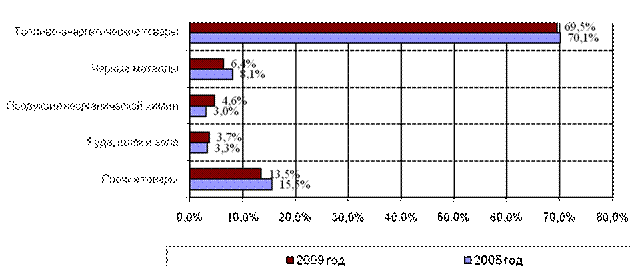 Source: CCC MF RK
Goods exported to the countries of the Customs Union. According to the Kazakh customs statistics on the share of exports to Russia accounted 8.2% or 3.5 billion US dollars, while the share of exports to Belarus - 0.1% or 54.7 million US dollars.
The main products exported from Kazakhstan to Russia:
Iron ores and concentrates - 13.7% (485.5 million US dollars, or 8.3 million tons);
Coal - 11.6% (412 million US dollars, or 23.8 million tons);
Crude oil - 9.8% (347.3 million US dollars, or 1.8 million tons);
artificial corundum - 8.6% (305.2 million US dollars, or 1.4 million tons);
Radioactive chemical elements - 7.6% (268.6 million US dollars or 3 thousand tonnes);
flat-rolled products of iron clad - 6.3% (223.8 million US dollars or 277.7 thousand tonnes);
gas oil - 4.7% (168.3 million US dollars, or 6.7 million tons).
Thus, most of the imported goods is a raw material or semi-finished product used for the production of final products.
The main products exported from Kazakhstan to the Republic of Belarus:
flat-rolled products of iron clad - 44,7% (24,5 mln. US dollars, or 33.1 thous. tonnes);
flat-rolled products of iron cold - 17% (9.3 mln. US dollars, or 20.7 thous. tonnes);
Conveyor or transmission belts - 5.2% (2.8 mln. US dollars or 1 thousand. tonnes);
flat-rolled products of iron hot - 5,1% (2,1 mln. US dollars or 2 thousand. tonnes);
ferroalloys - 3.9% (1.8 mln. US dollars, or 4.7 tons).
In Belarus also mainly exported either raw materials or semi-finished products for further processing.
From the above it is evident that before the creation of the Customs Union customs tariff policy of Kazakhstan on regulation of export mainly support domestic enterprises-exporting raw materials and semi-finished products, but did not stimulate the production and subsequent processing of the finished product. As a result, today there is a significant proportion of exports of raw materials and semi-finished products. Thus, this characteristic applies mainly to metals and oil products. Given the increase in customs and tariff protection to an average of 10 - 20%, there is a need for raw materials to industries such as engineering, production of finished steel products, building materials, chemical and petrochemical, light industry.

|
Из за большого объема этот материал размещен на нескольких страницах:
1 2 3 4 5 6 7 8 9 10 11 12 13 |
