


Партнерка на США и Канаду по недвижимости, выплаты в крипто
- 30% recurring commission
- Выплаты в USDT
- Вывод каждую неделю
- Комиссия до 5 лет за каждого referral
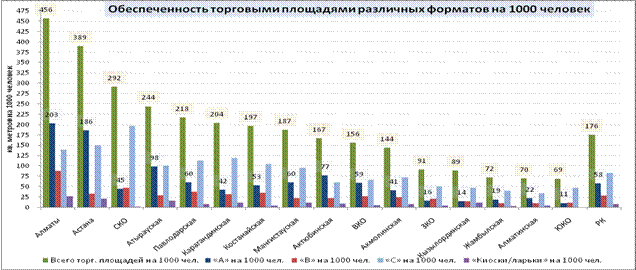
Source: JSC "Center for Trade Policy"
Of all the regions of the best retail space per 1,000 people in the region is provided Almaty (456 sq ft), then Astana (389 sq m) and standard deviation (292 sq m). The worst position in retail space is observed in Almaty (70 sq m) and South Kazakhstan (69 sq m) areas, indicating that the preferential development of trade in these regions through the markets, not the stores.
Service markets
According to the Agency of statistics for 2008, the largest areas of "markets" are in the Almaty region - 1 120 sq m or 20% of all markets in the country.
In the South-Kazakhstan region is 825 square meters or 15% of the total market. Almaty area markets are in third place - 635 square meters (11%). Approximately equal areas occur in Astana (430 square meters, or 8%), Zhambyl (393 square meters or 7%) and the East Kazakhstan region (377 square meters or 7%).
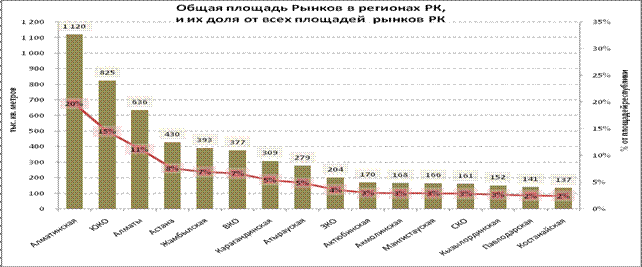
Source: Agency of RK for Statistics
The lowest share of the market mark areas in the North-Kazakhstan (161 square meters, or 3%), in Kyzyl-Orda (152 square meters, or 3%), Pavlodar and Kostanay oblasts (approximately 140 square meters, or 2%).
The ratio of provision of the population of Kazakhstan and regions trade and market square. The population of the republic much more secured areas relating to the market (according to the classification of the Statistics Agency "Markets") than the area belonging to the shops (on the classification of the Statistics Agency "Merchants"). The average for the country, according to the calculations of the company "Center for Trade Policy", their area by 1000 people relate as 67% (352 sq ft) and 33% (176 sq ft).
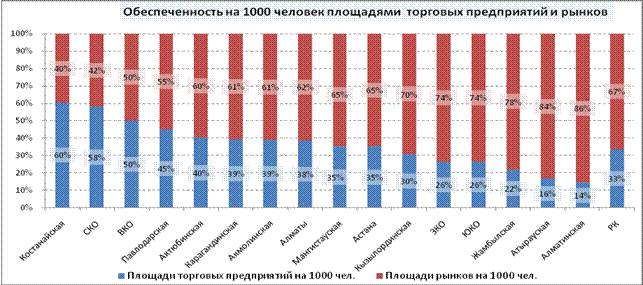
Source: JSC "Center for Trade Policy"
In terms of regions most positive picture is observed in Kostanay oblast, where 60% of the retail space accounts for 40% of the shops and - on trading markets. In the East Kazakhstan region area of shops and markets are about the same - 50% to 50%. In Zhambyl, Atyrau and Almaty oblasts of 78%, 84% and 86%, the area falls on trading markets. This ratio is called as a preference of consumers shopping markets and the overall level of welfare.
Efficiency trade
According to calculations by the Joint Stock Company "Center for Trade Policy", in 2009 on 1 square meter of retail space accounted on average for the country - 800 thousands tenge per year.
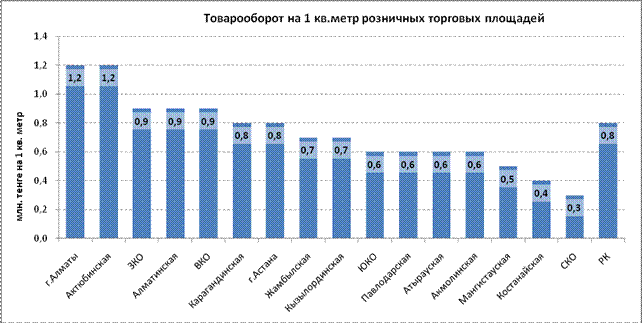
Source: JSC "Center for Trade Policy Development"
Maximum effective loading of retail space was observed in Almaty and Aktobe region, where 1 m of retail space was sold products worth - 1 million 200 thousand tenge per year. The lowest efficiency was observed in the retail space Kostanay area - 392 thousand tenge and in the North-Kazakhstan oblast - 315 thousand tenge per 1 square meter in 2009.
The degree of consolidation
An important indicator of quality retail development is the consolidation of the market, by which is meant turnover / sales by commercial enterprises presented not one but several retail outlets, ie chain of stores or retail chain.
In Kazakhstan, the consolidation of the food market is not more than 5%. In Russia, according to the Association of Retail Companies consolidation of local retail market reaches 11% of the total turnover.
One of the main reasons for this significant difference is that in Kazakhstan, unlike Russia, security stores category «A» is significantly lower, and trading networks, such as the sale of food products, operating primarily in the format «A». Also, no less an obstacle to the consolidation of retail trade turnover is the model of consumer behavior, preferences, which are reduced to the purchase of products through the markets.
Among the reasons for the lack consolidated market in Kazakhstan celebrate the abundance and low population density in Kazakhstan, which makes for a business of scale observed in Russia. This is also the reason that Western and Russian retail chains while carefully considering the possibility of entering the market.
Thus, the prevalence of trading in the markets, which accounted for 51% of turnover and 67% of the retail space in the commercial sector in Kazakhstan, is not conducive to the civilized development of trade.
On the market there are no proper level of consumer protection, it is difficult to ensure the sanitary and epidemiological requirements and tax collection. Furthermore, it is impossible to analyze markets size, structure, dynamics, and flow of goods, respectively.
In countries with developed trade, markets are an archaic form of retail and practically eliminated, or operate in specialized areas (eg, traditional crafts).
As noted earlier, the prevalence in the country clearly so-called "non-modern formats", ie store category «B», «C» and «Shop", which accounted for 67% of the total area of the store. These categories describe the limited size of the areas, low bandwidth, high unit costs that cannot be the basis for the consolidation of trading activity.
More advantages and disadvantages of various categories of shops, as well as the market are given in the table.
Advantages and disadvantages of the different channels and retail formats
EFFICIENCY CRITERIA RETAIL CHANNELS AND FORMATS | Markets / IE | Shops category «B» / «C» / «Shop» | Separate store category «А» | Trade networks |
STATE INTERESTS | ||||
Consumer protection | Practically absent | low | Central | High |
Monitoring and statistics | Practically absent | low | Central | High |
Protection and promotion of the domestic producer | Practically absent | Practically absent | low | High |
tax collection | low | low | low | High |
Observance of sanitary norms and requirements | low | low | Central | High |
INTERNAL PROCESSES | ||||
Opportunity to get discounts and trade credit from suppliers | Practically None | Practically None | Low | High |
The use of modern planning systems | Practically None | Practically None | Low | High |
The quality of management of human resources | Low | Low | Medium | High |
Specific costs for management and staff | High | High | Medium | Low |
The cost of third-party services (transport companies, consultancy.) | High | High | Medium | Low |
Use efficiency of logistics infrastructure (transport, storage, refrigerators, loaders) | Low | Low | Medium | High |
Unit costs of logistics | High | High | Medium | Low |
Ability to work with manufacturers directly | Low | Low | Medium | High |
WORK WITH PURCHASERS | ||||
Offered prices | Medium | High | Medium | Low |
The breadth of assortment | Low | Low | High | High |
The effectiveness of advertising campaigns | None | None | Low | High |
Effective discount and other loyalty programs | None | None | Low | High |
Factors listed in the table allow trading networks to operate with low levels of trade margins. For example, trade networks in Western Europe, such as METRO, REAL, Auchan, Carrefour operated at average trading cheat in the chain "Manufacturer - Trading Network" 3 - 4%, due to operating efficiency and economies of scale of their operations.
Obviously, small shops, markets and even individual stores category «A» uncompetitive compared to retailers and store operation in the country only because of the weak infrastructural development and the inadequate level of investment in retail trade.
Thus, a review of retail space retailing in the regional context of various formats and comparative analysis of their effectiveness evidence about the benefits of modern retail formats and retail chains. Along this route were developed countries, and Kazakhstan should not be the exception.
Wholesale.
Wholesale - this is the business of the sale of goods intended for resale or other purposes not related to personal, family, household and other similar use.
Wholesale performed in specialized or mixed in the presence of separate seats separated from sites of retail trade, shops, homes and commercial markets.
According to the Kazakh Statistics Agency in 2009 compared with 2005, wholesale trade (in current prices) increased by 127.5% to 6 872, 3 billion tenge. In 2009, the share of wholesale trade of food products was 16.9%, non - 83.1%.
The last five years a significant share in the wholesale trade of the country occupies Almaty - 3 075, 3 billion tenge or 45% of total wholesale trade. The second indicator in Astana in the amount of 1 002, 5 billion tenge (or 15%) in third place - Karaganda region (495.1 billion tenge or 7%).

|
Из за большого объема этот материал размещен на нескольких страницах:
1 2 3 4 5 6 7 8 9 10 11 12 13 |
