


Партнерка на США и Канаду по недвижимости, выплаты в крипто
- 30% recurring commission
- Выплаты в USDT
- Вывод каждую неделю
- Комиссия до 5 лет за каждого referral
LESSON TWO
I. Study text A. Try to understand all details. Use a dictionary if necessary:
Text A
Lasers and Masers
1. A laser is a machine for making and concentrating light waves into a very intense beam. The letters LASER stand for Light Amplification by Stimulated Emission of Radiation. The light made by a laser is much more intense than ordinary light. With ordinary light, all the light waves are different lengths. With lasers, all the light waves have the same length, and this increases the intensity.
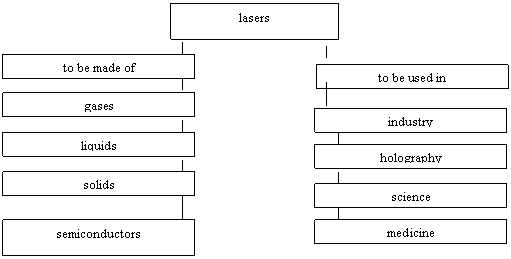
2. Atoms are made up of neutrons, electrons and protons. The electrons circle round the protons and neutrons. In a laser, the electrons are "excited" to a high energy level. As the electrons fall back from their "excited" state to their normal state, they give off energy. This energy is given off as light which can be seen. A number of materials have this property including some gases, liquids, solids and semiconductors. Thus a number of different types of lasers have been developed.
3. Lasers are now used for many scientific, medical and industrial purposes. The thin beam of light gives a lot of heat and it is used to join metal when a very small joint is needed. The beam can also be used as a drill, to make holes in steel, or even in diamonds. Because the beam is so small, it's very important in delicate surgery and is used in eye operations.
4. Lasers are also used in holography. A hologram is a three-dimensional image, a bit like1 a photograph. It's different from a photograph because it looks solid. As you walk round a hologram, it changes, as if it were real. Now holography is used for testing engineering ideas. An engineer can use a hologram to build up and check a new building such as a bridge. He can find out all about it before he builds it.
5. The word MASER is also an acronym – for Microwave Amplification by Stimulated Emission of Radiation. The maser is operated on the same principle2 as the laser except that the wavelengths generated are much longer and therefore the energy jumps involved are smaller. The excited bodies in a maser are molecules rather than atomic electrons and the beam generated is a coherent beam of microwaves which is not visible to the eye.
6. Masers have made revolutionary advance possible in a number of different fields. They are up to 1.000 times more sensitive3 than any other type of amplifiers. Maser amplifiers mounted on radio telescopes can increase even their great range by a factor of 10, allowing us to reach out to the bounds of the known universe. Because of the very constant frequency with which masers can be made to oscillate they can be used as master controls for atomic clocks of unbelievable accuracy: an error not exceeding 1 second in 10.000 years has already been achieved.
7. The idea of using stimulated emission of radiation for amplification of very short waves came, from A. Prokhorov and N. Basov of the Lebedev Institute in Moscow.
Notes
1. a bit like – немного напоминающий
2. is operated on the same principle – работает на том же принципе
3.1.000 times more sensitive – в 1000 раз более чувствительный
II. Say whether the following statements are true or false:
1. The light made by a laser is much more intense than ordinary light. 2. With ordinary light, all the light waves have the same length. 3. With lasers all the light waves have different length. 4. A laser concentrates light waves into a very intense beam.
III. Answer the following questions on paragraph 2:
1. What are atoms made up of? 2. To what level are the electrons excited in a laser? 3. When do they give off energy? 4. In what form is this energy given off?
IV.Find the place in paragraph 3 containing the information of the uses of lasers. Render this information to your group-mate.
V. In paragraph 4 find the English equivalents of the following words:
голография, голограмма, объемное изображение, выглядеть, испытывать, проверять, выяснять.
VI. Translate paragraph 5.
VII. Read paragraph 6 and say where masers are used.
VIII. Write out of the text the words and phrases describing a laser.
IX.Describe the uses of lasers.
X. Divide text A into logical parts and find the topical sentences of each part. Put them down.
XI.Speak about lasers using the topical sentences and the logical diagram given below.
LESSON THREE
I. Look through the list of English words and their Russian equivalents facilitating reading text B:
micro welding – микросварка; resistor trimming – подгонка резисторов; isolation – выделение; отделение; power engineering – энергетика; extrapure – сверхчистый; resolution – разрешающая способность; to store – запоминать, хранить; to process – обрабатывать; archive – архив; to display – отображать (данные); выводить (данные); screen – экран; information carrier – носитель информации; to come in handy – пригодиться, прийтись кстати; indispensable – обязательный, необходимый; to put into effect – осуществлять.
II. Read the following text and entitle pare your title with the one given by the author. (See the key on page 106).
Text В
Just some decades ago, neither laser installations nor the very word laser were in existence. Today, lasers are used in electronics, medicine, engineering, communications, the automobile and aircraft industry, agricultural machine building, and other fields of the economy and science. But the field of laser applications is expanding very rapidly. Let us point out only a few new uses of the laser.
Lasers have wide-ranging technological uses. In the production of electronic components lasers are used in such operations as micro welding, resistor trimming, etc., something that can be performed perfectly well today.
Laser radiation has the property of selective excitation of atoms and molecules, enabling laser isolation of isotopes. The first successful experiment in separating isotopes by laser was performed at the Institute of Spectroscopy of the USSR Academy of Sciences, in 1972. This work is regarded by specialists as highly promising for power engineering and production of extrapure materials.
The use of laser technology has considerably increased the resolution and sensitivity of the spectroscopic methods.
Without the laser beam, there could be no optical electronics which computer specialists see as a highly promising direction for making high-performance and small-size computers. Optical electronic instruments for recording, storing and processing information use a laser beam.
Lasers can quickly record and read out information, with recording density being 100 times higher than in the most advanced magnetic system. It is evident that in the near future centralized archives will be set up allowing us to display any required information on a home TV screen.
We have succeeded in designing a new information carrier which can be used for multiple recording of light signals, similar to the magnetic tape recording.
Great importance is attached today to the use of lasers in medicine. Lasers have been successfully used in eye treatment.
Thus the laser today comes in handy in solving process and quality control problems, in medicine, communications and computer technology. It can do hundreds of jobs; the number has been constantly increasing, and before long, the laser will become a customary and indispensable assistant in most professions.
Projects are now being discussed in scientific literature of using high-power lasers for long-distance space communications. These projects have not yet been put into effect, primarily because of the great technological difficulties and, therefore, of the great cost involved. But there is no doubt, that in time, these projects will be realized and the laser beam will begin operating in outer space as well.
III. Answer the following questions:
1. Where are lasers used today? 2. The field of laser applications is extending very rapidly, isn't it? 3. Where do lasers have wide-ranging technological uses? 4. In what fields is the use of lasers highly promising? 5. What projects are now being discussed in scientific literature?
IV. Give the main points of text В in 3-5 sentences.
V. Speak about the new uses of the laser.
LESSON FOUR
I. Look through the list of English words and their Russian equivalents. You will need them for better understanding text C:
thermonuclear fusion – термоядерная реакция, термоядерный синтез; to condense – конденсировать; сгущать; evolvement – развитие; создание; exploration – исследование; target – мишень, цель; angle reflector – угловой отражатель; incident – падающий; reverse – обратный, противоположный; range – дальность; geodetic – геодезический; precision – точность.
II. Read the following text carefully. While you are reading look for the answers to the questions:
1. What idea have specialists of the quantum radiophysics laboratory suggested? 2. How is the distance to the Moon measured?
Text С
Laser at Work
1. In a department of the Lebedev Physics Institute of the USSR Academy of Sciences (FIAN) scientists from the quantum radiophysics laboratory have suggested the idea of laser-controlled thermonuclear fusion and obtained priority results in this field. Experiments in heating and condensing plasma to receive thermonuclear fusion are being conducted at one of the world's biggest laser thermonuclear installations "Delfin" (Dolphin).
2. The Institute carries out research in developing new types of lasers, studying the interaction of coherent radiation with matter, in laser thermonuclear fusion and in optoelectronics.
3. The results of this fundamental research find wide application in the development of new instruments and technological processes, in the evolvement of substances with new properties in medicine, in metrology and in the latest methods of information processing.

|
Из за большого объема этот материал размещен на нескольких страницах:
1 2 3 4 5 6 7 8 9 10 11 12 13 14 15 16 17 18 19 20 21 22 23 24 25 26 27 28 29 30 31 32 33 34 35 36 37 38 39 40 41 42 43 44 45 46 47 48 49 50 51 |
