


Партнерка на США и Канаду по недвижимости, выплаты в крипто
- 30% recurring commission
- Выплаты в USDT
- Вывод каждую неделю
- Комиссия до 5 лет за каждого referral
light pulses, light wave communications system, transmission system, telecommunications network, glass fiber, voice signal, data signal, television signal, telephone conversation, telecommunications transmission, construction cost, underground duct, copper cable, signal regenerator, carrier system, device reliability, laser beam, laser beam wave, radio wave, radio wave speed.
X. Choose the sentences from the text containing word combinations with nouns as attributes. Translate these sentences into Russian.
XI.Match up the words which have a similar meaning:
a) concept, information, sophisticated, versatile, enormous, speed, to undermine, single, inexpensive, conventional, significant, to handle, to require, space.
b) important, to operate, to demand, room, idea, traditional, data, many-sided, cheap, the only, very large, destruct, rate, intricate.
XII. Try to memorize all the words and word-groups:
■ decade – десятилетие ■ light pulse – световой импульс ■ to transmit information – передавать информацию ■ lightwave communications system – система связи с использованием световых волн ■ hair-thin glass fiber – стекловолокно толщиной в человеческий волос ■ voice signal – речевой сигнал ■ capacity – мощность ■ contents – содержание ■ high-speed data signal – высокоскоростной сигнал данных ■ accommodate – включать, охватывать ■conventional – традиционный, обычный ■ copper wire – медная проволока ■ to substitute for – заменять, замещать ■ to install – устанавливать ■ electromagnetic interference – электромагнитная помеха (интерференция) ■ lightguide cable – световодный кабель ■ carrier system – многоканальная система связи ■ signal regenerator – регенератор сигнала ■ electrical digital carrier system – система электрической многоканальной цифровой связи ■ equipment оборудование ■ protection – защита
LESSON TWO
I. Read text A. Try to understand all details. Use a dictionary if necessary:
Text A
Modern Light-Wave Communications Technology
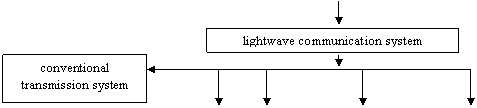
1. Some time ago, the concept of using light pulses instead of electrical signals1 to transmit information was only that – a concept. Today, lightwave communications systems are among the most sophisticated transmission systems in the telecommunications network. They are at once efficient, versatile and relatively inexpensive to install and maintain.
2. The efficiency of lightwave systems is perhaps their most renowned quality2. They carry enormous amounts of information over long distances at very high speeds. Consider, for example, the speed and capacity of the Bell System's long distance lightwave system. Light pulsing through a single, hair-thin glass fiber in this system can transmit the entire contents of Webster's unabridged dictionary4 – more than 2700 pages – over thousands of miles in only six seconds.
3. No less impressive than this tremendous speed and capacity is the versatility of light-wave systems. Because they are digital systems, they can transmit easily any of these types of information: voice signals, high-speed data signals, and television signals. Without undermining quality or efficiency, a single system can accommodate thousands of telephone conversations, and alternately handle data or video signals.
4. Finally, lightwave systems are inexpensive to install and operate compared to their wire-and-cable counterparts. Moreover, they allow considerable savings.
5. The reasons for such savings stem from the technology of lightwave communications. Conventional telecommunications transmission is based on the conduction of electrons through metal (usually copper wires). Lightwave systems, however, substitute protons for electrons and glass fibers for copper. These technological differences translate into big savings5, the most significant of which is in construction costs. Because lightguide cables are only a fraction of the diameter and weight6 of copper cables, they are easy to handle and take up far less space. They can be installed in existing underground ducts and rights-of-way7, sometimes right next to copper cables.
6. In addition, lightwave systems eliminate certain equipment and operating costs. They are immune to electromagnetic interference8, and therefore require no protection from it. Also, light can travel much farther through lightwave cables without regeneration than can electrons through copper carrier systems. This is because the light encounters little resistance from the very pure glass fibers through which it travels. Lightwave systems require significantly fewer signal regenerators than do electrical digital carrier systems: typically one every ten miles instead of one every mile.
Notes
1. the concept of using light pulses instead of electrical signals – идея использования световых импульсов вместо электрических сигналов
2. their most renowned quality – их самое известное свойство
3. over long distances – на большие расстояния
4. the entire contents of Webster's unabridged dictionary – полное содержание неадаптированного словаря Вебстера
5. translate into big savings – приводят к большой экономии
6. only a fraction of the diameter and weight – только частица в диаметре и по весу
7 right-of-way – полоса отчуждения
8. are immune to electromagnetic interference – невосприимчивы к электромагнитной интерференции
II. Say whether the following statements are true or false:
1. The concept of using light pulses instead of electrical signals to transmit information is not new. 2. The efficiency of lightwave systems is their most renowned quality. 3. Lightwave systems can transmit various types of information: voice signals, high-speed data signals, and television signals. 4. Conventional telecommunications transmission is not based on the conduction of electrons through metal.
III. Answer the following questions on paragraph 1:
1. Is the idea of using light pulses instead of electrical signals to transmit information new?
2. Do lightwave communications systems belong to the most sophisticated transmission systems?
3. What are the qualities of lightwave communications systems?
IV. Find the place in paragraph 2 containing information about the possibility to transmit the entire contents of Webster's dictionary over thousands of miles in only six seconds.
V. In paragraphs 3 and 4 find the English equivalents of the following words and word combinations:
огромная скорость, по сравнению с, разносторонность; система дискретной (цифровой) связи, речевой сигнал, сигнал данных, видеосигнал, устанавливать, качество, эффективность.
VI. Translate paragraph 5 into Russian.
VII. Read paragraph 6 and say:
a) whether lightwave systems eliminate certain equipment and operating costs; b) whether they are immune (невосприимчивы) to electromagnetic interference; c) whether light can travel much farther through lightguide cables without regeneration than electrons; d)whether lightwave systems require significantly fewer signal regenerators than electrical digital carrier systems.
VIII. Write out of the text words, word combinations for describing advantages of light wave systems. Use these words for describing these advantages to your group-mate.
IX. Describe the technological differences between conventional telecommunications transmission and lightwave systems.
X. Divide text A into logical parts and find topical sentences in each part.
XI. Fill in the boxes of the following logical diagram of text A with Russian equivalents:
|
 |
 |
 |
|
|
| |||
XII. Read text A again. Make a list of key fragments picked out from each successive paragraph. Rearrange the key fragments, make a plan and then use it to write a précis. The number of sentences in your précis should be approximately the same as the number of paragraphs in the original.
LESSON THREE
I. Look through the list of the English words and their Russian equivalents facilitating reading text B:
fiber – волокно; strand – прядь, жила, нитка; breakthrough – достижение, открытие; transparent – прозрачный; call – телефонный разговор, заказ; вызов; immune – устойчивый, невосприимчивый; interference – помеха, вмешательство; интерференция; to affect – влиять, воздействовать; to sweep through – охватывать; to handle – обращаться, управлять; core – стержень, сердцевина; to reflect – отражать; ingredient – компонент, составная часть; to draw (drew, drawn) – тянуть, вытягивать; to coat – наносить покрытие; grain – крупица, зерно; application – применение.
П. Read text В and entitle pare your title with the one given by the author (see the key on page the author (see the key on page 169)
Text B
Optical fibres, hair-thin strands of pure glass carrying information as pulses of light1, have been described as "probably the biggest breakthrough in telecommunications since the invention of the telephone". All kinds of communications can be carried along the same optical fibre cable – speech, text, photos, drawings, music, computer data, etc. – at higher speeds than have been previously possible.

|
Из за большого объема этот материал размещен на нескольких страницах:
1 2 3 4 5 6 7 8 9 10 11 12 13 14 15 16 17 18 19 20 21 22 23 24 25 26 27 28 29 30 31 32 33 34 35 36 37 38 39 40 41 42 43 44 45 46 47 48 49 50 51 |
