


Партнерка на США и Канаду по недвижимости, выплаты в крипто
- 30% recurring commission
- Выплаты в USDT
- Вывод каждую неделю
- Комиссия до 5 лет за каждого referral
XIII. Choose the sentences with attributive clauses from the ones
given below. Translate them into Russian:
munication is a process by which information is exchanged between individuals through a common system of symbols, signs or behaviour. puters are machines which are able to solve complex mathematical problems. 3. Atoms and electrons are so small that they cannot be seen under the most powerful microscopes. 4. Radio is a device that transmits and receives signals and programs by electromagnetic waves. 5. A transistor is a small electronic device whose function is the same as that of an electronic tube 6. The medium or channel through which the message is carried may take the form of face-to-face communication. 7. It is often said that one should use the language of those to whom one is speaking. 8. Corrosion is a very serious problem which worries scientists, technologists and economists.
XIV. Find in text A complex sentences. Define the types of subordinate clauses and translate the sentences into Russian.
XV. Match up the words which have a similar meaning:
a) to broadcast, symbol, to understand, discipline, purpose, to include, to speed up, to change, quantity, to reduce, medium, for example, to appreciate.
b) to alter, to radio, for instance, environment, to approve, to realize, to accelerate, subject, aim, to embrace, sign, amount, to cut down.
XVI. Listen to the following tape-recorded lexical programme, memorize all the words and word groups:
■ to exchange — обменивать (ся), менять (ся) ■ tool — перен. орудие, средство; инструмент ■ communications models — модель связи (коммуникации) ■ system of spoken symbols — система речевых знаков ■ theorist — теоретик ■ source — источник я encoder — кодирующее устройство; кодировщик ■ message— сообщение, сигнал ■ decoder — декодирующее устройство; декодер
■ feedback — обратная связь ■ to originate — происходить, брать начало ■ to translate — преобразовывать, переводить в другую систему ■ to accomplish — выполнять; завершать ■ message fidelity — точность (верность) сообщения ■ message for transmittal — сообщение для передачи ■ precise meaning — точное значение ■ ingredient — составная часть, компонент в negotiations — переговоры
■ call — телефонный разговор; вызов ■ sound — звук ■ to select — выбирать, отбирать, подбирать ■ to convey — выражать; сообщать, передавать.
LESSON TWO
I. Read text A. Try to understand all details. Use a dictionary if necessary:
Text A
Communications Model
1. Communication is a process by which information is exchanged between individuals through a common system of symbols, signs, or behaviour.
2. Verbal communication, commonly referred to as1 "talking", is based on a system of spoken symbols that are used to relay ideas and emotions. It is a vital and powerful tool2 for the passage of information, the delivery of explanations and instructions, and the acts of negotiation and persuasion.
3. To fully understand oral communication3, let's look at the nature
of the process. Models are useful in the engineering discipline4, as they
are in our daily job-related5 and personal communications6. A model of
communication has been developed by several theorists in the field.
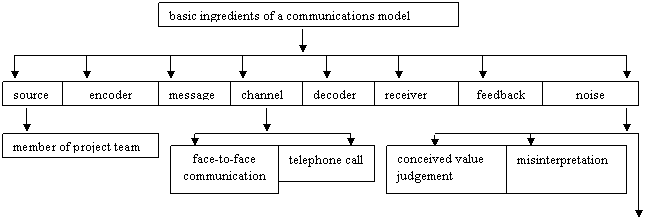
4. The basic ingredients of this model include a source, encoder, message, channel, decoder, receiver, feedback, and munication originates in the source, which may be conceived as a member of a project team7 who has some information to transmit. This information is translated via an encoding process into a set of symbols8 or a language. The purpose or intent of the source is expressed in the form of a message. The medium or channel through which the message is carried may take the form of face-to-face communication9, for example, or perhaps a telephone call. The receiver decodes and interprets the message in light of his own frame of reference10 and experience. The feedback, the receiver provides the source, informs the message initiator11 whether the communication has been effectively accomplished. Noise, in the behavioural sense, includes factors such as conceived value judgments, misinterpretations, and misunderstandings which can reduce the message fidelity.
5. The presentation and discussion of the model of communication is intended to help the engineer understand why some of the messages sent are not received as originally intended. For example, care must be taken12 in encoding a message. The words selected by the source must convey precise meaning if the receiver is to decode them as they were intended, not in light of one's personal value system13. This suggests that when one is sending a message, one should place oneself in the position of the receiver and prepare and encode the message accordingly. It is often said that one should use the language of those to whom one is speaking. The engineer, accordingly, should understand and appreciate the process of decoding as he does the encoding of the message for transmittal.

Notes
monly referred to as — на которую обычно ссылаются как на
2. its is a vital and powerful tool — это важное и мощное средство
3. oral communication — устное общение, коммуникация 4 engineering discipline — техническая дисциплина
5. job-related communication — деловое общение
6. personal communication — личное (персональное) общение
7. project team — проектная группа
8. a set of symbols — набор символов (знаков)
9. f ace-to-face communication — личное общение
10. in light of his own frame of reference — согласно его собственной компетенции
11 the message initiator — отправитель сообщения
12care must be taken — следует быть осторожным
13 not in light of one's personal value system – не в собственной интерпретации
II. Say whether the following statements are true or false:
munication is a process by which information is exchanged between individuals through a common system of symbols, signs, or be haviour. 2. Verbal communication is not considered to be a vital and powerful tool for the passage of information, the delivery of explanations and instructions. 3. The basic ingredients of a communications model do not include a source, encoder, message, channel, decoder, receiver, feedback and noise. 4. The presentation and discussion of the model of communication is intended to help the engineer understand why some of the messages sent are not received as originally intended, 5. The engineer should understand and appreciate the process of decoding as he does the encoding of the message for transmittal.
III. Find the place in paragraph 2 containing information about verbal communication,
IV. In paragraph 3 find the English equivalents of the following words and word combinations:
техническая дисциплина, модель, деловое общение, разрабатывать, теоретик, природа, область, понимать, ежедневно, иллюстрировать.
V. Answer the following questions on paragraph 4:
1. What are the basic ingredients of a communications model? 2. Where does communication originate? 3. The purpose of the source is expressed in the form of a message, isn't it? 4. How does the receiver decode and interpret the message?
VI. Read paragraph 5 and say:
a) what the presentation and discussion of the model of communication is intended for; b) whether care must be taken in encoding a message; c) how one should behave when one is sending a message; d) what language one should use in sending a message; e) how the engineer should treat the processes of decoding and encoding the message for transmittal.
VII. Write out of the text words, word combinations for describingthe procedure of encoding the message.
VIII. Describe the basic ingredients of a communications model to your partner.
IX. Divide text A into logical parts and find the topical sentences
in each part.
X. Fill in the boxes of the following logical diagram of the text
with Russian equivalents:
 | |
|
 XI. Speak about a communications model using topical sentences and words from the scheme.
XII. Read text A again. Concentrate on key fragments in black type. Rearrange the key fragments so as to make a logical plan of a would-be precis. Write the precis of the text. Try to make the number of the sentences in your precis equal to the number of paragraphs in the original.
LESSON THREE
I. Look through the list of the English words and their Russian equivalents facilitating reading text B:
medium (pi. media) — средство, способ, путь; среда; to evolve - развивать, разрабатывать; message — сообщение, послание; to revolutionize — революционизировать; information – информация; to remain — оставаться; facility — средство; to displace — вытеснять, смещать; mail — почта; to supply — поставлять; снабжать; to store – хранить; continuous – непрерывный; to exhibit – демонстрировать, показывать; feature – характерная черта, особенность.
II. Read the text and try to find the main information of it:
Text В
New Electronic Media
Over time, a wide range of communications media1 have been evolved to support human activities. In the process, new media have often assumed some (or all) of the functions of existing media. For example, Letters have been a personal communications medium for thousands of years. In the 19th century priority messages began to travel by telegraph, and since the end of that century, people have been able to talk to each other over the telephone. This development so revolutionized personal communications that writing letters is a dying art – the information they contain and the functions they perform are now included in a telephone call. Telegraph has also undergone change While it may still exist as a wire connection carrying low-speed data2 it has also developed into an automatic network serving commercial and industrial establishments. Even though the majority of message traffic has been diverted to Telephone, the telex network remains a vital communications facility in many nations. In other nations, Telegraph is being displaced by Data Communications4, and both Telegraph and Telephone are being replaced by Electronic Mail5, and other media.

|
Из за большого объема этот материал размещен на нескольких страницах:
1 2 3 4 5 6 7 8 9 10 11 12 13 14 15 16 17 18 19 20 21 22 23 24 25 26 27 28 29 30 31 32 33 34 35 36 37 38 39 40 41 42 43 44 45 46 47 48 49 50 51 |
