


Партнерка на США и Канаду по недвижимости, выплаты в крипто
- 30% recurring commission
- Выплаты в USDT
- Вывод каждую неделю
- Комиссия до 5 лет за каждого referral
2. The kind of ray that mankind has known for the longest time is light. It helps us see the objects that surround us, when the objects reflect the light into our eyes. Because our eyes can detect light, we call it a visible ray. The other rays are invisible.
3. We find three types of invisible rays in use in our homes. When we listen to a radio programme, we are using the rays that are called radio waves. When we cook a meal on an electric cooker, we are using hurried rays, sometimes referred to as heat rays. When we sit under a suntan lamp, we are using ultraviolet rays. We meet the other three types of rays outside the home. Inside the hospital we shall find X-rays, produced by X-rays machines, and used for taking pictures of the insides of our bodies. At airports everywhere we shall find microwaves used with radar equipment to detect planes in the air, or guide them in to land. Also in hospitals we find gamma rays used as invisible bullets to kill cancer cells.
4. These seven types of rays resemble each other in that they are all electromagnetic waves. What makes them different from each other is their frequency or their wavelength. The distance that the wave moves during the time it takes for one complete cycle of vibration is called the wavelength of the wave. The frequency is the number of cycles in a second. Notice that radio waves are the longest of the electromagnetic waves and have the lowest frequency.
Notes
1. Isn't it a small world – Мир тесен.
2.occurrences in nature – явления в природе
3. things or events that at first seem to have nothing to do with... – предметы или события, которые, как кажется на первый взгляд, ничего не имеют общего...
III. Say whether the following statements are true or false:
1. These seven types of rays do not differ from each other. 2. Seven kinds of rays are close relatives. 3. We find three types of invisible rays in use in our homes. 4. We meet three types of rays outside the home. 5. These seven types of rays differ from each other in their frequency. 6. The frequency is the number of cycles in a second. 7. Radio waves have the highest frequency.
IV. Find the information explaining why we call light a visible ray. Read the information to your partner.
V. 1) Answer the questions on paragraph 3:
1. What rays do we deal with when we listen to a radio programme? 2. How are infrared rays referred to sometimes? 3. What rays do we use when we sit under a sun-tan lamp? 4. What kind of rays can we find inside the hospital? 5. Are microwaves used with radar equipment?
2) Name the types of invisible rays we find in use: a) in our homes-, b) outside the home.
VI. In paragraph 4 find the English equivalents to the following words:
луч, тип, частота, расстояние, напоминать, длина волны, период, полный (законченный), двигаться, называть, длинный, низкий, количество.
VII. Speak about the electromagnetic waves using English words from the logical diagram.
VIII. Fill in the boxes of the following logical diagram with English equivalents.
IX. Say briefly what each paragraph is about.
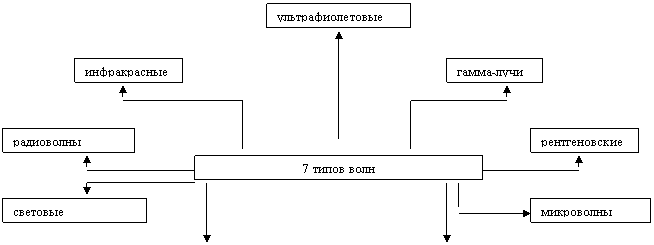 | |||
 |  | ||
|
| ||
| |||
X. Read paragraph 4 again and say what makes the seven rays different from each other.
LESSON THREE
I. Look through the list of the English words and their Russian equivalents for better understanding text B:
subtle – тонкий, неуловимый; to occur – происходить; to convert – преобразовывать; receptive – восприимчивый; beyond – за пределами; wavelength – длина волны; to range – колебаться в пределах; frequency – частота; to approach – приближаться; beam – пучок; луч; to fan out – расходиться, распространяться.
II. Read text В. Find out the main information of the text.
Text В
Radio Waves
During the last few decades, a subtle change has occurred which none of our senses1 can register. Radio waves, bearing messages in many tongues2, flow ceaselessly around us, through us and above us. We can only hear and see them if we convert them to other waves to which our ears and eyes are receptive.
Radio waves are the longest members of the family of electromagnetic waves. In the spectrum, in which the waves are arranged in order of increasing wavelength3, they lie beyond the infrared waves. Their wavelengths range from about three hundredths of a centimetre to about 300 kilometers. Radio broadcasts today are made by two different methods known as AM (amplitude modulation) and FM (frequency modulation). The frequencies of the waves used are expressed in kilocycles or megacycles. The vibrating current is fed into an antenna from which the radio waves are broadcast into space.
Microwaves are the smallest radio waves. In the spectrum of electromagnetic waves they lie between infrared rays and the long radio waves. The shortest microwaves have a wavelength of about three hundredths of a centimetre and a frequency of one million megacycles. The longest microwaves have a wavelength of about three metres and a frequency of one hundred megacycles.
The first microwaves made by man were the two-foot waves produced by Heinrich Hertz. It is interesting that they were the last to be put to a practical use. Long waves were easier to produce and send out over long distances. Scientists had to return to the use of short waves in order to solve a problem4 that came up during World War II. The problem was "How can you detect an approaching enemy plane while it is still far away? " A possible answer to the problem was to send a beam of radio waves. Long radio waves could not be used for this purpose because they fan out too quickly from the broadcasting antenna. Very short waves were necessary to make the radar system work. So new transmitters and receivers were designed to make and use microwaves.
NOTES
1) none of our senses – ни одно из наших чувств
2) bearing messages in many tongues – несущие сообщения на многих языках
3) in order of increasing wavelength – в порядке увеличения длины волны
4) in order to solve a problem – чтобы решить проблему
III. Find answers to the following questions:
1. Can we hear and see radio waves? 2. What place do radio waves occupy in the spectrum of electromagnetic waves? 3. Who produced the first microwaves? 4. Were the microwaves the first to be put to a practical use? 5. What kind of problem came up during World War II?
IV. Speak about the characteristics of radio waves and microwaves.
LESSON FOUR
I. Look through the list of the English words and their Russian equivalents:
activity – деятельность; to support – поддерживать; to administer – управлять; responsible – ответственный; announcement – сообщение; to intend – намереваться; to remain – оставаться.
II. Before you read the text study the questions. Then read the text to yourself to find out which questions the author answers:
1. What is the name of the organization responsible for administering radio sport in Great Britain? 2. What word is the key one in radio sport? 3. Is radio sport supported by the government? 5. Do "foxes" identify themselves every five minutes? 6. Is the competitive spirit typical of Soviet electronics?
Text С
Radio Sport: a Serious Business
1. In Russian vocabulary the electronics enthusiasts are known as "radio sportsmen". Radio sport is a highly organized, serious activity supported and administered by the government. The organization responsible for administering radio sport is called the Radio Sports Federation. In radio sport, the key word is competition. The highest award, one held by a relatively few sportsmen, is "Master of Radio Sport". One particularly interesting form of radio competition is called "Fox Hunting". This is a contest in which teams of "hunters" (young people carrying portable direction finders ) race against time2 to find "foxes" (hidden transmitters). The rules call for3 the three "foxes" to take up positions one or two miles apart in a large wooded area. At the starting signal, the "foxes" begin identifying themselves by voice announcements4 at one-minute intervals, each "fox" therefore being on the air5 once every five minutes. The announcements, which are very brief, are made on amateur bands6 by means of low-powered transmitters, usually homemade. The winning "hunter" is the one who first locates all three "foxes" in sequence7. The kind of competitive spirit8 that characterizes radio sport is typical of electronics in general. Whether it be the technological state of the art, TV via communication satellite, or techniques for electronic training, the our people are fully aware of the importance9 of communications-electronics in the space age, and they intend to remain competitive in every possible way.
Notes
l) a portable direction finder – переносный радиопеленгатор
2) race against time – бегут на время
3) fthe rules call for – правила требуют
4) identify themselves by voice announcements – дают знать о себе голосом

|
Из за большого объема этот материал размещен на нескольких страницах:
1 2 3 4 5 6 7 8 9 10 11 12 13 14 15 16 17 18 19 20 21 22 23 24 25 26 27 28 29 30 31 32 33 34 35 36 37 38 39 40 41 42 43 44 45 46 47 48 49 50 51 |
