


Партнерка на США и Канаду по недвижимости, выплаты в крипто
- 30% recurring commission
- Выплаты в USDT
- Вывод каждую неделю
- Комиссия до 5 лет за каждого referral
puters can be used to compose music, write poems, and produce drawings and paintings. A work generated by a computer may resemble that of a certain artist in both style and form, or it may appear abstract or random. In either case, however, any creativity in the work is basically that of the person who programmed the computer.
puters are also used in the study of the fine arts, particularly literature. They have also been programmed to help scholars identify paintings and sculptures from ancient civilizations.
Notes
puters help in tracking the vehicles – компьютеры помогают следить за полетом ракет
2. information science brings together – информатика объединяет
3. rely on computers – используют компьютеры
4. for reference purposes – для библиографических целей
III. Say whether the following statements are true or false:
puters play an important role in society. 2. Without computers it would be possible to perform the enormous number of calculations. 3. Researchers don't use computers to construct mathematical models of devices, systems and theories. puters provide an efficient means of storing and locating scientific research data for various purposes.
IV. Answer the following questions on paragraphs 1 and 2:
1. What can computers do in most major industries? puters enable engineers to design complicated structures, don't they?
V. Find the place in paragraph 3 containing the description of information science. Say this to your group-mate.
VI. In paragraphs 1 and 2 find the English equivalents of the following words:
многочисленный; управлять; включать, (выключать); регулировать; главный (основной); исследователь; служащий; решение; выполнять; огромный; вычисление; передовой (прогрессивный); помогать; запускать; летательный аппарат (ракета); следить; оборудование; исследовать.
VII. Translate paragraphs 4 and 5.
VIII. Write out of the text words and word combinations for describing the use of computers in engineering and the sciences.
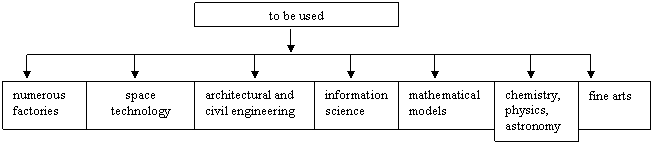
IX. Find Russian equivalents to the words given in the boxes of the logical diagram.
 |
 |
X. Make an outline of the text.
XI. Speak about the application of the computer using your outline and the words from the logical diagram.
LESSON THREE
I. Look through the list of English words and their Russian equivalents. You '11 need them for better understanding of text B:
sequence – последовательность; to deliver – выдавать; to refer to – ссылаться на; software – программное обеспечение (средство) ; hardware – аппаратное обеспечение (средство); high-level language – язык высокого уровня; low-level language – язык низкого уровня; to require – требовать; to suit – подходить; to add – прибавлять, складывать; to subtract – вычитать; to represent – представлять; sign – знак; assembly language – (входной) язык ассемблера; compiler – компилятор, компилирующая программа; assembler – ассемблер, компонующая программа.
II. Skim through the text and try to formulate the main idea (you are given 10 minutes).
Text В
Programming a Digital Computer
Programming involves the preparation and writing of detailed instructions for a computer. These instructions tell a computer exactly what data to use and what sequence of operations to perform with the data. Without such programs, a computer could not solve problems or deliver any other desired result.
In most cases, computer scientists and other computer specialists called programmers write the instructions. They refer to programs as software because the instructions have no physical parts. The term hardware is applied to the computer itself, including its electronic circuits and peripheral equipment.
A programmer writes the instructions for a computer in a programming ch a language consists of letters, words, and symbols as well as rules for combining those elements. Some programming languages closely resemble the language of mathematics. Others enable programmers to write instructions in simple, everyday expressions, such as "READ", "ADD", and "STOP". Programming languages of this kind are called high-level languages.
The language that a programmer uses depends largely on the job to be done. If a task involves processing business data, the programmer would most likely use COBOL (COmmon Business Oriented Language)1. However, preparing a computer to solve complicated scientific problems might require the use of ALGOL (ALGOrithmic Language)2, which is a mathematically oriented programming language.
Some high-level languages can be used for business, technical, or scientific ch languages include FORTRAN (FORmula TRANslation)3; APL (A Programming Language)4; and PL/1 (Programming Language One)5.
Another commonly used programming language is BASIC (Beginner's All-purpose Symbolic Instruction. Code)6. BASIC is well suited for writing relatively simple programs for minicomputers and microcomputers.
Some computer programs may be written in an assembly language. This kind of language is harder to use than a high-level language because it involves symbols as well as words. For example, an assembly language might use the symbols AD for add and S for subtract.
A computer cannot work directly with a program written in a high-level or assembly language. The instructions have to be translated into a machine language composed of binary digits that represent operation codes, memory addresses, and various symbols, such as plus and minus signs. Machine language is also known as low-level language. Special programs called compilers and assemblers translate high-level and assembly languages into machine language.
Notes
1. COBOL (COmmon Business Oriented Language) – КОБОЛ (язык, ориентированный на выполнение общих экономических расчетов)
2. ALGOL (ALGOrithmic Language) – АЛГОЛ (алгоритмический язык)
3. FORTRAN (FORmuia TRANslation) – ФОРТРАН (перевод формулы)
4. APL (A Programming Language) – АПЛ (язык программирования)
5. PL/l (Programming Language One) – ПЛ/1 (язык программирования/1)
6. BASIC (Beginner's All-purpose Symbolic Instruction Code) – БЭЙСИК (многоцелевой язык символических инструкций для начинающих)
III. Answer the following questions on the contents of the text:
1. What does programming involve? 2. Who writes the instructions? 3. What does a programming language consist of? 4. What programming languages do you know? 5. What is a machine language composed of?
IV. Give the main points of text В in some sentences.
V. Speak about high-level and low-level languages.
LESSON FOUR
I. Look through the list of English words and their Russian equivalents facilitating reading text C:
advantage – преимущество; weight – вес; load – груз; pay-load – платный груз; to apply – применять; response – ответ, реакция; blind landing – посадка по приборам; flight – полет; immediate – немедленный; vehicle – летательный аппарат, ракета; reliability – надежность; solid-state device – твердотельное устройство; square inch – квадратный дюйм; complicated patterns – сложные схемы, human brain – мозг человека; reason – причина; component – элемент; dimension – размер; cost – стоимость; to save – экономить.
II. Scan text C looking for answers to the following questions:
1. What are the advantages in making computers as small as one can? 2. What is the problem of further miniaturization of computers?
Text С
Miniaturization
1. There are several advantages in making computers as small as one can. Sometimes weight is particularly important. A modern aircraft, for example, carries quite a load of electronic apparatus. If it
2. is possible to make any of these smaller, and therefore lighter, the aircraft can carry a bigger pay-load. This kind of consideration applies to space satellites and to all kinds of computers that have to be carried.
3. But weight is not the only factor. The smaller the computer, the faster it can work.
This increase of operation is a real advantage. There are some applications in which computers could be used which require very fast response times. For example, automatic blind landing of aircraft requires continuous computer calculations which result in control of the aircraft flight. The more immediate the responses are, the more stable that control can be.
3. Another advantage is that less power is required to run the computer. In space vehicles and satellites this is an important matter.
Another advantage is reliability. Mini-computers have been made possible by the development of integrated circuits. And now that transistors and other solid-state devices are used instead of valves, printed circuits with their solid-state components have a very long life1 indeed. A computer can be built up of large numbers of similar units of this kind.
4. All these devices, small as they may be to the eye2 when hundreds of circuits can be packed on to one square inch, are still much larger than they need to be. So the problem is one of finding ways of making these complicated patterns automatically very precisely and yet smaller and smaller. The limit is a long way off yet3. Human brains have more than 100 million cells per cubic centimetre but there is no reason to think that we cannot pack solid-state devices more densely than this.
5. Computers could then easily be built up from these microminiaturized components to have data stores or memories as large as are needed for any job one could imagine. If they are large in information capacity, but small in physical dimensions, with present day techniques much time and cost can be saved.
Notes

|
Из за большого объема этот материал размещен на нескольких страницах:
1 2 3 4 5 6 7 8 9 10 11 12 13 14 15 16 17 18 19 20 21 22 23 24 25 26 27 28 29 30 31 32 33 34 35 36 37 38 39 40 41 42 43 44 45 46 47 48 49 50 51 |
