


Партнерка на США и Канаду по недвижимости, выплаты в крипто
- 30% recurring commission
- Выплаты в USDT
- Вывод каждую неделю
- Комиссия до 5 лет за каждого referral
1.Circle unfamiliar words and expressions.
2.Underline the ideas they do not understand.
3.Make notes about sections in the text they would like to discuss about.
The Aral Sea
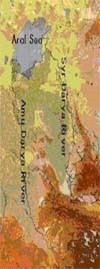
The degradation of the Aral Sea has been called the greatest human-caused ecological disaster of all time From 1960 to 2000 it lost 75 percent of its volume and 50 percent of its surface area. In the early 1960s the Soviets began to use the waters of the two main rivers flowing into it, the Syr-Daria and Amu-Daria to irrigate the plains of Uzbekistan and Kazakhstan in order to grow cotton.
The degradation of this sea has been ruinous to the people and plant and animal life in its region. None of the twenty species of fish once found in the Aral survives in the sea's heavily polluted and highly saline water. The water become very salty and lost most of its natural plants and animal life. The low quality of water has caused many diseases. Towns that were once sea-side resorts or which relied on the fishing industry for their viability now sit in the desert, many miles from the shore line. The ships Muynac's population once used for its thriving fishing industry now sits on desiccated land full of salt and pesticides. The dust from this degraded land is carried by the wind for as far as 150 miles, which presents health hazards to populations of the region. Studies also show that with the reduction of the Aral Sea's size, the surrounding climate has mmers are hotter and dryer; winters are longer, colder, and snowless. This has a significant impact on agriculture in the region; the growing season has been reduced
Several international organizations including the UNDP and
UNEP are now helping the Government of Uzbekistan tackle the problem of the Aral Sea. The World Bank is giving over $30 million to help save the Aral Sea.
In fact, there is a joke that if every expert who visit the Aral Sea brought a bucket of water the problem could be Solved! But for the people of the area it is no laughing matter. Written in chalk on the side of a ship stuck in the sand near Muynak are the words, “Forgive us Aral. Please come back!” Whether the Aral is prepared to forgive us is still an unanswered question.
Step4.Have students brainstorm answers to the following questions in their groups and write down their responses: (10 min)
- How does the current situation in the Aral Sea region affect your daily life (as a biologist, fisherman, etc.)? What power, if any, do you have to improve conditions in the Aral Sea region? Do you want to improve conditions in the Aral Sea region? Why or why not?
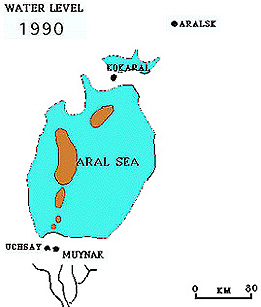
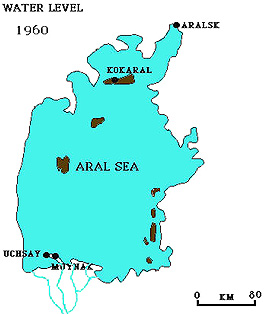
Let students compare the level of water in 1960 and 1990.
Step 5. Divide the class into 4 groups ask students to consider how the following are affected by changes in the Aral Sea, and write their point of view on this topic: (15 min)
- Human health Agriculture Fishing industry Ecosystems
Homework:Ask students to imagine that they are experts who have been called in to the Aral Sea region to help find solutions to the problems there. Have them, either individually or in their groups, list the things that they think would need to be done to help.
As an option, have students carefully assess their lists and write paragraphs answering the question "Do you think there is any hope for the Aral Sea and its people? Why or why not?"
Lesson 2. Investigation of the Aral and Salton Seas
Step 1. Students answer the question (5 min )
Why has the water become more and more salty?
- Why are more people getting sick? How is the climate changing? What has happened to the fishing industry, and why?
Step 2. Draw a puzzle on a blackboard, write each question on a peace of paper and put them up-side-down on the desk, let students come to the blackboard and choose one question and write the answer into the puzzle, the questions and the answers of the puzzle written bellow. (10 min)
1.One of the organizations working to save the Aral Sea.
2.The layer in the atmosphere protects us from the sun’s harmful rays.
3.Breathing dirty air can affect your…..
4.The salinity of the Aral Sea is high. In other words it contains too much…..
5.By cutting down too many trees we are disturbing the balance of…..
6.The planet on which we live.
7.A time when there is very little food in region.
8. A combination of smoke and fog.
9.A former fishing town near the Aral Sea.
Answers:
1.UNEP 2.ozone 3.health 4.salt 5.nature 6.earth 7.famine 9.Muynak
Step 3.Speaking and reading and comparing. Bellow is a text about Salton Sea in Southern California which has the same problem as the Aral Sea, it is given to students so student could have an idea about the water problems in other part of the world. (10 min)
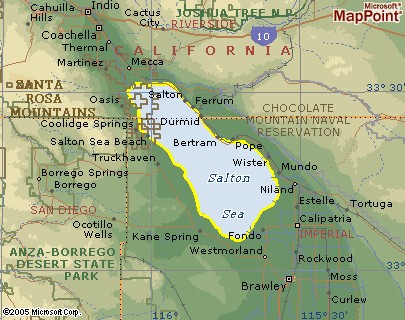
The Salton Sea, located in Imperial County of Southern California, is a saline lake that was formed in a large basin (called the Salton Trough) created by releasing bend of the San Andreas fault. In modern times, the Salton Trough became a lake in 1891, but dried up within a year. It began to form again in 1893. In 1905, the Colorado River was diverted into the Salton Trough to create the Salton Sea. The Salton Sea was originally a fresh water lake. The Aral Sea, located in Uzbekistan and Kazakhstan, is historically a saline lake. It is very much like the Salton Sea of Southern California, except much larger. The Aral Sea was also formed in a basin formed by a releasing bend of a strike slip fault. The Aral Sea and the Salton Sea are both prime examples of dynamic environments. The Aral Sea is considered a true environmental disaster, but most students do not think this could ever happen in the United States, much less in their own back making students aware that the Aral and Salton Seas share many similarities, we hope that students will become more environmentally conscious. It may be too late to "save" the Aral Sea, but there is still hope to prevent the ecological collapse of the Salton Sea.
Step4. Divide the class into two groups. (15 min)
First group write about similarities and second group write about differences between the Salton Sea and the Aral Sea.
Approximate answers:
Differences and similarities between the Salton (SS) and the Aral (AS) Seas
Recent major environmental changes that were caused by humans.
Potential dangers from military toxins/wastes.
Loss of fisheries due to human-caused environmental changes.
Sea water that is polluted by sewage, pesticides, defoliants, selenium (SS), agent orange (AS), and DDE (SS).
Salinity at near-fatal (SS) or fatal (AS) level for sea-living organisms.
Salinity levels that are still on the rise.
Major source of airborne particles (dust) for their respective regions.
Cotton growing regions.
Closed systems, with no outlet except for evaporation.
The health of animals and people in the areas have been negatively affected.
Evaluate students according to the answers. (5 min)
Homework:
Search for information in Internet, answering the following question:
What are the names of the rivers supplying the water to the Salton Sea?
Is there any other source(s) of water entering the Salton Sea?
What is grown in the Salton Sea region?
Does the agriculture in the area create any environmental concerns/problems?
Do any organisms live in the Salton Sea?
What is the recent history (since 1900) of the Salton Trough?
What is the more ancient history of the Salton Trough?
Alternative version of the lesson plan about Aral Sea
Hamidova Natalya
Karshi, school #34
Teacher of English language
Subject and the class: This lesson plan for English language lesson in 8th forms.
Name of the lesson : “The Aral Sea”
(the theme was taken from the book English Matters, Unit 8 , Environmental matters, lesson 2-3) the lesson plan was elaborated in accordance with educational standard of the Republic of Uzbekistan. The theme is divided into two lessons (45 min each, 90 min. totally)
Lesson goals:
- learn about the Aral Sea figure out why the problem of Aral Sea appeared learn about the organizations that help Uzbekistan to solve this problem learn new words and definitions
- practice using active and passive voice(turning the sentences from active to passive & passive to active)
Description of necessary resources:
Paper – to print the information on, to use in group work.
Printer – to print the information.
Wall map – to find the location of Aral Sea.
Internet access – to find necessary information.
Posters – for the interactive part.
New terms and definitions :
Environment, damage, spill, crisis, exceed, marble, cancer, smog, burst, rust, jobless, shrink, decline, irrigation, livelihood, harvest, slogan, healthcare, increase, decrease, consequences, disaster
According to the curriculum the lesson “The Aral Sea” is divided into two parts – two lessons, a plan lesson 45 min., so there is 90 min. for explaining the causes of the changes in the Aral Sea.
Detailed description of the lesson, indicating the steps and timeline:
Before the lesson, find recent information about the Aral Sea location, its environmental Problems and causes of disappearance, consequences of the changes in the Aral Sea, about current situation in Muynak, about organizations working to save the Aral Sea.
Make a photocopy to each pupil with the information about the Aral Sea. This information can be taken from following sites :

|
Из за большого объема этот материал размещен на нескольких страницах:
1 2 3 4 5 6 7 8 9 |
