


Партнерка на США и Канаду по недвижимости, выплаты в крипто
- 30% recurring commission
- Выплаты в USDT
- Вывод каждую неделю
- Комиссия до 5 лет за каждого referral
http://www. fi. edu/qa97/puzzle12/puzzle12.html - website of Franklin Institute online, where you can find interesting crossword about water and word related to water.
Water Words
P | T | U | C | S | E | B | Q | A | W | N | P |
P | R | C | N | C | S | K | A | T | A | V | O |
O | E | F | I | L | T | R | A | T | I | O | N |
J | A | O | H | Y | R | D | U | H | H | L | D |
G | T | U | O | B | E | R | S | I | Y | E | Q |
M | M | N | A | M | A | I | C | R | K | R | F |
I | E | T | E | L | M | N | X | S | L | T | M |
N | N | A | L | X | P | K | A | T | D | E | T |
T | T | I | J | G | N | I | M | M | I | W | S |
A | Q | N | E | B | R | W | D | J | R | C | T |
K | U | F | D | K | Q | B | G | E | E | S | E |
E | G | N | I | R | P | S | T | U | S | I | A |
H | Z | Y | X | D | E | A | H | E | O | E | M |
S | R | I | O | F | W | V | C | Z | U | O | S |
F | L | U | I | D | F | H | N | R | R | R | S |
O | K | H | D | R | I | P | E | A | C | M | E |
C | S | A | N | O | Z | U | U | P | E | R | W |
R | I | V | E | R | U | D | Q | U | W | E | E |
U | N | G | G | T | X | D | N | I | A | S | R |
V | A | P | O | R | I | L | W | J | L | U | E |
N | M | T | R | G | V | E | I | T | O | D | S |
Y | T | I | D | I | M | U | H | P | O | E | T |
R | I | Q | Y | E | N | I | L | E | P | I | P |
P | B | L | H | P | U | G | R | S | U | T | V |
Directions: Find the following water-related words. | ||
bathe | liquid | sewer |
Prompt: 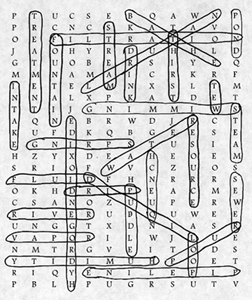 Step 4- Conclusion, making best solutions to save water.(10 min)
People in cities waste a lot of water everyday
You brush your teeth. The water runs. You waste 15-20 liters of water every minute.
You do your washing up. The water runs. You waste 15-20 liters of water.
In the summer the water runs when you wait for cold water. You can fill 24 bottles.
You have a shower. You use 15-20 liters water every minute! You can fill 40 bottles.
You have a bath. You use 230 liters of water.
When you reduce the water you save water.
Answer the questions:
1. Now many times a day do you do each thing?
2. Count how much water do use each time.
3. Write the total water you use each day.
Home assignment: Ask student to write their opinion about water according to the directions bellow:
I need water to _____.
Ask students why they think it is so important to keep the water. Students will brainstorm things they do to protect and save the water. Discuss ways that people water. Students will brainstorm on the various ways to save water and brainstorm as a class the following questions.
What would you do if you found a leaky faucet?
How can you use less water when you brush your teeth?
What can you do when you want a drink of cold water instead of letting the water run? Students will brainstorm on the various ways to save water and brainstorm as a class the following questions.
What would you do if you found a leaky faucet?
How can you use less water when you brush your teeth? What can you do when you want a drink of cold water instead of letting the water run?
Boltaeva Charos
Teacher of English Language in school # =34
Kashkadarya Region, Karshi Town
Lesson plan
Name of lesson: Dangerous Earth.
This lesson accords to the educational standards of Uzbekistan, the theme is taken from the book Fly High: Unit 7,lesson 5.
Subject and class: lesson of English language for 6th grade students
Objectives:
1.To revise the vocabulary of natural disasters.
2.To present and practice some more vocabulary in order to enable pupils to talk about damages, distractions and victims.
3. To increase awareness about natural disasters.
4.Searching information about recently occurred disasters.
Necessary resources: Internet access to find overall information about natural disasters, printer to print the information on paper for each student, paper for individual work and collaborative work. Pos
New terms and definitions:
Hurricane, forest fire, victim, death, injuries, damage, flooding, catastrophe, emergency, aid,
earthquake, tragically, courage, event
Detailed description of the lesson Steps and Timeline:
The information can be taken from the following sites:
http://tashkent. freenet. uz/e_ze. htm - Tashkent v 1966 g
http://www. /img/uzbekistan/tashkent/ - about modern Tashkent.
http://www. /ReadingComprehension_38_18.html - about tsunami
Step 1.lntroduce the topic to the student (5 min.)
1.Disasters.
Brainstorm.
1.The teacher shows the picture of well-known monument in Tashkent and asks the following questions:
Where is the monument?
Why it is there?
What time does the clock show?
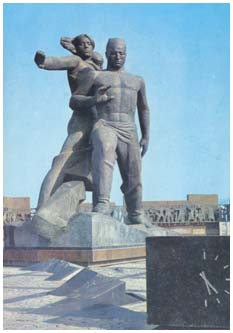
Pupils answers”
1.In Tashkent
2. The symbolic of a monument is the strong earthquake in Tashkent.
3. 5.23 at the morning - this is the time when the earthquake begun.
Step 2. – Reading -14 min.
The teacher shows the pictures and gives a copy of the text containing information about the earthquake in Tashkent in 1966 taken from web resources.
The pupils read it attentively. During reading tell them to :
1.Circle unfamiliar words and expressions.
2.Underline the ideas they do not understand.
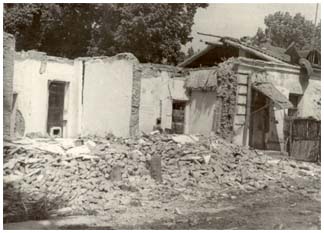
The last strongest earthquake taken place in Tashkent April 26, 1966. This tragically event of the newest history of two-thousand-year city found the reflection in the memorial "Courage" located on a coast of ancient channel Anhor. A choice of a place for a monument is not random. Channel Anhor divides Tashkent on two parts. On the right of its (western) coast there is an old city, and on east side from Anhor a so-called new (European) city appeared in second half XIX centuries. After joining of Tashkent to Russian empire this new city was designed and built up as the provincial center. In this place where there was an epicenter of the strongest earthquake of 1966, the monument "Courage" was erected.

|
Из за большого объема этот материал размещен на нескольких страницах:
1 2 3 4 5 6 7 8 9 |
