


Партнерка на США и Канаду по недвижимости, выплаты в крипто
- 30% recurring commission
- Выплаты в USDT
- Вывод каждую неделю
- Комиссия до 5 лет за каждого referral
6. Students will become familiar with what Earth Day is, why it is important, and why it is celebrated.
Necessary resources: Internet access to find overall information about Earth Day, printer to print the information on paper for each student, paper for individual work and collaborative work, , information about specified endangered animals (articles or books),endangered Animals worksheet, posters - for discussion part.
http://teacherlink. ed. usu. edu/tlresources/units/Byrnes-celebrations/Earth%20Day-%20Home%20Page
New terms and definitions: ecology, environment, pollution, damage, ozone layer, become existing, habitat, pollution, endangered species, affect
Detailed description of the lesson Steps and Timeline:
Step 1.
1.Before the reading, introduce the topic –Earth Day. Ask the students what they know about it (allow the limited use of the mother tongue if needed).
2.Pre-teach key words, either by explaining the meaning or giving the translation.
3.Get them to read the text. Allow enough time for this.
4.Give each pupil a copy of the text containing information about Earth Day taken from web resources. Let them to read it attentively
About Earth Day
Environmentalists have been actively aware of these issues, and are doing their best to promote awareness. In the late sixties, Senator Gaylord Nelson of Wisconsin first suggested the idea of an Earth Day to bring people to the realization that Earth has some problems, and we as humans need to do something about it. The first Earth Day celebration took place on April 22, 1970. It was a nationwide focus. Twenty million Americans joined in to proclaim the message, "Give Earth a Chance." A series of events took place on a community level, most of which were organized by student groups. Since then, Earth Day has expanded. The tenth anniversary of the celebration in 1980 was sponsored partly by The United States Environmental Protection Agency. The twentieth anniversary in 1990 was sponsored by hundreds of environmental organizations across the nation. Every year on April 22, all Americans are asked to celebrate Earth, to take a look at what is being done to help our ecosystem, and to ask ourselves, "What am I doing to help?" Many people use the day to plant flowers or trees, clean up communities, promote recycling, forest and wildlife protection, etc., and look to the future of the earth.
Ask following questions:
1.What is the text about?
2.When did the first Earth Day take place?
3.Who first suggested the idea of an Earth Day?
4.Do many people celebrate this day nowadays?
Step 2.
Divide children into three groups and give them different texts about environmental problems.
Group 1:1.Pollution has become more and more a problem, especially in the past century with the drastic increase in technology. Garbage, sewage, chemicals, and oil are being dumped into the ocean. As human population grows, people are looking to the ocean more for resources. Landfills and littering have polluted the land. Dangerous levels of chemical emissions from cars, planes, factories, aerosol cans, etc., enter the air without end. Plants and animals are dying because of pollution.
Group 2:.Many species became extinct before mankind made its appearance, however, since humans have existed on the earth, the extinction rate has risen dramatically. More than 4,000 species are currently considered threatened. Plant and animal life become endangered for many reasons. Forest depletion, hunting, and pollution are the most obvious factors. When an animal becomes endangered, dozens of other species can also become endangered. For example, elephants disappeared from southern Africa about 80 years ago because of hunters. Elephants continue to be hunted, mainly for their costly ivory tusks. The endangerment of elephants also has endangered such animals in their area as wildebeest and antelope who live off of the open-grassland which elephants create by eating their way through a jungle.
Group 3:Ozone is a form of oxygen that has collected in a layer about 30 km above the earth's surface. This ozone layer protects us from most of the dangerous ultraviolet radiation from the sun. Without this layer, living things could not thrive on the earth. Satellites have detected in the last ten or so years damage done to the ozone. The damage is often referred to as a hole in the ozone. This damage has been caused by certain chemicals being emitted into the atmosphere that react with the ozone. One major chemical is called chlorofluorocarbons (CFCs), which are commonly used in such products as solvents used for cleaning electronics such as television and computer circuit boards, cooling fluid in automobile air conditioners, aerosol spray cans, etc. Ozone depletion has effected the temperature of the earth. Some scientists say that if CFCs were not in existence, the earth would be cooler now than it presently is. This global warming is often called the greenhouse effect.
Step 3 – Interactive game(15 min for the game 5 min for conclusion)
Divide children into three groups. Give each group a poster. Ask them to write the problem they read about in brief and propose the solutions to these problems. Ask each group to choose a leader and make a presentation of the poster.
Make a conclusion of the lesson ask students to express their opinion about the lesson.
Home assignment: Write an essay about “Why should we save water, energy, natura, animals and gas”
Boltaeva Charos
Karshi, school #34
Teacher of English language
Subject and the class: This lesson plan for English language, lesson in 8th forms.
Name of the lesson : “Animals in danger”
(the theme was taken from the book English Matters, Unit 8, Environmental matters, lesson 10) the lesson plan was elaborated in accordance with educational standard of the Republic of Uzbekistan.
Lesson goals:
To increase awareness of the ecological importance of animals. To practice group decision-making skills and writing. learn new words associated with endangered animals and protection to explore personal values and feelings about endangered animalsDescription of necessary resources:
Paper – to print the information on, to use in group work.
Printer – to print the information.
Internet access – to find necessary information.
New terms and definitions :
Environment - Everything around us, plants, air, land, life etc.
Species - A certain type of plant or animal
Exotic species - Animals or plants introduced to new environments different from where they originated; may be dangerous to native species
Habitat - Natural home of plant or animal
Deforestation - Clearing forests of trees
Detailed description of the lesson, indicating the steps and timeline:
Before the lesson, find recent information about endangered animals
Make a photocopy to each pupil with the information about endangared animals
This information can be taken from following sites :
http://www. unep. org/geo2000/pacha/glossary. htm glossary about endangered animals
http://www. unep. org/geo2000/pacha/index. htm general info about endengered animals
http://www. unep. org/geo2000/pacha/bio/bio2.htm info about tigers
http://www. /activity/pdf/endangered. pdf - research form for the problems and solutions of endangered animals
http://www. /activity/endangered. html - information about problems and solutions of endangered animals
Overview:
“The deer, the horse the great eagle, these are our brothers......the Earth is our mother.......all things are connected like blood which unites our own house” - The Dalay Lama
Step 1 –Introduce the lesson : (10 min)
Discussion.
Get students come up with animals they know to be in danger in the world.
Discuss how they heard about them.
Why they are in danger?
Give each student a printed copy of the following picture, this is a picture of the animals which are being in danger at the present moment, let students define the names of animals and write down the ones which are unfamiliar to students.
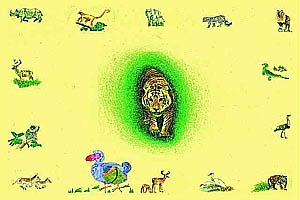
Step 2. Reading and disscussing: (20 min)

A species is said to be extinct when it has not been seen for over 50 years. Dinosaurs became extinct 65 million years ago but, in the last 50 years, more animals and plants have become extinct, because of hunting and loss of habitat. Globally, many hundreds of species will face extinction in a very few years without intensive conservation, education and environmental management and policy-making.
Dodos
The dodo was a large bird found on Mauritius, an island in the Indian Ocean. It was like a big turkey with a large beak. Since it had no natural enemies, it had lost the ability to fly. Having no experience of predators, the dodo was easy for the newly arrived European settlers to catch and kill. The rats and pigs they brought with them also killed 1680, 80 years after the arrival of Europeans, the last dodo was dead.

In January 1999, hundreds of parrots, toucans and macaws ate fruit from farms in Guyana. In response, the farmers, using government money, poisoned the birds. People are angry because they believe that a foreign company had destroyed the birds’ habitat, which had forced the birds to invade the fruit farms.
We must take action against those who get satisfaction in driving species to extinction.

Tigers are just one of the beautiful species of animals that face extinction in the wild if we cannot step up our efforts to conserve their habitat, and protect them from poachers.
Discuss following questions:
Many animals are in danger because people kill them for sport or profit. Can you imagine a world without animals? How can we stop it becoming a reality?

|
Из за большого объема этот материал размещен на нескольких страницах:
1 2 3 4 5 6 7 8 9 |
