


Партнерка на США и Канаду по недвижимости, выплаты в крипто
- 30% recurring commission
- Выплаты в USDT
- Вывод каждую неделю
- Комиссия до 5 лет за каждого referral
http://visearth. ucsd. edu:16080/VisE_Int/aralsea/- general information about Aral Sea
http://www. dfd. dlr. de/app/land/aralsee/aralregion. html-
Geographical location of the Aral Sea
http://giserv. karelia. ru/aral/- reasons, consequences, solutions of the Aral Sea problem
First part of the lesson (45 min.)
Step 1 –Introduce the lesson : ( 5 min. introducing,20 min. reading, 25 min. totally)
Introduce the topic to the students : The Aral Sea.
Give each pupil a copy of the text containing information about the Aral Sea taken from web resources.
Let them read it attentively. During reading tell them to :
1.Circle unfamiliar words and expressions.
2.Underline the ideas they do not understand.
3.Make notes about sections in the text they would like to discuss about.
Step 2- Reading comprehension ( 5 min. )
Ask pupils if they didn’t understand something, explain it to them and than ask them to check out the unfamiliar words in online dictionaries, like www. lingvo. ru
Step 3 – Check out how they understood the text (15 min.)
Ask following questions:
1.Which of the following would you choose as a title for the text?
Environmental Problems in Uzbekistan …
The Pollution of the Aral Sea …
The Aral Sea Disaster …
2.Find the answers to the following questions in the text :
How many species of the fish once lived in the Aral Sea? By how much has the level of the Aral Sea fallen since 1960 ? How much money is the World Bank giving to help tackle the problem? How much water is lost from the Sea each year through evaporation? What was the increase in the rate of infant death between 1980 and 1989 ?
Home assignment: Design a notice to inform people about the problem you have chosen and to make them think about the way they act.
Remember:
- to make the message clear and direct to include some facts to strengthen the message to think of a memorable slogan the design should be “eye-catching”
The second part of the lesson using interactive methods: (45 min.)
Step1- preparation for group work (10min.)
Divide pupils into three groups.
1-group) Reasons of Aral Sea problem
2-group) Consequences of Aral Sea problem
3-group) Problem solutions
Step2-Work in groups, grammar practice(30min totally, 20 min. work with posters,10 min. presentation,3 min. for each speaker )
Each group will get a poster, where they have to write 5 sentences in active voice about the topic they are given: 1-group: reasons of Aral Sea problem, 2-group: Consequences of Aral Sea problem, 3-group: Problem solutions and then turn them to passive voice and write them down at the poster. The sentences should be created basing on the main text they read at the first part of the lesson.
After completing this task each team will choose a leader that will present the poster of the team.
Step3-Conclusion (5 min):
Make a conclusion of the lesson let students express their opinion about the lesson.
Home assignment: To solve an environmental crossword copied for each student.
Expected results:
- During the lesson students are expected to: learn about the problem, consequences and solutions of Aral Sea problem. Practice their grammar(active and passive voice) Learn new words and definitions.
Kashkadarya Region, Karshi
Hamidova Natalya
Teacher of English Language in school # 34
Name of lesson: The catastrophe in Asia.
Class of the lesson: the lesson is elaborated for the 8th form, The lesson plan totally accord to the educational standards of Uzbekistan (the lesson is taken from the book English Matters, Unit 7,lesson 5)
Objectives:
1.To show pupils examples on how disasters work and why they occur.
2.To present and practice some vocabulary in order to enable pupils to talk about different disasters.
3.To increase awareness about disasters: what we can learn from previous disasters and how these lessons can help us to be prepared for future disasters.
Necessary resources: Internet access to find overall information about natural disasters, printer to print the information on paper for each student, sites about disasters, copies of map for every student.
New terms and definitions: catastrophe, disaster, hurricane, earthquake, forest fire, drought, tsunami, ocean, killed, injured, death, destruction, damage, forecast, unexpected, unprepared.
Detailed description of the lesson Steps and Timeline:
Before the lesson, the teacher find recent information about natural disasters and its consequences. The teacher makes a photocopy to each pupil with the information about natural disasters and map about the most affected countries. This information can be taken following sites:
http://www. /TsunamiMap2.htm- the map about the most affected countries by tsunami
http://www. /ReadingComprehension_38_18.htm - information about what tsunami is
The teacher suggest to view the following sites for preparing homework:
http://news. bbc. co. uk/1/hi/in_depth/world/2004/asia_quake_disaster/default. stm
http://story. news. /fc? tmpl=fc&cid=34&lp=3&ll=b3&pg=1&mod=interactives___graphics&in=science&cat=asia_tsunami_disaster
Step 1.Introduce the topic to the student: Disasters. -5 min
1.The teacher asks the pupils about disasters they know.
If pupils don’t know them in English the teacher helps them. (flooding, hurricane, earthquake, forest fire, drought)
2.The teacher asks the pupils about disasters they heard about in the news or read from Internet during the past few days.
Examples of answers - Tsunami in Indonesia, Thailand and India. Flooding in Russia, Lithuania, Switzerland and England. Forest fire in Florida, USA. Strong storm in New Jersey, USA. Blizzard in Colorado, USA.
Step2. Reading. -15 min
It isn’t easy to guess what nature will do? Every year natural disasters, such as earthquake, hurricanes, floods, forest fires, cause death and destruction all over the world. Natural catastrophes now kill a million people each decade and cause billions of dollars of damage. Although scientists try to forecast them and warn people, disasters are often unexpected and strike when people are unprepared. And now briefly about each disaster: tsunami is an undersea earthquake, earthquake is a shaking of the earth of the earth’s surface, flooding is the covering of dry land with water, hurricane is a very strong fast wind, forest fire is the fire spreading rapidly through trees, blizzard is a strong storm with wind and snow, drought is a long period without rain.
Step 3.Work with map. -5 min
The teacher gives each pupil a copy of the map containing information about the most affected places by tsunami. The teacher lets them to look it attentively and than pupils answer the following questions:
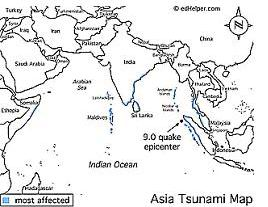
1.In what ocean is Indonesia, Thailand and India located?
The Indian Ocean
The Arctic Ocean
The Atlantic Ocean
Pacific Ocean
2.What can cause tsunamis?
Undersea quake
Wind
Fire
3. The state in the United States at greatest risk for a tsunami?
Texas
Florida
Ohio
Step 4.Writing. – 10 min.
Discuss with the teacher the following questions : -10 min.
1.Which disaster killed the most people?
2.Which disaster caused the most destruction?
3.Which disaster left the most people homeless?
4.Which disaster happened in Indonesia, Thailand and India?
Step 5 Matching. -5 min.
The pupils match the natural disasters with the definitions:
Earthquake an undersea earthquake
Flooding a shaking of the earth’s surface
Hurricane the covering dry land with water
Forest fire a long period without rain
Drought fire spreading rapidly through trees
Blizzard a strong storm with wind and snow
Tsunami a very strong fast wind
Step 6 Conclusion and home assignment 5 min.
The teacher explains that it is important to know what people must do when disasters occurred. People have to learn from previous disasters and be prepared for future disasters.
People have to help each other when they are in trouble.
Home assignment: to find information about recent disasters and complete the table:
Type of disaster | Where | Number killed | Number injured | Other effects |
http://www. /ReadingComprehension_38_18.htm - information about tsunamis.
Expected results: during the lesson students are expected to:
- Learn about natural disasters and its sequences. Learn about the most affected countries Learn new words and definitions about natural disasters Speaking, reading, writing practices
Turabaeva Kamila
Teacher of English Language in school # =34
Kashkadarya Region, Karshi Town
Lesson plan
Name of lesson: Earth Day.
This lesson accords to the educational standards of Uzbekistan, the theme is taken from the book English Matters: Unit 8, lesson 5-6.
Subject and class: lesson of English language for 8 grade students
Objectives:
1.Students will be able to recognize the various problems that Earth faces (pollution, endangered species, ozone depletion, etc.).
2.Students will identify and express how they feel about environmental problems on the Earth.
3. Students will become familiar with the terms pollution, activist, endangered species, extinction, recycling, ozone, hole in the ozone) the greenhouse effect.
4.Students will demonstrate their knowledge of what they can do personally to help protect and beautify the earth.
5.Students will demonstrate knowledge of an assigned endangered animal, and will become familiar with four additional endangered animals.

|
Из за большого объема этот материал размещен на нескольких страницах:
1 2 3 4 5 6 7 8 9 |
