


Партнерка на США и Канаду по недвижимости, выплаты в крипто
- 30% recurring commission
- Выплаты в USDT
- Вывод каждую неделю
- Комиссия до 5 лет за каждого referral
This function meaningful to the probability related to an individual interval. It is called the density of probability or statistical weight. Sometimes function  is called the differential function of distribution.
Value  is called an element of probability. Geometrically is presented by the area of the elementary rectangle limited from below to a piece
 . The probability of hit of a random variable
  on a piece from A to B
 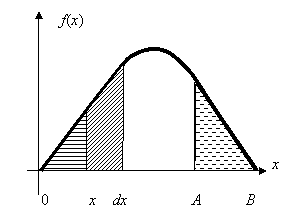 is equal to the sum of elements of probabilities on this entire site, i. e. to integral
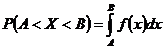 (2)
(2)
Let’s enter a designation
 , (3)
, (3)
Then 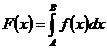 (4)
(4)
In common case:
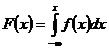 (5)
(5)
Function  is called the integral function of distribution. Geometrically is the area of a curve of the distribution, laying more to the left of a point x. Function is pure number without units. Dimension of density of distribution is return dimension of a random variable.
Examples of random variables
- number of students in the class;
- number of newborns;
- quantity of books in shop.
In these examples random variables can accept separate, isolated values, which can be counted. These values 0, 1, 2, 3,… The random variables accepting values separate from each other are called discrete variables.
Discrete random variables can accept a certain arithmetical meaning.
Let’s the discrete random variables x presented next table:
Discrete random variables, xi | X1 | X2 | X3 | X4 | X5 | X6 |
Probability, pi | 1/6 | 1/6 | 1/6 | 1/6 | 1/6 | 1/6 |
The complex of  and
and  is called the distribution. The total sum of the probabilities is 1. This is condition of the norm:
 (6)
(6)
There are random variables of other type. For example:
- the temperature of human body;
- pressure of an atmosphere at the set level;
- the quantity of energy.
Possible of such random variables are not separated from each other. They continuously fill some interval. Random variables, which possible values continuously fill in some interval, are called continuous random variables.
The condition of the norm of continuous random variables may be written in the form:
 (7)
(7)
where is the differential function of distribution or the probability density function.
4.2. The Numerical Characteristics of Discrete Random Variables
Let us  – discrete random variables, where n – a total number of variables.
I. The mathematical expectation.
The sum of all possible variables multiplied by corresponding probabilities is called mathematical expectation. The mathematical expectation is marked M(x), and calculated by following formula:
 (8)
(8)
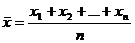
If n large  ,
,  , where the symbol
  is the arithmetic mean.
The basic properties of mathematical expectation
1. If  , where C – an arbitrary constant, then mathematical expectation
  .
.
2. We can put the constant factor before the sign of the mathematical expectation, i. e.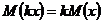 , where
  – constant.
3. The mathematical expectation of the algebraic sum of two functions is equal to the algebraic sum of the mathematical expectations of those functions taken separately, i. e. 
4. The mathematical expectation of the product of two functions is equal to the product of the mathematical expectation taken separately, i. e.  .
.
II. The dispersion.
Dispersion is characterizes the grade of dissipation of random variables near the mathematical expectation. Dispersion is marked  and calculated by following formula:
 (9)
(9)
III. Standard deviation.
Root-mean-square deviation is marked  and calculated by formula:
 (10)
(10)
IV. Mode and median.
The most popular value of a random variables or the value which occurs most often is called the mode of random variables. Mode is marked – Mo.
If the condition  or
or 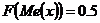 is true, then the value
  is called a median of random variables.
Example 1. Find  , and for next distribution
xi | 3 | 5 | 2 |
pi | 0.1 | 0.6 | 0.3 |
Solution:
Using formula 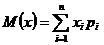 we can find the mathematical expectation:

Dispersion of discrete random variable is equal:  .
.
Firstly we find mathematical expectation of  , i. e.
  ,
,

Then,  .
.

In this case  and
and  .
.
5.1. The Numerical Characteristics of Continuous Random Variables
I. The mathematical expectation for continuous random variables:
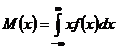 , (11)
where is the differential function of distribution.
II. The dispersion for continuous random variables:
 (12)
(12)
III. Standard deviation:
 (13)
(13)
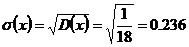
Example 2. Find density of distribution, , and for continuous random variable which represented by the integral function of distribution:
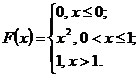
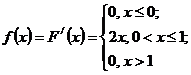
Solution: Using formula (3), we can find density of distribution:
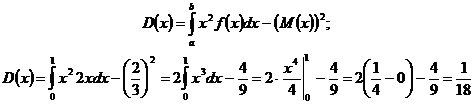
In this case mathematical expectation is equal:

Exercises
1. Find  and
and  , where and
  are discrete variables, which represented next tables:
xi | 5 | 2 | 4 |
pi | 0.6 | 0.1 | 0.3 |
yi | 7 | 9 |
pi | 0.8 | 0.2 |
2. Find and  , where and are discrete variables, which represented next tables:
xi | 7 | 3 | 9 |
pi | 0.1 | 0.7 | 0.2 |
yi | 1 | 2 | 5 |
pi | 0.8 | 0.1 | 0.1 |
3. Find , and for discrete random variable, which represented next table:
xi | 1 | 2 | 3 |
pi | 0.3 | 0.21 | 0.49 |
4. Find , and for the next random variable:
xi | 1 | 2 | 10 | 20 |
pi | 0.4 | 0.2 | 0.15 | 0.25 |
5. Find , and for the next random variable:
xi | 2 | 3 | 10 |
pi | 0.1 | 0.4 | 0.5 |
6. Find , ,  and for the next random variable:
xi | 1 | 4 | 6 | 7 |
pi | 0.1 | 0.4 | 0.3 | 0.2 |
7. Find , , and for the next random variable:
xi | 1 | 2 | 3 | 4 | 5 |
pi | 0.2 | 0.1 | 0.1 | 0.4 | 0.2 |
8. Find , , , Me and for next discrete variable:
xi | 0 | 1 | 2 | 3 | 4 | 5 | 6 | 7 |
n | 11 | 11 | 18 | 20 | 15 | 15 | 5 | 5 |
9. Find , , and for next discrete variable:
xi | 0 | 2 | 2 | 3 |
pi | 0.216 | 0.432 | 0.288 | 0.064 |
10. Random variable x an interval (3; 5) represented by differential function of distribution 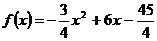 , an intervals
  and
and 
 . Find , and .

|
Из за большого объема этот материал размещен на нескольких страницах:
1 2 3 4 5 6 7 8 |
