


Партнерка на США и Канаду по недвижимости, выплаты в крипто
- 30% recurring commission
- Выплаты в USDT
- Вывод каждую неделю
- Комиссия до 5 лет за каждого referral
11. Find  ,
,  and
and  for continuous random variable, which represented an interval (a; b) by differential function of distribution:
  .
.
12. Find , and for continuous random variable, which represented by the integral function of distribution:
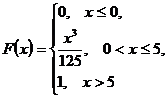
13. Find , and for continuous random variable, which represented by integral function of distribution:
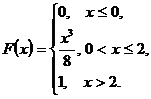
14. Find , and for continuous random variable, which represented by the integral function of distribution:
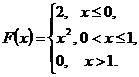
15. Find , , for continuous random variable, which represented by the differential function of distribution:
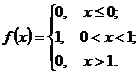
Lesson 6
Laws of Distribution of Random Variables
All problems of mathematical statistics are connected with the analysis of results of supervision of the mass phenomena. For example: definitions of the law of distribution of a random variable on the statistical data, checking the truthfulness of hypotheses
Concepts of parent population and sample are used in statistics.
When it is desired to obtain information about the characteristics of some large population, such as the inhabitants of a country (parent population), it is often practically impossible to observe or measure every individual in the whole population. The method used in such situations is known as the representative method: a sample of individuals is selected for observation, and it is necessary to make the sample of the total population as representative as possible. Then the observed characteristics of the sample are used to form estimates of the total population.
6.1 Distributions
1. A simple statistical line is a set of observable values of a random variable. Usually it writes down as the table. For example:
number of measurement | 1 | 2 | 3 | 4 | 5 | 6 | 7 | 8 | 9 | 10 | 11 | 12 | 13 | 14 | 15 | 16 |
value of a random variable | 2 | 4 | 3 | 4 | 4 | 5 | 2 | 1 | 3 | 3 | 4 | 5 | 6 | 2 | 4 | 3 |
2. A statistical line is a set of intervals of values of a random variable and frequencies corresponding to them. For construction of statistical lines it is necessary to execute the following:
- find number of intervals :  ,
,
where N – number of intervals, n – number of measurements;
- find width of an interval:
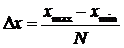 ,
,
- find frequencies of occurrence of a random variable in each interval.
For example:

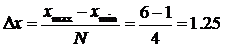
| 1-2.25 | 2.25-3.5 | 3.5-4.75 | 4.75-6 |
p (frequencies) | 4/16 | 4/16 | 5/16 | 3/16 |
 (intervals of values)
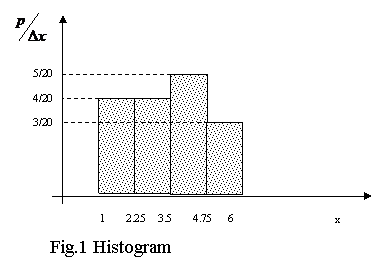
A histogram is a graphical display of tabulated frequencies. A histogram is the graphical version of a table which shows what proportion of cases fall into each of several or many specified categories. The categories are usually specified as no overlapping intervals of some variable. The categories (bars) must be adjacent. The area under the curve represents the total number of measurements. This type of histogram is ideal for an overview of absolute numbers.
For construction of the histogram it is necessary:
- note on a horizontal axis intervals of values of a random variable,
- construct on these intervals rectangular which heights are equal:  .
.
For example:
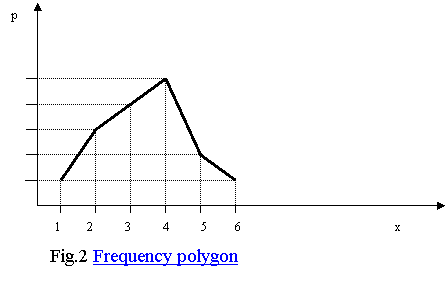
3. Histograms, by definition, are stair case functions. A smoother alternative to histograms can be seen as frequency polygons. Frequency polygons are basically the same as histograms where the rules valid for histograms are also valid for frequency polygons. They are a smoother alternative to histograms. Frequency polygons can be constructed from histograms by joining the midpoints of the histogram bars with lines. The areas below the histogram and the frequency polygon are equal. In general, one should prefer to use histograms rather than frequency polygons, as the width of the classes cannot be seen well in frequency polygons. A line of distribution is a set of values of a random variable and corresponding values of probability. It represented as a table or a polygon of distribution. For example:
value of a random variable | 1 | 2 | 3 | 4 | 5 | 6 |
probability | 1/16 | 3/16 | 4/16 | 5/16 | 2/16 | 1/16 |
To construct a polygon of distribution it is necessary to note values of a random variable on the horizontal axis, corresponding values of probabilities should be noted on a vertical axis. The received points should be connected by direct lines. For example Fig.2.
|
6.2 The Law of Normal Distribution (The Gaussian Distribution)
The normal distribution, also called Gaussian distribution by scientists (named after Carl Friedrich Gauss due to his rigorous application of the distribution to astronomical data) is a probability distribution of great importance in many fields. It is a family of distributions of the same general form, differing in their location and scale parameters: the mean ("average") and standard deviation ("variability"), respectively. The standard normal distribution is the normal distribution with a mean of zero and a variance of one. It is often called the bell curve because the graph of its probability density resembles a bell.
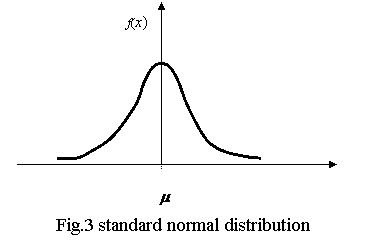 The normal distribution was first introduced by Abraham de Moivre in an article in 1734 in the context of approximating certain binomial distributions for large n. His result was extended by Laplace in his book “Analytical Theory of Probabilities” (1812), and is now called the theorem of de Moivre-Laplace. Laplace used the normal distribution in the analysis of errors of experiments. The important method of least squares was introduced by Legendre in 1805. Gauss, who claimed to have used the method since 1794, justified it rigorously in 1809 by assuming a normal distribution of the errors. The name "bell curve" goes back to Jouffret who first used the term "bell surface" in 1872. The name "normal distribution" was coined independently by Charles S. Peirce, Francis Galton and Wilhelm Lexis around 1875. The probability density function of the normal distribution with mean μ and variance σ2 (equivalently, standard deviation σ) is a Gaussian function
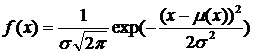 .
.
The main properties of the Gauss curve:
· bell-shaped;
· exponential branches;
· the density function is symmetric about its mean value;
· non crosses the horizontal axis;
· if the  is decreasing, the top of the Gaussian curve becomes more sharp;
· the area under the Gaussian curve is equal to 1;
· The mean is also its mode and median.
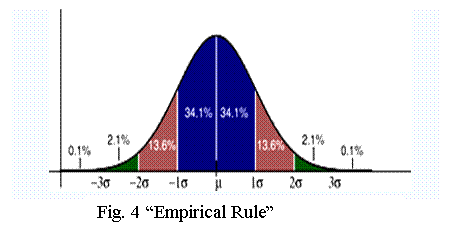 The inflection points of the curve occur at one standard deviation away from the mean.
About 68% of values drawn from a standard normal distribution are within 1 standard deviation away from the mean; about 95% of the values are within two standard deviations and about 99.7% lie within 3 standard deviations.
This is known as the ".7 rule" or the "Empirical Rule".
6.2. Student’s Distribution
Suppose X1, ..., Xn are independent random variables that are normally distributed with expected value μ and variance σ2. Let  be the sample mean, and
 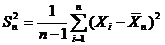 be the sample variance. It is readily shown that the quantity
  is normally distributed with mean 0 and variance 1, since the sample mean
  is normally distributed with mean μ and standard deviation
  . Gusset studied a related quantity,
  and showed that T has the probability density function
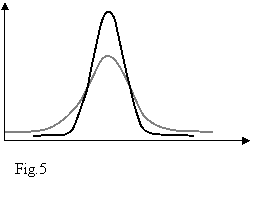

with  equal to n − 1. The distribution of T is now called the t-distribution. The parameter is conventionally called the number of degrees of freedom. The distribution depends on , but not μ or σ; the lack of dependence on μ and σ is what makes the t-distribution important in both theory and practice. Γ is called the Gamma function. It is the basis of the popular Student's t-tests for the statistical significance of the difference between two sample means, and for confidence intervals for the difference between two population means. The derivation of the t-distribution was first published in 1908 by William Sealy Gusset, while he worked at a Guinness brewery in Dublin. He was not allowed to publish under his own name, so the paper was written under the pseudonym Student. The overall shape of the probability density function of the t-distribution resembles the bell shape of a normally distributed variable with mean 0 and variance 1, except that it is a bit lower and wider. As the number of degrees of freedom grows, the t-distribution approaches the normal distribution with mean 0 and variance 1. The following images show the density of the t-distribution for increasing values of n. The normal distribution is shown as a dark line for comparison.; note that the t-distribution (gray line) becomes closer to the normal distribution as n increases. For n = 30 the t-distribution is almost the same as the normal distribution.
6.3. Table of Selected Values
The following table lists a few selected values for t-distributions with degrees of freedom for the 90%, 95%, 97.5%, and 99.5% one-sided confidence intervals. Note that the last row also gives critical points: a t-distribution with infinitely-many degrees of freedom is a normal distribution.
n | 75% | 80% | 85% | 90% | 95% | 97.5% | 99% | 99.5% | 99.75% | 99.9% | 99.95% |
1 | 1.000 | 1.376 | 1.963 | 3.078 | 6.314 | 12.71 | 31.82 | 63.66 | 127.3 | 318.3 | 636.6 |
2 | 0.816 | 1.061 | 1.386 | 1.886 | 2.920 | 4.303 | 6.965 | 9.925 | 14.09 | 22.33 | 31.60 |
3 | 0.765 | 0.978 | 1.250 | 1.638 | 2.353 | 3.182 | 4.541 | 5.841 | 7.453 | 10.21 | 12.92 |
4 | 0.741 | 0.941 | 1.190 | 1.533 | 2.132 | 2.776 | 3.747 | 4.604 | 5.598 | 7.173 | 8.610 |
5 | 0.727 | 0.920 | 1.156 | 1.476 | 2.015 | 2.571 | 3.365 | 4.032 | 4.773 | 5.893 | 6.869 |
6 | 0.718 | 0.906 | 1.134 | 1.440 | 1.943 | 2.447 | 3.143 | 3.707 | 4.317 | 5.208 | 5.959 |
7 | 0.711 | 0.896 | 1.119 | 1.415 | 1.895 | 2.365 | 2.998 | 3.499 | 4.029 | 4.785 | 5.408 |
8 | 0.706 | 0.889 | 1.108 | 1.397 | 1.860 | 2.306 | 2.896 | 3.355 | 3.833 | 4.501 | 5.041 |
9 | 0.703 | 0.883 | 1.100 | 1.383 | 1.833 | 2.262 | 2.821 | 3.250 | 3.690 | 4.297 | 4.781 |
10 | 0.700 | 0.879 | 1.093 | 1.372 | 1.812 | 2.228 | 2.764 | 3.169 | 3.581 | 4.144 | 4.587 |
11 | 0.697 | 0.876 | 1.088 | 1.363 | 1.796 | 2.201 | 2.718 | 3.106 | 3.497 | 4.025 | 4.437 |
12 | 0.695 | 0.873 | 1.083 | 1.356 | 1.782 | 2.179 | 2.681 | 3.055 | 3.428 | 3.930 | 4.318 |
13 | 0.694 | 0.870 | 1.079 | 1.350 | 1.771 | 2.160 | 2.650 | 3.012 | 3.372 | 3.852 | 4.221 |
14 | 0.692 | 0.868 | 1.076 | 1.345 | 1.761 | 2.145 | 2.624 | 2.977 | 3.326 | 3.787 | 4.140 |
15 | 0.691 | 0.866 | 1.074 | 1.341 | 1.753 | 2 | 2.602 | 2.947 | 3.286 | 3.733 | 4.073 |
16 | 0.690 | 0.865 | 1.071 | 1.337 | 1.746 | 2.120 | 2.583 | 2.921 | 3.252 | 3.686 | 4.015 |
17 | 0.689 | 0.863 | 1.069 | 1.333 | 1.740 | 2.110 | 2.567 | 2.898 | 3.222 | 3.646 | 3.965 |
18 | 0.688 | 0.862 | 1.067 | 1.330 | 1.734 | 2.101 | 2.552 | 2.878 | 3.197 | 3.610 | 3.922 |
19 | 0.688 | 0.861 | 1.066 | 1.328 | 1.729 | 2.093 | 2.539 | 2.861 | 3.174 | 3.579 | 3.883 |
20 | 0.687 | 0.860 | 1.064 | 1.325 | 1.725 | 2.086 | 2.528 | 2.845 | 3.153 | 3.552 | 3.850 |
21 | 0.686 | 0.859 | 1.063 | 1.323 | 1.721 | 2.080 | 2.518 | 2.831 | 3.135 | 3.527 | 3.819 |
22 | 0.686 | 0.858 | 1.061 | 1.321 | 1.717 | 2.074 | 2.508 | 2.819 | 3.119 | 3.505 | 3.792 |
23 | 0.685 | 0.858 | 1.060 | 1.319 | 1.714 | 2.069 | 2.500 | 2.807 | 3.104 | 3.485 | 3.767 |
24 | 0.685 | 0.857 | 1.059 | 1.318 | 1.711 | 2.064 | 2.492 | 2.797 | 3.091 | 3.467 | 3.745 |
25 | 0.684 | 0.856 | 1.058 | 1.316 | 1.708 | 2.060 | 2.485 | 2.787 | 3.078 | 3.450 | 3.725 |
26 | 0.684 | 0.856 | 1.058 | 1.315 | 1.706 | 2.056 | 2.479 | 2.779 | 3.067 | 3.435 | 3.707 |
27 | 0.684 | 0.855 | 1.057 | 1.314 | 1.703 | 2.052 | 2.473 | 2.771 | 3.057 | 3.421 | 3.690 |
28 | 0.683 | 0.855 | 1.056 | 1.313 | 1.701 | 2.048 | 2.467 | 2.763 | 3.047 | 3.408 | 3.674 |
29 | 0.683 | 0.854 | 1.055 | 1.311 | 1.699 | 2.045 | 2.462 | 2.756 | 3.038 | 3.396 | 3.659 |
30 | 0.683 | 0.854 | 1.055 | 1.310 | 1.697 | 2.042 | 2.457 | 2.750 | 3.030 | 3.385 | 3.646 |
| 0.674 | 0.842 | 1.036 | 1.282 | 1.645 | 1.960 | 2.326 | 2.576 | 2.807 | 3.090 | 3.291 |

The estimation of errors of direct measurement

|
Из за большого объема этот материал размещен на нескольких страницах:
1 2 3 4 5 6 7 8 |
