


Партнерка на США и Канаду по недвижимости, выплаты в крипто
- 30% recurring commission
- Выплаты в USDT
- Вывод каждую неделю
- Комиссия до 5 лет за каждого referral


3. Switch on tumbler ВK2 and receive on the screen of the oscilloscope impulses of differentiating chain. Draw the graph.
4. Switch on tumbler ВK1 and receive on the screen of the oscilloscope impulses of integrating chain. Draw the graph.
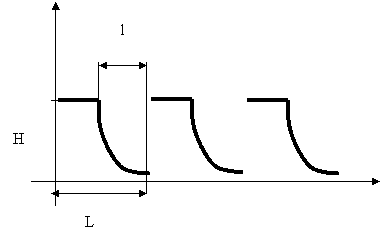 |
Fig. 4
Laboratory Work №3
Study of Circuit for a Galvanization and a Medicinal Electrophoresis with the Help of the Oscilloscope
The aim of this work:
1. To study the theory of the rectifying of AC.
2. To calculate the main characteristics of the impulses current.
The equipment:
1. The rectifying circuit.
2. Voltmeter.
3. Oscilloscope.
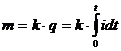
The tissues of the human body contain up to 65 % of water and are conductors of a current of second sort - electrolytes. The electrical conductivity of different fabrics is various. Blood, urine, a lymph, a spinal fluid, muscles will well carry out a current. The poor conductors of an electric current are a fatty tissue, sinews, nerves, bones. Will not carry out an electric current a horn stratum of a dry skin, nails and hair. In a skin a current transit through channels of soporiferous and sebaceous glands. A various electrical conductivity of tissues of an organism stipulate transiting a current not rectilinearly, and on paths of the least resistance - on intercellular spaces, blood and lymphatic vessels. Under influence of an electric field ions move with a different velocity and accumulate about cell-like diaphragms, forming the colliding electric field called polarization. Thus, the initial operation of a direct current is interlinked to driving ions, their separation and a modification of their concentration in different devices of fabrics. The continuous direct current 60-80V is used by voltage as a medical method of physiotherapy - a galvanization. Action on an organism of two factors is widely used in medical practice: electrical and pharmacological - a medical electrophoresis. Thus on a hum noise of an operation of a direct current as biological stimulus response of an organism specific to everyone medicinal substance takes place. Directional driving in solutions of electrical charged particles – ions is used for introduction in an organism of medicinal substances, and these substances are introduced in correspondence with is familiar their charge ("+" or "-") at a dissociation in a solution. Force of an electric current dose under observations of milliammeter. The indicated magnitude pays off on a current density (0,05 - 0,1 мА/см2), increased on square of the surface. According to the law of Faraday, an amount of allocated substance on an electrode proportionally to a charge q, past through an electrolyte:
 (1)
(1)
where k – an electrochemical equivalent, i – a current, t – time.
From last expression it is visible, that the proportioning of a mass of a medical product is reduced to a proportioning of time at a stable value of a current. Stability of a current, defined stability of voltage is reached by using filters which operation will be circumscribed below.
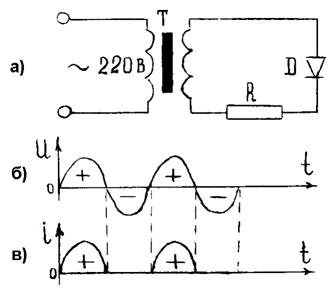
Fig. 1 (a, b, c)
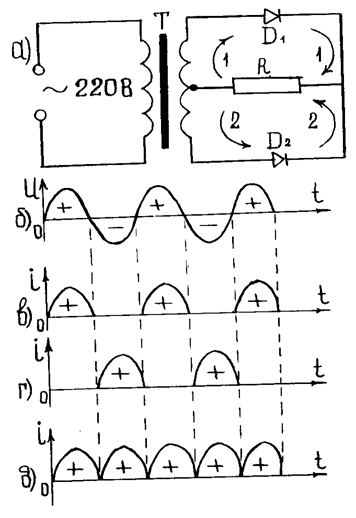
The elementary circuit for a rectification of alternating-current is shown on fig. 1 а. In it the secondary winding of transformer T, diode D and resistance of loading R sequentially are connected. This circuit is termed as the half-wave plan as in it the current transits only during one half-period. The curves showed on fig. 1 b, c – voltage
|
|
|
|
|
The bridge circuit has two diodes, and the secondary winding of the transformer has a deduction from a medial (zero) point. Both diodes work in turn.
In the first half of phase one diode and one half of winding of the transformer work.
The current transits in a direction indicated by a pointer 1.
In the second half of phase the second diode and the second half of winding of the transformer works. The current transits in a direction indicated by a pointer 2. The curve (b) in the indicated figure figures character of a modification of voltage on a secondary winding of the transformer, curves (c) and (d) - rectified currents for each diode, a curve (e) - on loading resistance R.
That the current and voltage in loading resistance R were stationary values, it is necessary to smooth pulsations by means of the filter. A problem of the filter is the passage of a stationary value component in loading resistance and elimination of a variable component. Various circuits of flattening filters are shown on fig. 3.
The value, showing in how many times the filter reduces pulsations, is termed as a permeability coefficient or coefficient of flattening . For “L – C” (fig. 3 a) value of is calculated by formula:
 . (1)
. (1)
|
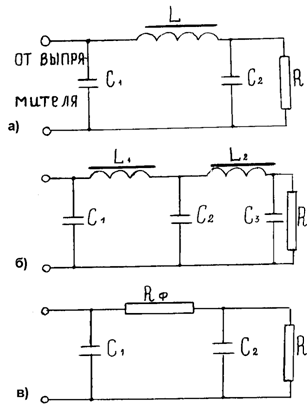
Fig. 3
For “R – C” (fig. 3b) value of is calculated by formula:
 (2)
(2)
The difference of voltage for first capacity is equal:
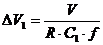 (3)
(3)
The difference of voltage on exit of filter is equal:
 (4)
(4)
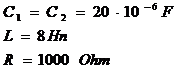
Order of Carrying Out of the Laboratory Work
1. Set the key Ko in a position "on", switches K, К1, К2 and К3 in a position "off". Switch K4 in the position "~" (alternating current). Switch on oscilloscope and receive the character of a modification of alternating voltage and draw it.
2. Set K4 to the position (direct current) "=". Receive on the screen of oscilloscope a rectified half-wave voltage and draw it. Write-down the value of V0.
3. Switch on the key K and receive on the screen of oscilloscope rectified bridge voltage and to draw it. Write-down the value of V0.
4. Using expressions (1), (3) and (4) calculate ripple coefficient and pulsations of voltage for an inlet and an exit of the filter.
5. Using keys K1, К2 and К3 test flattening action of devices of filter L, C1 and C2 (fig. 3a), everyone and at their joint operation. Draw the obtained figures.
6. Observed dates write-down in table 1.
Table 1
the half-wave circuit | bridge circuit | ||||||||
|
|
|
|
|
|
|
|
|
|
50 | 100 |
 , Hz
, Hz , V
, V , V
, V , V
, VLaboratory Work №4
Study of Dependence of Index of Refraction of Solutions Concentration
The aim of this work:
1. To study the theory of the refraction of light.
2. To find the unknown value of concentration of solution.
The equipment:
1. Apparatus for measurement of index of refraction.
2. The NaCl solutions of different concentrations.
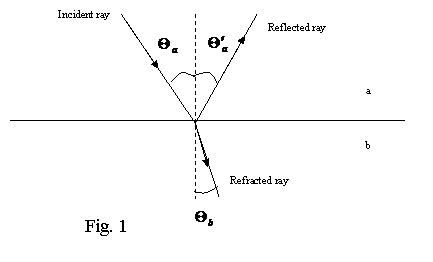
Experimental studies of the directions of the incident, reflected and refracted rays at a smooth interface between two optical materials lead to the following conclusions:
1. The incident, reflected, and refracted rays and the normal to the surface all lie in the same plane. The plan of the three rays is perpendicular to the plan of the boundary surface between the two materials.
2. The angle of reflection  is equal to the angle of incident
  for all wavelengths and for any pair of materials. That is
 (1)
(1)
3. For monochromatic light and for a given pair of materials, a and b, on opposite sides of the interface, the ratio of the sinus of the angles and  , where both angles are measured from the normal to the surface, is equal to the inverse ratio of the two indexes of refraction:
 (2)
(2)
On fig. 1 shown the case, in which material b has a smaller index of refraction than material a, so  . The refracted angle is greater than the incident angle .
 |
The Dutch scientist Christian Huygens () proposed a wave theory of light had much merit. Still useful today is a technique he developed for predicting the future position of a wave front when an earlier position is known. This is known as Huygens’ Principle and can be stated as follows: Every point on a wave front can be considered as a source of tiny wavelets that spread out in the forward direction at the speed of the wave itself. The new wave front is the envelope of all the wavelets – that is, the tangent to all of them.
It is easy to show that law of refraction follows directly from Huygens’ principle, given that the speed of light  in any medium is related to the speed in vacuum,
  , and the index of refraction,
  :
:  .
.
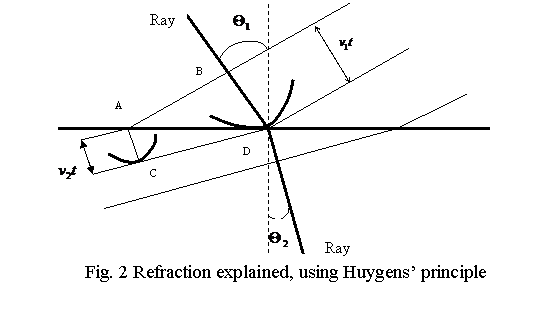
From the Huygens’ construction of Fig. 2, angle ADC is equal to  and angle BAD is equal to
 . Then for the two triangles that have the common side AD, we have
 ,
, 
We divide these two equations and obtain:
 .
.
Then, since  and
and ,
,
 ,
,
which is law of refraction.
When a light wave travels from one medium to another, its frequency does not change, but its wavelength does.
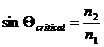
When light rays reach the boundary of a material where the index of refraction decreases, the rays will be totally internally reflected if the incident angle is such that Snell’s law would predict  ; this occurs if exceeds the critical angle
  given by:
 (3)
(3)
Total internal reflection will occur if the angle of incidence is greater than or equal to .
When a beam of light enters at one end of a transparent rod (fig.3), the light can be totally reflected internally if the index of refraction of the rod is greater than that of the surrounding material. The light is “trapped” within the rod even if the rod is curved, provided that the curvature is not too great. Such a rod is sometimes called a light pipe. A bundle of fine glass or plastic fibers behaves in the same way and has the advantage of being flexible. A bundle may consist of thousands of individual fibers, each of the order of 0.002 to 0.01 mm in diameter. If the fibers are assembled in the bundle so that the relative positions of the ends are the same (or mirror images) at both ends, the bundle can transmit an image.
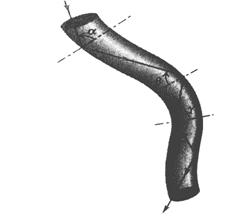
Fig.3
Fiber-optic devices have found a wide range of medical applications in instruments called endoscopes, which can be inserted directly into the bronchial tubes, the colon, and so on for direct visual examination. A bundle of fibers can be enclosed in a hypodermic needle for study of tissues and blood vessels far beneath the skin.
For example, a patient’s lungs can be examined by inserting a light pipe known as a bronchoscope through the mouth and down the bronchial tube. Light is sent down an outer set of fibers to illuminate the lungs. The reflected light returns up a central core set of fibers. Light directly in front of each fiber travels up that fiber. At the opposite end, a viewer sees a series of bright and dark spots, much like a TV screen – that is, a picture of what lies at the opposite end. The image may be viewed directly or on a TV monitor or film. The fibers must be optically insulated from one another, usually by a thin coating of material whose refractive index is less than that of the fiber. The fibers must be arranged precisely parallel to one another if the picture is to be clear. The more fibers there are, and the smaller they are, the more detailed the picture. Such instruments, including bronchoscopes, colonoscopies, and endoscopes (stomach or other organs) are extremely useful for observing hard-to-reach places for surgery or searching for lesions without surgery. The instrument may also be equipped with a mechanism for pinching off tissue samples for biopsies or removal.
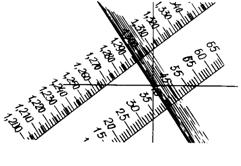
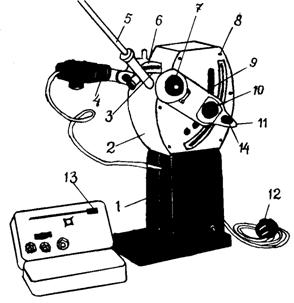
Fig. 4. Apparatus for measurements of index of refraction of a solution.
Order of Carrying Out of the Laboratory Work
1. Switch on the apparatus (12).
2. Open the lid (6) of the chamber of the apparatus and wash a surface of prisms. Wipe the surfaces.
3. Put the 3-4 drops of a NaCl solution on the surface of prism and close a lid of apparatus.
4. Direct the light from a lamp (4) on the window of the chamber.
5. Turn a handle (11) for occurring in eyepiece 10 the light-shadow border.
6. Turn the eyepiece, setting the clear picture.
7. Using the handle (11) set the light-shadow boundary on the center of crossing of lines.
8. Using the top scale in field of vision, find the value of an index of refraction of a solution.
9. Repeat all operations 5 times.
10. Write the results of measurements in table 1.
11. Make operations 1-7 for other solutions.
12. Write the results in table 2.
13. Construct the graph of dependence of index of refraction of solutions concentration.
14. Using this graph, find the value of unknown concentration “X%”.
Table 1
№ | C,% | n |
| (n- | (n- | SF |
|
|
1 | ||||||||
2 | ||||||||
3 | ||||||||
4 | ||||||||
5 |
 )
)Calculate error of measurement using these formulas:
 ; ;
; ; 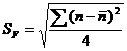 ;
;  ;
;
 - Student’s coefficient, if
  and
and  , then
  ;
;
 ;
;
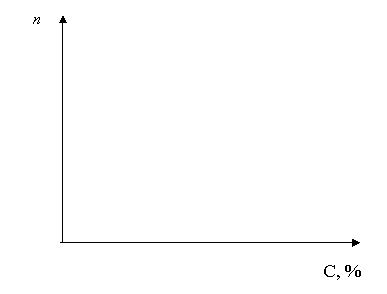 Table 2
№ | C, % | n |
1 | ||
2 | ||
3 | ||
4 | ||
5 | ||
X |
Laboratory Work №5
Study of Dependence of Absorption of Solution of its Concentration
The aim of this work:
1. To study the theory of the absorption of light.
2. To find the unknown value of concentration of solution.
The equipment:
1. Apparatus for measurement of transparency and optical density of solution.
2. The solutions of different concentrations.
Definition of concentration of the painted solutions is based on the phenomenon of absorption of light by these solutions. Light as wave process will consist from mutually perpendicular electric and magnetic fields. The energy of light is equal to a constant  times its frequency f.
 , (1)
, (1)

|
Из за большого объема этот материал размещен на нескольких страницах:
1 2 3 4 5 6 7 8 |
