


Партнерка на США и Канаду по недвижимости, выплаты в крипто
- 30% recurring commission
- Выплаты в USDT
- Вывод каждую неделю
- Комиссия до 5 лет за каждого referral

6. Put all data in table 2.
Table 2.
Diffraction order maximum | x, mm | l, mm |
| d, mm |
|
|
K=1 | ||||||
K=2 | ||||||
K=3 |
 , mm
, mm7. Write you conclusions.
I. Calculate error of measurement using these formulas:
 ;
;  ;
; 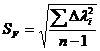 ;
;  ;
;
 - Student’s coefficient, if
  and
and  , then
  ;
;
 ;
; 
II. Calculate error of measurement using these formulas:
 ;
;  ;
; 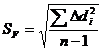 ;
;  ;
;
- Student’s coefficient, if and , then ;
 ;
; 
Laboratory Work №7
Studying of Laws Radiation of Blackbody
The aim of this work:
1. To study the basis laws radiation of blackbody.
2. To study biophysical basis of thermoregulation.
3. Qualitatively to check up performance of the Wien displacement law.
The equipment:
1. Spectral device UM-2.
2. Lamp.
3. Voltmeter.
4. Potentiometer.
5. Ammeter.
6. Diagram – dependence R = f(t) and dependence  .
.
Thermal radiation is a radiation of electromagnetic waves by bodies which temperature is more than ambient temperature.
Convection is transfer of heat by mass motion of a fluid from one region of space to another. Familiar examples include hot-air and hot-water home heating systems, the cooling system of an automobile engine, and the flow of blood in the body. If the fluid is circulated by a blower or pump, the process is called forced convection; if the fluid caused by differences in density due to thermal expansion, such as hot air rising, it’s process is called natural convection or free convection.
Hot matter in condensed states (solid or liquid) nearly always emits radiation with a continuous distribution of wavelengths rather than a line spectrum. An ideal surface that absorbs all of electromagnetic radiation incident upon it is also the best possible emitter of electromagnetic radiation at any wavelength. Such an ideal surface is called a blackbody, and the continuous-spectrum radiation that it emits is called blackbody radiation. First the total intensity I (the average rate of radiation of energy per unit of average power area) emitted from the surface of an ideal radiation is proportional the fourth of the absolute temperature. This total intensity I emitted at absolute temperature T is given by the Stefan-Boltzmann law:
 (1)
(1)
where  is a fundamental physical constant called the Stefan-Boltzmann constant. In SI units,
  .
.
Second the intensity is not uniformly distributed over all wavelengths. Its distribution can be measured and describes by the intensity per wavelength interval  , called the spectral emittance. Thus
  is the intensity corresponding to wavelengths in the interval from
  to
to  . The total intensity I, given by eq.(1), is the integral of the distribution function over all wavelengths. Which equals the area under the versus curve:
 (2)
(2)
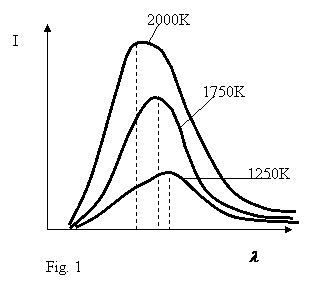
Measured distribution functions for three different temperatures are shown in fig. 1.
Each curves has a peak wavelength  at which the emitted intensity per wavelength interval is largest. Experiment shows that is inversely proportional to T, so their product is constant. This result is called the Wien displacement law. The experimental value of the constant is
  m·K:
m·K:
 (Wien displacement law) (3)
At the temperature rises, the peak of becomes higher and shifts to shorter wavelengths. A body the glows yellow is hotter and brighter than one that glows red; yellow light has shorter wavelengths than red light. Finally, experiments show that the shape of the distribution function is the same for all temperatures; we can make a curve for one temperature fit any other temperature by simply changing the scales on the graph.
Convection
Convection is a heat transfer by air flows or liquid flows down the heat gradient

K" – coefficient of convection.
There are two kinds of convection: 1) natural; 2) compulsory (forced)
The cause of natural convection is a temperature difference between different parts of media. The cause of compulsory convection is an external force moving media.
Heat Radiation
Heat radiation is an emission of infra-red rays by a warm body. The amount of emitted heat is found under the next formula:
 , where
σ - Stephan-Boltsman's coefficient.
S - square of body surface contact with environment
P - power lost by a man at the interaction with environment
Stephan-Boltsman's coefficient is equal:
δ = α · σ,
where – absorption coefficient; σ - emition coefficient
It is possible to calculate the amount of heat emitted by a man at the interaction with environment.
Evaporation
Evaporation is a phase transfer from liquid to gas. If the temperature is high and the humidity is low the evaporation is the most effective kind of heatexchange.
,
where – specific heat of evaporation; m – mass of evaporated liquid.
All kinds of heatexchange, except the evaporation, act only when the temperature of external medium is lower than the temperature of skin. In contrary case the conduction, the convection and the heat radiation convert into the mechanism of additional heat of organism. It is shown under the equation of heat balance

“-” if Te<Tj (body temperature); “+” if Te> Tj,
M – quantity of heat gelling as a result of metabolism i. e.  .
.
Thermoregulation may be subdivided into physical and chemical. Chemical thermoregulation is realized by the reinforcement of weakening of metabolism intensity. Physical thermoregulation is realized by the change of intensity of body's heat output. It is very difficult or may be impossible exactly to point the distribution of given out of heat for the kinds of heatexchange, that's why different causes make an influence on the termoregulation such as: condition of an organism, body's temperature, emotion condition, warming motions, taking warm food an so on. The state of environment is very important too, such as air temperature, humidity, air motion and etc. Clothes is very important too, the material from which it is made of, its form, colour and thickness. Inside the organism the heatexchange between the cells is insignificant. The body is a bad conductor of heat. The inner organs give out heat mainly by the forced convection. The blood movement is the main factor of heat exchange down the organism. From body surface heat is given out by different ways and at different conditions not all kinds of heatexchange work. For example: if a man is at the state of rest and the temperature of environment is near 20 0C, the kinds of heatexchange are characterized by the next values: heat conduction is very small near 0 that's why air conduction is incignificient, convection is 15%-20%, evaporation from surface skin and lungs is near 30%, heat radiation is near 50% and is the most part of heat losses', which is realized from opened parts of a body and through clothes. If temperature of environment is more than temperature of skin, all the heatexchange is realized only by water evaporation from skin and lungs. The amount of evaporated liquid may be from 0, 3-0, 4 1t till 10-12 lt a day.
All ways of the thermoproduction may be subdivided in the dependence on the temperature ranges of environment. The level of the metabolism is regulated by central nervous system. The more metabolism the more thermoproduction.
The internal organs of human's body have different levels of the metabolism and their temperature may be different. The changes of temperature (the deviations from norm ) may be used for diagnostic. This method is called the thermography. The heatvisjon allows to receive the temperature «portrait» of an organ on the screen of the heatvisor.
Order of Carrying Out of the Laboratory Work
1. Switch on device.
2. Find voltage U on the lamp, using voltmeter.
3. Find I, using ammeter.
4. Calculate resistance R by next formula R = U/I.
5. Find temperature using graph 1.
6. Rotating a drum to define values of a photocurrent through 10 mkА.
7. For each value N define value of wavelength.
8. Put all data in table.
9. Draw the graph – dependence  . Put all data in table.
10. To reduce a voltage U on the lamp.
11. Find I, using ammeter.
12. Calculate resistance R by next formula R = U/I.
Table
№ | R1, Оm | Т1, К | N | l1, nm | i1,A | R2, Оm | Т2, К | N | l2, nm | i2, А |
1 | ||||||||||
2 | ||||||||||
3 | ||||||||||
4 | ||||||||||
5 | ||||||||||
6 | ||||||||||
7 | ||||||||||
8 | ||||||||||
9 | ||||||||||
10 |
13. Find temperature using graph 1.
14. Rotating a drum to define values of a photocurrent through 10 мкА.
15. For each value N define value of wavelength.
16. Put all data in table.
17. Draw the graph – dependence  .
.
18. Write you conclusion.
Laboratory Work №8
Application of Ultra High Frequency Electromagnetic Oscillations with Curative Aim
The aim of this work:
1. To know the principle of the apparatus for ultra high frequency (UHF) therapy.
2. To investigate the electric field of the UHF apparatus.
3. To investigate the heat influence of the UHF field on the solutions of an electrolyte and a dielectric.
4. To know the theoretical bases of the UHF field influence on the biological tissue.

|
Из за большого объема этот материал размещен на нескольких страницах:
1 2 3 4 5 6 7 8 |
