


Партнерка на США и Канаду по недвижимости, выплаты в крипто
- 30% recurring commission
- Выплаты в USDT
- Вывод каждую неделю
- Комиссия до 5 лет за каждого referral
For a small number of measurements (it is less then 30) we are using the Student’s distribution. With its help it is possible to find an interval in which there is a true value of the measured random variable.
1. To find the mean arithmetical of all measured values: 
2. To find the dispersion: 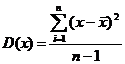
3. To find the standard deviation : 
4. To find the absolute error of all measurements: 
5. To write down the results of measurements so:
 .
.
Exercises
1. At measurement of a random variable the following values have been received:
a) 87, 89, 90, 89, 92, 94, 95, 98, 92, 90, 90, 91, 93, 95, 97, 94, 94, 97, 94, 95, 96, 97, 95, 90, 94, 96, 93, 96, 92, 97.
b) 1, 4, 5, 7, 4, 6, 2, 3, 2, 4, 7, 5, 7, 5, 4, 3, 4, 8, 9, 12, 4, 5, 4, 3, 1, 2, 1, 4, 3, 1.
Construct a polygon of distribution.
2. At measurement of a random variable the following values have been received:
a)1, 2, 4, 5, 3, 3, 3, 1, 4, 5, 6, 8, 10, 5, 7, 3, 6, 4, 5, 6, 7, 5, 6, 4, 3.
b) 97, 98, 89, 88, 99, 100, 89, 93, 95, 94, 97, 98, 98, 89, 90, 100, 89, 87, 96, 95,
96, 94, 98, 100. Construct a histogram.
3. At measurement of a random variable the following values have been received:
a) 10, 12, 8, 9, 10, 9, 12 ( =0.95);
b) 5, 4, 3, 3, 5, 5, 6, 4, 6, 3(=0.99).
To make an estimation of errors of a direct measurement.
4. At measurement of a random variable the following values have been received:
21, 20, 19, 18, 25, 20, 24, 20, 25, 18, 19, 22, 25, 24, 23, 22, 21, 25, 19, 20, 27, 28, 28, 27, 18. To construct a polygon of distribution, a histogram, to make an estimation of errors of a direct measurement =0.95).
5. At measurement of a growth of 30 children in the age of 2 years the following data have been received: 94, 95, 98, 102, 100, 87, 87, 98, 98, 99, 101, 104, 101, 102, 87, 86, 99, 87, 103, 100, 98, 99, 89, 90, 98, 99, 102, 101, 89, 102.
Construct a histogram. To make an estimation of errors for  .
.
Laboratory Work №1
Studying the Work of the Electronic Amplifier
The aim of this work:
1. To study the theory of the amplifier.
2. To construct the peak characteristic of the amplifier.
3. To construct the frequency characteristic of the amplifier and find a pass
band of the amplifier.
The equipment:
1. Electronic amplifier.
2. Audio-frequency generator, AC generator.
3. Oscilloscope.
4. Voltmeters.
A valve amplifier (UK and Aus.) or tube amplifier (U. S.), is a device for electrically amplifying the power of an electrical signal, typically (but not exclusively) sound or radio frequency signals. Until the invention of the Transistor in 1947, all "electronics" was by definition based on the therrmionic valve. The Diode was invented by Fleming (working for Edison at the time), and was able to rectify signals. The first device capable of amplification was the triode (called the 'Audion' by Le Forest who invented it). In electronics, a vacuum tube, electron tube, or (outside North America) therrmionic valve or just valve, is a device generally used to amplify, switch or otherwise modify, a signal by controlling the movement of electrons in an evacuated space. For most purposes, the vacuum tube has been replaced by the much smaller, less power-hungry, and less expensive transistor, either as a discrete device or in an integrated circuit. However, tubes are still used in specialized applications, such as in high-end audio systems, instrument amplifiers and high power RF transmitters. Cathode ray tubes are still used as a display device in television sets and computer monitors (although they face serious competition from LCD and plasma displays), and magnetrons are the source of microwaves in microwave ovens.
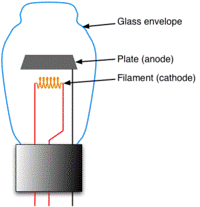
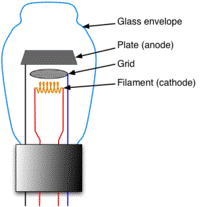
Fig.1 Diode Fig. 2 Triode
Vacuum tubes, or therrmionic valves, are arrangements of electrodes in a vacuum within an insulating, temperature-resistant envelope. Although the envelope is classically glass, power tubes often use ceramic and metal. The electrodes are attached to leads which pass through the envelope via an air tight seal. On most tubes, the leads are designed to plug into a tube socket for easy replacement. The simplest vacuum tubes resemble incandescent light bulbs in that they have a filament sealed in a glass envelope which has been evacuated of all air. When hot, the filament releases electrons into the vacuum: a process called therrmionic emission. The resulting negatively-charged cloud of electrons is called a space charge. These electrons will be drawn to a metal "plate" inside the envelope if the plate (also called the anode) is positively charged relative to the filament (or cathode). The result is a current of electrons flowing from filament to plate. This cannot work in the reverse direction because the plate is not heated and cannot emit electrons. This very simple example described can thus be seen to operate as a diode: a device that conducts current only in one direction. The vacuum tube is a voltage-controlled device, which means that the relationship between the input and output circuits is determined by a transconductance function. Very much frequently there is a necessity to register weak electric signals (for example biopotentials of bodies). The device serving for amplification of electric signals with use of energy of an extraneous source refers to as the amplifier.
The basic characteristic of the amplifier is the coefficient of amplification. It shows in how many times the voltage on an output of the amplifier is more than voltage on an input.
 (1)
(1)
If it is necessary to receive very big amplification the n amplifiers are connected consistently. Such amplifiers are called cascade. In this case, the total coefficient of amplification is equal:
 (2)
(2)
At work of the amplifier there are can be distortions, when is change the form of a signal. Distortions can be nonlinear and linear.
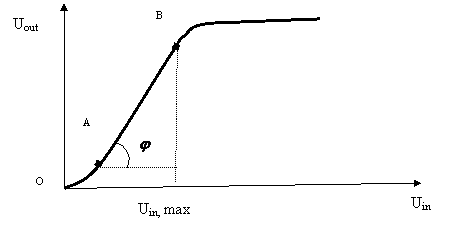 Nonlinear distortions is an occurrence on an output of the amplifier a new frequencies which was not in an entrance signal. They appear, if the amplitude of an entrance signal exceeds allowable values. To define as much as possible allowable values of entrance signals, it is necessary to construct the peak characteristic of the amplifier (Fig. 3).
Fig. 3
For this purpose on a horizontal axis postpone values of an entrance voltage, and on vertical - values of a target voltage corresponding to them (at seem frequency of a signal). To allowable values of an entrance signal there corresponds a direct site of the schedule. The expression is thru:
 (3)
(3)
Linear distortions arise that the amplifier contains condensers and coils of inductance, and their resistance depends on frequency, hence the coefficient of amplification depends on frequency. Dependence of the coefficient of amplification on frequency is called the frequency characteristic (Fig. 4) of the amplifier. The decreasing of coefficient of amplification up to  practically does not deform a signal. The interval of the frequencies, corresponding
  is called a pass band of the amplifier (interval [f1;f2] in Fig. 4).
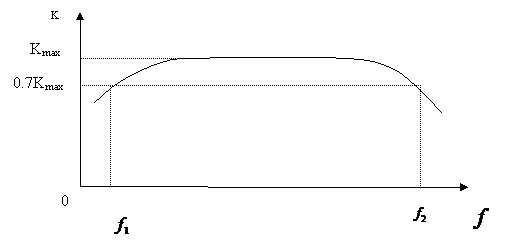 |
Fig. 4
The voltage gain of the amplifier depends on the frequency range over which the amplifier operates. The frequency response of the RC coupled is shown in the Fig4. It is generally divided into three ranges.
(i) Mid frequency range (MFR)
It is that frequency range in which the voltage gain is practically constant and is not affected by changes of the capacitance in the circuit.
(ii) Low Frequency range (LFR)
It is that frequency range in which the gain increases with increase 01 frequency. The gain increases up to the value of mid frequency gain.
(iii) High frequency range (HFR)
It is that frequency range in which the gain decreases from mid frequency gain value as the frequency increases
Order of Carrying Out of the Laboratory Work
1. To study the electric circuit.
2. To switch the generators, voltmeters and an oscilloscope.
3. To set on the sound-frequency generator voltages on an input, according to the table 1.
4. To measure voltage on an output of the amplifier, values to write down in the table 1.
5. In the column of distortion will put sign “+” if they are, or a sign of “-“ if they are not present.
6. Draw the peak characteristic of the amplifier. Using this graph, to find the intervals of voltages on an input, for which is a not nonlinear distortion (AB in fig. 3).
Table 1.
Vin, V | 0.1 | 0.2 | 0.3 | 0.4 | 0.5 | 0.75 | 1.0 | 1.2 | 1.5 | 1.8 |
Vout, V | ||||||||||
distortion |
7. To set on the sound-frequency generator voltage 0.3 V
8. To set frequencies on the sound-frequency generator according to the
table 2.
9. To measure voltages on an output of the amplifier, values to write down in the table 2.
Table 2
f, Hz | ||||||||||
Log f | ||||||||||
Vout, V | ||||||||||
K |
10. To calculate values coefficient of amplification K, using formula (1).
11. Draw the frequency characteristic of the amplifier ( horizontal axe – values of log f, vertical axe – values of K).
12. Using this graph, to find the intervals of frequencies, for which values of K is corresponding to (interval [f1; f2] in fig 4).
Laboratory Work №2
Study of Operation of the Multivibrator and Formative Circuits
The aim of this work:
1. To study the theory of the impulses.
2. To calculate the main characteristics of the impulses.
3. To find the main characteristics of the impulses, using oscilloscope.
The equipment:
1. Multivibrator and formative circuits.
2. DC generator.
3. Oscilloscope.
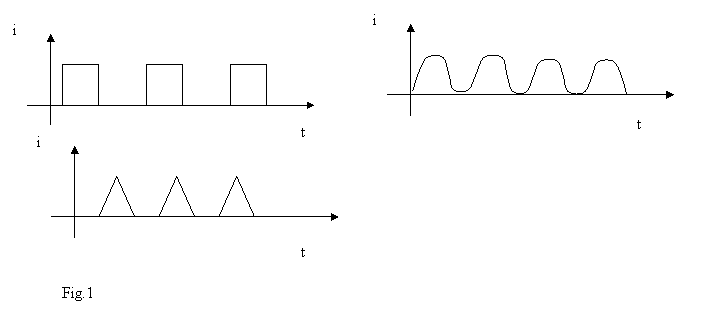 Application of electrical irritation with the purpose of a modification of the functional state of cells, organs and fabrics is termed as electro stimulation. For electro stimulation the currents called impulse, which are used have a constant direction, but change the value. The shape of impulse currents can be various (fig. 1).
 |
According to Dubois - Rayman law the irritation appears at a modification of a current intensity and depends on a velocity, which is modificated. As the current intensity i = dq/dt in an aquosystem depends both on number of propellant ions, and on a velocity of their transition, hence, the velocity of a modification of a current intensity di/dt = d2q/dt2 should be compared to their acceleration.
Therefore we can say, that the irritating operation of a current is stipulated by acceleration at transition of ions of fabric electrolytes.
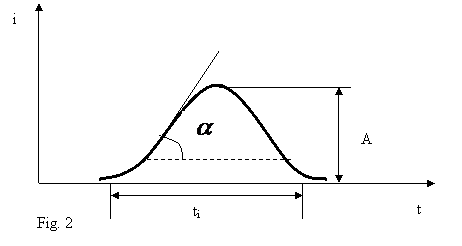
The irritating operation of single impulse of a current depends on a steepness of increase of a current (tan α), a pulse length ti and amplitudes A (fig. 2) which are its basic performances.
At physiological examinations impulse of the rectangular shape are applied more often. The irritating operation of rectangular impulse is featured by the equation of Weiss - Lapeck:
it = a / ti + b,
where it - the minimum force of irritation calling a response of an excitable fabric and called threshold; a and b - the coefficients, depending on nature of the excitable fabric and its functional state.
Experience shows, that the greatest irritating operation of a current takes place at the moment of closure of a chain under the negative electrode (cathode), smaller - under the anode. Therefore the cathode is the fissile electrode at electro stimulation.
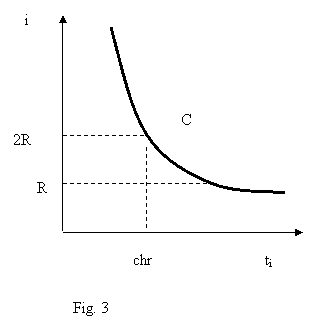 There is a particular connection between threshold (it) amplitude and duration of rectangular impulse which call irritation (fig. 3).
To each point of a curve and the points laying above the curve, correspond impulses which call cutting muscles. The points laying below the curve, map the impulses which are not calling irritations. The curve shown on fig. 3, is termed as performance of excitation. Extremely transient impulses calling bias of ions, are commensurable with amplitude of oscillation in thermal driving, and do not render irritating operation. At enough long-lived impulses ti the irritating operation it as it is shown on fig. 3, becomes independent of duration. The value of a threshold current it thus is termed reobase (R). Point C of a curve, which ordinate is equal to doubled reobase, determines a pulse length called chronaxia (chr). Chronaxia and reobase characterize excitability of an organ or a fabric and can serve as indexes of their functional state.
Order of Carrying Out of the Laboratory Work
1. Using following formulas: for symmetric impulses
 ,
,  ;
;  ;
;
for non symmetric impulses  ,
,  ,
,  , , calculate the basic characteristics of the obtained impulses.
Observed dates write in table 1.
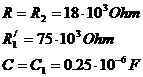
Table 1
|
|
|
| K, V/mm | H, mm | V, mm | L, mm | l, mm |
| |
Symmetric | ||||||||||
Non symmetric |
 , s
, s , s
, s , s
, s th
th2. On the screen of oscilloscope horizontal axe – axe of time, vertical axe – axe of voltage. In fig. 4 are shown the main characteristics of impulses. Using this graph, and graph on the screen of oscilloscope, measure its. All results write – dawn in table.

|
Из за большого объема этот материал размещен на нескольких страницах:
1 2 3 4 5 6 7 8 |
