


Партнерка на США и Канаду по недвижимости, выплаты в крипто
- 30% recurring commission
- Выплаты в USDT
- Вывод каждую неделю
- Комиссия до 5 лет за каждого referral
The feature of development of meat branch of the USA is that unlike other countries, the agriculture branch has been focused on creation of a strong forage reserve for animal industries. Thus, without having problems with forages, the American farmers conducted long-term and purposeful work on creation of new specialized breeds and lines, were engaged in working out of industrial technologies, achievement of the highest labor productivity level and a high production efficiency of cattle-breeding production. [3]
From the table it is visible that from growth of manufacture of all kinds of meat is observed. First of all more than fowl manufacture has increased by 6 million tons. In the world production it is possible to explain share decrease to that for the given period of time growth of world production of meat has been provided at the expense of such countries as China and Brazil where for the given period manufacture have increased almost twice.
In 1990th years the agrarian sector of Russia has had enormous losses; the animal industries have especially suffered. In 2009 the share of import meat in the domestic market has made 30-40 %. For Russia the question on increase in manufacture and quality improvement is rather actual.
The tendency of increase in import is rather characteristic in a present situation, the basic Russian manufacturers of meat directly depend on the state support. The long time of recovery of outlay does animal industries branch in the investment plan not attractive, considering a material and technical condition, it is difficult to commodity producers to impose competitive struggle.
The particular interest in activity of the American agricultural commodity producers of meat is caused by methods of realization of the state support. Unlike Russia where support is carried out in the form of direct financing, in the USA diverse program approaches, for example, when the help not are used by money resources, and technological innovations. [3]
In the USA with the Law on a small-scale business in 1953 the small-scale business Administration, small independent federal agency of the government of the USA has been created. Agency problems is assistance, consultation, the help and protection of interests of a small-scale business, creation of a free market competition, support and national economy strengthening as a whole. The small-scale business administration is engaged in financing, that is gives the financial help on a covering of debts, participates in programs of crediting and loans, with a view of business development gives free individual consultations, inexpensive training, is engaged in the state contracts and small-scale business protection. [4]
According to experience of the USA, methods of realization of the state support of agricultural commodity producers promote development of meat branch. Efficiency of support is reached at the expense of active actions from outside the governments.
Thus, the means spent by the state for animal industries developments, undoubtedly, give huge return.
In 2008 the USA exported meat for a total sum more than 11 milliard dollars have acted as the Basic buyers Mexico, Japan, Canada, Russia and China. [6]
Features of the Russian agriculture demand the special relation from outside the government, in particular and on the state support which is one of major factors of development of branch.
The state financial support which is received by the Russian manufacturers of meat, cannot give properly stimulus and deduce manufacture on the necessary level, namely with these problems the government of the USA has once consulted.
Sharp reduction or full deprivation of state financing of agricultural commodity producers of meat for realization of government programs cannot be a variant, other actions from outside the governments are for this purpose necessary.
Список использованной литературы:
1. Сельская экономика : учеб. пособие / , С. А Харитонов., [и др.]. – М. : ИНФРА-М, 2008. – 527 с.
2. Сельскохозяйственные рынки: учебное пособие / [и др.]. – М. : Колос, 2001. – 264 с.
3. Черняков, фермерство: XXI век: монография. – М. : Художественная литература, 2002. – 399 с.
4. Официальный сайт Администрации малого бизнеса США : http://www. sba. gov.
5. Официальный сайт Продовольственной и сельскохозяйственной организации ООН: http://www. fao. org
6. Официальный сайт Международного торгового центра: http://www. intracen. org.
УДК 631.3.005.93
WORKING OUT OF INFORMATION MODELS OF TECHNOLOGICAL REPAIR BLOCKS FOR RESTORATION OF AGRICULTURAL MACHINE DETAILS WITH THE USE OF SYSTEMATIC APPROACH AT FORMATION OF THEIR STRUCTURE AND PROPERTIES
Chernysh A. P., Tsurkan A. I.
FSEI HPE Kemerovo State Agricultural Institute
РАЗРАБОТКА ИНФОРМАЦИОННЫХ МОДЕЛЕЙ ТЕХНОЛОГИЧЕСКИХ РЕМОНТНЫХ БЛОКОВ ДЛЯ ВОССТАНОВЛЕНИЯ ДЕТАЛЕЙ СЕЛЬСКОХОЗЯЙСТВЕННЫХ МАШИН С ИСПОЛЬЗОВАНИЕМ СИСТЕМНОГО ПОДХОДА ПРИ ФОРМИРОВАНИИ ИХ СТРУКТУРЫ И СВОЙСТВ
,
ФГОУ ВПО «Кемеровский государственный сельскохозяйственный институт», г. Кемерово
Статья посвящена максимальному сохранению и восстановлению функциональных свойств деталей, подвергающихся различным видам износа, путем систематизации и идентификации показателей качества функциональных поверхностей, создания логики построения информационной модели технологического блока.
Conditions of technological processes of agricultural crop cultivation and variety of agricultural machine designs are defined by conformities of natural laws between influence sets of machines working organs and influence reactions to these processed environments. One of the actual tasks in modern conditions machine operation for cultivation of agricultural production is to preserve and restore the functional properties of the details exposed to various kinds of deterioration.
The decision of this problem consists in preliminary definition, systematization and identification of quality indicators of functional surfaces for concrete service conditions, their interrelations, logic creation of information model construction of the technological block (TB). The technological block is understood as set of methods on processing surfaces, the equipment, technological materials, modes, the metrological maintenance, allowing to provide quality of functional surfaces of machine working organs.
Formation of information model TB provides using of a considerable quantity of the initial data characterizing environment operation systems, constructive-technological tribocharacteristics of module surfaces refusal objects, definition of their interdependence and their character influence on a choice of elements TB.
One of modelling methods and logic creation of technological blocks synthesis is use of neural networks.
The artificial neural network is the device of parallel calculations consisting of a number of co-operating elements – neurals. Each neural periodically receives a signal and sends them to another neurals. All neurals are connected in big network with operated interaction.
At the neural network modelling the bank of experiment results with known entrance arguments and target factors on which the neural network is formed is necessary. Such network gets ability to build communication between arguments and functions of technical system in the form of system model. Thus, to develop neural network model to develop on the basis of the multilayered neural networks, expressing formation process of operational properties of details.
The trained neural network which has successfully passed the test is a ready neural network model adjusted on the decision of a specific target and is a part of integrated system, containing the module of the data preparation; the module of neural network parameters definition; the module carrying out training; the module of testing and the module of neural network allocation.
Data preparation is carried out by means of the inherent tables. The number of the general latent layers does not exceed 10, number of neural in a layer - no more than 100, number of inputs and outputs - no more than 100.
The algorithm of running investigations on neural network model is represented in a following kind:
1. Problem localization, number of inputs and outputs definition;
2. Preparation of investigation results in the form of data tables;
3. Specification of a neural network architecture, a number of the latent layers, a number of neurals in layers;
4. Neural network training;
work testing, error definition at testing;
6. Test on neural network model.
The trained neural network is used for calculation of expected speed of wear process of curvilinear surfaces of friction along their forming.
Test results on neural network model have shown the correlated link between settlement and experimental data that confirms adequacy of model.
The offered technique will allow to systematize repair objects and in addition to identify them on quality indicators (reliability, adaptability to manufacture, application). Such systematization of repair objects will create objective preconditions for a choice and synthesis of technological repair blocks (TRB). One of the examples is the typical scheme TRB based on a blochno-modular principle. In drawing 1 TRB is presented for smelting of flat surfaces of agricultural machine details.
Thus, the offered system concept of restoration objects representation and hardening in the form of surface modules will allow to carry out their system unification, to create element base for technological provision of restoration quality and increase of agricultural machine details resource.
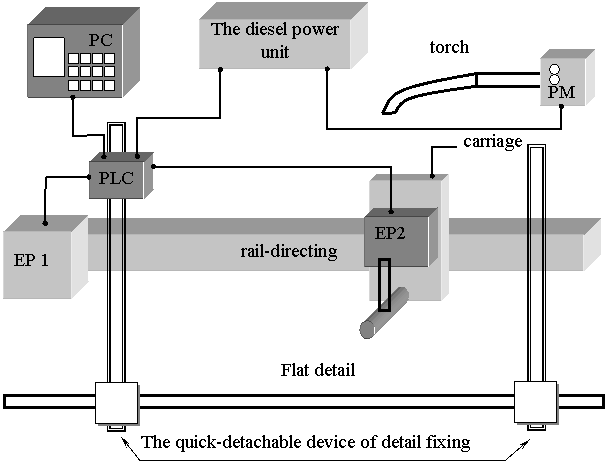
Drawing 1 – Scheme TRB for smelting of flat details: EP 1, EP 2 – servo mechanisms, PLC – the programmed logic controller in a control package; PC – a portable control unit; PM – a semiautomatic device torch.
The literature
1. Kogan, B. I. Methodology of formation of information model of technological repair blocks / B. I. Kogan, A. P. Chernysh // the Bulletin of the Russian Academy of Natural Sciences. 2006. – № 10. – P. 131-137.
2. The Patent. 2333088 RU, MPK С2 В23Р 6/00. A mode of formation of the technological repair block / B. I. Kogan, A. P. Chernysh, (RU). – № /02; Заявл. 8/18/2006; Опубл. 27.02.08, Bjul. № 25.
3. Chavdarov, A. V. Modern mechanical welding equipment / A. V.Chavdarov // Innovations. Technologies. Decisions. – 2006, March. – P. 8-9.
4. Chernysh, A. P. Formation of information models of technological repair blocks // Tractors and agricultural machines, 2007. – № 11. – P. 36-39.
УДК 632.937
BIOLOGICAL INSECTICIDES AS AN ELEMENT OF ENVIRONMENTAL PROTECTION
Shternshis M. V.
FSEI HPE Novosibirsk State Agrarian University Novosibirsk
БИОЛОГИЧЕСКИЕ ИНСЕКТИЦИДЫ КАК ЭЛЕМЕНТ ОХРАНЫ ОКРУЖАЮЩЕЙ СРЕДЫ
ФГОУ ВПО «Новосибирский государственный аграрный
университет» г. Новосибирск
Рассмотрено использование биологических препаратов на основе природных энтомопатогенных микроорганизмов как альтернативы синтетическим инсектицидам для защиты растений от фитофагов. Показаны преимущества биологических инсектицидов по сравнению с химическими в отношении охраны окружающей среды.
It is well known that all crops are damaged by harmful insects and this fact requires plant protection against these phytophages. As a rule, synthetic insecticides are applied for this purpose. However, severe climatic conditions in Siberia cause particular vulnerability of plants to stress; therefore, massive application of chemical pesticides for plant protection is undesirable. In addition, synthetic insecticides kill not only pests but also beneficial insects such as entomophages and pollinators. Chemicals are accumulated in soil, water and air causing the environmental pollution. Accumulation of synthetic insecticides in crop fruits is especially dangerous to human health. Biological insecticides are indispensable alternative to chemical pesticides. Biological formulations are based on natural entomopathogenic microorganisms with specific ability to control harmful insects. Any of entomopathogens including baculovirus, bacterium or fungus is a necessary part of environment. Periodically, these microorganisms cause sharp epizootics controlling the number of harmful phytophagous insects in nature, especially in forestry.
The first attempt to control a pest with a fungal agent was carried out by I. I. Mechnikov in Russia in 1888, when the fungus now known as Metarhizium anisopliae (Metsch.( Sor.) was mass produced and sprayed in the field for control of the beet weevil. This is recognized all over the world as the very beginning of microbial pest control [1]. Later, in the former USSR Beauveria bassiana-based mycoinsecticide for control of Colorado beetle and codling moth was developed in 1965. However, the most common biological pesticides for microbial control of phytophages are bacterial Bacillus thuringiensis-based formulations. Historically, the first bacterial insecticide in Russia was developed by Siberian researcher E. V. Talalaev [2]. He isolated Bacillus thuringiensis (Bt) subsp. dendrolimus (sotto) from larvae of a serious forest pest - the Siberian silkworm Dendrolimus superans sibiricus - during epizootics in Eastern Siberia. This Bt subspecies provided the basis of the formulation Dendrobacillin® for insect control. Initially, Dendrobacillin® was used for plant protection against pest insect in forestry. It was warranted because forest occupied the great area of Siberia and the maintenance of biodiversity of this biocenosis by elimination of chemicals was very important. Later, the same formulation was used for lepidopteran insect control on agricultural crops as well. In the second half of 20th century, some research groups were organized in Eastern and Western Siberia (Irkutsk, Krasnoyarsk and Novosibirsk) for research and development of biopesticides based on entomopathogenic microorganisms. Nowadays, Novosibirsk is a center of biocontrol research in Siberia, including research teams at State Agrarian University, some Institutes of Siberian Branch of Russian Academy of Sciences, and State Scientific Center of Virology and Biotechnology. The main directions of research are as follows: isolation and identification of potential biocontrol agents; mechanism of interaction of biocontrol agent with its target organism; application technology of ecologically safe formulations; enhancement of biocontrol efficacy.
It should be noted also that in 1960s the first Russian factory (now known as SibBiopharm) producing biological insecticides based on the most common biocontrol agent Bt was built near Novosibirsk. This fact accelerated the research on the application and improvement of the biological insecticides. Together with Bt-formulations, preparations based on entomopathogenic viruses were considered as attractive ecologically safe alternatives to chemical insecticides. Several strains of baculoviruses were isolated by Siberian researchers from the serious forest pests, such as D. superans sibiricus, Neodiprion sertifer and Aporia crataegi [2]. Again, it was a basis for development of plant protection technology including viral entomopathogenic formulations. For example, a serious polyphagous pest of vegetable and many other crops – the beet webworm Pyrausta sticticalis, was shown to be suppressed by specific granulosis virus (GV) and nucleopolyhedrovirus (NPV). The GV appeared to be more virulent to larvae of beet webworm than NPV, therefore, viral preparation was developed using the GV.
Long-term application of microbial insecticides discovered its advantages for environment such as the conservation of beneficial insects, absence of chemicals in soil and water, residues in fresh fruits. Therefore, we can consider the biological insecticides as an element of environmental protection.
REFERENCES
1. Lord, J. C. From Metchnikoff to Monsanto and beyond: the path microbial control/J. C. Lord// J. Invertebr. Pathol. – 2005. – V.89. – P. 19-29.
2. Shternshis, M. V. Ecologically safe control of insect pest: the past, the present and the future/ M. V.Shternshis// Emerging concepts in plant health management (Eds. R. Lartey & A. Caesar). – Research Signpost, 2004. – P. 187-212.
УДК
TENDENCIES OF DEVELOPMENT OF CATTLE-BREEDING BRANCH IN THE KEMEROVO REGION
Ivanova K. M.
FSEI HPE Kemerovo Agriculture Institute Kemerovo
ТЕНДЕНЦИИ РАЗВИТИЯ ЖИВОТНОВОДЧЕСКОЙ ОТРАСЛИ В КЕМЕРОВСКОЙ ОБЛАСТИ
ФГОУ ВПО «Кемеровский государственный сельскохозяйственный институт» г. Кемерово
В данной статье рассматривается значение такой ведущей отрасли сельского хозяйства, как животноводство. Также выявляется степень влияния этой отрасли на экономику сельского хозяйства в целом. Рассматриваются цели, задачи, приоритеты, ожидаемые результаты региональной целевой программы «Государственная поддержка агропромышленного комплекса и социального развития села в Кемеровской области на годы».
Animal industry is one of the leading branches of agriculture. Value of this branch is defined not only by a high share in gross output, but also a greater influence on a rural economy.
The animal industry provides the population with foodstuffs (milk, butter, meat, eggs, etc.) and light industry with raw materials (wool, bristle, meat, milk, etc.) gives live draught force (horses, oxen, donkeys, mules, camels, deer) and organic fertilizers –manure. From products and animal industry wastes some forages (a meatbone flour, a bone flour, etc.) and also various medical products (whey, hormonal preparations, etc.) are received.
Let’s consider tendencies of development of cattle-breeding branch in the Kemerovo region.
Let’s analyze the data about cattle livestock from 2007 to 2009.
Table 1 – A livestock (economies of all categories)
Indicators, thousand animals | 2007 | 2008 | 2009 | Thousand animals | % |
1. Cattle | 257,3 | 253,3 | 224 | -13,3 | 94,8 |
Including cows | 111,8 | 115,5 | 112,4 | +0,6 | 100,5 |
2. Pigs | 337 | 350,8 | 379,4 | +42,4 | 112,6 |
3. Sheep and goats | 65,5 | 67,9 | 70 | +4,5 | 106,9 |
From the data considered in the table we can see that cattle livestock in 2009 has decreased by 5,2% compared with 2007 and by 3,7% compared with 2008. The livestock of pigs has grown by 12,6% and made up 379,4 thousand animals in 2009. The livestock of sheep and goats has increased by 6,9% compared with 2007 and by 3,1% compared with 2008 and made up 70 thousand animals.
Proceeding from the data about a cattle livestock (tab.1), we will consider dynamics of animal industry production in economies of all categories.
Table 2 – Animal industry production (economies of all categories)
Indicators, thousand tons | 2007 | 2008 | 2009 | Thousand tons | % |
1. Cattle and birds on slaughter in live weight | 101,5 | 106,2 | 112 | +10,5 | 110,3 |
2.Milk | 432,6 | 440 | 426 | -6,6 | 98,5 |
3. Million eggs | 728,8 | 745,8 | 686 | -42,8 | 94,1 |
From the given table we see that in 2009 there was an increase in a volume of meat output by 10,3% compared with 2007 and by 5,5% compared with 2008. Milk production has decreased by 6,6 thousand tons (1,5%) compared with 2007 and by 3,2% compared with 2008. Eggs production has also decreased by 42,8 million compared with 2007.
Having analyzed all data it is possible to come to a conclusion that the increase of output volumes of meat has occurred because of increase in cattle and birds at slaughter that has resulted in increase in realization volumes. Volume of milk production has decreased because of reduction of cows that has accordingly lowered production volume of realization. Also the volume of eggs output and realization of eggs were considerably reduced.
Let’s consider the data about realization of animal industry production.
Table 3 – Realization of animal industry production (economies of all categories)
Indicators ,thousand tons | 2007 | 2008 | 2009 | Thousand tons | % |
1.Cattle and birds on slaughter in live weight | 83,1 | 91,4 | 95,3 | +12,2 | 114,7 |
2. Milk | 247,1 | 256,8 | 249 | +1,9 | 100,8 |
3. Million eggs | 617,8 | 641,4 | 604 | -13,8 | 97,8 |
From the given table we see that in 2009 the quantity of meat realization increased by 14, 7% compared with 2007 and made up 95, 3 thousand tons. Milk realization has grown by 0, 8% compared with 2007 and has decreased by 3% compared with 2008. As for eggs realization it has decreased by 13, 8 million eggs (2, 2%) in 2007 and by 37,4 million eggs (5,8%) compared with 2008.

|
Из за большого объема этот материал размещен на нескольких страницах:
1 2 3 4 5 6 7 8 9 10 11 12 13 14 |
