


Партнерка на США и Канаду по недвижимости, выплаты в крипто
- 30% recurring commission
- Выплаты в USDT
- Вывод каждую неделю
- Комиссия до 5 лет за каждого referral
Last years the cattle-breeding branch of agriculture worked in the most complicated conditions. High labour input, power consumption and grain consumption of animal industries at free prices for energy carries and mixed fodders led to considerable growth of the cost price and decrease of production profitability.
In 2009 there was a change of output volumes of cattle-breeding production. In economies of all categories cattle and bird production has increased by 5, 5% but milk manufacture decreased by 3, 2% and eggs by 8% compared with 2008.
For situation improvement in the agriculture there is regional target program «The state support of agricultural complex and social development of village in the Kemerovo region from 2008 to 2011» [2].
The purpose of this program is to improve of life quality of the population both in a city and a village.
The task is to increase the manufacture of grain, meat and milk, to increase the availability of credit resources for all forms of managing in agriculture.
The basic priorities:
1) The accelerated development of animal industries: development of dairy animal industry; development of early meat animal industry.
2) Development of grain and forages production.
3) Stimulation of development of small forms of managing in agriculture.
Expected results of the given program:
The acceleration development of dairy animal industries will allow:
- to increase milk production by 6, 4%.
Development of early meat animal industry will allow:
- to increase meat production by 12%.
Development of grain and forages production will allow:
- to increase grain and forages production by 25%.
Stimulation of development of small forms of managing in agriculture will provide:
- the growth of consumer, marketing and credit cooperative societies;
- the growth of output volumes of agricultural production in private farms and agricultural enterprises.
Last years the attention of the Administration of Kemerovo region to agriculture became more tangible. A number of the important standard documents were accepted, there was a financial support.
The great attention is given to simulation of cattle-breeding production. From the regional budget in 2million roubles were directed on the support of cattle-breeding production and compensation of a part of mixed fodders cost in the sum of 26 million roubles.
In the basic direction is the increase of agricultural production of grain, potato and animal industry production. Stability of branch and increase of agricultural production guarantees employment of agricultural population and creation of new workplaces that will provide workers of the agricultural organizations with the guaranteed wages.
Creation of vertically integrated companies providing steady annual growth of agricultural production should become one of measures of work improvement. It will allow to keep workplaces and to create new and also to increase payments in budgets of all levels.
In order to provide the stabilization of agricultural production it is necessary to develop the system of the state support of the agricultural enterprises, first of all modernization in agriculture and animal industries. In animal industries the problem on development of breeding business will dare. Besides, the assistance in updating of agricultural machine park will be rendered. [2]
I consider that it is possible to increase manufacture and realization of animal industry production due to improvement of cattle maintenance and increase of forage nutritiousness.
The literature:
1) Agriculture of Kuzbass (municipal unions). The statistical collection, part 2/ Territorial organ of Federal Agency of the state statistics on the Kemerovo region – Kemerovo, p.
2) http: //www. *****
3) http:// www. *****
УДК 632.
ESTIMATION OF THE BIOLOGICAL PREPARATIONS FOR PROTECTION OF THE SOYBEAN AGAINST DISEASES UNDER THE CONDITIONS OF WEST SIBERIA
Korobeinikov A. S
FSEI HPE Novosibirsk State Agrarian University Novosibirsk
ОЦЕНКА БИОЛОГИЧЕСКИХ ПРЕПАРАТОВ ДЛЯ ЗАЩИТЫ СОИ ОТ БОЛЕЗНЕЙ В УСЛОВИЯХ ЗАПАДНОЙ СИБИРИ
ФГОУ ВПО «Новосибирский государственный аграрный
университет», г. Новосибирск
Проведена оценка перспективных биологических препаратов, в сравнении с химическими, для защиты сои от болезней в условиях Западной Сибири. Выявлено, что наиболее эффективными в подавлении болезней, а также в увеличении урожайности сои оказались бактофит и иммуноцитофит.
Soybean is the crop of great significance in agriculture. Some components, obtained after processing the soybean are being used in many industrial sectors, such as food, mixed fodder, textile and other. In addition, the ability of soybean to assimilate the atmospheric nitrogen plays an important role in saving of soil fertility.
Although the history of the growing of soybean in Russia is known long ago, this is relatively new crop for West Siberia. Development the technology of growing soybean makes this culture available for this region. Under the conditions of West Siberia the soybean crops are permanently damaged by diseases, causing the yield losses and reducing the seed mass. The most important diseases for West Siberia are bacterioses, fusarium root rot and complex root rots. These diseases often spread by 80-100%.
Increasing environmental pollution requires several researches for seeking the ecological-safe and pesticide-free methods to carry out. The conception of reducing the use of chemical pesticides becomes a part of legislative acts in many countries of European Union. The needed level of chemical pesticides replacement depends on several factors, including soil and weather conditions in this region.
Taking into account the necessity of ecological alternative we carried out several trials of biological preparations, belonging to various groups, such as immunomodulators, bacteria-based and BAS-based formulations on the crops of soybean cultivar SibNIIK-315. The experiments were conducted during in the field plots of Siberian Institute of Fodder Crops. According to most widespread diseases, the preparation based on antibiotics (phytolavin 300 and strekar), bacteria (bactophyt) and multipurpose stimulator immunocitophyt (based on arachidon acid) were selected.
Chosen biological formulations were applied by seed treatment with moisturizing and by spraying the plants. Condition of seeds, roots, overground organs as well as influence of preparations on yield structure elements was registered. The chemical fungicide vincit was used as chemical standard.
Before the treatment preliminary analysis of seed was done. It showed that seeds were damaged by bacterial and fungal pathogens at high level. Therefore, we could conduct the trials of preparations at high infection level. Seed infection was exceeded by 4-6 times comparing to economic threshold. We managed to identify the Pseudomonas bacteria and several species of Fusarium fungi among the isolated pathogens.
Starting from the flowering phase we carried out estimation of the disease spreading and its severity. Overground organs of soybean were significantly damaged by bacterial blights. High humidity and temperature level promote the rapid disease spreading. Deterrent effect was provided only by immunocitophyt, some infection reducing on the seeds of a new yield, obtained from test plots were also registered. Treatment by other preparations doesn’t provide significant influence on the spreading and severity of diseases.
Weather conditions, mainly the abundant precipitation, provide the fast growth of soybean. Root part of the plans often crackled and were damaged by root rot. In bactophyt variant spreading and severity of diseases tends to decrease, although differences were not statistically reliable. The smaller damage in the flowering phase was explored in strekar variant; we observed decreasing both spreading and severity of the disease. Other variants don't provide significant decreasing of these parameters.
Growth-stimulating effect of bactophyt and immunocitophyt was observed. First shoots have been observed 2-3 days earlier in the variants with these preparations in comparison to raw seeds. Seed treatment with preparations, selected for the trial, provided the better shoots, although seed lesion did not changed essentially.
The positive influence of treatments on a growth of the soybean was also established. For example, average height of plants in the start of flowering was 6-7 cm higher, than in control. The antibiotic formulations and vincit didn't influence plant's height. Moreover, reliable effects of increasing the tuberous bacteria activity and root nodes forming were shown with bactophyt and immunocitophyt application.
Soybean capacity in the West Siberia is usually estimated about 1,63-2,88 t/ha. However, during the years the higher yield of soybean was obtained (about 3 t/ha). Nevertheless, with the comparison of control we observed increasing of the saved yield in the experimental plots. For all 3 years the elements of the main yield structure tend to improve on the plots with bactophyt and immunocitophyt. Values of these parameters exceed the values, obtained with antibiotic preparations and chemical standard vincit.
Thus, the application of biological preparations is more reasonable because they have both the fungicide, growth-stimulating and immunizing effects. Using the bactophyt and immunocitophyt for seeds and plant treatment cause more rapid germination of soybean, stimulate the growth of tuberous bacteria, restrain the severity of phytopatogen organisms. This causes to decreasing the spread and severity of main diseases, provides stable soybean yield rise at the level of 0,5-0,6 t/ha. All of this provides increasing ecological stability of soybean agrocenose in the Siberian region.
УДК 632.937
SURVIVAL OF CABBAGE BUTTERFLY ON HOST PLANT
Shatalova E. I.
FSEI HPE Novosibirsk State Agrarian University Novosibirsk
ВЫЖИВАЕМОСТЬ КАПУСТНОЙ БЕЛЯНКИ НА РАСТЕНИИ-ХОЗЯИНЕ
ФГОУ ВПО «Новосибирский государственный аграрный
университет» г. Новосибирск
Представлены результаты лабораторных и полевых экспериментов по определению выживаемости и численности гусениц капустной белянки (Pieris brassicae L.) на разновидностях капусты как растения-хозяина. Полученные данные являются основой для дифференцированного применения биопрепаратов против фитофага.
In recent years, biological plant protection has been paying attention to the influence of plants upon a feeding phytophage. Therefore, we must study the effect of different plant species on phytophage before we consider it in the tritroph system. Today it is important to apply biological control on vegetable plants, especially on cabbage as the most common crop in field.
The purpose of the research is to study the survival and number of large cabbage butterfly (Pieris brassicae L.) larvae on different subspecies and cultivars of cabbage.
To study the problem under laboratory conditions, we took 10 hatched larvae and placed them on leaves of different subspecies and cultivars of cabbage located in Petri dishes. The early white cabbage, late white cabbage, red cabbage and cauliflower were used as host plants. We determined the number of survived larvae and their mass every day during the experiment. In field, the population dynamics was investigated in Toguchin and Novosibirsk districts in . The number of larvae was accounted once in 7-10 days. The data obtained was processed by the method of dispersion analysis.
We had no essential differences in mortality of larvae caterpillars on different subspecies and cultivars of cabbage in laboratory. However, the period of larvae development depended on subspecies and cultivars of cabbage. Faster development of larvae was observed on early white cabbage and cauliflower. Mass pupating lasted for 2-3 days. A more extended period of pupating was on red cabbage that lasted for 8 days (Table 1).
Table 1 – Effect of cabbage subspecies on development and mortality of P. brassicae larvae in laboratory
Subspecies of cabbage | Number of live larvae (age) / pupae, % on day | |||||||
2 | 4 | 6 | 8 | 12 | 14 | 18 | 22 | |
Late white cabbage | 100 (I) | 100 (II) | 100 (III) | 92 (IV) | 86 (V) | 56(V)/ 28 | 0/80 | 0/80 |
Early white cabbage | 100 (I) | 100 (II) | 100 (III) | 96 (V) | 60(V)/ 32 | 6 (V)/ 86 | 0/88 | 0/88 |
Cauliflower | 100 (I) | 100 (II) | 100 (III) | 98 (IV-V) | 40(V)/ 48 | 2 (V)/ 84 | 0/80 | 0/80 |
Red cabbage | 100 (I) | 100 (II) | 100 (III) | 98 (IV) | 96 (IV-V) | 94 (V) | 22(V)/ 68 | 0/84 |
LSD 05 for caterpillars / for pupae | - | - | - | 7,9 | 33,3/ 23,6 | 11,8/ 19,3 | 9,2/ 22,8 | 24,6 / 33,9 |
We had no essential differences in quantity of pupae in the variants. The mass of pupae was fluctuated from 0.23 to 0.31 grams (Table 2).
Table 2 – Quantity and mass of P. brassicae pupae after larvae feeding on different subspecies of cabbage in laboratory
Variant (species of cabbage) | Quantity of pupae (mean per a variant) | Mass of pupae, gram. (mean per 1 pupa) |
Late white cabbage | 8 | 0.28 |
Early white cabbage | 8.8 | 0.25 |
Cauliflower | 8 | 0.31 |
Red cabbage | 8.4 | 0.23 |
LSD 05 | 2.46 | 0.037 |
In 2008, number of larvae in both field plots was at low level. It should be noted that cauliflower was more attractive for insect oviposition. Amount of oviposition was 15-17 eggs per 100 plants. In 2009, in Toguchin plot most of larvae emerged in 3th part of August. Maximum of larvae number was on cauliflower – 529; less number of pests was on late white cabbage – 190 per 100 plants. Least of one was on red cabbage. As to the second plot (Novosibirsk), we could found only several caterpillars.. The population dynamics of insect was irregular in 2008 and 2009. However, late white cabbage and cauliflower were more damaged by the larvae.
Having analyzed the statistical data, we can come to conclusions that different subspecies and cultivars of cabbage influence the development and larvae mortality, and pupae mass of P. brassicae. The result of the research will be the basis for following experiments on biological pest larvae control.
УДК 004:811:378.14
INTERNET CORRESPONDENCE AS A RESOURCE TO PROMOTE FOREIGN LANGUAGE STUDY (STUDY OF MOTIVATIONS)
Kalashnikova N. T., Melnikov E. S.
“Krasnoyarsk State Agrarian University”
ИНТЕРНЕТ-ПЕРЕПИСКА КАК СРЕДСТВО ПОВЫШЕНИЯ ИНТЕРЕСА К ИЗУЧЕНИЮ ИНОСТРАННОГО ЯЗЫКА (ИССЛЕДОВАНИЕ МОТИВАЦИЙ)
,
ФГОУ ВПО «Красноярский государственный аграрный
университет» г. Красноярск
Исследована возрастная динамика показателя мотивации учащихся к изучению иностранного языка в образовательных учреждениях г. Красноярска (средняя школа №2, Красноярский Государственный Аграрный Университет). Найденное падение мотивации у шестых-девятых классов школы и на средних курсах университета, согласуется с опубликованными данными по снижению качества обучения в аналогичных классах школы сельской местности. Применение методики интернет-переписки на иностранном языке во внеклассной работе с учащимися повышает их мотивацию и устраняет это негативное явление.
Novelty of the study.
The use of Internet communication were recommended by teachers earlier along with other tools to revive the language lessons (plays, role-playing games, audio, video, and computer programs, immersion in a foreign language). However, there was no comprehensive scientific approach with implementation of action, arising from the research.
The analysis of the problem defined method of remediation, which was used for the most problematic category of pupils and revealed positive effect.
INTRODUCTION
Large part of senior pupils and students lose an active interest in foreign languages. Reasons are insufficient language training time and weak technology of individual study aimed at self-education. One of the ways to improve the training can become strengthening motivation to learn. There is large literature on motivation in general and on the motivation to foreign languages in particular. However, some proposed methods are too labour-consuming for a teacher. Others assume special computer technologies which can help only enough motivated pupils.
Pupil’s training activity is induced by hierarchy of motives, in which the principal must be internal motives associated with the need of a learner to take a position in the system of public relations. There are also external motives, they are demands of parents, school. Needs and motivations are developed with age.
To find a solution to the problem, we should analyze motivations of youth studying foreign languages.
The object of study is the process of forming motivation to study a foreign language in terms of techniques for their strengthening.
1. Study of motivation
The study was conducted at Krasnoyarsk school №2 and KrasGAU.
The investigation was carried out by questionnaire as it allows to capture large quantity of learners. Questions are made to reveal presence of three kinds of motives to study: the internal, external positive and external negative. Strengthening of internal motives is desirable for improvement of quality of education.
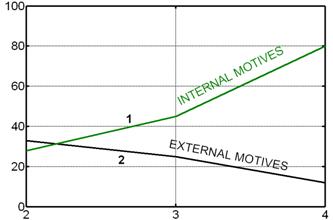
The obtained data are presented in drawing 1. In the second class external motives prevail over internal ones (33,3 % against 27,8 %). In the third and the fourth classes picture varies: the share of internal motives grows, the share of the external decreases. In the fourth class a share of internal motives is 80 % and the share of external motives decreases to 12 %.
|
(1-internal, 2-external motives), our data.
|
This change of motives dominating from external to internal, noted in initial classes, progresses further in middle and senior classes. It is natural, children mature and become more and more independent. Definition of a kind of prevailing motives is necessary for a choice of methods of pedagogical influence.
2. Motivation to study foreign language in a secondary school
Questioning captured 198 pupils of 3-11 classes. Some of them (15 %) consider that foreign language study is necessary for the reason that it is a program subject. Others (20 %) see the educational importance in studying of this subject. The third (8 %) connect motive with possible use of language in their future practical activities. For some part (7 %) the motive is realised with a possible trip abroad. 15 % of pupils learn language for the sake of an estimation which gives the general point at admittance in higher educational institute. About 15 % are interested in learning a foreign language. It is basic motive for pupils of 4th and 5th classes. It is clear, their interest is based on novelty of a subject. About 4 % answered that foreign language is necessary for them because it is connected with their future trade (translator, teacher). The rest 16 % are not determed.
At first sight many pupils have motives to study foreign language. However the most part of pupils do not represent practical application of language in future.
Conclusions on secondary school
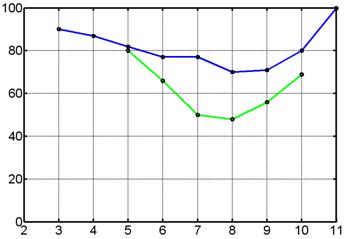
1) By the end of the 6th class stimulus to study language falls. This result of our research is in agreement with published data (Podlasova I. P).
 2) Social and economic importance of a foreign language is not clear for the most part of pupils.
|
|
|
|
3) Pupils are dissatisfied with their poor level of practical knowledge of a language. They feel feebleness at conversation, at listening to the text and at writing.
4) Now learners have no possibility to apply good speech skills and abilities, to improve and develop them out of lessons. It is a question of absence of communicative motivation which ideally should arise at lessons and have the further development on out-of-school employment.

|
Из за большого объема этот материал размещен на нескольких страницах:
1 2 3 4 5 6 7 8 9 10 11 12 13 14 |
