


Партнерка на США и Канаду по недвижимости, выплаты в крипто
- 30% recurring commission
- Выплаты в USDT
- Вывод каждую неделю
- Комиссия до 5 лет за каждого referral
The number of workers employed in agriculture is characterized by the following data (Table 2) [4].
Table 2 – Number of workers employed in the economy of the Kemerovo region, th. people
Index | 2005 | 2006 | 2007 | 2008 | Changes 2008/ 2005 | |
+/- | % | |||||
Total for all sectors of the regional economy | 1302,7 | 1313,1 | 1327,3 | 1317,6 | 14,9 | 101,14 |
Agriculture, forestry | 59,9 | 58,2 | 55,2 | 50,1 | -9,8 | 83,64 |
The share of employed in agriculture and forestry | 4,60 | 4,43 | 4,16 | 3,80 | -0,8 | 82,61 |
As for the wages, there is a tendency of growth (Table 3):
Table 3 – Average monthly wage of agricultural employees in comparison with the average wages for all sectors of the economy, *****bles
Wages | Year | Changes 2008/2004 | |||||
2004 | 2005 | 2006 | 2007 | 2008 | +/- | % | |
In average on economy industries | 6 707 | 8 654 | 10 408 | 12 555 | 15 410 | 8 703 | 229,8 |
In average on agriculture | 2 904 | 3 875 | 5 080 | 6 544 | 8 481 | 5 577 | 292,0 |
Let’s consider the distribution of employed in agricultural production by level of education (Table 4). [2]
Table 4 – The distribution of employed in agriculture by level of education, thousands of people
Level of education | Years | Changes 2008/2006 | |||
2006 | 2007 | 2008 | +/- | % | |
Fligh and incomplete high professional education | 3,3 | 1,8 | 3,3 | 0 | 100 |
Middle professional education | 8,9 | 4,6 | 10,8 | 1,9 | 121,3 |
Primary professional education | 13,2 | 10,1 | 9,8 | - 3,4 | 74,2 |
Secondary education | 19,7 | 21,5 | 14,8 | - 4,9 | 75,1 |
Basic, general education | 10,8 | 13,2 | 10,8 | 0 | 100 |
Primary education | 2,3 | 4 | 0,6 | - 1,7 | 26,1 |
Total | 58,2 | 55,2 | 50,1 | - 8,1 | 86,1 |
To visualize the data on the distribution of employed by education in 2008 let s make a diagram (Fig. 2).
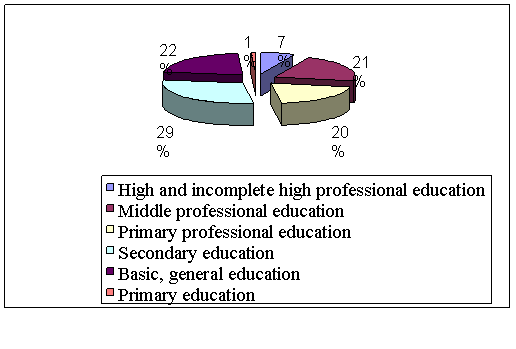

Based on the data presented in diagram 2, we make the following conclusions: the majority (29%) employed in agriculture have secondary education, a significant number of people have the basic, general education (22%), middle professional education (21%) and primary education (20%). Share of specialists with high education is only 7%. This indicates not high qualification of employed in agriculture. As you can see 1% has only primary education or doesn’t even have it. But in general, analyzing the structure we can conclude that the qualification level of employed in agricultural production has increased.
Analyzing the problems of the village we can notice quite a paradox: on the one hand there is unemployment, but on the other hand there is no wish to get the vacant, often low-wages jobs.
Another problem is the low wages of agricultural workers. Let’s consider the data on wages in agriculture. (Table 5)
Table 5 – Average monthly wage of agricultural workers compared with
the average wages for all sectors of the economy
Index | Years | Changes 2008/2004 | |||||
2004 | 2005 | 2006 | 2007 | 2008 | +/- | % | |
Average wages in agriculture | 2 904 | 3 875 | 5 080 | 6 544 | 8 481 | 5 577 | 292,0 |
Average wages in economic sector | 6 707 | 8 654 | 10 408 | 12 555 | 15 410 | 8 703 | 229,8 |
From the submitted data in table 7, we see that the wage from 2004 to 2008 increased. The pace of wage growth in agriculture is higher than in other industries. But in spite of this in 2008 the wages in agriculture only reached the level of wages which was in economic sectors in 2005.
Let’s consider the structure and dynamics of investments in different sectors of economy of the Kemerovo region in . (Table 6):
Table 6 – Financial investments by economic activities, rubles.
Index | Years | Changes 2007/2009 | |||
2007 | 2008 | 2009 | +/- | % | |
Agriculture, hunting and forestry | 69 580 | 75 263 | 62,68 | ||
Extraction of natural resources | 92 | 81 | 369 | 399,09 | |
Manufacturing | 75 | 76 | 52 | 69,81 | |
Production and distribution of electricity, gas and water | 8 | 3 | 2 | 458,33 | |
Construction | 1 | -1 130 | 99,88 | ||
Wholesale and retail trade | 4 | 6 | 14 | 10 | 325,86 |
Transport and communications | 633,30 | ||||
Total investments | 193 | 183 | 447 | 230,8329 |
Based on the data presented in table 9, we can conclude that the proportion of investments in agriculture is less than 0,02% of total investments in all economic activities. This indicates a low investment attractiveness of agriculture compared with other sectors of the economy.

|
Из за большого объема этот материал размещен на нескольких страницах:
1 2 3 4 5 6 7 8 9 10 11 12 13 14 |
