


Партнерка на США и Канаду по недвижимости, выплаты в крипто
- 30% recurring commission
- Выплаты в USDT
- Вывод каждую неделю
- Комиссия до 5 лет за каждого referral
Shielded Metal Arc
In shielded metal-arc welding a metallic electrode, whiсh conducts electricity, is coated with flux and connected to a source of electric current. The metal to be welded is connected to the other end of the same source of current. An electric arc is formed by touching the tip of the electrode to the metal and then drawing it away.
Words:
to join – соединять; an application – применение; heat – нагрев; pressure – давление; to divide – делить; to achieve – достигать; to use – использовать; instead of – вместо; bolting – крепление болтами; riveting – крепление заклепками; construction – строительство; machinery – машиностроение; aircraft – самолетостроение; to depend –зависеть; property – свойство; equipment – оборудование; according to – в соответствии с…; source – источник; employed – применяемый; electron-beam – пучок электронов; flame –пламя; an edge – край; simultaneously – одновременно; | wire – проволока, провод; rod – прут, стержень; filler metal – металл наполнитель; to melt – таять, плавить(-ся); joint – стык; advantage – достоинство; portable – переносной; surface –поверхность; are coated – покрыты; flux – флюс, плавень; fusible – плавкий; to shield – закрывать, экранировать; continuous – длительный; supply – поставка; alternating – переменный; current - ток; to create – создавать; gas-tungsten arc – сварка оглавлением вольфрамовым электродом в среде инертного газа; gas-metal arc – аргонодуговая сварка; submerged arc – сварка с погруженной дугой. |
Exercise 1. Найдите в тексте все конструкции в пассивном залоге.
Exercise 2. Переведите на русский язык:
Flame, edge, filler metal, wire, rod, joint, surface, flux, fusible, advantage, heat, pressure, steel, air, equipment, bolting, riveting, to melt, to depend, to coat, electron-beam, to shield, property, simultaneously, continuous.
Exercise 3. Поставьте все возможные вопросы к предложению:
Gas welding is non-pressure process using heat from a gas flame.
Exercise 4. Найдите в правой колонке слова, перевод которых дан в левой колонке:
1. heat – давление, стык, нагрев;
2. application – значение, применение, причина;
3. fusible – применяемый, плавкий, переменный;
4. source – сварка, источник, заряд;
5. gas-metal arc – аргонодуговая сварка, газосварка, электросварка;
6. pressure – давление, нагрев, флюс;
7. to shield – зависеть, закрывать, плавиться;
8. joint – стержень, провод, стык;
9. to melt – зависеть, плавиться, создавать;
10. advantage – достоинство, строительство, крепление болтами.
Exercise 5. Составьте предложения из данного набора слов:
1. together, is, a metal process, when, parts, are joined, welding.
2. is, process, the most important, for joining, steels, arc-welding.
3. is used, nowadays, welding, instead of, bolting.
Exercise 6. Дайте английские эквиваленты фразам:
1. переменный ток;
2. в наши дни;
3. процесс сварки;
4. источники нагрева и давления;
5. сварка пучком электронов;
6. несколько достоинств над другими методами сварки;
7. прямой или переменный электрический ток;
8. сваривание достигается давлением;
9. свойства металлов, цель их применения;
10. широко используемый сегодня.
Text B. Other Types of Welding
Arc Welding
As non-consumable electrodes tungsten or carbon electrodes can be used. In gas-tungsten arc welding a tungsten electrode is used in place of the metal electrode used in shielded metal-arc welding. A chemically inert gas, such as argon, helium, or carbon dioxide is used to shield the metal from oxidation. The heat from the arc formed between the electrode and the metal melts the edges of the metal. Metal for the weld may be added by placing a bare wire in the arc or the point of the weld. This process can be used with nearly all metals and produces a high-quality weld. However, the rate of welding is considerably slower than in other processes.
Gas-metal Arc
In gas-metal welding bare electrode is shielded from the air by surrounding it with argon or carbon dioxide gas and sometimes by coating the electrode with flux. The electrode is fed into the electric arc, and melts off in droplets that enter the liquid metal of the weld seam. Most metals can be joined by this process.
Submerged-arc welding is similar to gas-metal arc welding, but in this process no gas is used to shield the weld. Instead of that, the arc and tip of the wire are submerged beneath a layer of granular, fusible material that covers the weld seam. This process is also called electro slag welding. It is very efficient but can be used only with steels.
Resistance Welding
In resistance welding heat is obtained from the resistance of metal to the flow of an electric current. Electrodes are clamped on each side of the parts to be welded, the parts are subjected to great pressure, and a heavy current is applied for a short period of time. The point, where the two metals touch, creates resistance to the flow of current. This resistance causes heat, which melts the metals and creates the weld.
Resistance welding is widely employed in many fields of sheet metal or wire manufacturing and is often used for welds made by automatic or semi-automatic machines especially in automobile industry.
Words:
non-consumable – нерасходуемый; tungsten - вольфрамовый; carbon – угольный электрод; inert – инертный; argon – аргон; helium – гелий; carbon dioxide – углекислый газ; to shield - закрывать, экранировать; oxidation – окисление; to melt – плавить(-ся); added – добавлен; bare – неизолированный; nearly – почти; to produce – производить; high-quality – высококачественный; considerably – значительно; surrounding – окружение; coating – покрытие; is fed into – снабжен (чем-то); droplet – капелька; liquid – жидкость, жидкий; weld seam – сварной шов; submerged-arc welding – сварка с погруженной дугой; | similar – похожий; is used – используется; instead of that – вместо этого; tip – верхушка, наконечник; beneath – под; layer – слой; granular – зернистый, гранулированный; electro slag welding – электросварка окалиной; efficient – эффективный; resistance – сопротивление; is obtained – добывается; to flow – течь; are clamped –зажаты; to be welded – должны быть сварены; are subjected - подвергнуты; is applied – применен; to touch – касаться; to cause – вызывать, быть причиной; sheet – лист; made by – делаемых (чем-то, кем-то). |
Exercise 1. Найдите в тексте все конструкции в пассивном залоге.
Exercise 2. Переведите на русский язык:
Tungsten, steel, resistance, high-quality, bare, is obtained, weld seam, submerged-arc welding, submerged-arc welding, to touch, coating, electro slag welding, are subjected, layer, to cause, droplet.
Exercise 3. Найдите в правой колонке слова, перевод которых дан в левой колонке:
1. liquid – жидкость, газ, капелька;
2. weld seam – дуговая сварка, газовая сварка, сварной шов;
3. carbon dioxide – углекислый газ, инертный, плавкий;
4. to depend – зависеть, влиять, употреблять;
5. electric current – электрический заряд, электрический ток, электрическое оборудование;
6. to shield - закрывать, течь, покрывать;
7. layer – шов, слой, капелька;
8. resistance – окисление, угольный электрод, сопротивление;
9. carbon – угольный электрод, углекислый газ, окисление;
10. oxidation – окисление, угольный электрод, углекислый газ;
Exercise 4. Составьте предложения из данного набора слов:
1. resistance, manufacturing, is widely employed, in many, welding, fields of.
2. nearly all metals, this process, with, can be used.
3. inert gas, a chemically, is used, the metal, to shield, from oxidation.
Exercise 5. Дайте английские эквиваленты фразам:
1. угольный электрод;
2. углекислый газ;
3. закрыть металл от окисления;
4. плавить края металла;
5. неизолированная проволока;
6. производить высококачественное сваривание;
7. покрытие электрода флюсом;
8. электрод снабжен электрической дугой;
9. электрод погружен под слой гранулированного, плавкого материала;
10. сопротивление вызывает нагревание.
Unit 7:
My Future Trade. Electrician.
Text. Electric Current Serves Us in A Thousand Ways
The electric current was born in the year 1800 when Volta constructed the first source of continuous current. Since that time, numerous scientists and inventors, Russian and foreign, have greatly contributed to its development and practical application.
As a result, we cannot imagine modern civilization without the electric current. We can’t imagine how people could do without electric lamps, without vacuum cleaners, refrigerators, washing machines and other electrically operated devices that are widely used today. In fact, telephones, lifts, electric trams and trains, radio and television have been made possible only owing to the electric current.
The student reading this article is certainly familiar with the important part which the electric current plays in everyday life. From the moment he gets up in the morning until he goes to bed at night, he widely uses electric energy. Only when going to the lyceum either on foot or by bicycle he can do without electricity. In fact, it is well known that electric current is necessary for the operation of trolley-buses, trams, buses and modern trains.
During the day the student will also use some electrical devices working in the laboratory, making use of the telephone, the lift, the tram and so on. As for the evening, if he studies or reads by an electric lamp, watches television, goes to the theatre or cinema, he certainly uses electricity.
Some people are more familiar with the various applications of the electric current in their everyday life than they are with its numerous industrial applications. However, electric energy finds its most important use in industry. Take, for example, the electric motor transforming electric energy into mechanical energy. It finds wide application at every mill and factory. As for the electric crane, it can easily lift objects weighing hundreds of tons.
A good example which is illustrating an important industrial use of
the electric current is the electrically heated furnace. Great masses of metal melted in such furnaces flow like water. Speaking of the melted metals, we might mention one more device using electricity that is the electric pyrometer. These are only some of the various industrial applications of the electric current serving us in a thousand ways.
Words:
current – ток; to construct – построить; source – источник; continuous – продолжительный; could do without – обойтись без; to operate – приводить в движение; device – прибор; are used – используются; have been made possible – стали возможны; owing to – благодаря; familiar – знакомый; everyday life – повседневная жизнь; necessary – необходимый; making use of – пользуясь; and so on – и т. д.; | to contribute – внести вклад; development – развитие; application – применение; to imagine – вообразить; various – разнообразный; industrial – промышленный; however – однако; transforming – преобразующий; mill – мельница, пресс; weighing – весящий; to heat – разогревать; furnace –['fə:nis] - печь, горн; melted – расплавленный; might mention – могли бы упомянуть; pyrometer – пирометр; to serve – служить. |
Exercise 1. Найдите в тексте все конструкции в пассивном залоге.
Exercise 2. Дайте краткие ответы на следующие вопросы:
1. Does the motor find wide application in industry?
2. Is Volta a Russian scientist?
3. Does your friend go to the lyceum on foot?
4. Did you go to the theatre yesterday?
5. Is there an electric lamp on your table?
6. Has your friend bought a new bicycle?
7. Are there many trolley-buses and trams in Moscow?
8. Do you watch television every day?
9. Do you use electrical devices?
10. Can you do without electricity?
11. Does the electric current play an important part in our life?
12. Does the electric motor transform electrical energy into mechanical energy?
13. Is the electric current necessary for the operation of trolley-buses and trams?
14. Is your house heated by an electric furnace?
Exercise 3. Переведите следующие предложения:
1. Speaking of the electrically operated devices, one can mention the refrigerator.
2. Having mentioned the name of Volta, the teacher spoke about his invention.
3. The first source of continuous current constructed by Volta appeared in 1800.
4. The temperature of hot flowing metals is often measured by the electric pyrometer.
5. The pyrometer used in industry is a device measuring temperature.
6. The pyrometer showing the temperature of metals melted in furnaces is also an electrical device.
7. Making this instrument, we could not do without a machine operated by electricity.
8. Going along the streets, one can see running trams, trolley-buses, buses and cars.
9. Being widely used in industry, electrical motors are also used in every home.
Exercise 4. Составьте предложения, используя слова данные ниже:
Model: lift, the, heavy, can, electric, objects, crane —>
The electric crane can lift heavy objects.
1. finds, industry, energy, in, application, electric, wide.
2. does, study, he, at, not, the, institute?
3. day, use, every, do, devices, you, electrical?
4. the, theatre, go, to, we, yesterday, not, did.
Exercise 5. Задайте все возможные вопросы к следующим предложениям:
1. The electric motor finds wide application in industry.
*****ssian scientists contributed greatly to the science of electricity.
Exercise 6. Переведите следующие словосочетания:
1.в повседневной жизни;
2.промышленное применение;
3.печь, нагреваемая электричеством;
4.огромные массы металла текут как вода;
5.важное применение;
6.преобразующий механическую энергию;
7.постоянный ток;
8.при электрической лампе;
9.в результате, благодаря электричеству;
10.смотреть телевизор вечером.
Exercise 7. Переведите предложения на английский язык, обращая внимание на причастия:
1. Электрический мотор, преобразующий электрическую энергию в механическую, используется в повседневной жизни.
2. Говоря об электрическом токе, мы можем упомянуть имя Вольта.
3. Электрический пирометр измеряет температуру расплавленных металлов.
4. Поработав на фабрике, мой товарищ поступил в институт.
5. Электрические приборы, упомянутые в этой статье, были созданы русскими учеными.
6. Измеряя температуру металла, студент пользовался пирометром.
7. Измерив температуру металла, мы начали измерять температуру воды.
Exercise 8. Найдите неверные утверждения и исправьте их, используя несколько предложений:
1. It is impossible to measure the temperature of hot flowing metals.
2. The industrial application of the electric current contributes to the technological progress.
3. We use few electrical devices in our everyday life.
4. Modern civilization can do without the electric current.
5. The electric motor operates all electrical devices.
Exercise 9. Выберите правильный ответ:
What device
1. measures the temperature of hot metals?
a) refrigerator, b) pyrometer, c) motor.
2. transforms electrical energy into mechanical energy?
a) bicycle, b) telephone, c) motor
3. lifts objects weighing hundreds of tons?
a) electric crane, b) electric furnace, c) vacuum cleaner.
4. lights your room?
a) tram, b) lift, c) lamp.
Unit 7:
My Future Trade. Driver.
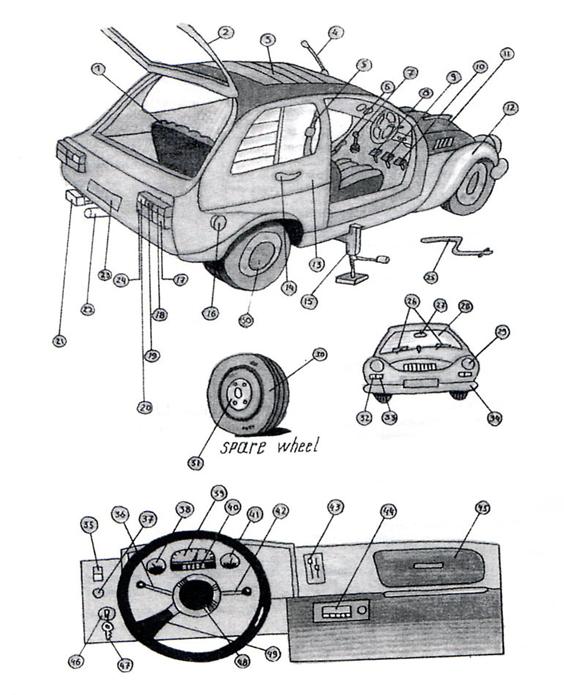
Words:
1. back seat; 2. tailgate/hatch; 3. roof; 4. aerial; 5. seat belt; 6. handbrake; 7. gear lever; 8. clutch (pedal); 9. brake (pedal); 10. accelerator (pedal); 11. bonnet; 12. wing; 13. door; 14. handle; 15. jack; 16. petrol cap; 17. rear light; 18. brake light; 19. indicator; 20. reversing light; 21. fog light; 22. exhaust pipe; 23. number plate; 24. reflector; 25. wheel brace; | 26. windscreen wipers; 27. rear-view mirror; 28. windscreen; 29. headlight; 30. tyre; 31. hub; 32. indicator; 33. sidelight; 34. bumper; 35. light switch; 36. indicator switch; 37. choke; 38. temperature gauge; 39. speedometer; 40. kilometer; 41. fuel gauge; 42. windscreen wiper switch; 43. heater controls; 44. radio; 45. glove compartment; 46. ignition; 47. key; 48. horn; 49. steering wheel; 50. hubcap. |
The Early Days of Automobile
In 1825 a steam engine was built in Great Britain. The vehicle carried 18 passengers and covered 8 miles in 45 minutes. However, the progress of motor was met with great opposition in Great Britain. Further development of the motor car lagged because of the restriction resulting from legislative acts. The most famous of these acts was the Red Flag Act of 1865, according to which the speed of the steam-driven vehicles was limited to 4 miles per hour and a man with a red flag had to walk in front of it. Motoring really started in the country after the abolition of this act.
In the Russia there were cities where motor cars were outlawed altogether. When the editor of local newspaper in the city of Uralsk bought a car, the governor issued these instructions to the police: «When the vehicle appears, it is to be stopped and escorted to the police station, where its driver is to be prosecuted).
There is the famous «Beguile Motor Museum» - the home for veteran cars. The founder of the Museum is Lord Montague, the son of England’s motoring pioneer, who opened it in 1952 in memory of his father. Lord Montague’s father was the first person in England to be fined by the police for speeding. He was fined 5 pounds for going faster than 12 miles per hour!
In the Museum’s collection there is a car called the Silver Ghost which people from near and far go to see. It was built by Rolls-Royce in 1907, and called the Silver Ghost because it ran so silently and was painted silver.
There is a car called The Knight. It is the first British petrol - driven car. Its top speed was only 8 m.p. h.!
In the Museum there is also a two - seated car built in 1903.
Words:
a steam engine - паровой двигатель; a vehicle - транспортное средство; to carry - перевозить; to cover – покрывать, пробегать; development - развитие; to lag - отставать; restriction - ограничение; legislative - законодательный; speed - скорость; abolition - отмена; | per hour – в час; to outlaw - объявить вне закона; to appear – появляться; to escort – сопровождать; to prosecute - преследовать в судебном порядке; a founder - основатель; to fine – штрафовать; m. p.h. - miles per hour; a two - seated car - двухместный автомобиль. |
Exercise 1. Найдите в тексте все конструкции в пассивном залоге.
Exercise 2. Переведите на русский язык:
A motor car, speed, a steam-driven vehicle, 4 miles per hour, the governor, in memory of, to be fined for speeding, petrol - driven car, m. p.h., a two - seated car.
Exercise 3. Поставьте все возможные вопросы к предложению:
In 1825 a steam engine was built in Great Britain.
Exercise 4. Найдите в правой колонке слова, перевод которых дан в левой колонке:
development –транспортное средство, развитие, двигатель; legislative – законодательный, паровой, местный; abolition – развитие, ограничение, отмена; to appear – появляться, объявлять вне закона, сопровождать; to outlaw – появляться, объявлять вне закона, сопровождать; to fine – сопровождать, штрафовать, появляться ; a two - seated – двухсторонний, двухколесный, двухместный. motoring – машиностроение, моторы, моторостроение.Exercise 5. Составьте предложения из данного набора слов:
1. the covered in ten fifty vehicle minutes miles.
2. motor altogether cars outlawed were.
3. the vehicles speed of limited the steam-driven was to per hour 4 miles.
Exercise 6. Дайте английские эквиваленты фразам:
1. дальнейшее развитие;
2. паровой двигатель был построен;
3. согласно которому;
4. транспортное средство покрыло 8 миль за 45 минут;
5. человек с красным флагом должен был идти перед ним;
6. отмена этого акта;
7. машины были полностью объявлены вне закона;
8. губернатор издал эти распоряжения;
9. водитель должен преследоваться в судебном порядке;
10. пионер машиностроения в Англии.
Carburettor
Air is mixed with the vapour of the petrol in the carburettor. To prevent the air and the carburettor from becoming too cold for successful evaporation of the fuel, the air for the carburettor is usually taken from a point close to a heated part of the engine. Modern carburetors are fitted with a so-called float-feed chamber and a mixing or spraying chamber. The first is a small chamber in which a small supply of petrol is maintained at a constant level. The petrol is pumped from the main tank to this chamber, the float rising as the petrol flows in until the desired level is reached, when the inlet closes. The carburettor is equipped with such devices as accelerating pumps and economizer valves, which automatically control the mixture ratio for efficient operation under varying conditions. Level-road driving at constant speed requires a lower ratio of petrol to air than that needed for climbing hills, for acceleration, or for starting the engine in cold weather. When a mixture extremely rich in petrol is necessary, a valve known as the choke cuts down the air intake, permitting large quantities of unvaporized fuel to enter the cylinder.
Words:
carburettor – карбюратор; is mixed – смешан; vapour – пар, пары; petrol – бензин; evaporation – испарение; fuel – топливо; so-called – так называемый; are fitted (with) – снабжены; float-feed – потоком подающая; chamber – камера; spraying – распыляющий; supply – подача; is maintained - поддерживается; to require – требовать; extremely – чрезвычайно; | is pumped – накачивается; to flow – течь; inlet – впускное отверстие; is equipped – снабжен; device – устройство; accelerating – ускоряющий; economizer – подогреватель; valve – вентиль; mixture - смесь; ratio [ ́rei∫iəu] - пропорция; efficient – эффективный; level-road driving – езда по ровной дороге; choke – воздушная заслонка, дроссель; intake – впускное устройство. |
Exercise 1. Найдите в тексте все конструкции в пассивном залоге.
Exercise 2. Переведите на русский язык:
Air, operation, to prevent, a chamber, rich in petrol, a pump, under varying conditions, the desired level, so-called, supply of petrol, is equipped with devices, unvaporized fuel, needed for climbing hills.
Exercise 3. Найдите в правой колонке слова, перевод которых дан в левой колонке:
1. mixture – пар, смесь, топливо;
2. vapour - пар, смесь, топливо;
3. is equipped – смешан, поддерживается, снабжен;
4. fuel - бензин, смесь, топливо;
5. is maintained - смешан, поддерживается, снабжен;
6. device – впускное устройство, устройство, камера;
7. to require – течь, смешивать, требовать;
8. supply – пропорция, подача, камера.
Exercise 4. Переведите следующие предложения:
1. The air for the carburettor is usually taken from a heated part of the engine.
2. Modern carburetors are fitted with a mixing or spraying chamber.
3. A small supply of petrol is maintained at a constant level.
4. The petrol flows in until the desired level is reached.
5. The petrol is pumped from the main tank to a small chamber.
6. The carburettor is equipped with different devices.
7. Level-road driving at constant speed requires a little ratio of petrol.
Exercise 5. Дайте английские эквиваленты фразам:
1. пар бензина;
2. успешное испарение топлива;
3. поддерживать на постоянном уровне;
4. современные карбюраторы снабжены;
5. бензин закачивается из основного бака;
6. при постоянной скорости;
7. завод двигателя;
8. вентиль, известный как дроссель.
Ignition
The mixture of air and petrol vapour delivered to the cylinder from the carburettor is compressed by the first upstroke of the piston. This heats the gas, and the higher temperature and pressure facilitate ignition and quick combustion. The next operation is that of igniting the charge by a spark plug. One electrode is insulated by porcelain or mica; the other is grounded through the metal of the plug, and both from part of the secondary circuit of an induction system.
The principal type of ignition now commonly used is the battery-and-coil system. The current from the battery flows through the coil and magnetizes the iron core. When this circuit is interrupted at the distributor points by the interrupter cam, a current is produced in the primary coil with the assistance of the condenser. This induces a high-voltage current in the secondary winding. This secondary high voltage is needed to cause the spark to jump the gap in the spark plug. The spark is directed to the proper cylinder by the distributor, which connects the secondary coil to the spark plugs in the several cylinders in their proper firing sequence. The interrupter cam and distributor are driven from the same shaft, the number of breaking points on the interrupter cam being the same as the number of cylinders.
The electrical equipment controls the starting of the engine, its ignition system, and the lighting of the car. It consists of the battery, a generator for charging it when the engine is running, a starter and the necessary wiring. Electricity also operates various automatic devices and accessories, including windscreen wipers, directional signals, heating and air conditioning, cigarette lighters, powered windows and audio equipment.
Words:
ignition – зажигание; to deliver – доставлять; is compressed – сжат; upstroke – движение (поршня) вверх; piston - поршень; to facilitate – содействовать; combustion – сгорание; charge – заряд, загрузка; spark - искра; plug - штепсельная вилка; is insulated – изолирован; porcelain ['posəlin] – фарфор; mica ['maikə] – слюда; circuit ['sə:kit] – цепь; induction – индукция; coil - катушка; | current – поток; to magnetize – намагничивать(-ся); core – сердцевина; is interrupted – прерван; distributor – распространитель; cam – патрон; condenser – конденсатор; to induce – индуктировать; voltage – напряжение; winding – обмотка; gap - зазор; to connect – соединять; sequence – последовательность; shaft – ось, вал; equipment – оборудование; charging – нагрузка; wiring – электропроводка. |
Exercise 1. Найдите в тексте все конструкции в пассивном залоге.
Exercise 2. Переведите на русский язык:
Petrol vapour, the first upstroke of the piston, pressure facilitate ignition, electrode is insulated by porcelain or mica, is grounded through the metal of the plug, the spark is directed to the cylinder, the interrupter cam, the electrical equipment, various automatic devices, heating and air conditioning.
Exercise 3. Найдите в правой колонке слова, перевод которых дан в левой колонке:
1. ignition – патрон, оборудование, зажигание;
2. core - вал, сердцевина, цепь;
3. wiring - обмотка, катушка, электропроводка;
4. to deliver – соединять, доставлять, содействовать;
5. circuit – цепь, распространитель, обмотка;
6. charge – катушка, штепсельная вилка, загрузка;
7. distributor – распространитель, конденсатор, катушка;

|
Из за большого объема этот материал размещен на нескольких страницах:
1 2 3 4 5 6 7 8 |
