


Партнерка на США и Канаду по недвижимости, выплаты в крипто
- 30% recurring commission
- Выплаты в USDT
- Вывод каждую неделю
- Комиссия до 5 лет за каждого referral
8. equipment – поршень, электропроводка, оборудование;
9. voltage – напряжение, обмотка, сгорание;
10. combustion - сердцевина фарфор, сгорание.
Exercise 4. Переведите следующие предложения:
1. The electrical equipment controls the ignition system of the car.
2. The mixture is compressed by the first upstroke of the piston.
3. The principal type of ignition is the battery-and-coil system.
4. The current from the battery magnetizes the iron core.
5. The high-voltage current is induced in the secondary winding.
6. Electricity operates powered windows and audio equipment.
Exercise 5. Дайте английские эквиваленты фразам:
1. высокая температура и давление способствуют;
2. смесь воздуха и бензина;
3. электрод изолирован фарфором или слюдой;
4. вторичная цепь;
5. с помощью конденсатора;
6. это индуктирует поток высокого напряжения;
7. в нужной зажигательной последовательности;
8. различные автоматические устройства и аксессуары.
Вывески на дорогах
1. No passing 2. Speed limit – 55 3. Traffic line 4. Auto repair 5. Detour 6. Railroad crossing 7. Car wash 8. Slow, children! 9. Traffic circle 10.Public parking | Обгон запрещен Ограничение скорости – 55 миль/час Автомагистраль Ремонт машин Объезд Ж/д переезд Мойка машин Осторожно, дети! Кольцевое движение Общественная стоянка |
Words:
1. back seat - задние сидение; 2. tailgate/hatch - багажник; 3. roof - крыша; 4. aerial - антенна; 5. seat belt - ремень безопасности; 6. handbrake - ручной тормоз; 7. gear lever - коробка передач; 8. clutch (pedal) - педаль сцепления; 9. brake (pedal) - тормоз; 10. accelerator (pedal) - педаль газа (акселератор); 11. bonnet - капот; 12. wing - крыло; 13. door - дверь; 14. handle - ручка; 15. jack - домкрат; 16. petrol cap - крышка бензобака; 17. rear light - габаритные огни; 18. brake light - стоп сигнал; 19. indicator - задние габариты; 20. reversing light - фонарь заднего хода; 21. fog light - противотуманный фонарь; 22. exhaust pipe - выхлопная труба; 23. number plate - государственный номер; 24. reflector - подсветка государственного номера; | 25. wheel brace - ключ для снятия колес; 26. windscreen wipers - дворники; 27. rear-view mirror - зеркало заднего вида; 28. windscreen - лобовое стекло; 29. headlight - фары; 30. tyre - шина; 31. hub - колесный колпак; 32. indicator - передние габариты; 33. sidelight - указатель поворота; 34. bumper - бампер; 35. light switch - включение основного света; 36. indicator switch - переключатель дальнего и ближнего света; 37. choke - датчик давления масла; 38. temperature gauge - датчик температуры антифриза; 39. speedometer - спидометр; 40. kilometer - километраж; 41. fuel gauge - топливный датчик; 42. windscreen wiper switch - переключатель дворников; 43. heater controls - печка; 44. radio - радио; 45. glove compartment - бардачок; 46. ignition - замок зажигания; 47. key - ключ; 48. horn - сигнал; 49. steering wheel - руль; 50. hubcap - диск. |
Unit 7:
My Future Trade. Operator
Words:
computer – компьютер; hardware – аппаратное обеспечение; software – программное обеспечение; processor – процессор; to process – обрабатывать; monitor – монитор; screen – экран; mouse – мышь; board – доска; keyboard – клавиатура; key – клавиша; button – кнопка; To type – печатать; | character – символ; dot – точка; drive – дисковод; driver – программа управления устройствами; strain – напряжение, нагрузка; power – сила, мощность, энергия; resolution – разрешающая способность; to display – показывать; to plug in – вставлять штепсель в розетку; a screen saver – режим отключения экрана при паузах. |
Windows
Microsoft Windows (or simply Windows) is a software program that makes your IBM PC (or compatible) easy to use. It does this by simplifying the computer's user interface. The word interface refers to the way you give your computer commands, the way you interact with it.
Usually the interface between you and the computer consists of the screen and the keyboard: you interact with the computer by responding to what's on the screen, typing in commands at the DOS command line to do your work. DOS often isn't very intelligent at interpreting your commands and most people consider it awkward or intimidating as a user interface. These commands can be confusing and difficult to remember. Who wants to lam lots of computer commands just to see what's on your disk, copy a file, or format a disk?
Windows changes much of this. What's been missing from the PC is a program that makes the computer easy to use. Windows is just such a program. With Windows you can run programs, enter and move data around, and perform DOS-related tasks simply by using the mouse to point at objects on the screen. Of course, you also use the keyboard to type in letters and numbers. Windows interprets your actions and tells DOS and your computer what to do.
In addition to making DOS housekeeping tasks such as creating directories, copying files, deleting files, formatting disks, and so forth, easier, Windows makes running your favorite applications easier, too. (An application is a software package that you use for a specific task, such as word processing. WordPerfect is an example of an application. In this book, I'll use the words «program» and «application» interchangeably.)
Windows owes its name to the fact that it runs each program or document in its own separate «window». (A window is a box or frame on the screen). You can have numerous windows on the screen at a time, each containing its own program and/or document. You can then easily switch between programs without having to close one down and open the next.
Another feature is that Windows has a facility - called the Clipboard - that lets you copy material between dissimilar document types, making it easy to cut and paste information from a spreadsheet into a company report or put a scanned photograph of a house into a real estate brochure. In essence, Windows provides the means for seamlessly joining the capabilities of very different application programs. Not only can you paste portions of one document into another, but by utilizing more advanced document-linking features those pasted elements remain "live". That is, if the source document (such as some spreadsheet data) changes, the results will also be reflected in the secondary document containing the pasted data.
As more and more application programs are written to run with windows, it'll be easier for anyone to lam how to use new programs. This is because all application programs that run in Windows use similar commands and procedures.
Windows comes supplied with a few of its own handy programs, and we will discuss them in this book. There's a word-processing program called Write, a drawing program called Paintbrush and so on.
Words:
to use – использовать; user – пользователь; to consist of… - состоять из…; to respond – отвечать; to interpret – переводить; intimidating – пугающий; confusing – путающий; to lam – удирать to miss – отсутствовать; to enter – входить; to perform – выполнять; to relate – относиться; task – задача; to point – указывать; application – применение; | interchangeably – взаимозаменяемо; to contain –содержать; to switch –переключать; feature – особенность, признак; facility – приспособление; dissimilar – непохожий; to paste – вклеивать;spreadsheet – разворот газеты; estate – (зд.) имущественный; seamlessly – без швов, цельно; capability – способность; similar – похожий; supplied (with) – снабженный; so on – и т. д. |
Exercise 1. Найдите в тексте все конструкции в пассивном залоге.
Exercise 2. Прочитайте текст и ответьте на вопросы:
1. What are the advantages of Windows?
2. What is Windows?
3. Why do we call it Windows?
4. What is another feature of Windows?
5. What firm was the first to have some results developing the prototype of Windows?
Exercise 3. Найдите в правой колонке слова, перевод которых дан в левой:
1. программное обеспечение a) hardware, b) commands,
c) feature, d) software.
2. обрабатывать a) to access, b) to process,
c) to relate, d) to delete.
3. символ a) letter, b) figure, c) character,
d) key.
4. применение a) spreadsheet, b) application,
c) capability, d) facility.
5. напряжение, нагрузка a) task, b) drive, c) strain,
d) power.
6. дисковод a) driver, b) screen saver, c) key,
d) drive.
7. разрешающая способность a) resolution, b) application,
c) facility, d) feature.
8. клавиша a) button, b) dot, c) mouse,
d) key.
9. особенность, признак a) application, b) facility,
c) feature, d) capability.
10. способность a) capability, b) similar, c) board,
d) application.
Exercise 4. Дайте английские эквиваленты фразам:
1. давать компьютеру команды,
2. состоит из дисплея и клавиатуры,
3. трудный для запоминания,
4. копировать файл,
5. форматировать диск,
6. выполнять задачи,
7. указывать мышкой на объект на экране,
8. создавать директории,
9. удалять файлы,
10. иметь много окон на экране,
11. сканированная фотография дома.
Unit 7: My Future Trade.
Locomotive Driver &
The Duty Over The Station.
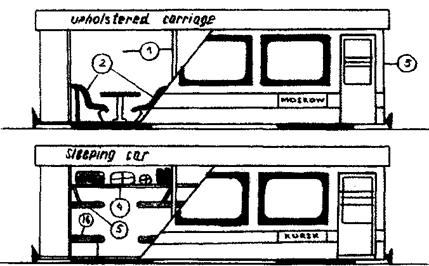
|
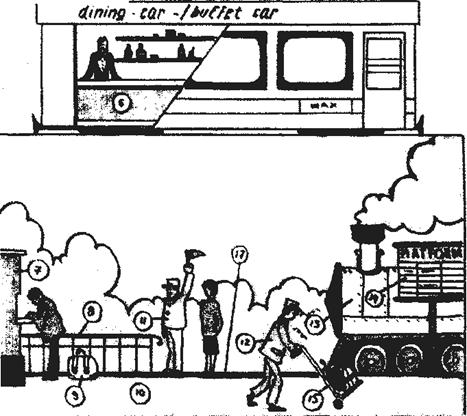
 Railway
1. Compartment – купе;
2. Seats – места;
3. Carriage/ car – вагон;
4. Luggage rack - багажная полка;
5. Upper berth – верхняя полка;
6. Counter – прилавок;
7. Ticket/ booking office – билетная касса;
8. Barrier – ограждение;
9. Luggage bag – сумка;
10. Platform – платформа;
11. Guard – дежурный по станции;
12. Porter – носильщик;
13. Locomotive/ engine – локомотив;
14. Indicator board – расписание движения поездов;
15. Trolley – тележка;
16. Lower berth - нижняя полка;
17. Track – железнодорожный путь;
Text. The Wheel, Steam Carriages and Railways
One of mankind's earliest and greatest inventions was the wheel. Without it there could be no industry, little transportation or communication, only crude farming, no electric power.
Nobody knows when the wheel was invented. There is no trace of the wheel during the Stone Age, and it was not known to the American Indians until the White Man came. In the Old World it came into use during the Bronze Age, when horses and oxen were used as work animals. At first all wheels were solid discs.
The problem to be solved was to make the wheels lighter and at the same time keep them strong. At first holes were made in the wheels, and they became somewhat lighter. Then wheels with spokes were made. Finally, the wheel was covered with iron and then with rubber.
Light two-wheeled carriages were used widely in the ancient world. As time passed they were made lighter, stronger, and better. Later people joined together a pair of two-wheeled carts into a four-wheeled vehicle. At first only kings and queens had the privilege of driving in them.
In the West the first steam carriage was invented in France. The three-wheeled machine had the front wheel driven by a two-cylinder steam engine, and carried two people along the road at a walking pace. It was not a great success, as the boiler did not produce enough steam for keeping the carriage going for more than about 15 minutes.
The steam engine appeared in 1763. It was followed by several improved steam road carriages. Their further development was prevented by railway companies. The rapid spread of railways in the United Kingdom was due largely to George Stephenson, who was an enthusiast as well as a brilliant engineer.
He demonstrated a locomotive that could run eighteen kilometers an hour and carry passengers cheaper than horses carried them. Eleven years later Stephenson was operating a railway between Stockton and Darlington. The steam locomotive was a success.
In Russia the tsar's government showed little interest in railway transportation. After long debates the government, which did not believe in its own engineers, finally decided to invite foreign engineers to submit projects for building railways in Russia.
Yet at the very time when foreign engineers were submitting their plans, in the Urals a steam locomotive was actually in use. It had been invented and built by Cherepanovs, father and son, both skilful mechanics and serves. The first Russian locomotive was, of course, a "baby" compared with the locomotives of today. Under the boiler there were two cylinders which turned the locomotive's two driving wheels (there were four wheels in all). At the front there was a smoke stack, while at the back there was a platform for the driver.
Words:
a wheel – колесо; steam – пар; mankind – человечество; invention – изобретение; industry – промышленность; transportation – транспорт; communication – сообщение; power – энергия, сила; to invent – изобретать; trace – след; oxen – скот; solid – цельный; to keep – сохранять; a hole – дыра; a spoke – спица колеса; to cover – покрывать; iron – железо; rubber – резина; to join together – соединять вместе; a pair – пара; | a cart – повозка; a vehicle – транспортное средство; an engine – мотор; to carry – перевозить; pace – шаг; success – успех; a boiler – котел; to produce – производить; to appear – появляться; to follow –следовать; to improve – улучшать; to prevent –препятствовать; rapid – быстрый; spread – распространение; due largely to – благодаря; government – правительство; to submit – представлять; a serf – крепостной; to turn – поворачивать; a stack – труба. |
Exercise 1. Найдите в тексте все конструкции в пассивном залоге.
Exercise 2. Ответьте на следующие вопросы:
1. What kind of animals was used for work during the Bronze Age?
2. What were the first wheels like?
3. What are the stages in the development of the wheel?
4. How many people did the first steam carriage carry?
5. Who demonstrated the first locomotive in the United Kingdom?
6. Was the Russian government interested in railway transportation?
7. Who were the Cherepanovs?
8. What was the first Russian locomotive like?
9. Are the locomotives widely used in Russia?
10. What kind of locomotives is used in Russia now?
Exercise 3. Переведите на русский язык:
1. The invention of the wheel was the earliest and the greatest one.
2. The wheel was invented during the Stone Age.
3. People used oxen and horses for transportation during the Bronze Age.
4. It was necessary to make wheels lighter but keep them strong.
5. At last wheels were covered with iron.
6. Nowadays people cover wheels with rubber.
7. Only kings and queens could drive four-wheeled vehicles.
8. The boiler couldn’t produce enough steam for high speed.
9. George Stephenson was the inventor of the first railway in the United Kingdom.
10. The serves Cherepanovs were skilful mechanics.
11. They produced the railway in the Urals and it was actually in use.
Exercise 4. Переведите словосочетания на русский язык:
1. the earliest and greatest inventions;
2. the wheel was invented;
3. all wheels were solid discs;
4. to make the wheels lighter and at the same time keep them strong;
5. the wheel was covered with iron and then with rubber;
6. people joined together a pair of two-wheeled carts;
7. a four-wheeled vehicle;
8. the front wheel driven by a two-cylinder steam engine;
9. at a walking space;
10. the boiler did not produce enough steam;
11. the improved steam road carriages;
12. the rapid spread of railways;
13. a steam locomotive was actually in use;
14. two cylinders which turned the locomotive's two driving wheels.
Exercise 5. Переведите словосочетания на английский язык:
1. никто не знает;
2. в Старом Свете;
3. вошло в оборот (в использование);
4. проблема, которую нужно было решить;
5. легкие двухколесные повозки;
6. в древнем мире;
7. переднее колесо, приводимое в движение двухцилиндровым паровым двигателем;
8. это не было великим успехом;
9. паровой двигатель появился;
10.дальнейшему развитию препятствовали;
11.быстрое распространение железных дорог;
12. 18 километров в час;
13.проявлять мало интереса к железнодорожному транспорту;
14.предоставить проект для строительства железной дороги;
15.она (железная дорога) была изобретена и построена;
16.по сравнению с сегодняшними локомотивами;
17.под котлом было два цилиндра;
18.дымовая труба;
19.платформа для водителя.
Russian Railways Are More That 150 Years Old
On October 30, in 1837 after a loud whistle from a tiny locomotive a train carrying eight carriages full of society people set off from St. Petersburg to Tsarskoye Selo. That memorable 33-minute journey marked the beginning of the Russian rails.
Jubilee celebrations, devoted to 150th anniversary of Russian railways, were held in front of the first Russian railway station in Pavlovsk. The occasion was also marked by a press conference given by the Minister of Railways on board of the ER-200 express train which runs between Moscow and St. Petersburg. The Minister told business representatives and reporters from Germany, Sweden and Britain about the prospects and plans for rail development, and about the problems to be solved in the near future.
Meanwhile, the express train gathered its speed to 216 kph and then, suddenly as if to illustrate the Minister's words about unresolved problems, slowed down. The fault was detected and put right within minutes. The train rushed on. Should the railway men operate as efficiently on weekdays as they did on their holiday, we can be sure of an early solution of the existing problems.
Words:
whistle – свисток; to set off - отправляться; memorable – памятный; journey - путешествие; to mark – обозначать; a representative – представитель; to be solved – должны быть решены; kph – kilometers per hour; fault – ошибка; | jubilee - юбилей; anniversary – годовщина; were held - проводились; occasion – событие ; to run – ходить, курсировать; within – в течение; to rush on – мчаться, нестись; to be sure – быть уверенными; solution – решение. |
Exercise 1. Найдите в тексте все конструкции в пассивном залоге.
Exercise 2. Ответьте на следующие вопросы:
1. When is the birthday of the Russian railway?
2. Where was the Russian railway born?
3. How long did the first journey last?
4. Which anniversary of Russian railways is described?
5. Where were jubilee celebrations held?
6. How was the occasion marked?
7. What was the rout of the ER-200 express train?
8. What was the speed of the ER-200 express train?
Exercise 3. Переведите словосочетания на русский язык:
1. a loud whistle from a tiny locomotive;
2. carriages full of society people;
3. that memorable 33-minute journey;
4. jubilee celebrations, devoted to 150th anniversary;
5. the occasion was also marked;
6. a press conference given by the Minister of Railways;
7. the prospects and plans for rail development;
8. the problems to be solved in the near future;
9. the fault was detected and put right within minutes.
Exercise 4. Найдите в правой колонке слова, перевод которых дан в левой колонке:
1. to rush on - мчаться, обозначать, курсировать;
2. solution – юбилей, ошибка, решение;
3. to run - мчаться, курсировать, отправляться;
4. fault – ошибка, событие, путешествие;
5. anniversary – юбилей, годовщина, путешествие;
6. occasion – путешествие, событие, годовщина;
7. journey – путешествие, событие, ошибка;
8. to set off – мчаться, отправляться, курсировать.
Bringing Back Steam Power
Until about 30 years ago, you could go by train to many small towns and villages in Britain. When British Rail took over the railway lines, they closed the smaller ones because they didn't make money. But there is movement to reopen these small lines and to run trains on them again: not modern diesel trains, though, but steam trains!
London Transport's last steam engine made its final trip in 1971. Two thousand people turned up for the ride and showed everyone how popular the old steam trains were. But since then, overs of steam have been opening up lines and bringing engines to life all over the country. Who are these enthusiasts? Well, some are groups or clubs which raise money to keep lines open and to buy and maintain steam engines. Others are individuals who want to see this form of transport become popular again.
Private lines can be profitable because, often, people work on them for no wages, and because the owners charge high fares and people will pay high prices for the pleasure of a ride on a steam engine.
One old line that has been brought back to life again is the Watercress Line in Hampshire. The line first opened in 1865 and got its name from the bright-green watercress, that the train used to take to market. When the line was closed by British Rail a great deal of work was done on the old locomotives; the railway itself was repaired and now steam engines are running on it once again.
Words:
to take (took) over – вступить во владения; to reopen – снова открыть; a trip - поездка; to turn up – оказаться; to bring to life – вернуть к жизни; to maintain – поддерживать; profitable – прибыльный; | wages – (обычно pl) заработная плата; an owner – владелец; to charge – назначать цену; fare – плата; a watercress – бот. кресс водяной; a great deal of – большое количество; was repaired - был отремонтирован. |
Exercise 1. Найдите в тексте все конструкции в пассивном залоге.
Exercise 2. Переведите словосочетания на русский язык:
1. until about 30 years ago;
2. go by train;
3. to take over the railway lines;
4. movement to reopen lines;
5. raise money;
6. the owners charge high fares;
7. got its name from the bright-green watercress.
Exercise 3. Переведите словосочетания на английский язык:
1. с тех пор;
2. удовольствие от езды на паровозе;
3. линии могут быть прибыльными;
4. ездить поездом;
5. по всей стране;
6. вернуть локомотивы к жизни.
Exercise 4. Найдите в правой колонке слова, перевод которых дан в левой колонке:
1. wages – заработная плата, поездка, плата;
2. to turn up – вернуть к жизни, оказаться, назначать цену;
3. fare – плата, заработная плата, владелец;
4. to bring to life – назначать цену, вернуть к жизни, поддерживать;
5. to maintain – вернуть к жизни, поддерживать, оказаться;
6. a trip - поездка, плата, владелец.
Unit 7: My Future Trade.
Excavator Driver
The History and Perspectives of Development of The
Basic Production
Text A.
Kurskaya Magnetic Anomaly takes a special place among the well-known ferrous ore deposits. Stoilenskoye ferrous ore deposit, discovered in 1931, is situated in the central part of the north-eastern side of KMA. The exploitation of the ferrous ore quarry began in June, 1961. The first mass explosion of the ore took place on November 5, 1968, and from 1969 there is a systematic supply of the raw material to all the metallurgic plants of our country. Since 1968 the rich ferrous ore quarry with a capacity of 2 million tons a year has been exploited.
As to reserves, concentration, quality and technological characteristics of overburden rocks and iron ore the raw materials of enterprise is unique and can provide long time enterprise operation, its extension and even construction of new mining and dressing plant to proceed iron ore and produce construction materials as well.
The iron ore (reserves in the mine outline are more that 6 billion to) is deposited under the layer of sedimentary rocks consisting of loams, clays, chalks, sands and sandy-and-argillaceous soils. The bed rocks and ferruginous quartzites are of sedimentary and metamorfogen origin and have complicated fold structure, with a quiet big fall — up to 80—90 degrees and highly developed jointing. Shales and quartzites sand stones are the enclosing rocks.
Words:
development – развитие; to take place – занимать место, происходить; ferrous ore – железная руда; a deposit – месторождение; exploitation – разработка; a quarry - карьер; an explosion – взрыв; supply – поставка, обеспечение; raw materials – сырье; capacity – вместимость; to exploit – эксплуатировать; reserve –запас; quality – качество; overburden – обогащенный; an enterprise – предприятие; quartzite – кварцит; metamorphosis – метаморфоза, изменение; | to provide – обеспечивать; extension – протяженность; mining and dressing plant – горно-обогатительный комбинат; to proceed – возобновлять; to produce – производить; a layer – слой; sedimentary rocks – осадочные породы; loam - суглинок; clay – глина; chalk – мел; argillaceous – глинистый; soil – почва; bed rocks – залегающие породы; ferruginous – содержащий железо; fold – впадина; shale – (глинистый) сланец. |
Exercise 1. Найдите в тексте все конструкции в пассивном залоге.
Exercise 2. Ответьте на следующие вопросы:
1. When was Stoilenskoye ferrous ore deposit discovered?
2. Where is Stoilenskoye ferrous ore deposit situated?
3.When did the exploitation of the ferrous ore quarry begin?
4. When did the first mass explosion of the ore take place?
5. Since what time has the rich ferrous ore quarry been exploited?
6. What are the reserves, concentration, quality and technological characteristics of the raw materials?
7. Where is the iron ore deposited?
Exercise 3. Переведите словосочетания на русский язык:
1. takes a special place among;
2. is situated in the central part of the north-eastern side;
3. the first mass explosion of the ore;
4. a systematic supply of the raw material;
5. the rich ferrous ore quarry;
6. can provide long time enterprise operation;
7. sedimentary rocks consisting of loams, clays, chalks, sands and sandy-and-argillaceous soils.
Exercise 4. Найдите в правой колонке слова, перевод которых дан в левой колонке:
1. ferrous ore – месторождение, железная руда, осадочные породы;
2. exploitation – взрыв, протяженность, разработка;
3. raw materials – сырье, осадочные породы, железная руда;;
4. capacity – протяженность, вместимость, суглинок;
5. a quarry – карьер, суглинок, сланец;
6. sedimentary rocks – железная руда, осадочные породы, сырье;
7. mining and dressing plant – горно-обогатительный комбинат, осадочные породы, железная руда;
8. to provide –производить, обеспечивать, взрывать.
Exercise 5. Переведите словосочетания на английский язык:
1. первый взрыв руды произошел;
2. разработка железорудного карьера;
3. систематическая поставка сырья;
4. технические характеристики обогащенных пород;
5. расположено под слоем осадочных пород;
6. залегающие породы и железосодержащие кварциты;
7. имеет сложную структуру впадины.
Text B.
The first and most important section of technological line is a mine. Mining works at deposit were started in 1956 to extract iron ore bedding in top over oxidized part of ore body that do not need additional dressing. Since 1972 the mining works to extract ferruginous quartzites, raw materials for dressing plants, were started.
To blast hard irrigated ferruginous quartzites and hard rocks the hot-flow explosive slurry produced locally -"Akvatol"- is used. After blasting hard rocks are loaded to railway transport by excavators EKG-81, EKG-10, EKG-15. Hard rocks are transported by dump-trucks with capacity 110-120 tons to internal transfer stations to load rocks into railway carriages and then they are brought to dressing plant or used as construction materials. Useless rocks are stored in external excavator dumps.

|
Из за большого объема этот материал размещен на нескольких страницах:
1 2 3 4 5 6 7 8 |
