

Партнерка на США и Канаду по недвижимости, выплаты в крипто
- 30% recurring commission
- Выплаты в USDT
- Вывод каждую неделю
- Комиссия до 5 лет за каждого referral
In 2008 spending on national security will rise by 21% in relation to 2007, and will increase further in by 10% yearly:
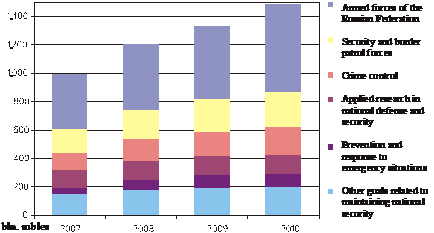
Spending on all aspects of national security will increase in , which will allow the federal government to improve the stability of its operations in this respect. Funding for the Armed forces, which makes up the greater part of national security spending, will grow by 20% in 2008 in relation to 2007, and another 20% in 2010 in relation to 2009. Funding for prevention and response to emergency situations and for fire safety programs will grow by 75.6% in 2008 (as compared with 2007). Spending on crime control will grow by 30% in 2008 (as compared with 2007).
5.1 Maintaining National Defense Capabilities
and Defense against External Threats
By 2010 national defense spending will grow by 34.4%, compared with 2007; in 2008 alone it will grow by 14.2% (table 5.1)[4]
Table 5.1
Federal Budget Expenditures for National Defense
2007 (by law) | 2008 (project) | 2009 (project) | 2010 (project) | ||
bln. rubles | *****bles | growth from 2007, % | bln. rubles | *****bles | |
Military personnel | 139.8 | 186.2 | 33.2 | 229.9 | 241.5 |
Food supply | 23.0 | 21.9 | -4.8 | 23.8 | 27.4 |
Logistical support | 93.7 | 100.8 | 7.6 | 104.4 | 114.5 |
Combat training | 17.0 | 22.3 | 29.7 | 23.3 | 23.7 |
Accumulation/mortgage system of housing provision for the military | 5.5 | 8.3 | 50.9 | 11.8 | 14.2 |
Organization of military registration and call-up (taking subventions into account) | 5.4 | 2.4 | -55.5 | 2.5 | 2.9 |
Mobilization training and retraining of reserves | 2.2 | 4.8 | 118.1 | 5.3 | 5.7 |
Presidential Program Disposal Chemical Weapon Stockpiles in the Russian Federation | 26.6 | 28.2 | 6.4 | 27.2 | 19.6 |
FTP Restructuring the Stockpiles of Missiles, Ammunition and Explosive Materials and Ensuring Their Explosion- and Fire-Safe Storage and Maintenance in | 6.6 | 7.7 | 16.7 | 7.2 | 7.6 |
FTP Industrial Recycling of Arms and Military Hardware () | 4.3 | 4.7 | 9.3 | 4.9 | 5.2 |
FTP Development of the System of Black Sea Fleet Bases in the Russian Federation in | 1.2 | 2.8 | 142.2 | 3.7 | 3.7 |
FTP Improvement of the Federal Airspace Reconnaissance and Control System of the Russian Federation () | 1.0 | 1.1 | 3.9 | 1.2 | 1.2 |
Non-program investment in fixed assets | 18.7 | 27.5 | 47.1 | 23.4 | 24.6 |
National Weapons Program
As part of the National weapons program for the federal government will purchase 17 intercontinental ballistic missiles Topol-M, 4 satellites, 4 rocket boosters, 6 bomber planes SU-34, 5 helicopters Mi-26H, 31 tanks T-90, 10 BMD-4s, about 100 BTR-80s, a battery of air-defense systems, C-400, 2000, KamAZ trucks and other equipment. Moreover, seven airborne squadrons (including one long-range aviation squadron), six helicopter squadrons, seven tank squadrons and 13 infantry battalions received new modern weapons and equipment.
In total the government National weapons program provides for 36 new strategic silos, 66 mobile missile stations Topol-M 50 long-range strategic bombers Tu-160 and Tu-95MC, over 30 ships, submarines and nuclear-powered cruisers. Moreover, 40 tank battalions, 90 infantry battalions and 50 paratrooper battalions will receive new weapons and equipment; 5 missile brigades will receive missile stations Iskander-M; 2 regiments will receive new rocket launchers Uragan-M1. Finally, by 2016 the military plans to adapt new radar missile warning systems Voronezh, OTH radar system Konteiner, radar systems Nebo, Podlet and Rezonans.
Military-Industrial Complex
The military-industrial complex will receive the necessary support from the government. Modernization and hardware overhaul of military-industrial organizations is funded through various federal targeted programs. The most significant of these is the program titled Development of the military-industrial complex of the Russian Federation, , and through 2015; in 2008 the government will spend 18.5 *****bles on this program; 21.3 bln. in 2009 and 28.4 bln. in 2010. The federal targeted program National technology base, another crucial program in this sphere, will receive 8.3 *****bles in 2008, 9.8 bln. in 2009 and 11.3 bln. in 2010.
Continued Preparations for Transition To Professional Army
One of the key objectives in improving the defense capabilities of our country is to create a functional professional army.
Beginning in 2008 the term of mandatory military service is reduced to one year. Gradually the Armed forces must be reorganized on a contractual basis. This challenge is being addressed through a number of measures, including differentiated incentive pay for special training circumstances: up to 5,000 rubles per month in the 42nd infantry division and the 46th special forces brigade attached to the Ministry of the Interior; up to 3,300 rubles per month for all other active units. The budgets provide funds for maintaining the said incentives (9.5 *****bles in 2009 and 9.8 *****bles in 2009).
5.2 Combating Crime and Preventing Terrorist Threats
A key challenge facing law-enforcement agencies is rapid detection and complete exposure of crime, ensuring full accountability for the committed act. Funds set aside by the federal government for crime prevention and control in will greatly increase the number of solved crimes, specifically severe crimes. Another objective is to stabilize and reduce the number of sever crimes committed in public places.
Unit of measurement | 2006 (actual) | 2007 (ex ante) | 2008 (plan) | 2009 (plan) | |
The ratio of solved felonies and grave crimes to the crimes against individual under investigation | % | 39.8 | 41.9-43.4 | 42.3-43.7 | 42.5-43.9 |
The ratio of solved felonies and grave crimes committed in streets, squares, parks and gardens to all such crimes | % | 15.2 | 13-15 | 12-14.5 | 10.5-12.5 |
With respect to crime control the government’s activities are aimed at increasing the security of all guarded private property and stemming economic crime. The main efforts within the realm of combating economic and tax crime will be directed at protecting all manner of property from criminal infringement, decriminalizing key sectors of the economy and the regions of the Russian Federation, exposing and eradicating instances of embezzlement and improper use of funds.
Reducing the threat of terrorism and extremist activities will remain one of the biggest national challenges in . Federal funds will be used by the Interior forces conducting missions aimed at exposing and eradicating terrorist and extremist crime in the Northern Caucasus; forming special task forces for investigating crime perpetrated by members on illegal armed groups and criminal organizations; preventing crimes associated with illegal arms trafficking.
5.3 Prevention and Response to Emergency Situations and Natural Disasters
In 2008 fire safety will be the main focus of federal programs directed at prevention and response to emergency situations (48.2% of total spending). Other funds will be set aside for civil defense (24.7%) and for protecting lands and population from natural and man-induced disasters (27.1%)
An increase in federal funding of fire safety measures will result in a reduction of fire safety violations (in relation to total exposed violations) and a reduction in personal injuries suffered in fires.
In 2010 62% of the Russian population will be covered by special civil defense measures, which is a 32% increase from 2006. Measures directed at protecting lands and people from natural and man-induced disasters will by 2010 result in a reduced number of deaths from various emergency situations: 6-7.5% reduction, compared with 2004, as well as a reduced number of personal injuries: 3.5-4% reduction.
6. Confidence in the Nation’s Future
The prosperity of future generations is the most important task of any nation. A socially responsible nation aims at providing the most comfortable future for posterity, creating favorable conditions for population renewal, improving quality of life and security, facilitating growth, and administrating rights and liberties.
The essential factor dictating the confidence of the Russian Federation in its national future is its human capital, in terms of quantity and quality. This factor presupposes a solution to the demographic problem, and, in the long range, a return to the positive dynamic of population growth. We must develop the scientific, cultural, innovative and natural potential, a competitive education system, and preserve the environment. Quality, comfortable life is only attainable in an environment where rights and freedoms are cultivated, democracy and civil society encouraged, and the government itself effective.
Directives from the Budget Address | Realized in the Fiscal Code of the Russian Federation |
In 2010 we will make the first cash payments from the maternity (family) fund. The system of managing these funds and the required budgetary expenses must be fully worked out by that time. | The maternity fund will begin making payments beginning in 2010. The federal government has set aside 55.0 *****bles for this purpose in the 2010 budget. |
We must continue to develop target programs for dealing with issues of nuclear a radiation safety. | The federal targeted program titled Nuclear and radiation safety, 2008 and through 2015 will receive 10.0 *****bles in 2008, 14.9 *****bles in 2009 and 16 *****bles in 2010. |
We must continue to draft target programs aimed at developing a microelectronics industry, space center infrastructure and the nano industry. | The federal targeted program Microelectronics and electronics developments, will receive 5.5. *****bles in 2008, 6.8 *****bles in 2009, and 7.4 *****bles in 2010. The program Social infrastructure development at the space center Plesetsk and the town of Mirnyi will receive 1.8 *****bles in 2008, 3.8 *****bles in 2009 and 6.6 *****bles in 2010. The program Nano industry infrastructure development, will receive 9.5 *****bles in 2008, 7.9 *****bles in 2009 and 7.5 *****bles in 2010. |
Federal funds offered to academic institutions must, first of all, be directed at fundamental scientific research and take the form of subsidies and grants. | Competitive grants instituted by the federal government will make up 41.6% of all research funding in 2008, 43.7% in 2009 and 45.1% in 2010. This includes the federal targeted program Research and development of Russia’s priority technological sector, 2007. |
In order to cultivate the potential for future growth the federal budget must concentrate its spending on top priority objectives, such population growth, education development, technological and innovations potential, environmental protection, renewable natural resources and better government practices:
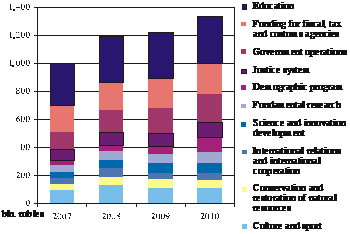
In 2008 federal spending on future development will grow by 20% (as compared with 2007); in 2010 they will grow by 9.4% as compared with 2009. Spending on education will grow by 10% (compared with 2007). As part of the national objective for the development of innovative technologies, the federal government will increase its spending on science and innovative technologies by 40%, as compared with 2007. Funding for culture and sports will increase by nearly 35% as compared with 2007. Payments made from the maternity (family) fund, beginning in 2010, account for the significant increase of 95% in federal spending within the demographic program.
Consequently, the portion of the federal budget allocated to future development (excluding service fees on federal and municipal debts) is 18% of total spending.
6.1 The Demographic Program
In his 2006 Address to the Federal Assembly the President of the Russian Federation has stated that demographics prove to be the most acute problem facing Russia today. On average the total population of our country is decreasing by 700,000 individuals every year.
To solve the demographic problem the nation must achieve concrete results along the three basic components of the demographic policy: higher birth rate, lower mortality rate, and renewal of natural population attrition through migration. The most important objective of the demographic program is to stabilize the population of the Russian Federation by 2015 at 140-142 million, while raising the average life expectancy to 68.5 years.
Unit of measurement | 2005 | 2006 | 2007 | 2008 | 2009 | 2010 | |
Life expectancy at birth | years | 65.3 | 66.7 | 67.5 | 68.0. | 68.3 | 68.5 |
Resident population | mln. people | 143.1 | 142.5 | 141.9 | 141.4 | 141 | 140.6 |
Combined birth ratio (number of children per woman) | people | 1.29 | 1.31 | 1.43 | 1.46 | 1.49 | 1.55 |
Total birth ratio (number of births per 1,000 people) | people | 10.4 | 10.6 | 10.9 | 11.3 | 11.6 | |
Number of deaths per 1,000 people | people | 16.1 | 15.2 | 14.1-14.5 | 13.4-14.1 | 12.9-13.2 | 12.6-12.8 |
Population increase through migration in one year | thous. people | 107.4 | 128.3 | 156.2 | 186.7 | 222.4 | 264.2 |
Increasing Birth Rate

|
Из за большого объема этот материал размещен на нескольких страницах:
1 2 3 4 5 6 7 8 9 10 11 12 13 14 15 16 17 18 19 20 21 22 23 24 25 26 27 28 29 30 31 32 33 |
