

Партнерка на США и Канаду по недвижимости, выплаты в крипто
- 30% recurring commission
- Выплаты в USDT
- Вывод каждую неделю
- Комиссия до 5 лет за каждого referral
Beginning in 2007 the federal government has begun work along the main course of the program: increasing birthrate; this includes a series of measures that will raise the overall birthrate indicator (number of children borne by one woman) to the desired level: 1.65-1.7 children. In 2005 this indicator was at 1.29 children, and in 2007 it is expected to rise to 1.43 (The “safe” level, guaranteeing the population renewal, is thought to be 1.5 children).
In 2008 and 2009 the federal government will spend 43.9 *****bles and 47.6 *****bles, respectively on programs aimed at increasing the birthrate; in 2010 this amount will increase significantly as the government begins making payments from the maternity (family) fund (table 6.1)
Table 6.1
Demographic Program Financing
2007 *****bles | 2008 *****bles | 2009 *****bles | 2010 *****bles | Thous. people | |
Demographic program, total | 31.0 | 43.9 | 47.6 | exc. 90 | |
Social policy | 2.0 | 2.1 | 2.2 | 2.3 | |
Inter-budgetary transfers | 29.0 | 33.8 | 33.4 | 88.9 | |
An increase in the child support allowance until the child reaches the age of 1.5 for first child up to 1 500 rubles, for second and following rubles | 13.8 | 18.2 | 17.8 | 18.2 | 463 |
Compensation to parents for costs incurred by preschool education of their first child by a sum of 20%, of their second – 50%, and their third 70% of the average price paid by parents for preschool accommodation | 8.0 | 8.0 | 8.0 | 8.0 | over 4,500 |
Introduction of 8,000-ruble lump-sum allowances to encourage foster family care for children without parental care | 0.7 | 1.1 | 1.1 | 1.2 | approx. 120 |
Increasing child support payments to guardians and foster families to the level of not less than 4 000 rubles and salaries to foster parents to 2 500 rubles per month | 6.2 | 6.2 | 6.2 | 6.2 | 260 |
Base maternity capital payments of 250,000 rubles since 2010 | - | - | - | 55.0 | 220 |
Additionally: development of high-tech obstetric care centers (20 centers) | - | 8.0 | 12.0 | - | - |
In the first year the birthrate initiative has yielded positive results: the number of children born across the Russian Federation in Jan-Feb of 2007 reached 242,600, compared with 223,500 in the same period of 2005.
Social Protection for Orphans, Guardians and Foster Families
One of the major factors involved in the cultivation of the nation’s human capital and the improvement of the quality of life for every individual child is the family environment. One of the incentives aimed at promoting adoption and guardianship is increased financial assistance for for families adopting children and higher wages for adoptive parents. This will raise the number of orphaned children accepted into adoptive families from 68% of the total population in 2005 to 72% in 2008. The number of children without caretakers will drop from 2,41% of all children in 2006 to 2.26% in 2008 and 2.17% thereafter.
Lowering the Mortality Rate among People of Working Age
The program aimed at increasing the birthrate will have no effect on the size of the workforce and the development of the working population for at least twenty years. At the same time, a drop in the working population may become the greatest hindrance to the nation’s economic development.
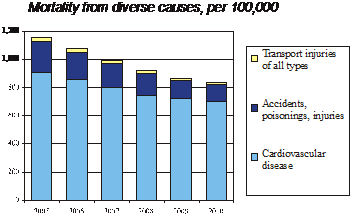
The key factor responsible for the drop in the size of the workforce is a high mortality rate among people of working age. To address this issue the government has created such target programs as Prevention and treatment of socially significant diseases, and Improved traffic safety. Another federal subprogram tiled High blood pressure has been instituted to combat one of the most significant factor in this category: fatal cardiovascular disease. This program is expected to lower the number of mortality cases resulting from cardiovascular disease from 860 (per every 100,000) in 2006 to 700 in 2010:
Starting in 2007 the federal government will begin implementing measures directed at stimulating migratory replenishment of natural population attrition. The federal program aimed at facilitating voluntary resettlement of Russians living abroad also works to attract ethnically Russian and Russian-speaking foreign nationals.
6.2 Accessibility and Quality of Education
The main objective of the federal education policy is to raise the education level of the population, as well as to improve access to quality education for all levels of society, irrespective of birth, income and place of residence. Federal educational agencies are granted the authority to fund undergraduate and post-graduate professional education. (table 6.2)
Table 6.2
Federal Budget Expenditures for Education
2007 (by law), *****bles | 2008 (projected) | 2009 (projected) *****bles | 2010 (projected) *****bles | ||
*****bles | growth from 2007, % | ||||
Basic vocational education | 8.8 | 11.8 | 33.1 | 12.4 | 11.7 |
Secondary vocational education | 25.4 | 29.5 | 16.4 | 31.6 | 34.0 |
Higher vocational education | 214.1 | 239.9 | 11.8 | 245.7 | 255.7 |
Retraining and advanced training | 4.6 | 4.1 | 6.3 | 4.5 | 4.7 |
FTP Development of Education in | 11.1 | 9.3 | -16.0 | 9.8 | 10.8 |
FTP Military Training Reform | 0.9 | 0.7 | -24.6 | 1.0 | 0.1 |
College and Professional Education
One of the main tasks of the government’s education policy is to raise the level of education in response to economic demands. The government plans to direct its effort in toward preparing highly qualified workers possessing professional skills in the fields of high technology and information systems, while retaining the number of college-educated professionals.
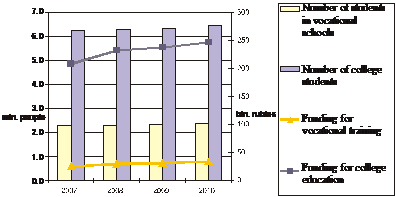
One of the ways of modernizing the educational system is to involve private enterprise in the educational process. As a result of coordinating educational programs with economic requirements, the number of unemployed graduates of colleges and vocational programs is expected to drop from 6.3% and 8.3% of total graduates, respectively, in 2006 to 3.0% and 5.5% in 2010. In general the number of graduates o f vocational programs to receive jobs will rise from 95.2% in 2006 to 99.0% in 2010.
National Priority Project Education
The federal government has set aside considerable funds toward the national priority program titled Education (table 6.3).
Table 6.3
National Priority Project Education
Expenditures and Outcomes
Measures | Unit of measurement | 2007 (budgeted) | 2008 (projected) | 2009 (projected) |
Priority national project Education, total | *****bles | 48.9 | 42.9 | 21.1 |
Introduction of innovative educational programs in educational institutions | *****bles | 18.0 | 13.0 | - |
higher education establishments /thous. schools | 13.3 | 40/3 | - | |
Introduction of modern educational technologies | *****bles | 4.0 | 1.1 | 1.1 |
educational establishments | 60.0 | 60.0 | 60.0 | |
Development of the network of national universities and other educational institutions | *****bles | 6.0 | 4.8 | - |
higher education establishments | 2.0 | 2.0 | - | |
Annual incentives to best teachers | *****bles | 1.0 | 1.0 | 1.0 |
thous. teachers | 1.0 | 10.0 | 10.0 | |
Compensation for classroom management at general educational institutions | *****bles | 11.7 | 11.7 | 11.7 |
thous. teachers | over 800 | over 800 | over 800 | |
State support to talented young people | *****bles | 0.2 | 0.2 | 0.2 |
number of premiums | 5,350 | 5,350 | 5,350 | |
Purchase of buses for state and municipal schools in rural areas | *****bles | 1.0 | 1.0 | - |
thous. buses | 1.6 | 1.6 | - | |
Provision of general education institutions with teaching equipment | *****bles | 2.3 | 2.3 | - |
thous. units | 6.5 | 6.5 | - | |
State support to the Russian Federation subjects that introduce comprehensive education modernization measures | *****bles | 3.9 | 5.3 | 5.3 |
subjects of the Russian Federation | 20 | 30 | 30 | |
State support for the training of personnel and specialists for high-tech industries | *****bles | 0.3 | 1.8 | 1.8 |
educational establishments | 60 | 60 | 60 | |
Basic vocational education for persons drafted into military service | *****bles | 0.3 | 0.2 | - |
education centers NPO | 24 | 24 | - | |
Organization of training at preliminary courses at higher education institutions for persons who have served in the Armed Forces under contract as soldiers, seamen, sergeants and master sergeants for no less than three years | *****bles | - | 0.2 | - |
thous. people | - | 5.0 | - |
One of the objectives of this program is to raise the prestige of the teaching profession. In over 800,000 schoolteachers will receive salary increases of 1,000 per month; 10,000 of the best teachers will receive bonuses of 100,000 rubles.

|
Из за большого объема этот материал размещен на нескольких страницах:
1 2 3 4 5 6 7 8 9 10 11 12 13 14 15 16 17 18 19 20 21 22 23 24 25 26 27 28 29 30 31 32 33 |
