

Партнерка на США и Канаду по недвижимости, выплаты в крипто
- 30% recurring commission
- Выплаты в USDT
- Вывод каждую неделю
- Комиссия до 5 лет за каждого referral
Improving the Quality of Fiscal Accountability and Responsibility for Attaining Results
Directives from the Budget Address | Realized in the Fiscal Code of the Russian Federation |
It is imperative to infuse government practice with modern methods of evaluating the efficacy of budget spending in light of the aims of socio-economic policies and the results attained with respect to such aims. | Federal executive authorities compile annual Reports on their main areas of focus and their results; such reports describe the goals and the results of activities. At the planning stages of the budget main budget-planners must justify appropriations by describing the direct results to be attained through specific appropriations, i. e. the extent and quality of government services, and the extent of fulfilled government functions. |
We must improve the quality and the comprehensiveness of information provided to our citizens and legislative powers on the accomplished and proposed aims of the fiscal policy, and the results of government spending. | The reports on the main areas of focus and the results are printed and published online on official sites, beginning with the budget cycle . An explanatory note appended to the federal budget draft describes the accomplishments of the federal executive authorities. |
We must improve statistical monitoring of the results of target programs by regularly conducting specialized inspections, aimed at evaluating their efficacy of government spending. | The federal targeted program titled Improvement of Government Statistics in Russia in proposes monitoring with respect to new statistical indicators, reflecting the accomplishments of government agencies and the efficacy of their spending. |
The first steps toward greater efficacy in government spending were made in , in response to the proposed Reform of the budgeting process of the Russian Federation. Amendments made to the Fiscal Code of the Russian Federation in 2007 strengthen the new regulations and procedures, eliminate a number of fundamental problems within the budgeting system, and offer opportunities for improved efficacy of spending.
3. Quality of Life
The challenge of guaranteeing the quality of life of the nation’s current and future citizens, i. e. long, comfortable, secure and safe living, is the essential task of any contemporary democratic government. In this light the entire budget of Russia may be termed the people’s budget. At the same time, it is important to separate out the portion of the budget that deal directly with the most basic needs of the population. The portion of the budget’s total spending dedicated to this purpose, excluding funds used in servicing the federal and municipal debts, will rise from 49% in 2007 to 52% in 2010.
Raising military pay and the salaries of state employees, improving accessibility and quality of healthcare and housing services, and the social welfare of retired, disabled and low-income individuals: these are the top priorities of the national fiscal policy.
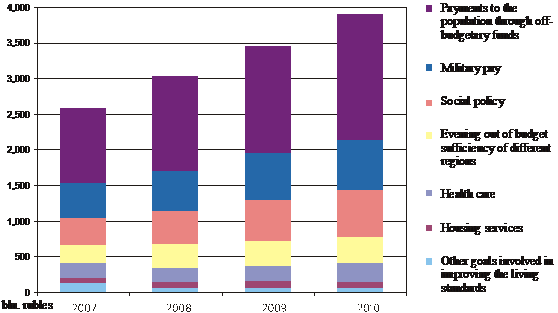
In the years there will be increased spending across all of the major components, which will result in an annual growth of 10%. Transfers to state extrabudgetary funds for social services make up the largest portion of spending. In 2008 such transfers will grow by 27.6& compared to 2007. In spending associated with social policy will grow by more than 20% annually.
As a consequence of the steady increase in social spending on the part of the government, the standard of living of the population will continue to improve, and the number of citizens living below the poverty line will continue to drop:
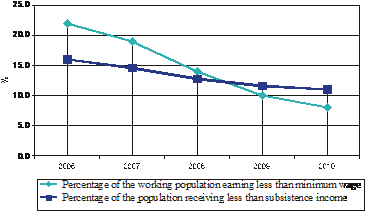
Quality of life does not merely mean an improved standard of living for the average citizen; it also means reducing social inequality.
Indicators | Unit of measurement | 2005 | 2006 | 2007 | 2008 | 2009 | 2010 |
Income differentiation ratio | times | 14.9 | 15.3 | 15.1 | 14.9 | 14.7 | 14.5 |
Average wage ratio of 10% top earners to 10% bottom earners | times | 25 | 24 | 22 | 20 | 18 | 16 |
The following measures outlined in the Budget Address are oriented toward improving the standard of living and reducing social inequality.
Directives from the Budget Address | Realized in the Fiscal Code of the Russian Federation |
It is imperative to set a schedule of incremental raise of the minimum wage above the subsistence level of the working population. As a first step we must work toward raising the minimum wage to 2,300 rubles by Sept 1, 2007 | The current rate of minimum wage of 1,100 rubles will be raised to 2,300 rubles beginning Sept 1, 2007; to 3,000 rubles beginning Dec 1, 2008; 3,500 rubles beginning October 1, the start of 2011 the minimum wage will increase to 5,238 rubles, thus rising above the minimum level of subsistence. |
In a medium-range view I consider it an imperative to meet the challenge of raising the social pension plan above the subsistence level of our pensioners. | In 2007 the amount paid out through the state pension plan is 1,960 rubles. Beginning in Oct 2009 the state pension will be set at 3,691 rubles per month, which is 3.5% higher than the minimum level of subsistence of a retired person. |
In realizing the project «Accessible and comfortable housing for the citizens of Russia» we must ensure that the plots of land slated for residential development are provided with necessary access to utility lines. | In *****bles will be allocated to providing adequate access to public utilities on plots of land slated for residential construction; 7.1 bll rubles in 2009, and 4.0 *****bles in 2010. |
It is essential that we continue to implement objective management solutions toward providing housing to members of the military. | Acquisition of housing for retiring members of the military and the interior services, or individuals of equivalent status, as part of the subprogram titled “Discharging government obligations of providing housing to citizens designated by federal law,” within the federal targeted program Housing. To be appropriated: 13.2 *****bles in 2008; 17.4 *****bles in 2009; 23.3 *****bles in 2010 |
Increased spending on education and healthcare must be directly correlated with achieving concrete results in improved quality and accessibility of these services. | Salary structures and appropriations for federally funded agencies will be reorganized in accordance with the government objective on providing government services. |
3.1 Adequate Compensation
In 2004 minimum wage was set at 600 rubles, i. e. 23% of the minimum subsistence level for the working population. In 2007 it will be raised to 2,300 rubles, i. e. 56% of the minimum subsistence level for the working population.
In 2010 minimum wage reach 5,238 rubles; by 2011 it well be equal to the minimum subsistence level for the working population.
Steady Increase in Wages for State Employees
In the government will continue to implement measures aimed at raising the standard of living for state employees. In 2005 the average monthly wage for 17.5 million state employees was set at 4,158 rubles; in 2007 it will rise to 6,242 rubles, on account of the inflation adjustment by a factor of 1.15, effective Sept 1, 2007.
Salary funds for state employees shall be adjusted relative to the inflation levels on Sept 1, 2008, Aug 1, 2009 and Jan 1, 2010.
In 2008-2mil federal employees paid in accordance with the unified wage rate scale will receive a sum total of 352 *****bles a year on average; this is approximately 5% of the total annual government spending, not counting funds used in servicing the federal debt.
Already beginning in late 2007 several activities will take place aimed at reorganizing the federal employee wage scale (currently the unified wage rate scale). In 2008 the federal budget provides for 16.9 *****bles towards incentives aimed at reorganizing employee compensation within state agencies and drafting federal appropriation based on the government objective on providing government services; this figure will rise to 46.2 *****bles in 2009 and 51.4 *****bles in 2010.
Moreover, the pay scale for military personnel will be readjusted by 15% beginning in Sept 2008, thereafter according to the inflation levels on Aug 1, 2009 and Jan 1 2010.
There are Plans for a Significant Raise in Compensation for Military Personnel
A 10% readjustment of salaries took place on Jan 1, 2007 according to position and rank; on Dec 1, 2007 another adjustment of 15% will take place, with a subsequent increase of 608.33 rubles (cost of food rations per month).
As a result the amounts received by military personnel in cash will increase significantly. For example between Dec 2007 and Dec 2008 a regiment commander will receive 20,503 rubles; this includes the added food ration cost (whereas in Jan 2005 he would have received 11,261 rubles); a battalion commander will receive 17,101 rubles (vs. 9,284 rubles in Jan 2005), and a squadron commander will receive 14,792 rubles vs. 7,847 rubles. At the same time will food rations and board will remain unchanged.
Further pay increases for military personnel are planned for : an increase of 15% beginning Sept 2008, and another of 6.8% beginning Aug 1, 2009. The amount provided in lieu of food rations is also subject to inflation adjustment.
3.2 Providing for the Retired Population
The government allocates approximately 10% of its revenue to the payment of pensions.
These payments are funded by the federal budget and the Russian Federation Pension Fund (table 3.3). The average amount of a worker’s pension shall increase by a factor of 1.7 over the next three years.
Table 3.1
Federal Budget Expenditures for Pension Payments
2007 (budgeted), *****bles | 2008 | 2009 | 2010 | ||
(projected), *****bles | growth from 2007 | (projected), *****bles | (projected), *****bles | ||
Inter-budgetary transfers from the federal budget to that of the Pension Fund of the Russian Federation | |||||
For payment of the base part of the work pension | 559.8 | 707.7 | 26.4 | 876.6 | 1,033.0 |
Pensions under state pension provision, additional material support, additional pension payments, benefits and compensations | 100.1 | 122.4 | 22.3 | 151.5 | 168.3 |
Cover of the budget deficit of the Pension Fund of the Russian Federation | 88.2 | 184.6 | 109.3 | 149.1 | 251.6 |
Pension payments from the federal budget | |||||
Pensions to military personnel and their family members | 146.6 | 173.3 | 18.2 | 211.8 | 245.5 |
Average Pension Will Rise 1.7 Times in Three Years
In 2004 the average worker’s pension was set at 2,061 rubles a month; in 2007, in light of the scheduled increase, it will rise to 3,133 2010 the average pension will again rise to 5,060, i. e. 1.7 times the present rate.
Thus, the cumulative income of 36.4 mil retirees has grown by a factor of 1.2 over the last three years, and will grow by a factor of 1.4 in the next three years.
2006 | 2007 | 2008 | 2009 | 2010 | |
Timeframe and amounts of rises in the base part of work pensions | - | From April 1 -7.5%, From October 1 -13.2% | From April 1 -7.0%, From August 1 -14.6% | From April 1 -6.8%, From October 1 -18.2% | |
Average size of work pension (average annual), rubles. | 2,770 | 3,133 | 3,771 | 4,397 | 5,105 |
Starting in 2009 the Amount of a State Pension Will Overtake
the Minimum Living Standard for a Retired Person
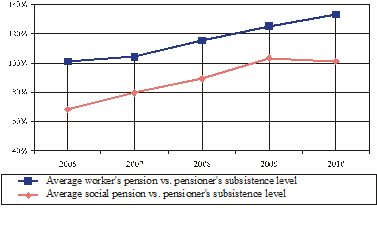
In 2004 the social pension was set at 1,296 rubles a month, or 72% of the minimum living standard for a retired person; today the rate is at 1,960 rubles. Starting October 1, 2009 the social pension will be set at 3,691 rubles per month, which will exceed the minimum living standard by 3.5%. The amount of a state pension will double today’s rate by 2010:
In addition to caring for current pensioners, who are paid out of present-day Pension Fund revenues, the government is gradually establishing a retirement plan system; in this system each worker surrenders a part of his/her income into a personal retirement fund. To improve the profitability of such retirement investment the private retirement funds are allowed to take part in the 2010 the percentage of the economically active population covered by additional retirement insurance, private pension plans, or professional retirement funds will rise to 11.3%, vs. the 7.4% in 2006.
Increased Pensions for Military Retirees
In 2005 the average pension sum for persons discharged from the Armed Forces of the Russian Federation was 4,200 rubles; by through annual increases this amount shall reach 7,500 rubles.
In 2008 the federal government will spend 173.3 *****bles to pay the pensions of retired military personnel, which is an 18% compared with 2007. In 2009 and 2010 this amount will rise to 211.8 bln. and 245.5 bln., respectively.
3.3 Social Protection
Social assistance provided by the government is aimed at improving the quality of life of citizens without social protection: retirees, veterans, people with disabilities, parentless children and families that have lost their main providers.
The federal budget provides funds sufficient for total discharge of the government’s obligation to its citizens, as prescribed by law. These include:
- funds for home repairs of over three thousand houses belonging to military families, who have lost a main provider: 7 bln. annually, a 40% increase from the amount allocated to this purpose in the 2007 budget;
- providing transportation services to over 6,000 disabled persons annually; the amount allocated for this purpose will increase by a factor of 1.2 over the next three years.
- compensations for rent payments, housing and other services to over 46,000 families of killed (deceased) military personnel; total amount of 1.1 *****bles annually.
In 2008 the federal government will pay 90 *****bles in housing services subsidies to individuals that were exposed to high doses of radiation as a result of the disaster at the Chernobyl nuclear power station, as well as other categories of veterans and disabled persons, totaling 17.5 mil individuals; this amount is a 10.1% increase from the 2007 figure. In 2010 it will rise to 32.8% of the 2007 figure, to reach 108.5 *****bles.
Funds designated for social protection will allow a greater number of citizens to be covered by social services and social rehabilitation:
Unit of measurement | 2005 | 2006 | 2007 | 2008 | 2009 | 2010 | |
Availability of social services to pensioners at home, per 10,000 pensioners | Persons | 338 | 342 | 346 | 350 | 354 | 358 |
The ratio of socially rehabilitated persons without registered residence or employment to the total number of persons applying to social security institutions | % | 134 | 16.0 | 19.1 | 22.8 | 27.2 | 32.2 |
The share of disabled persons provided with prosthetic and orthopedic devices | % | 76 | 82 | 92 | 96 | 97 | 98 |
The share of disabled children who have received rehabilitation services at specialized institutions for children with disabilities | % | 39.0 | 40.9 | 40.3 | 41.1 | 42.1 | 43.1 |
The share of vagrant children who have received rehabilitation services at specialized institutions for minors | % | 64.9 | 73.2 | 74.4 | 78.9 | 81.9 | 83.3 |
The share of families with children using the services of institutions catering to the needs of families and children | % | 14.4 | 19.2. | 19.3 | 19.6 | 19.8 | 20.0 |
Social protection services are funded through transfers to state extrabudgetary funds. “General” and “target” transfers to extrabudgetary funds makes up the largest spending article of the federal budget (table 3.2)

|
Из за большого объема этот материал размещен на нескольких страницах:
1 2 3 4 5 6 7 8 9 10 11 12 13 14 15 16 17 18 19 20 21 22 23 24 25 26 27 28 29 30 31 32 33 |
