

Партнерка на США и Канаду по недвижимости, выплаты в крипто
- 30% recurring commission
- Выплаты в USDT
- Вывод каждую неделю
- Комиссия до 5 лет за каждого referral
Beginning in 2008 he Stabilization fund is divided into two: Reserve fund and Future generation fund (National welfare fund). The Reserve fund is charged with maintaining a financial reserve in the event of short-term fluctuations in the oil market and an ensuing federal budget deficit.
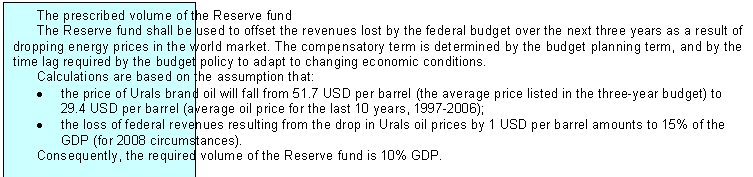
Moreover the Reserve fund shall finance the oil-and-gas transfer to the federal budget. The Reserve fund shall receive all federal oil-and-gas revenue throughout the year up to the amount dictated annually in the budget law.
The Reserve fund should have sufficient resource to close the deficit described above for three years. Beginning on Feb 1, 2008 the Reserve fund shall receive funds from the Stabilization fund in the amount of 10% GDP.
The remaining funds in the Stabilization fund of the Russian Federation will be transferred to the Future generations fund (National welfare fund); this fund shall be used toward maintaining and augmenting revenues from non-renewable natural resources for the future generations.
7.2 National Debt
In accordance with the principles of debt policy in 2005 and 2006 the Russian Federation sought to discharge external federal debt ahead of schedule. In January of 2005 the debt to the International Monetary Fund was discharged in full ahead of schedule. In June of 2006 the Russian Federation completely discharged its obligations to the Paris Club.
As a result, at present the level of national debt is kept at a safe level below 9% GDP (the amount of external debt will be brought down to 2.8% GDP by 2010), which provides for a stable financial system and advances Russia’s standing in the International community, as a nation with considerable financial and debt stability, having a reputation of a responsible borrower and striving to improve the countries investment climate through concrete measures.
The national debt policy of the Russian Federation for makes no provisions for attracting unattached financial credit on the external market.

In terms of internal loans the debt policy for will be guided by the objective of developing the bonds market. Key tasks will be raising the liquidity of the market portion of the federal internal debt and maintaining optimal duration and profitability in the bonds market.
The period of will see a positive balance of loans taken out in the internal market, which should keep interest rates steady. The federal government intends to take out medium and long-range loans in the internal debt market.
Conclusion
“Government spending at all levels must be oriented toward concrete results, which, in turn, must be attained through most effective means.”
The Budget Address of the President of the Russian Federation
May 9, 2007
The main objective of the fiscal policy for 2008, and through 2010 is to guarantee maximally effective and transparent use of funds in pursuit of concrete, quantifiable, socially significant results, while maintaining macroeconomic stability and a balanced, stable budget; this will in turn lead to a further increase of the nation’s financial abilities.
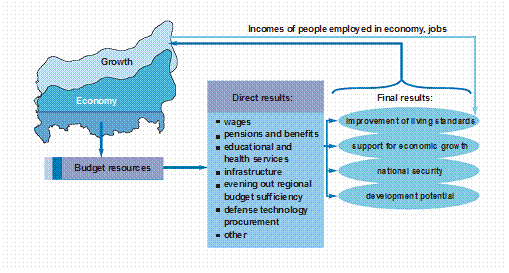
The federal budget for 2008 and through 2010 meets this challenge by providing:
quality of life, measured by:
- reduced number of individuals living below the poverty line from 16% to 10.7%; raised correspondence between the average salary for government employees and the minimum living standard for the working population from 1.7 to 2.6; raised correspondence between the working pension and the minimum living standard for a pensioner from 1.01 to 1.32; increased volume of new housing from 50.8 mil m3 annually to 80.0 mil m3.
stable economic growth, characterized by:
- a stable rate of economic growth at 6% GDP; a reduced inflation rate, from 5.0% to 6.0%; more than doubled investments into fixed capital; an increase in direct foreign investments: a factor of 1.5 in dollar amount.
confidence in the nation’s future, expressed in:
- increased life expectancy at birth: up to 68.5 years; increased birth rate coefficient, from 10.5 to 11.6 births per thousand people annually; reduced mortality rate from 15.2 to 12.6-12.8 deaths per thousand people annually; a high level of scientific potential and development of priority science and technology fields; diversification of industry and an increased portion of innovative production among total exported and domestically sold products; reliable national security and capability to respond to external and internal threats.
Appendix
Some results of the use of budget appropriations made by the main federal budget funds managers
CBP – Constituent of Budget Planning (code and title)
MBFM – Main Federal Budget Funds Managers (code and title)
Section
Subsection
01 – Ministry of Industry and Energy of the Russian Federation
023 – Federal Energy Agency
04 – National Economy
02 – Fuel and Energy Sector
Unit of measurement | Reporting period | Current year | Planned period | Resultant objectives/indicators the achievement of which has been aided by the results of using budget appropriations | |||
2006 (actual) | 2007 (approved) | 2008 | 2009 | 2010 | |||
1 | 2 | 3 | 4 | 5 | 6 | 7 | 8 |
Measures in the fuel and energy sector | Amount of appropriation | ||||||
SPE (Special-Purpose Expenditure Items) BE (Budget Expenditure) 012 - Performance of functions by budget institutions | *****bles | 4,079,725.2 | 4,308,836.0 | 4,435,673.6 | 6,023,987.0 | 6,289,800.0 | |
Indicators value/ Qualitative description of the result | |||||||
Indicator 1. Length of the underground workings to be liquidated | m | 136,500 | 45,900 | 0 | 0 | 0 | Completion of coal industry restructuring Objective: liquidation of coal companies |
Indicator 2. Remediation of disturbed land returned to landowners | ha | 150 | 2836 | 3834 | 5823 | 5357 | |
Indicator 3. Social support to workers due to liquidation of coal (oil shale) mining (processing) companies | *****bles | 1,306,400.0 | 1,423,900.0 | 708,500.0 | 710,600.0 | 814,300.0 | |
Indicator 4. Number of rationed coal recipients in liquidated companies | people | 61,351 | 58,894 | 56,545 | 61,000 | 50,000 | |
Interest rate subsidizing | Amount of appropriation | ||||||
SPE BE 006 - Subsidies to legal entities | *****bles | 391,086.2 | 500,000.0 | 500,000.0 | 250,000.0 | 250,000.0 | Creation of competitive business |
Indicators value/ Qualitative description of the result | |||||||
Indicator 1. Fixed assets renovation | % | 5 | 10 | 20 | 10 | 10 | |
Investments in the fuel and energy sector | Amount of appropriation | ||||||
SPE 34002 00 BE 003 – Budget Investments | *****bles | - | 1,756,300.0 | 1,850,000.0 | 1,400,000.0 | 1,500,000.0 | Increasing the efficiency of the fuel and energy sector and ensuring energy security |
Indicators value/ Qualitative description of the result | |||||||
Indicator 1. The number of facilities under construction | items | - | 5 | 2 | 1 | 1 |
Unit of measurement | Reporting period | Current year | Planned period | Resultant objectives/indicators the achievement of which has been aided by the results of using budget appropriations | |||
2006 (actual) | 2007 (approved) | 2008 | 2009 | 2010 | |||
1 | 2 | 3 | 4 | 5 | 6 | 7 | 8 |
Subsidies | Amount of appropriation | ||||||
SPE BE 006 - Subsidies to legal entities | *****bles | 400,000.0 | 400,000.0 | 400,000.0 | 400,000.0 | 400,000.0 | |
Indicators value/ Qualitative description of the result | |||||||
Indicator 1. The number of subsidy recipients | units | 60 | 45 | 45 | 45 | 45 | Fuel procurement for power plants’ operational needs |
Indicator 2. The number of subsidy recipients | units | 4 | 4 | 4 | 4 | 4 | Fuel procurement for sale to the population |
Indicator 3. The number of subsidy recipients | units | 1 | 1 | 1 | 1 | 1 | Fuel procurement for nuclear power plants |
CBP (code and title)

|
Из за большого объема этот материал размещен на нескольких страницах:
1 2 3 4 5 6 7 8 9 10 11 12 13 14 15 16 17 18 19 20 21 22 23 24 25 26 27 28 29 30 31 32 33 |
